
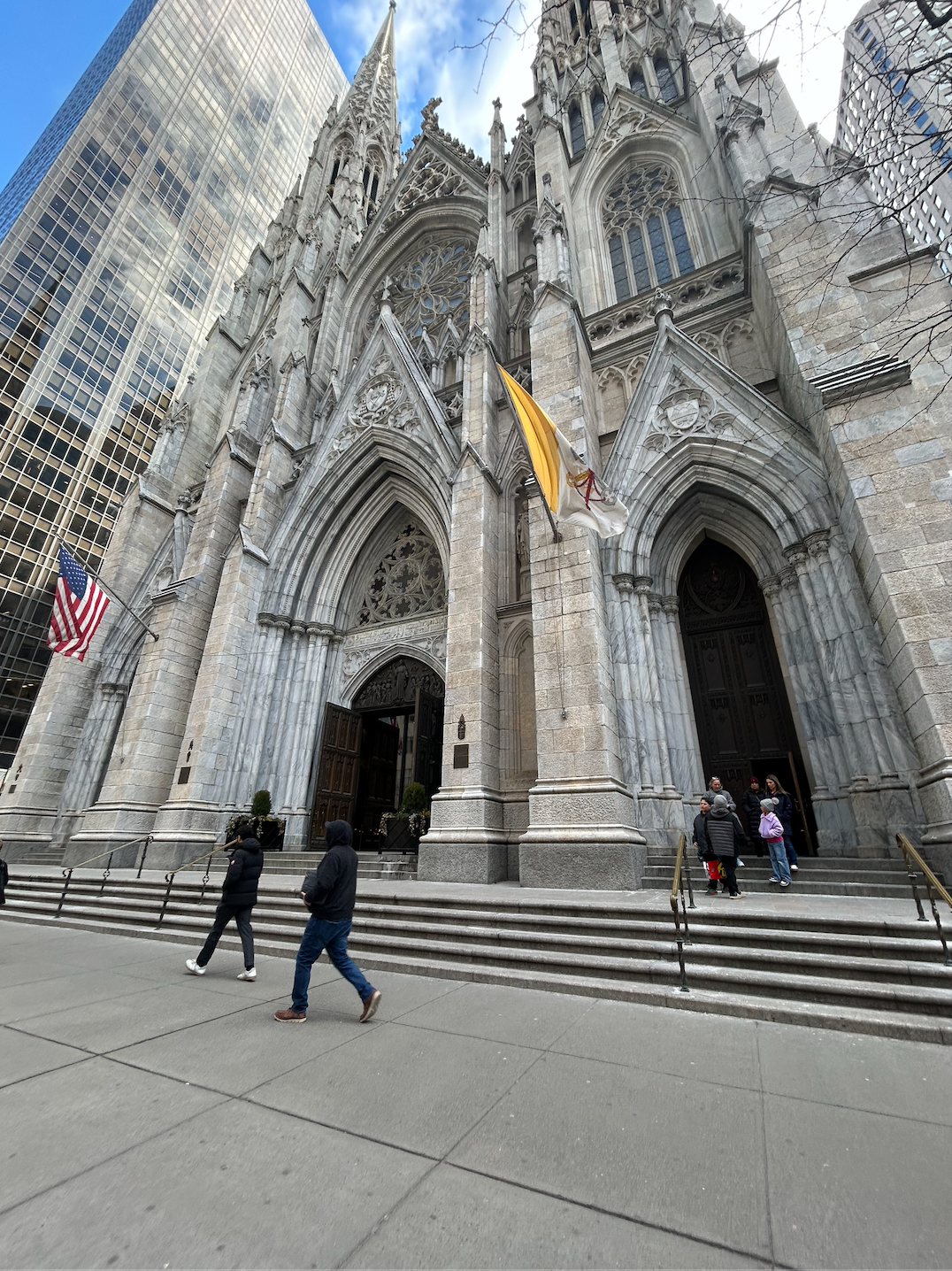
With towering spires and gorgeous Gothic architecture, St. Patrick’s Cathedral is a hotspot for both locals and tourists alike. Located on 5th Avenue, between 50th and 51st Street, the Cathedral is the mother church of the Archdiocese of New York. An archdiocese is a big Catholic district, led by an archbishop. The mother church is where the archbishop has his official seat, also known as the cathedra. Apart from being a place of worship, St. Patrick’s Cathedral gives insight into the evolution of the demographics and culture in the city. The history of the Cathedral brings to light topics such as discrimination and religious freedom, which are relevant in the modern day as well.
Presentation:
Appendix:
Enaiyah Martini
Going to St. Patrick’s Cathedral for the small group project was the second time I’ve been to this Cathedral; however, my experience of this visit was substantially different than my first, as I was not only able to observe the architecture more closely, but also reflect on its historical significance in a way I hadn’t before. My first trip to this Cathedral was for a school mass, as I went to a Catholic High School. During this day, the school bus that brought us to the Cathedral was delayed by at least half an hour, making our grade miss the first couple of minutes of the mass. In addition to this, our school had to wait towards the very back of the Cathedral (since it was filled with Catholic school students by the time we arrived), so I wasn’t even able to extensively view the Cathedral’s architecture. All I saw was a big pillar in front of my face and the backs of several students’ heads. Prior to this small group project, I was somewhat upset with the fact that my experience at St. Patrick’s Cathedral didn’t live up to my expectations, especially considering the fact that I am Muslim, and would most likely not visit a Cathedral again. Coming back to this Cathedral, however, I am very grateful that I got to experience the church again, but especially in a project-setting that allowed me to closely analyze the art within. It was especially meaningful to see shrines, such as Our Lady of Guadalupe, that I have previously learned about in class. This experience also helped me develop a closer connection to the Catholic faith in a way. Meticulously noting the religious artwork in the Church helped me form connections back to Islam (the religion I practice) and helped me notice the numerous shared values between them, such as worship, care for others, and charity. One other thing I deeply appreciated was the acknowledgment of how important immigrant stories were to the building of this Cathedral. Especially nowadays, immigrants are treated as second-class citizens, when in reality, they helped create some of the most beautiful structures in our city and nation. The showcasing of this was very prominent, and something I had deep respect for.
Rafeea Rahman
When I saw St. Patrick’s Cathedral on the list, I was definitely intrigued. Last semester, when visiting Grant’s Tomb, my attention and wonder was diverted towards Riverside Church instead. I remember marvelling at the beauty of just the exterior structure. This time, I got to focus solely on the Cathedral, and I also went inside. The inside of the Cathedral was so intricately crafted. By just staring at one pillar, you can see the level of detail and craftsmanship inside the marble. One thing I really love about church architecture, apart from the Gothic style, is the assortment of stained glass pieces. Both the Old St. Patrick’s and the current St. Patrick’s had beautiful stained glass lining the walls. The way the light comes through the glass makes it seem like the whole piece is glowing. Through doing research for this project, I realized the nature of discrimination. I was initially confused on why some early Protestants disliked Catholics so much when they were both Christian. As I read more documents, I realized that prejudice doesn’t have a logical reason. People can hate others simply because they are different, and that can happen to any religion, ethnicity, or skin color. Laws such as preventing Catholics from holding office or imprisoning those who housed Catholics are all reused techniques. I also thought about the incredible change of demographics from the 1700-1800 to now. For example, back then Italian immigrants were seen as foreigners, yet now they are a staple factor to New York’s identity. It’s interesting how, no matter who they are, immigrants have to “prove” themselves for a long time before they can be separated from the “foreigner” title. The project, as a whole, definitely made me realize that everyone is less different than one might initially think.
Amna Tayyab
As I walked on 5th Avenue and went down the block in front of the Cathedral, you can see the front part of the Cathedral with white marble pinnacles soaring high in the sky. The overall scale of the Cathedral was shocking. The sunshine that passed through the beautiful stained-glass windows made the Cathedral oh so majestic and breathtaking from the inside. The art inside the Cathedral really reflected the effort that the immigrants put in.
The stillness here is intimate even though there are thousands of visitors. You could speak of the flickering light of thousands of votive candles in front of the Lady Chapel, or the gloomy loveliness of the Pieta statue.
Coming out of the Cathedral is like waking out of a dream. You are among the saints and smell of incense one moment and the next moment you are among the skyscrapers. This contrast, with the holy pose on one and the opposite side of the stores, is what makes Saint Patrick his vital New York experience.
Overall, my experience with the Cathedral was very enjoyable and I had much fun. In my opinion, if one would like to visit the Saint Patrick’s Cathedral, they should go on a bright sunny day with no clouds. The weather can really affect your mood and your whole experience on the trip. If someone is going there during the afternoon mass time, they should have lunch at the Pasta Corner which is only 2 blocks away from the Cathedral. To make your lunch even more special, there is a waterfall with a seating area to make the experience even more magical and majestic.
Saint Patrick’s Cathedral Report:
Bibliography:
“A Few of the Faithful Departed Interred on the Grounds of the Basilica of St. Patrick’s Old Cathedral.” St. Patrick’s Basilica, oldcathedral.org/apostolate
Byrne, Julie. “Roman Catholics and Immigration in Nineteenth-Century America.” National Humanities Center, Nov. 2000, nationalhumanitiescenter.org/tserve/nineteen/nkeyinfo/nromcath.htm#:~:text=The%20story%20of%20Roman%20Catholicism,to%20change%20drastically%20and%20permanently.
Mathis, Marquisha. “A Mural of Welcome: St. Patrick’s Cathedral Honors Immigrants, Past and Present – Catholic Charities of New York.” Catholic Charities of New York, 22 Sept. 2025, catholiccharitiesny.org/news/st-patricks-cathedral-mural/.
McCann, Richard Daniel. “A History of The Basilica of St. Patrick’s Old Cathedral.” St. Patrick’s Old Cathedral, oldcathedral.org/history.
McNierney, Patrick J. “The Building of St. Patrick’s Cathedral.” New York Irish History, vol. 18, 2004, nyirishhistory.us/article/the-building-of-st-patricks-cathedral/
Rubinich, Andrew. “Saint Patrick’s Cathedral – History of New York City.” TLTC Blogs |, 21 February 2020, https://blogs.shu.edu/nyc-history/2020/02/21/st-patricks-cathedral/
Shah, Priyanshi, and Osama Nasir. “St. Patrick’s Cathedral, New York City: Case Study of the Largest Roman Catholic Cathedral.” Parametric Architecture, 29 September 2025, https://parametric-architecture.com/st-patricks-cathedral-new-york/.
“St Patrick’s Cathedral, New York.” Famous-Historic-Buildings.org.uk, 2018, www.famous-historic-buildings.org.uk/st-patricks-cathedral-new-york.html.
“St. Patrick’s Old Cathedral Brick Wall – City Lore.” City Lore, 22 Nov. 2023, citylore.org/places/st-patricks-old-cathedral-brick-wall/.
“What’s so Funny About Peace, Love, and Understanding Adam Cvijanovic, Oil and Gold Leaf on Canvas.” St. Patrick’s Cathedral, www.St.patrickscathedral.org/mural.

