
Introduction
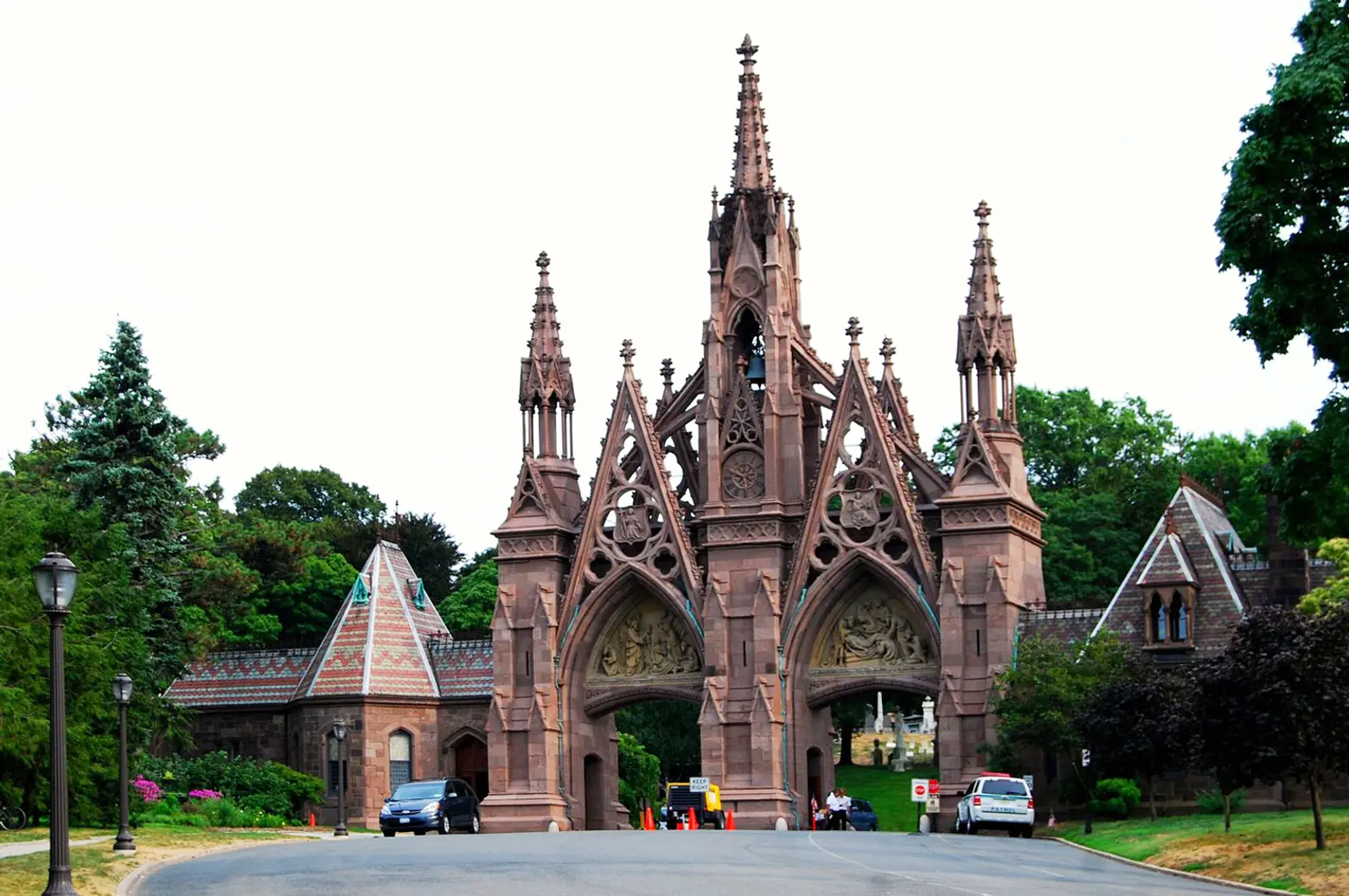
Green-Wood Cemetery is one of the most important landmarks in understanding and appreciating New York City as a whole. It is the largest cemetery in New York City. This allows for space within the cemetery for beautiful natural scenery and tasteful architecture. Green-Wood is more than just a place to honor the dead; it is a place to celebrate history, artistry, and the beauty of nature. Between the graves and mausoleums are interwoven beautiful sculptures and monuments, as well as historic and important trees and wildlife. Green-Wood is so valuable for this very reason; it is a place unlike any other in the city. Within the cemetery, the crazy and hectic energy of the city relaxes in order to mourn for the people it has lost. This is what makes it such a meaningful part of the city, and it all started when it was constructed.
Our Presentation Slides
Below is our full visual presentation on Green-Wood Cemetery, covering its history, nature, architecture, and prominent figures:
Appendix — Aarush Kumar
My visit to Green-Wood Cemetery was much more personal and emotional than I expected. We went on the weekend after the snowstorm, so the grounds were almost empty. Once we split up, Bogdan went off to one side and I took another route, and the cemetery became a kind of maze I had to figure out on my own. I tried to follow the online map on my phone, but the screen was too small, so I went to the guard at the entrance to ask for a paper map. He seemed surprised that two students had come in just to learn about the cemetery and write a report. The paper map turned out to be hard to use, it was not as clear as the online one, so I kept getting a bit lost between hills and sections.
The most intense part of my visit was the Hillside Mausoleum. When I stepped inside it was almost empty and very quiet. The names and dates on the walls ran from the 1800s all the way to 2025, which reminded me that this is not just a historic site but a place that is still filling up with people from the present. I saw long lives, but also people who died in their teens or twenties, close to my age, and that really hit me. As I climbed through the three floors, sitting on benches and looking out from the upper windows, the cemetery looked beautiful but also very fragile. On the top level, I saw a family gathered and crying near one of the newer niches, chanting softly, and I quietly turned away so I would not disturb them.
Later, when we found the grave of Samuel Morse, I was struck by how modest it was compared to the importance of his work. I liked that I had not memorized a list of names, and instead tried to recognize some of them on my own, like the Roosevelt family plot and others Bogdan pointed out. The snow made everything harder as my shoes were soaked and some doors were buried halfway. Walking along almost empty paths, seeing more geese than people, and watching how some visitors treated it like a park while others were deep in grief, I realized that the cemetery is a mirror of how New Yorkers deal with time, memory, and the fact that our lives, no matter how long or short, eventually join the same ground.
Appendix — Bogdan Selyomin
I originally chose Green-Wood because I heard a lot about it and it was a place close to my home that I haven’t really ever visited, and I was very pleasantly surprised with how beautiful and intricate the cemetery was. While wandering through and exploring the cemetery I felt so many different feelings and saw so many beautiful sights. I paid close attention while looking at and reading about nature while I was at the cemetery. It stood out to me just how much Green-Wood prioritizes and cares about the nature within it. I initially thought that the cemetery was going to be underwhelming because compared to many other internationally famous cemeteries it does not have a large amount of globally recognized people buried here. But walking through the cemetery made me realize that the appeal of Green-Wood is more than just honoring the dead and our shared history. I loved how much care was put into the nature walks and design of the monuments. I wish we had more time for this assignment so I could have visited the cemetery in spring and see the beautiful blooms of the trees. We also struggled with the weather, as the cemetery was covered in snow. Any time we were looking for a tombstone not near the main path we had to climb through deep snow, but I believe it was worth it.
I also got a new perspective on Green-Wood as a whole while constructing the report because I was able to read about the ideas and reasons behind different architectural and design choices that I had noticed while in the cemetery. I was also in awe of the wide array of different buildings and sculptures that we saw. However, throughout all of the giant and extravagant sculptures, my favorite was “Our Drummer Boy.” My favorite kind of art is the type that tells a story, and the one behind this statue was truly heartbreaking. One very difficult thing was finding the graves of some of the people we were looking for. Not all of the famous and notable people had extravagant and fancy tombstones, so we often had to Google pictures of the headstone in order to find it.
I can see why many people come back to stroll through Green-Wood. In my opinion, it is closer to a botanical garden or museum than a cemetery. There is so much beauty and passion that went into designing every aspect of the cemetery, and I appreciate all the hard work the architects, designers, and sculptors put in. I definitely want to come back in the spring and summer, when the weather clears up, so I can see how different it looks during each season.
Full Report
Read our complete research report on Green-Wood Cemetery, including sections on its history, nature, architecture, prominent figures buried there, and our conclusions:
Read the Full Green-Wood Cemetery Report →
Access the Presentation Slides on Google Slides →
Bibliography
- Bender, Thomas. Toward an Urban Vision: Ideas and Institutions in Nineteenth-Century America. Johns Hopkins University Press, 1982.
- Brenner, Dan. “POTW: Altar to Liberty, Green-Wood Cemetery.” Brooklyn Public Library Blog, 18 Sept. 2019, www.bklynlibrary.org. Accessed 1 Mar. 2026.
- Douglass, David Bates. Exposition of the Plan and Objects of the Green-Wood Cemetery. Printed by Jared W. Bell, 1839. Green-Wood Historic Fund Archives.
- “Green-Wood Cemetery.” New York Landmarks Conservancy, 10 Jan. 2023, nylandmarks.org. Accessed 1 Mar. 2026.
- “Green-Wood Cemetery.” NYC Bird Alliance, 31 Dec. 2024, nycbirdalliance.org. Accessed 1 Mar. 2026.
- “The Green-Wood Cemetery.” The Cultural Landscape Foundation, www.tclf.org. Accessed 1 Mar. 2026.
- The Green-Wood Cemetery. Green-Wood, 2026, www.green-wood.com. Accessed 1 Mar. 2026.
- “Life and Death in Green-Wood Cemetery: Rewilding Project Revives Native Flora and Fauna.” Brownstoner, 8 Apr. 2025, www.brownstoner.com. Accessed 1 Mar. 2026.
- Maranzani, Barbara. “Green-Wood Cemetery: A Victorian-Era Icon.” History, A&E Television Networks, 13 May 2013, www.history.com. Accessed 1 Mar. 2026.
- Williams, Paige. “Green-Wood Cemetery’s Living Dead.” The New Yorker, 9 June 2025, www.newyorker.com. Accessed 1 Mar. 2026.

