

Introduction
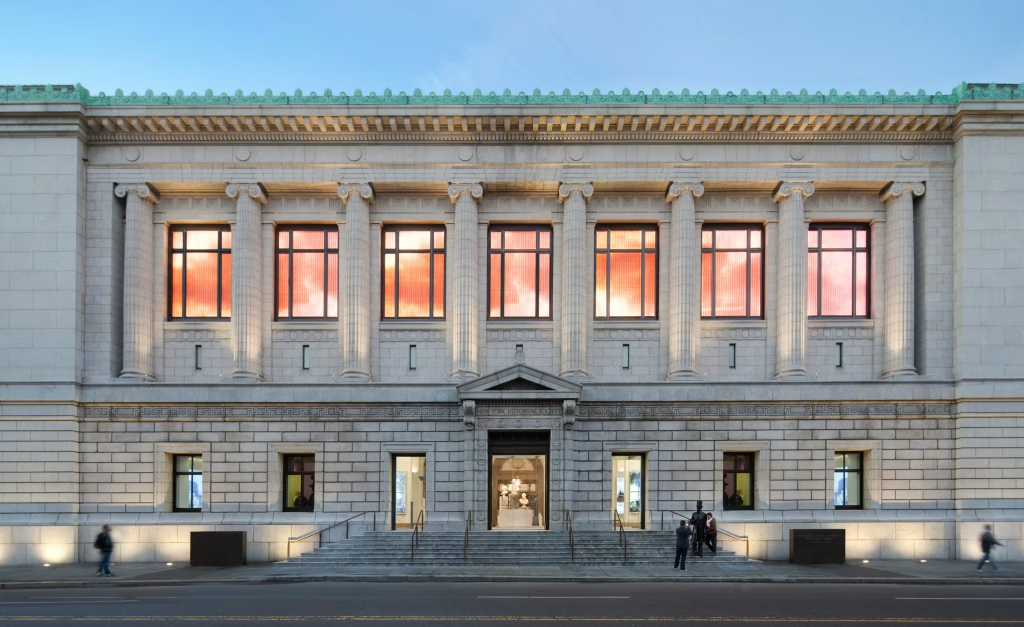
For our small group project in MHC 10201 HNRS, my partner and I visited the New-York Historical Society, now known as New York Historical. Located on Central Park West in Manhattan’s Upper West Side, right next to the American Museum of Natural History, this institution holds the distinction of being New York City’s very first museum. We stopped by on a late Friday afternoon, taking advantage of its pay-as-you-wish admission policy, and spent several hours exploring its rich collections and exhibits.
Founded in 1804 by eleven prominent New Yorkers, including DeWitt Clinton and Egbert Benson, the museum was created with a clear mission: to preserve the authentic history of New York and the United States through original documents, artifacts, and evidence. The founders, many of whom played active roles in the Revolutionary War, the British occupation of New York, and the rebuilding efforts that followed, believed strongly in the power of tangible records. They feared that without careful preservation, history would devolve into mere “ingenious conjectures and amusing fables.” This Enlightenment-inspired commitment to evidence and progress shaped the institution from its earliest days.
Over its more than two-century history, the museum faced significant challenges. It moved between seven different locations before settling into its first permanent home in 1908, enduring financial strain, space shortages, and even a five-year closure. Despite these obstacles, its collections grew steadily, encompassing everything from George Washington’s Revolutionary War camp bed and Alexander Hamilton documents to John James Audubon’s bird studies and Louis Comfort Tiffany lamps. Today, New York Historical continues this legacy while embracing a more inclusive approach, evident in its 2024 rebrand, which dropped the hyphen and the word “Society” to signal greater public accessibility.
The museum’s deep cultural connections to New York City are impossible to miss. Its exhibits highlight the city’s layered, often untold stories, from the chaos of the 1863 Civil War draft riots and the randomness of the Vietnam-era draft lottery to the vibrant street art culture captured in a 1970s graffiti-covered bathroom door. Located amid the elegant early 20th-century architecture of Central Park West, with views of Central Park’s greenery, the Ladies Pavilion, and Strawberry Fields, the museum sits at the heart of a neighborhood that blends history, nature, and modern urban life. It complements neighboring institutions and reflects New York’s resilient, diverse spirit as a global cultural capital.
Our visit brought these stories to life in ways textbooks cannot. The New York Historical Jeopardy game we created is designed to make this learning interactive and fun. By testing your knowledge of the museum’s founding, artifacts, exhibits, and NYC connections, it encourages you to explore, reflect, and educate yourself, just as we did during our trip. Each answer below reveals details that deepen your understanding of this essential New York institution.
Presentation
Jeopardy Board Link – https://jeopardylabs.com/play/new-york-historical-society
Appendix
Vic Chen
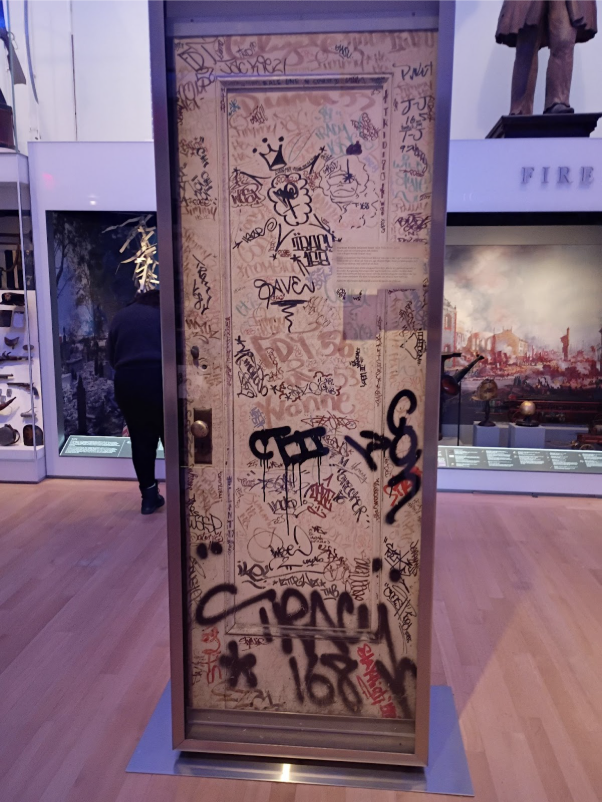
One exhibit that I found to be very interesting was called the Stewart Studio Graffiti Door. Personally, I felt like this exhibit captured the essence of Graffiti in New York City, especially considering the story behind how it was made. In the 1970s, artist John Stewart befriended many young graffiti artists, and while these artists were gathered at his studio one day, Stewart offered his bathroom door as a place to scratch that irresistible itch to mark every surface in sight. The different styles of graffiti that can be seen on this one surface alone is what fascinated me about this exhibit. Toward the bottom end of the door, this capitalized word style that is both bold yet soft contrasts greatly with the top half of this door. The top half contains many intricate designs, like what appears to be a person and/or explosion wearing a crown. To the right of this depiction is a person with long hair and glasses with a determined shimmer being illustrated with minimal yet precise detail. It’s very clear that whichever artist was responsible for the bottom half of the door didn’t tag the top half due to these differences in artistic philosophy.
In essence, this spirit can draw many parallels to both New York Historical and New York City’s characteristics as a whole. New York Historical’s exhibits are diverse in nature, with its main goal to preserve and distribute unique and unknown historical knowledge to the masses, telling stories. This graffiti art is not simply there for visual pleasure, but also to carry with it a purpose, meaning, and symbolism that can be interpreted in a number of ways depending on the individual. A parallel can also be drawn to New York City itself, because this city is known as a melting pot of different cultures, and this sample of diversity can be found in the graffiti art in how different artists express themselves. Thus, this exhibit caught my eye as a piece of NYC history that was very interesting to learn about.
Kai Meier
My impressions of the museum are mostly positive. I have visited the natural history museum several times but never noticed the New York Historical Society right next to it. It is way less imposing so I think it’s often overlooked, especially by tourists and visitors. Probably my favorite exhibit was the oval office replication. It does not have any cultural relevance other than that it is a place you can’t see in so much detail in real life. Outside the display, there is a whitehouse model with a line of all the presidents represented as little mannequins. The New York Marx toy company made them in the 1950’s and sold each president figure for fifteen cents. They were also cereal box prizes. Inside, the office is a duplicate of the real office and you can even sit behind the desk which is a super cool point of view to see what our president does when he makes world changing decisions. It made me realize that the president is actually just one of us, sitting behind a desk. Instead of writing essays or free writing, he is signing legislation or talking to world leaders.
Overall, the museum had a huge variety of displays, mostly connecting to New York. As someone whose knowledge of New York is mostly what it is now, it was cool to see actual artifacts and art from different stages of the city. It is somewhere I would definitely recommend to someone who wants to know more obscure things and stories of New York. It doesn’t have the huge crazy displays and art of museums but it shows a ton of different perspectives and parts of New York History.
Report
You can read our full report here.
Bibliography
“Celebrating 220 Years, New York’s First Museum Unveils New Wing Renderings and Announces Updated Name and Brand | the New York Historical.” Nyhistory.org, 2024, www.nyhistory.org/press/unveils-new-wing-renderings-updated-name-and-brand?ref=hyperallergic.com. Accessed 8 Mar. 2026.
“De Witt Clinton.” Visit the Empire State Plaza & New York State Capitol, empirestateplaza.ny.gov/hall-governors/de-witt-clinton.
“Egbert Benson – Historical Society of the New York Courts.” Historical Society of the New York Courts, 25 Jan. 2019, history.nycourts.gov/figure/egbert-benson/. Accessed 7 Mar. 2026.
“New-York Historical Society | About.” Www.nyhistory.org, www.nyhistory.org/about.
“New-York Historical Society Records Overview: NYU Special Collections Finding Aids.” Nyu.edu, 12 Jan. 2025, findingaids.library.nyu.edu/nyhs/nyhs_archives_rg00_overview/. Accessed 8 Mar. 2026.
“New-York Historical Society: Uncovering America’s History | the New York Historical.” Nyhistory.org, 2026, www.nyhistory.org/media/new-york-historical-society-uncovering-americas-history. Accessed 8 Mar. 2026.
“The New York Historical.” Nyhistory.org, 2018, www.nyhistory.org/blogs/happy-birthday-n-yhs-construction?ref=untappedcities.com. Accessed 8 Mar. 2026.
“What Is the New-York Historical Society and Why Is New-York Hyphenated? | the New York Historical.” Nyhistory.org, 2025, www.nyhistory.org/node/62820.

