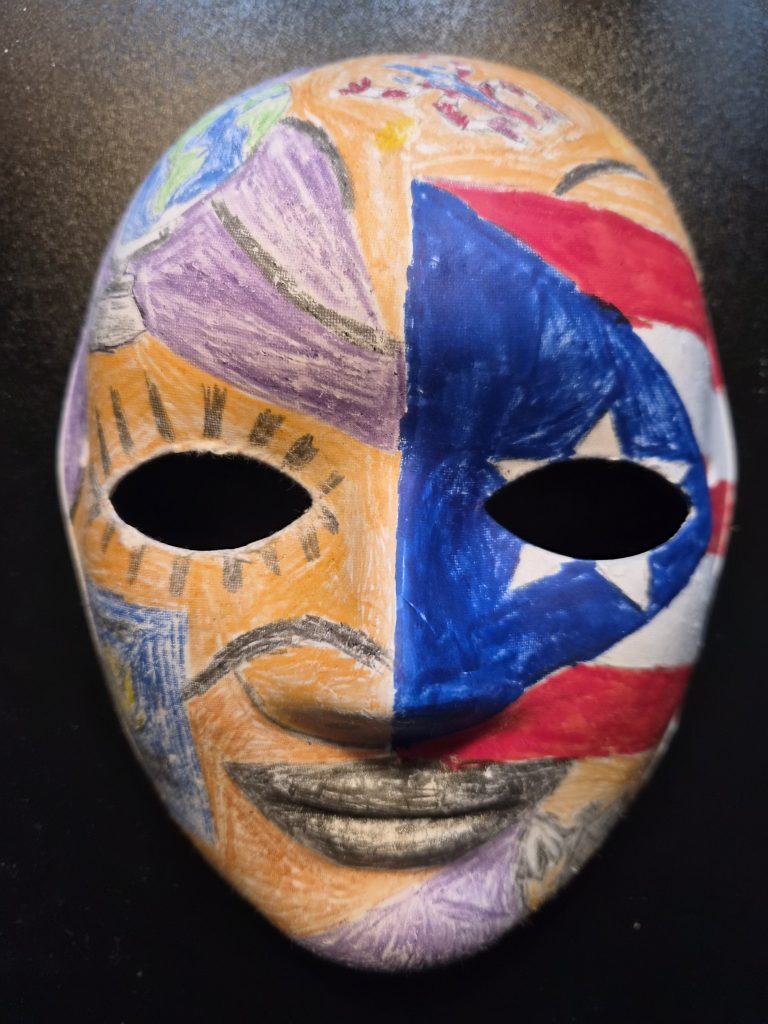
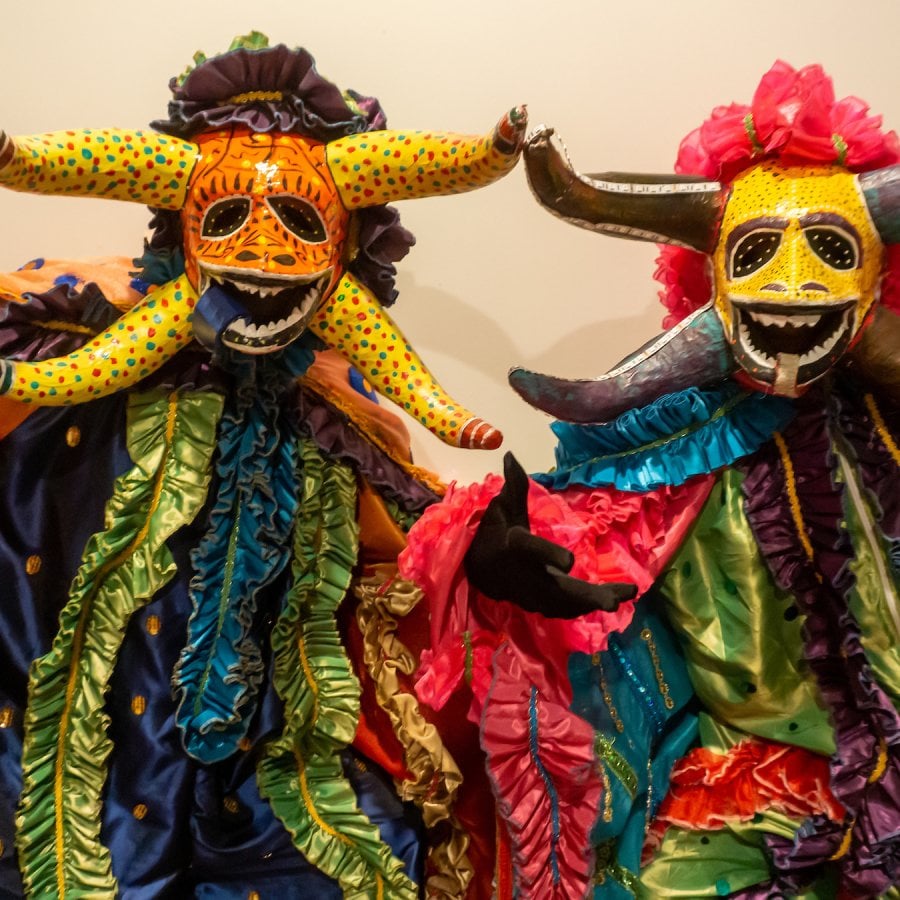
Never really sat down and asked myself, “What’s my identity?” Figuring out what to put on it was harder than actually doing it. I’m Puerto Rican, so I made half the face the flag, and made the star the eye because any way else and it wouldn’t’ve worked. You can’t really see most of what I put, but under the flag is the Bacardi Bat because the company moved to Puerto Rico from Cuba after a revolution and now its a PR thing. Above the flag is the coquí, adorable little frogs from PR who got the pokemon treatment because they are named after the sound they make. The left side of my face is a globe because I want to travel further than NJ. The mask is orange and purple to try to mimic the absurdity of vejigante masks created and worn during celebrations.
I tried for some teeth but that idea didn’t really work.
When you think of tattoos, you normally don’t think of its history or of it as an art form. You normally think of it as permanent images on your skin or as self expression, but on a zoom call last Friday with Rich Stremme I was introduced to tattooing as more than images on skin; he spoke about its history as an art form and as self expression.
I enjoyed how excited he seemed to be to teach us about tattooing. From sailors to prostitutes, to anyone 18 and above, he told the history of who used to get tattoos and what they used to represent.
I was shocked when he said Tattooing in Nyc was illegal from 1961-1997 because of how common it is to see a tattoo.
I liked how he spoke of his connection to tattooing. He enjoyed the older tools of the craft and appreciated the meaning of his craft, while also advising us on tattoos that we SHOULD NOT get.
I think what he said and his life were great examples of doing what you love no matter when you start.
Before last weekend I had never seen an opera, nor had I ever had any intention of seeing one. La Boheme is the first opera I have ever seen, and likely the only I will see because I have no interest in Opera. The opera itself wasn’t horrible. I was neither bored nor captivated; caught in between indifference and mild curiosity throughout the entire performance. The captions provided in front of us were the only thing that made the performance tolerable because I could at least have some clue as to what was going on beyond the general context of the performers’ movements and the performance pamphlet handed to us when we took our seats.
The cast was obviously very talented, learning how to pronounce and sing Italian. They also obviously put on a good performance and were very convincing of their actions when not singing, even the extras, especially when they were outside while Musetta was introduced (I watched the extras while they froze to see if anyone moved, only 1 guy did and it was seconds after they first froze).
Even with subtitles and the play pamphlet, I was not able to 100% follow the plot due to the subtitles sometimes not displaying what was being said. I still was able to understand the general story of love, and I accidentally read the description of act 4 and spoiled Mimi’s death.
In keeping with the tradition of the struggling Bohemian, I did NOT pay for the copy of Rent that I watched, and after watching, I can say that the movie is a decent modern take on a timeless struggle. The movie roughly follows the same plot of La Boheme; a group of aspiring artists who are dirt poor do whatever they can to make it another day.
Rent, being only 30 years old, touches on many things that were relevant then and still are today. The Aids pandemic, homosexuality, drug abuse, gender identity, love, and poverty.
The movie did take some creative liberties, such as putting Collins(Colline) and Angel(Schaunard) into a romantic relationship, and having Angel be the one who dies instead of Mimi.
Rent is a far more accurate and modern representation of struggling to survive, beyond being an artist. It showed how having people made life more enjoyable and was easier to connect to because it’s only about 30 years old, instead of nearly 200, like La Boheme.
I think I would’ve enjoyed Rent more than La Boheme, no matter the quality of Rent, because Rent is much more relatable and is in English. Rent was actually enjoyable, though, with good music, and characters whose struggles, personally and communally, still persist even into today.
When they said “Night at the Museum”, the idea I had about the night was more, “Explore a museum at night” and less, “Be confined to one floor of the museum for 2 hours staring at chairs”. The exhibit at the museum itself looked like your stereotypical museum art exhibit, jarring theme shifts as you walk through the exhibit, and an obvious focal point.
Unfortunately, the floor we were on seemed to exclusively have dozens of chairs on display, most of which you shouldn’t sit on. some chairs seemed to actually be art, not looking like a factory made chair, but most were just plain rocking chairs or children’s chairs, and a theatre showing transitions between different black and white films by means of doors, and there was even a plain white folding chair hanging on the wall as… art?
I didn’t see any meaning to the exhibit other than to show me a bunch of chairs, physical or painting.
I did see one work of art, a giant painting of a storm about to befall a mountain range, that I liked. It was more than just a landscape as it showed hunters chasing deer, with an already dead one nearby.
Overall, I neither enjoyed or hated the trip. It was definitely something different, but I wish there was a wider variety of exhibits for us to see.
I am not one for dance; whether it be contemporary or traditional. I do think the dancers put in a lot of work; they condition their bodies to dance and perform for hours a day, they have to have the strength and flexibility, and the agility, to move as they do, and it likely took them a life time of commitment, skill betterment, and perseverance to get where they are, and I appreciate and admire their effort and their loved for the preservation and celebration of culture and tradition, but I felt nothing more from the dance itself.
I recognize their talent and love for what they do, but I myself am not too intrigued by dance beyond the momentary spectacle of a difficult move or a grandeur sequence.
I did see some appeal in the feeling of watching the dance because I was tucked away up high in the corner of a dark theatre in the center of a big bustling city.
I didn’t hate the dance, they were clearly all talented and I wasn’t completely bored, but it may have been better if I wasn’t sick.
I went to the Art Lab at Snug Harbor on September 13th and attended the sculpting lab. There was a list given to me upon signing in for the event that told me what they offered, such as painting, photography, and of course, sculpting, and I picked what the lab I did randomly.
The lab itself was enjoyable: the man running it was kind and welcomed anyone who wanted to participate, and he gave you the suggestion of what to sculpt, a pumpkin, but let you do whatever you wanted. I chose to do the pumpkin, and began to roll, dig, and sculpt the clay into its final shape.
The clay had to be wet to shape, and after wetting it and rolling it into a ball, I had to hollow it out and then I carved a jack-o-lantern face into it and made it a top.
I think I managed to pick the messiest lab because my hands were caked in clay for the whole time I was sculpting, and even after washing my hands there was still clay left on me.
I enjoyed the process of making the pumpkin, but if I ever do something like this again, I will choose a less messy lab.
Banksy’s mural of a judge beating a protestor with a gavel, located on the Queen’s Court Building in London, September 8th 2025.
This mural depicts a judge beating a protestor with their gavel, beating the protestor enough to cause deep red blood to splatter on his sign, while the rest of the image is in black and white.
There are many layers to this mural: On the surface, it is a timeless piece, demonstrating the tendency for the law to silence what it cannot handle, or what it disagrees with; however, within context, it is both a social and political commentary.
The mural was made within the context of the current conflict occurring in Gaza, and its influence of global politics, in particular on protests and support groups.
Banksy created this mural to protest the UK designation of a Palenstinian support group as terrorists, leading to arrests of the members and other protestors.
The judge represents the Court’s choice to effectively legalize the abuse and silencing of those in support of Palestine, with the protestor themselves representing those oppressed.
The blood being the only color in the otherwise black and white work highlights the importance of the blood, showing the injury given by the Court to the freedom to express support for Gaza.
The blood also more broadly represents the continued abuses of the courts across time.
The use of black and white makes neither the judge nor the protestor specific enough to belong to any place or time, allowing anyone to see themselves and their oppressor, their struggle, expressed within the work.
This mural was created to demonstrate the current systematic censoring of anything deemed taboo or against the current political agenda: globally, regionally, or domestically.
The work was further enhanced when it was washed off the building; the building is a protected site, so the unlicensed mural was not something approved.
However, the removal of this mural highlighted one very important fact of protest and progress: the faces, names, and even specific details of an event may be lost to time or censorship, but the general shape, the outline of those before us, their effort, never fades.
It continues to inspire us and shows us what was so that we can bring forward what should be.
This is about my visit to the Met was supposed to be about my visit to the Met, but because of the condescending clerk who SHOULD have given us our tickets for free, and a classmate I traveled with’s strong sense of financial justice, we ended up leaving the Met without having even bought a ticket, but, seeing as I’m writing this, I did end up at a museum, if you could even call it that.
New York may be a crazy place to live where you have to exercise extreme caution, with a transit system that paradoxically is the best in the world while simultaneously being a nightmare for both commuters and employees alike; however, its vast size and desirability for status lends to the city’s appeal for businesses/attractions to set up, and conveniently, this meant that right down the block from the Met was the museum I ended up going to: The Guggenheim.
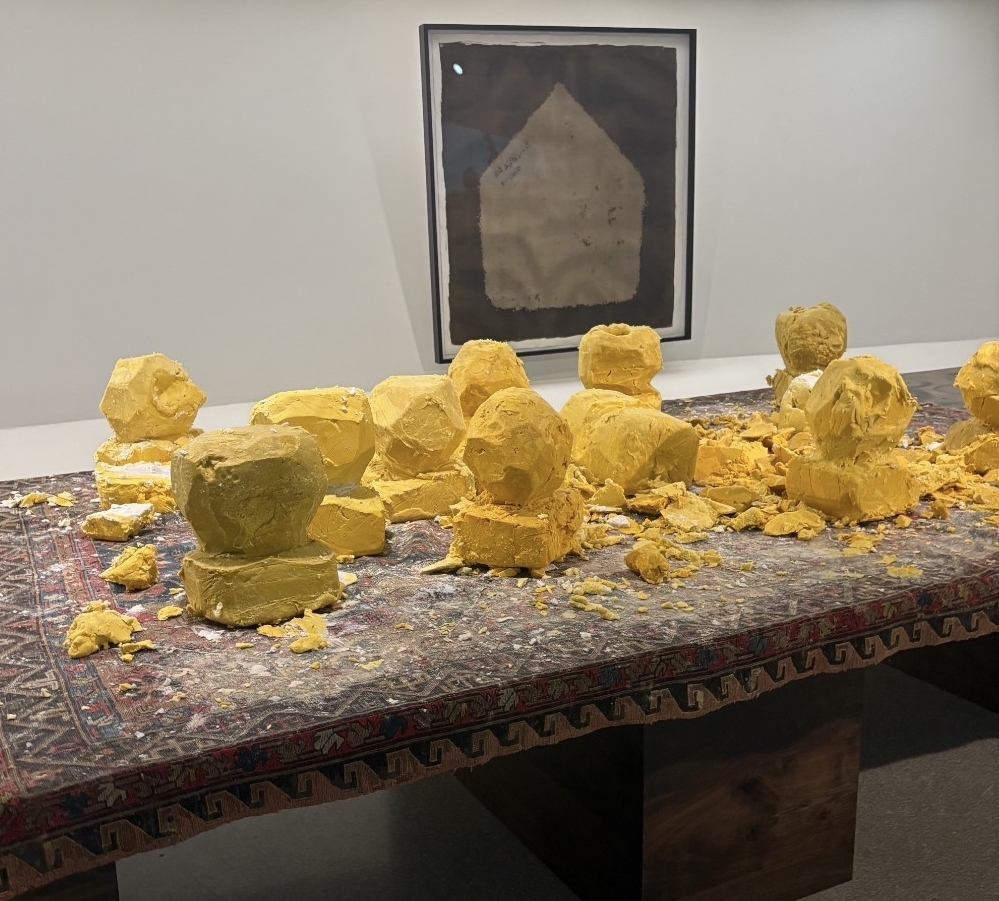
The clerk in the Guggenheim was eager to help us and made sure our tickets were free, while also explaining what our Cuny ids entitled us to at the museum, being free entry(very helpful, personable, and understanding, unlike the Met). Once inside, I was glad our entry was free as the works on display reminded of the works of a child a parent may put on the fridge, or take pictures of while saying, “Wow, you’re such an artist” despite the work being the same scribble done 5 dozen times on one canvas, or just a pile of rocks(both being actual works at the museum).
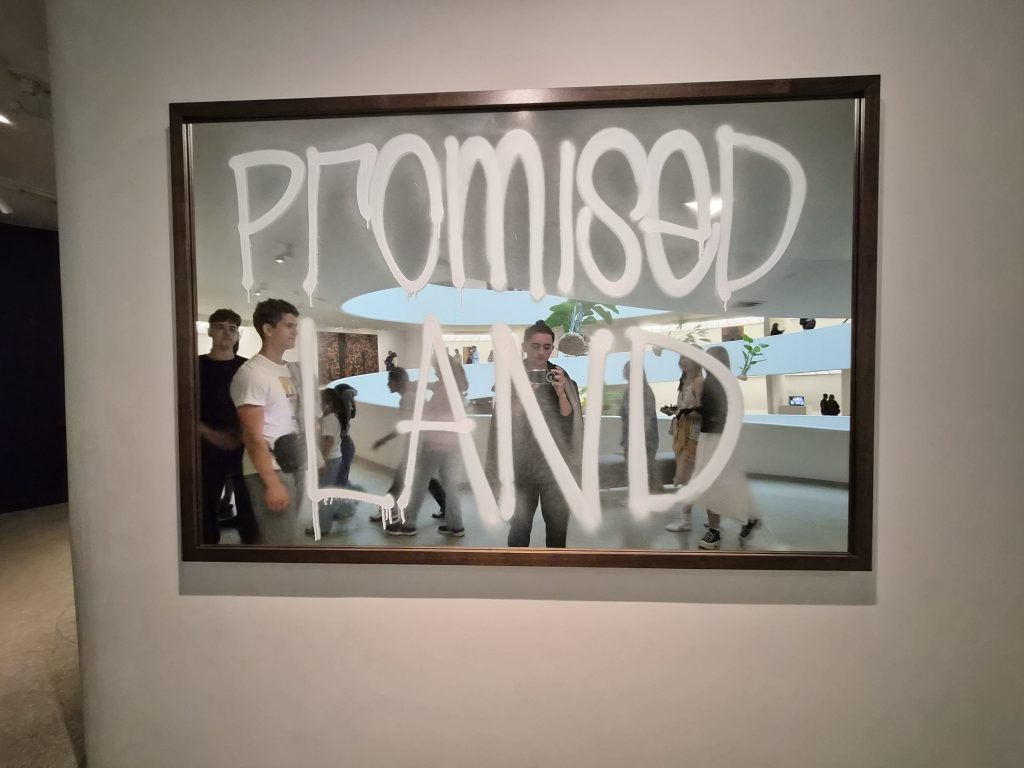
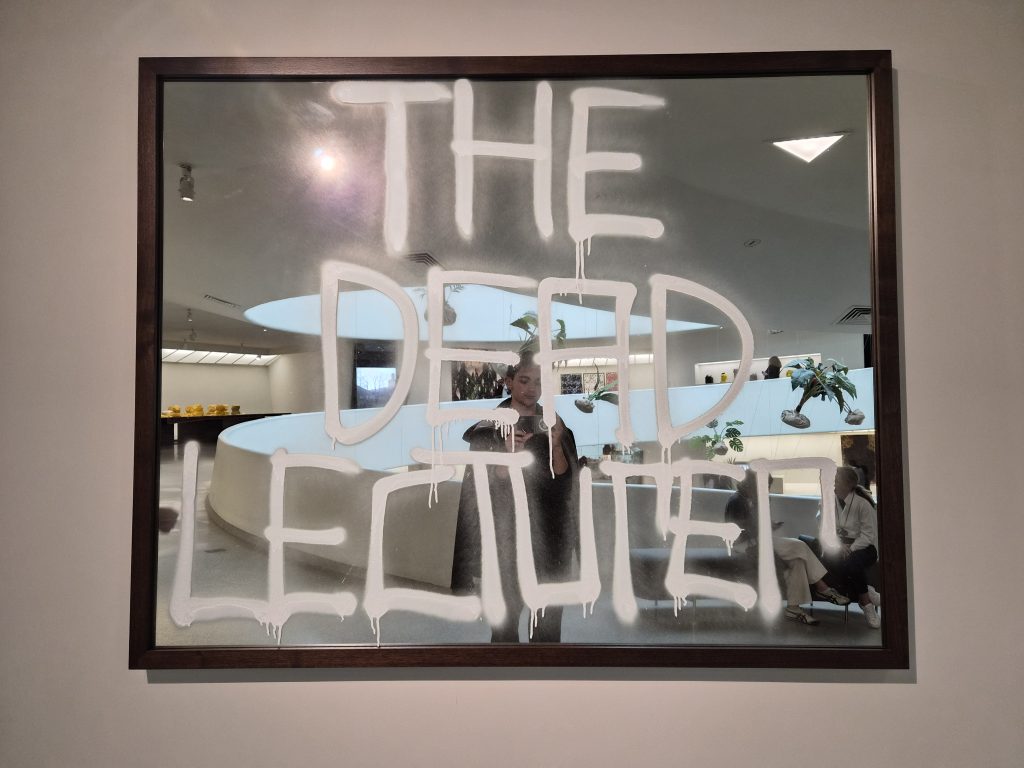
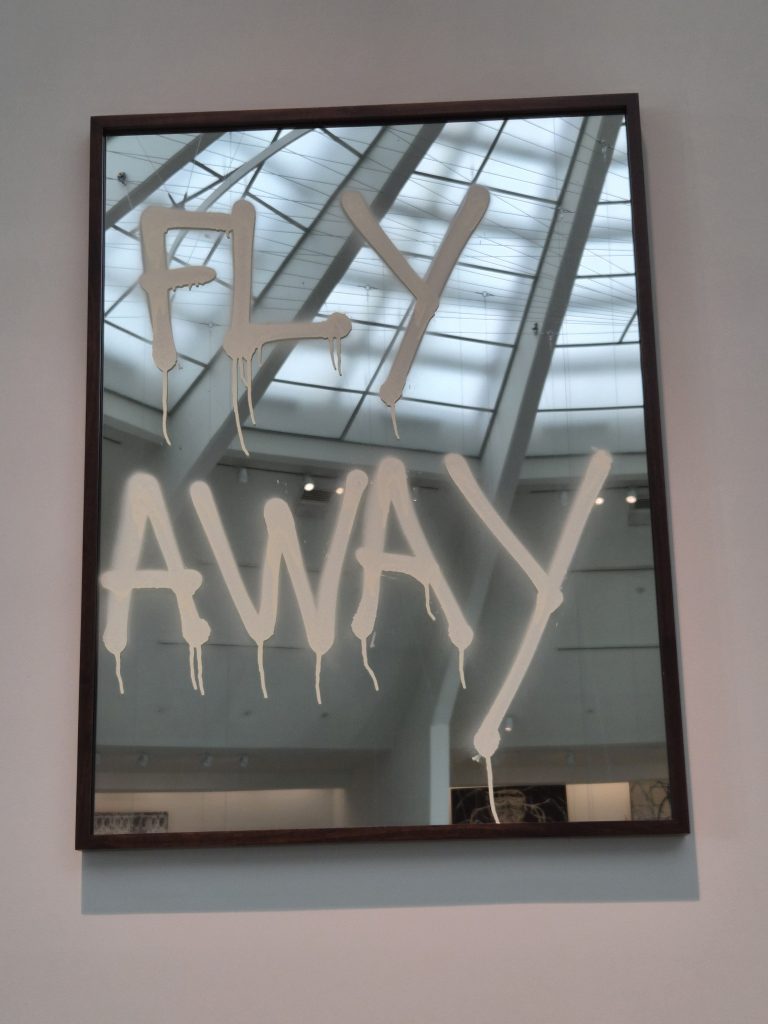
The museum’s shape itself, both outside and inside, was a jarring sight, a cork screw rising into the air, looking worse on the inside somehow. There were I think 6 labeled floors inside, and the floors were continuous in one giant spiral. The works were… abstract and very unique. None of them really spoke to me, unsurprisingly, and I felt no real connection to most of them as I couldn’t even begin to attempt to interpret them due to how random they were and how each work seemed to juxtapose the other works and even itself.
There at least was an elevator to save you the torture of having to go up and down the cork screw in the same trip, so thankfully after getting to the top floor I only had to walk it once.
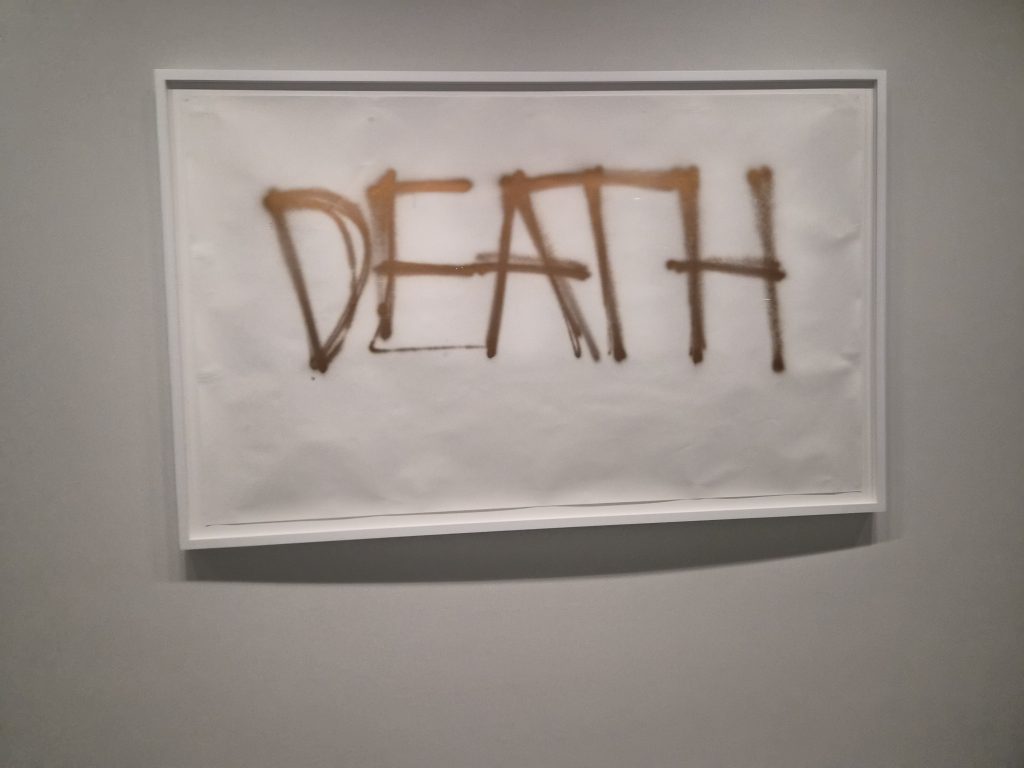
The cork screw does however force you to walk down and see the multiple works painted on to glass and other mediums displaying alarming messages, so in this regard the architecture does add to one of the works.
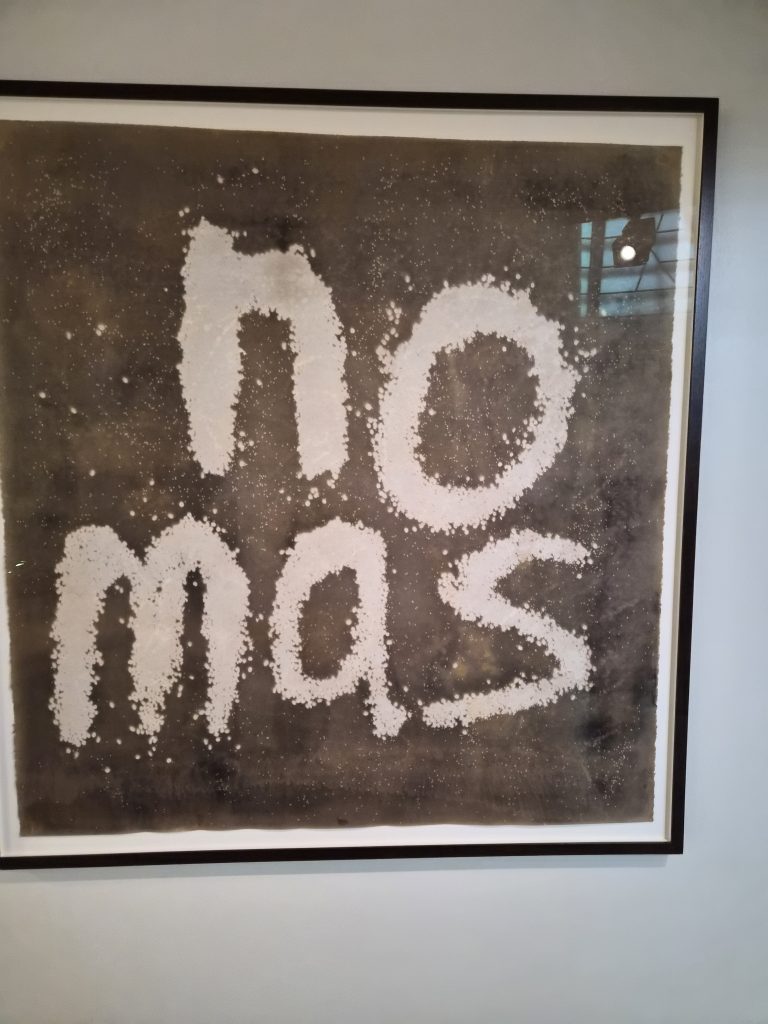
Beyond the cork screw, there were side exhibits each showcasing works that apparently did not fit the general theme of the museum(no clue what the theme could have been in all honesty), and these side exhibits were more enjoyable as they were all tangible and unique works that seemed to take more effort than just a fleeting impulse to bring to life.
Many of these side works were paintings, and one was a knitted work that wasn’t a blanket, but instead a large design. The paintings especially were full of effort and love as they were painted in various eras and areas, while also portraying a variety of topics and history.
Despite my liking of these paintings, overall, I was left disappointed in the art that the museum chose to put in its main exhibit, with much of it being too elaborate or scatter brained to for any sort of narrative beyond, ”elaborate and scatter brained”, which, if that were the narrative, would be a rather poor and uninspired narrative. I did like the spiral itself because it was something I hadn’t experienced before, but beyond the initial introduction to it, it quickly lost its luster as I had to descend its singular floor.
My trip to the Guggenheim wasn’t exactly planned, and was not the worst, but it makes me question whether I can get a refund for my time, or sue for psychological damages caused by the art. I will definitely not return again of my own free will. It will ;however, always be thought of by me as better than the Met because the Guggenheim seemed to welcome my entry, likely desperate for someone to see their vision(whoever’s vision that museum was made in needs to see an ophthalmologist).
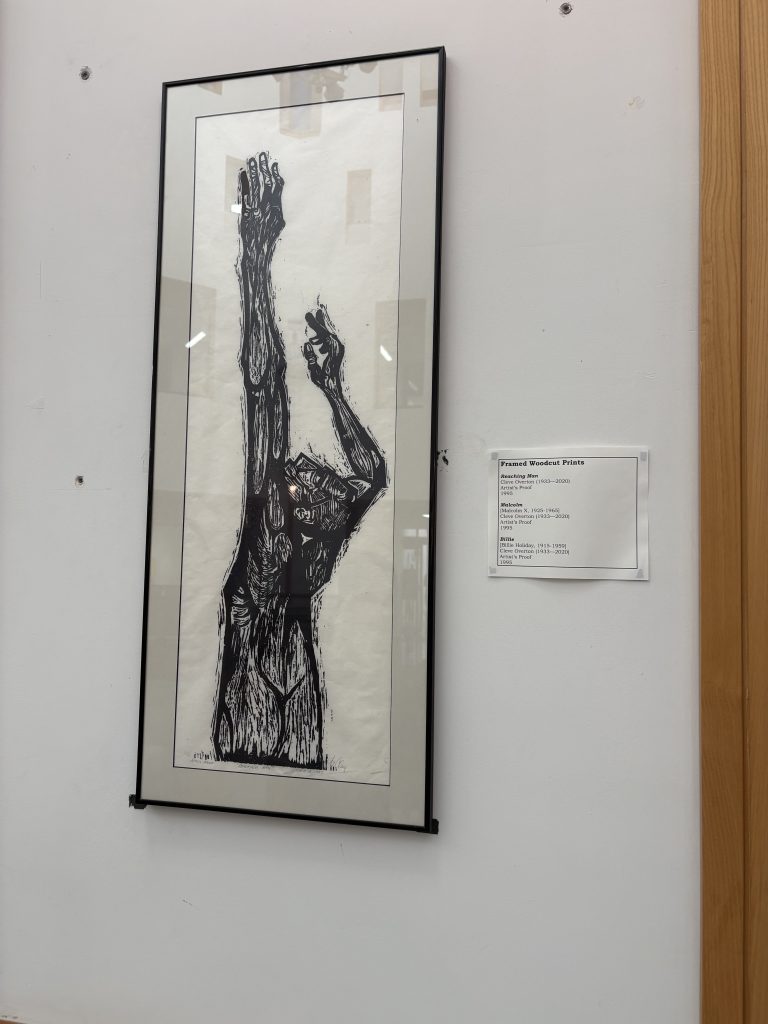
The image that we saw in the Library (of a black and white figure reaching upwards as though they were drowning) spoke to us profoundly, as it symbolizes a struggle which we often endure in our inability to control our lives.
We understood it, but it didn’t really speak to us and we didn’t think it relates to CSI as it did not reflect any of the opportunities CSI often awards its students, and, on the contrary, indicated themes laced with desperation.
The work in question had no apparent meaning to any of us when we saw it. It did not invoke any emotion, and although we understood that it was about struggling and feeling stuck in place, it felt very out of place and juxtaposed within the campus library.