Alternative Art Spaces and Art in the Service of Social Justice:(James Yaya Hough)

James Yaya Hough’s 3 panels of colored glass art pieces became part of Battery Park’s art collection. Each 3 of the panels represent different topics connected to the carceral system. He’s using his art to address this issue in social injustice. He’s trying to share a message of a future with a reformed carceral system through the use of bright colors amongst sad images. They are on the Esplanade Plaza Wall because it’s a very open and accessible place. This is part of the Battery Park Authority’s permanent collection and it’s a great example of how art is used to display social injustice issues. -Jacqueline Cohen
Shirin Neshat — Women of Allah (Exhibited at MoMA, NYC)

Women of Allah, Shirin Neshat (Iranian, born Qazvin 1957), Ink on Gelatin silver print

This powerful photographic series confronts Islamophobia by challenging how Muslim women are portrayed in Western culture. Neshats photographs Muslim women in black and white, then overlays their skin with handwritten Persian poetry about identity, loss, and resilience. By merging the body with literature, she reveals the inner voices that are often ignored or silenced. The work directly responds to the way Muslim women are reduced to political symbols and misunderstood through fear based narratives. Shown at MoMA, the series uses art as a form of social justice, reclaiming representation, correcting stereotypes, and insisting on the complexity, strength, and humanity of Muslim women.

Aden Martinez – Alternative Art Spaces and Art in the Service of Social Justice

A strong example of an artist who has shown their work in New York City and addressed issues of social justice

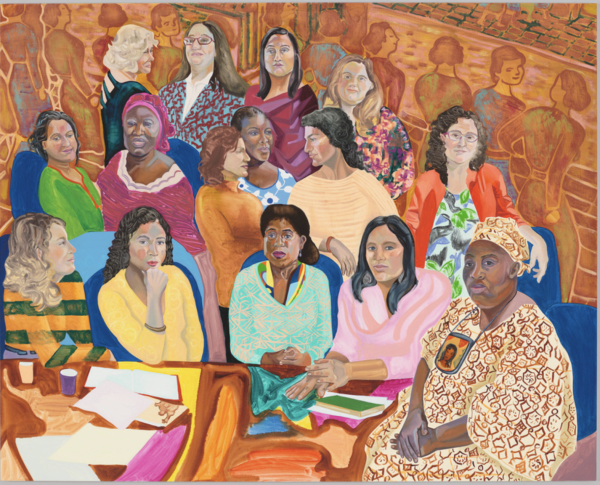
is Aliza Nisenbaum. Her work often depicts immigrants, particularly from Mexico and Central America, in intimate, dignified portraits. She uses her art to highlight the humanity of marginalized communities. One of her art pieces, MOIA’s NYC Women’s Cabinet, is a large group portrait that depicts 15 women from the New York Mayor’s Office of Immigrant Affairs program. This work was included in the Whitney Museum’s collection. The painting reflects her ethic of care and visibility. She paints undocumented immigrants and their communities. 

I don’t know how much painting can do in itself in terms of huge political agendas, but I think the fact of sitting with somebody or paying attention is a form of ethics in my mind.” – Aliza Nisenbaum

Dylan Torres- Alternative Art Spaces and Art in the Service of Social Justice

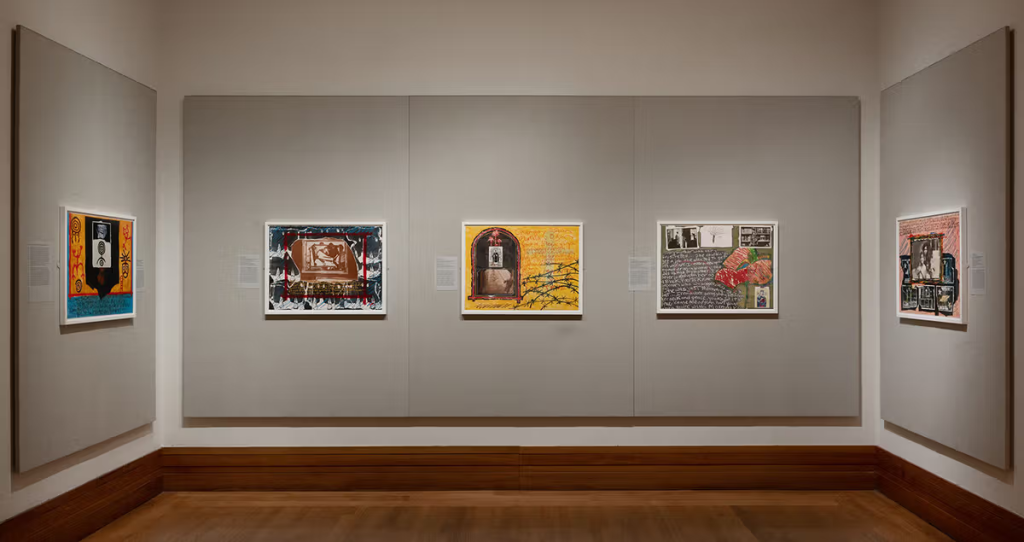
Juan Sánchez is a perfect example of an artist who has shown their work in New York City that addressed issues of social justice. He is commonly referred to as a “Nuyorican” (New York/Puerto Rican) artist, who’s work addresses issues of Puerto Rican life in the U.S. He was born and raised in Brooklyn and is the son of two Puerto Rican immigrants. Shown below is “Escrito en Piedra,” from “Guariquen: Images and Words Rican/Structured.” Here, according to the MET website, he evokes the legacy of the Taíno (Indigenous peoples who lived in Puerto Rico and other Caribbean lands) and their culture.


“Political art is a medium used as a weapon to hopefully recapture or regain the positive energy of celebration—to regain the goodness of humanity.” – Sánchez

What Is the Proper Way to Display a U.S. Flag? (Dread Scott)-Adi F

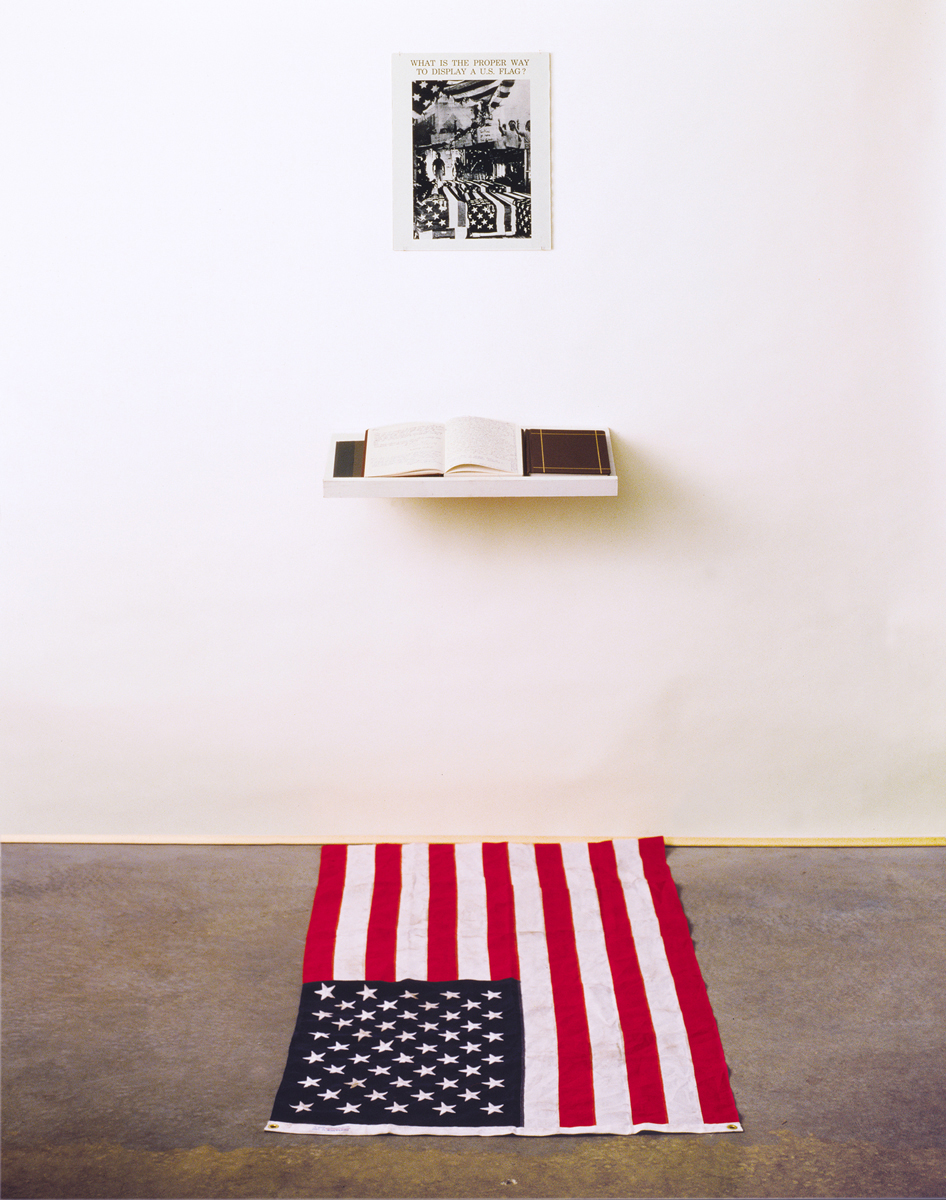
What is the Proper Way to Display a US Flag? - Dread Scott

Dread Scott makes art that talks about racism, unfair treatment by police, and what it really means to be an American. His famous artwork, What Is the Proper Way to Display a U.S. Flag?, lets people walk on a flag so they can write their opinion in a book above it. A lot of people got upset because the artwork showed the difference between what the flag is supposed to stand for and how many Black Americans are treated in real life. By making people actually step on the flag to take part in the artwork, Scott makes everyone think about what freedom, fairness, and patriotism really mean. His piece was shown in New York, and it shows how art can make people face uncomfortable truths about our country. It is displayed at the Whitney Museum in NYC.

Alternative Art Spaces and Art in the Service of Social Justice- Augusta Savage

Image result for the harp augusta savage

An example of an artist who has shown their work in New York City that has addressed issues of social justice is black female artist and activist Augusta Savage (1892-1962). One of her works was a sculpture called The Harp, which was inspired by the song “Lift Every Voice and Sing” and also originally named after the song. The Harp was commissioned for the New York World’s Fair in 1939 and destroyed shortly after it was open to the public because of lack of  funding. The significance of The Harp is that it represents black resilience and liberation. The 12 African American singers that make up this structure represent the strings of a harp that symbolize the strength and unity of the black community. The exaggerated heights of the children also symbolize a brighter future and metaphorical heights that can be reached through liberation (“The Harp – the Body Is Memory: An Exhibition of Black Women Artists”).  

“The Harp – the Body Is Memory: An Exhibition of Black Women Artists.” The Body Is Memory: An Exhibition of Black Women Artists, sites.smith.edu/afr111-f19/the-harp/.

– Emmanuella Bentil

social injustice artist

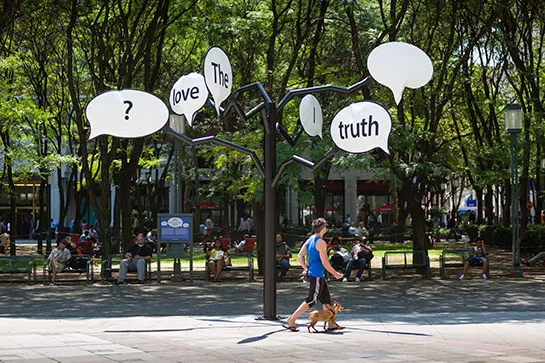
Hank Willis Thomas is a New York based artist who addresses social injustice through photography and sculptures. An example is his public art project called “The Truth Is I See You” which placed short and thought provoking messages in everyday city spaces to encourage to think about equality, empathy and how we see each other. He frequently uses historical and media images to question how race, power, and representation shape American culture, making his work a strong example of art used for social injustice in NYC.

Faith Ringgold

Faith Ringgold has had her art displayed across New York in ways that make social justice issues visible. In “Her American People Series #20: Die” she depicts a chaotic race riot with Black and white figures locked in violence, directly responding to the civil rights struggles of the 1960s.


Alternative Art Spaces and Art in the Service of Social Justice – Nicholas Faynvets

Jean-Michel Basquiat, Defacement, 1983

Jean-Michel Basquiat addressed police violence with his painting “Defacement.” He created the work after Michael Stewart died in police custody. The painting uses crowded forms to show tight harm and pressure. Viewers face the reality of racial injustice in New York City. Basquiat’s work shows how artists respond to events that shape public life. You see how he uses direct images to confront the issue instead of hiding it.

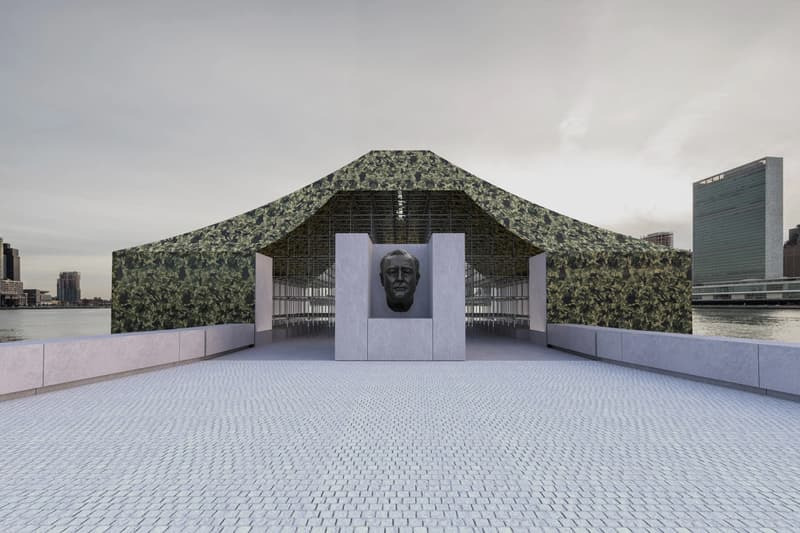
Camouflage: by Ai Weiwei


Chinese artist Ai Weiwei, renowned for his provocative work addressing human rights, government oppression, and social justice, created the public installation Camouflage at FDR Four Freedoms State Park on Roosevelt Island, New York City. The piece features netting patterned with cat silhouettes, a symbol of vulnerability and innocence, draped over parts of the park to explore themes of concealment, truth, and conflict. Visitors are invited to write reflections about freedom and tie them to the netting, making the installation a participatory and collective act that engages the public in conversations about fear, protection, and human rights.

Matthew Bologna

Proudly powered by WordPress | Theme: Baskerville 2 by Anders Noren.

Up ↑