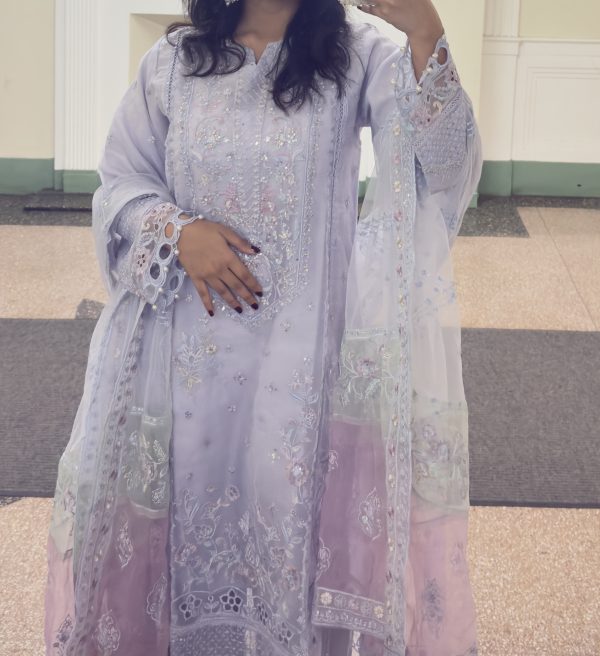
The object I chose is a lavender Bengali salwar kameez, detailed with soft pastel embroidery and paired with a light, flowing dupatta(scarf). I wore it for Eid-Ul-Fitr in 2026 in Queens, New York. At first glance, it is simply a traditional outfit, but to me, it carries a story shaped by memory, growth, and identity.Most of all, it brings nostalgia. The delicate patterns remind me of Eid mornings in Bangladesh when I used to get ready with my cousins, share laughter, and feel surrounded by family. Those moments feel distant now, yet this dress allows me to hold onto them.At the same time, wearing it in New York shows a different side of my identity. In a city where Muslim communities are visible and welcomed, I can celebrate Eid openly. It shows how different communities in Queens tend to have a positive attitude towards different religions. This balance between comfort and change defines my experience.What makes this outfit especially meaningful is that I bought it with my own money. As a child, I admired clothes like this but could not always afford them. Now, earning my own income reflects my transition into adulthood and independence. Although life in the United States is different, this salwar kameez keeps me connected to Bangladesh. It represents both who I was and who I am becoming, showing that identity can grow without being lost.
Threads of Light: From Cairo to New York
The object is a hand-size golden lantern that lights up with batteries. It has a handle at the top and a roof-like top, with a round base and two handles (mostly for decor) on the sides. The lantern was purchased by my mom in NYC. It sits on a medium-sized table within my house, mainly used for guests. Even though it simply looks like a fancy house decoration, it connects me with my culture and memories.
Growing up as an Egyptian, it was normal to see children before sunset running in crowded markets, pushing through adults while holding small lanterns of different shapes and sizes. They’d light up in different colors, not just golden yellow. Most of the time, the lanterns didn’t contain real candles. But they still felt cultural. Children would sing “Ramadan gaana,” and other different songs in anticipation of the month of Ramadan.
Because the small lantern signals Ramadan, it connects me to memories of fasting in Egypt on hot days, especially later in the day when I felt great for making it to the evening, knowing a large feast awaits my family.
This object fits into the broader story of New York City because New York City is a hub of immigrants, of many cultures uniting into one city. This makes New York so much different from other places in America. Being of an Egyptian background, I bring my perspective here, and even meet people from different countries who also celebrate Ramadan.