My grandmother has a qozon that looked like the one in the image, only much smaller. It was old and well-used. This is the qozon that made the food that my mom was raised on throughout her entire childhood. This is the qozon that made the food I was raised on during my childhood. It’s not a cooking utensil or a tool; at this point it’s an heirloom. It’s older than I am. It’s probably older than my mom. Its provenance, at least as far back as I can trace it, begins with my grandfather’s mother, who then passed it on to him. Being a stereotypical Uzbek man and not knowing how to cook, he gave it to his wife (my grandmother). My mom hopes to inherit it one day.
It’s funny just how much of Uzbek culture can be explained by this. Uzbek dishes are efficient: large and calorie-dense, a leftover (see what I did there?) from our nomadic days when little could be preserved and even less could be carried on the backs of horses. Because of this, Uzbeks traditionally have no concept of leftovers. My grandmother would cook three meals a day, every single day, each one big enough to fill this qozon to near-overflowing. The qozon is perfectly hemispherical, so an Uzbek kapkir (spatula) can very efficiently stir the food and scoop it out onto the plates of my grandmother’s four children. The pure cast iron gets hot and stays hot, and the material only gets stronger over time as it polymerizes with every use, preserving itself for future generations.
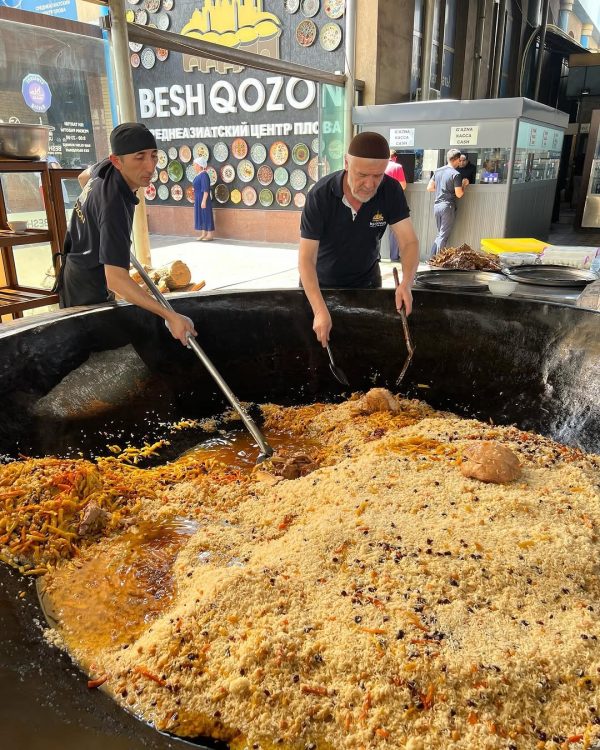
The second image is an example of a qozon used in communal cooking. These huge qozons are called “forty-ears” because they traditionally had forty handles, called ears, around the rim, and it would take forty men to carry them, one for each ear. There are restaurants in Uzbekistan that specialize only in one dish, osh, the national dish of Uzbekistan. The restaurant Besh Qozon makes portions of osh that weigh 350 kilograms (771 pounds).
I’ve had to describe it so many times, and each time I’m left underwhelmed because it’s impossible to experience it adequately (let alone authentically) unless you see it being made in front of your very eyes. It consists of Uzbek rice (not basmati or jasmine), julienned orange and yellow carrots, beef or lamb, spices, and toppings like whole peppercorns, raisins, quail eggs, stuffed grape leaves, whole garlic heads, or even quince. All of the toppings are not used at once; quince and garlic do not go well together. My favorite is fried in linseed oil, but the fanciest osh is made with dumba, the fat of a special type of ram only found in Central Asia.
Because osh comes in so many different forms, it is used in every aspect of Uzbek life: regular ol’ osh at home, fancier osh at restaurants and celebrations, and even fancier to’y oshi for weddings. The wedding, being the most important event in Uzbek culture, naturally gets the fanciest osh with all of the toppings. At the most old-fashioned of weddings, a ram and a big qozon are brought to the home of the bride. I think you can see where this is going. A butcher is called, the ram slaughtered, and some of the male relatives of the bride cook osh for the wedding. These days, things have become a bit more modernized. To’ylar (weddings) are usually held in to’yxonalar (wedding-houses), huge event halls specifically made for Uzbek weddings, which include 500 people on average.
From to’ylar to dumba to paxta-gul to osh, the qozon truly connects every facet of Uzbek culture together.
Uzbek Qozon