
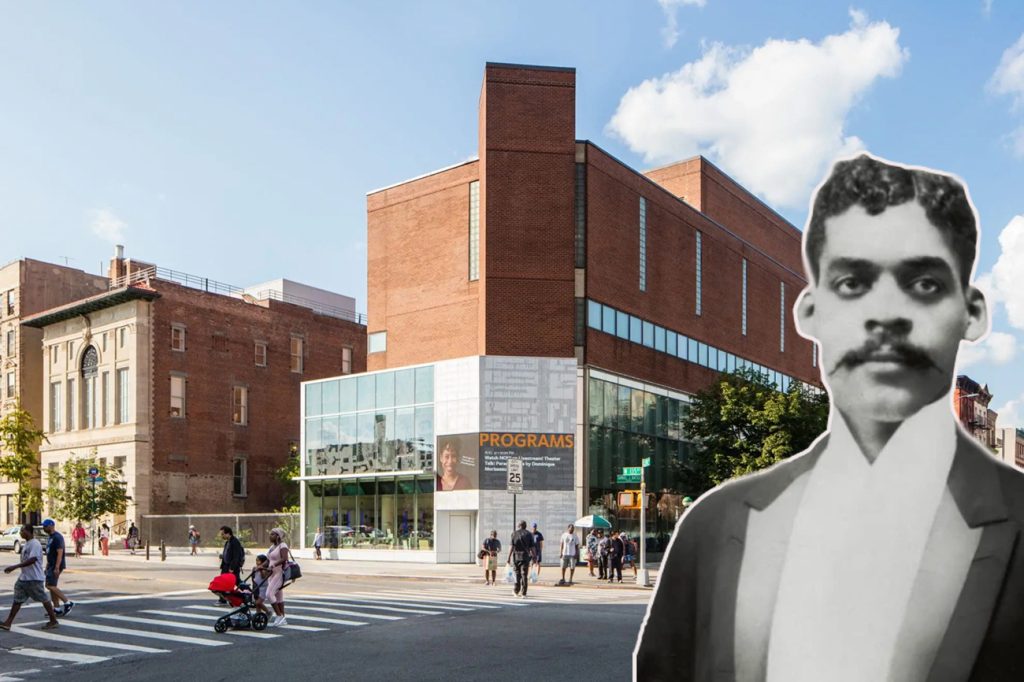
“Vindicating evidences of individual achievement have as a matter of fact been gathered and treasured for over a century” – Arturo Schomburg.
This quote in the exhibit is significant not only for what it represents historically but also for how it connects to New York City’s cultural identity.
His use of the phrase “Vindicating evidence” helps emphasize that once one leaves the exhibit they will have no doubt in their mind about the impact of African Americans. This exhibit placed in a city like New York known for its diversity and cultural influence makes this message especially powerful because it reinforces the idea that African Americans are deeply ingrained in the story of the city itself.
Our Presentation

Langston Hughes Buried Ashes
Interred beneath a public art installation titled Rivers in the lobby of the Schomburg Center for Research in Black Culture in Harlem, NYC
Our Research Report
Appendix:
Shalyssa
My personal impressions about this museum is that, you can tell that it clearly fosters a community across generations because I saw people of many different ages including people my age, younger, adults and the elderly. This showed me that the museum is successfully sharing and preserving African American culture. However I do wish it were a little bigger, especially considering it’s in a city like New York, but I understand why it’s not as big as it could be. There weren’t a lot of exhibits I thought there would be more, but I still enjoyed the exhibits that I went to. A goal of mine was to go to at least one museum related event in the city and the Schomburg Center can help with that with all their events. More specifically the Black On Screen event they will be hosting on the 25th of March.
Anna
I really enjoyed visiting this museum. Prior to this project, I hadn’t known this museum even existed, I appreciated learning and immersing myself with Black history and culture. I also liked that the museum was free as it made it very accessible for anyone and everyone to stop to buy and learn about Schomburg’s collection and in turn learn about Black accomplishments. My only con is that I wish that the museum was larger. There were only 3 floors for me and my group mates to explore and the exhibits were rather small. In fact one of the floors featured one exhibit and it was the length of a small wall. My peers and I found ourselves saying “That’s It?”, not realizing how small the exhibits are. For a center that started off with 10,000 items and has collected over 10 million artifacts in the past 100 years it’s been open, the exhibits do not reflect the center’s extensive collection. Regardless, for the information and exhibits my peers and I were able to see, everything was really well displayed and almost everything had a small explanation next to it and or featured the title of the piece and its creator.
Judea
I really enjoyed the exhibit because of its successful goal of inspiring the next generation. I felt very inspired by the pieces showcased and of the African American achievements. My main goal was learning something I didn’t know before which I succeeded in by learning about the off-broadway performances there. The most interesting aspect of the site is that some of Langston Hughes ashes were buried under the exhibit which felt spiritual walking on top and it really placed me in appreciation of all that was accomplished at the site. However, I only wished that the exhibit was bigger and perhaps had more floors to visit. I also think that the site could benefit from better marketing so that more people are aware of this amazing site.
Works Cited
“Arturo Alfonso Schomburg.” National Museum of African American History and Culture,Smithsonian Institution, 2023, nmaahc.si.edu/latinx/arturo-alfonso-schomburg. Accessed 8 Mar. 2026.
Arturo Schomburg. 1896. Schomburg Center for Research in Black Culture/The New York Public Library, www.lincolncenter.org/feature/legacies-of-san-juan-hill/stepping-into-the-public-sphere-arturo-schomburgs-letters-to-the-new-york-times. Accessed 8 Mar. 2026.
Black Fives Foundation. “Our New On-Court Mural in Harlem Honors the Legendary New York Rens | Black Fives.” Black Fives | Make History Now!, 26 June 2024, http://www.blackfives.org/our-new-on-court-mural-in-harlem-honors-the-legendary-new-york-rens/?utm_source Accessed 7 Mar. 2026.
CUNY Urban Food Policy Institute, and New York City Food Policy Center at Hunter College. “Eating in East Harlem – CUFPI.” CUFPI, Apr. 2022, https://cunyurbanfoodpolicy.org/resources/report/eating-in-east-harlem/?utm_source Accessed 8 Mar. 2026.
Douglas, Aaron. Aspects of Negro Life: Song of the Towers. 1934. Illustration History, illustrationhistory.org/illustrations/aspects-of-negro-life-song-of-the-towers. Accessed 9 Mar. 2026.
Douglas, Aaron. Aspects of Negro Life: The Negro in an African Setting. 1934. Illustration History, illustrationhistory.org/illustrations/aspects-of-negro-life-the-negro-in-an-african-setting. Accessed 9 Mar. 2026.
Lawson, Tammi. “Aaron Douglas’s Aspects of Negro Life Murals.” The New York Public Library, www.nypl.org/events/tours/audio-guides/100-century-collections-community-and-creativity/item/19631. Accessed 9 Mar. 2026.
New York Public Library. “Schomburg Center Acquires Collection of Hip-Hop Pioneer Fred ‘Fab 5 Freddy’ Brathwaite.” The New York Public Library, 2019, https://www.nypl.org/press/schomburg-center-acquires-collection-hip-hop-pioneer-fred-fab-5-freddy-brathwaite Accessed 8 Mar. 2026.
Policy, Food. “Foodscape: East Harlem.” NYC Food Policy Center (Hunter College), 23 Jan. 2022, https://www.nycfoodpolicy.org/foodscape-east-harlem/?utm_source Accessed 7 Mar. 2026.
Rodriguez, ET. “Turning Eyesores into Artworks: The Grandscale Mural Project in Harlem.” AmNewYork, 29 July 2025, https://www.amny.com/news/eyesores-art-grandscale-mural-project-harlem/?utm_source. Accessed 7 Mar. 2026.
Roy, Sushmita. “How One Man in Harlem Is Changing Lives, One Seed at a Time.” Global Citizen, 31 July 2019, https://www.globalcitizen.org/en/content/one-harlem-man-is-changing-lives-by-urban-farming/?utm_source Accessed 8 Mar. 2026.
Schomburg Center for Research in Black Culture, Art and Artifacts Division, The New York Public Library. “Aspects of Negro Life: An Idyll of the Deep South.” The New York Public Library Digital Collections, 1934, digitalcollections.nypl.org/items/24761540-c6f4-012f-2106-58d385a7bc34.Accessed 9 March 2026.
Schomburg Center for Research in Black Culture: Space Rental. The New York Public Library, www.nypl.org/spacerental/schomburg. Accessed 8 Mar. 2026.
“The 75th Anniversary of the American Negro Theatre.” The New York Public Library, www.nypl.org/events/exhibitions/75th-anniversary-american-negro-theatre. Accessed 8 Mar. 2026.
“The Schomburg Library.” Studio Museum in Harlem, www.studiomuseum.org/artworks/the-schomburg-library. Accessed 8 Mar. 2026.

