

Who Were the IRA?
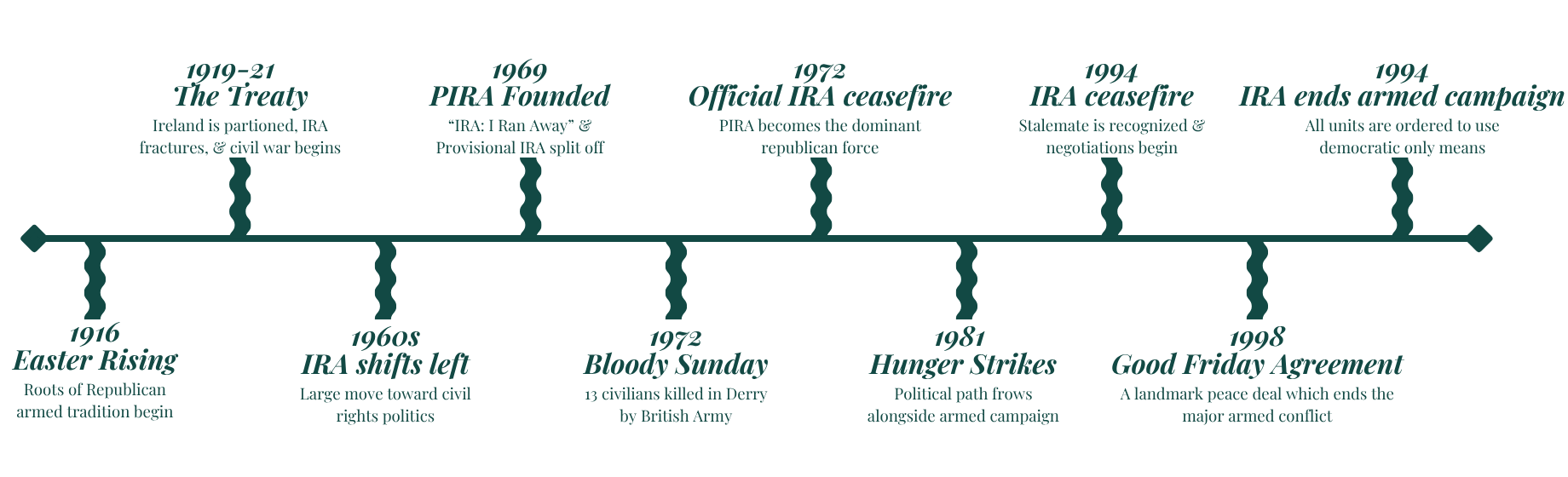
The Irish Republican Army (IRA) has roots that stretch back decades, though its modern iteration, the Provisional IRA (PIRA), arose from a long tradition of the use of physical force dedicated to ending British rule and occupation in Ireland. The IRA as an organized group began in the early twentieth century from the Irish Volunteers, who played a central role in the 1916 Easter Rising and the subsequent War of Independence that lasted from 1919 to 1921. The Anglo-Irish treaty of 1921, known in Ireland more commonly as just “The Treaty,” partitioned Ireland, creating the Irish Free State – declared The Republic of Ireland with the adoption of its new constitution in 1949 – while Northern Ireland remained part of the United Kingdom. The existence of this settlement fractured the Republican movement and ignited a civil war. The IRA continued to pursue sporadic campaigns but these efforts largely failed, leaving the organization weakened both physically and ideologically by the mid-1960s (English 112-17). This period of weakening coincided with the beginning of what became known as The Troubles, a thirty-year period of ethno-nationalist conflict in Northern Ireland. During this time, unionists and loyalists, who were majority Protestants, wanted Northern Ireland to remain a part of the United Kingdom, while Irish nationalists and republicans, who were mostly Catholics, wanted Northern Ireland to leave the United Kingdom and become part of a united Ireland. Despite the significant division between Protestants and Catholics, many historians who have studied this time period in depth agree that this was not fundamentally a religious war, though religious identities were largely tied to national identities, and also drove the division between British settlers in Ireland and the native Irish (Mitchell 5).
To understand how the Provisional IRA came into being, it is necessary to understand the structural conditions of Northern Ireland’s existence as a divided society. Since partition, the Catholic minority in the North endured systematic discrimination in housing, employment, and political representation under the unionist majority Stormont government. Under Chief of Staff Cathal Goulding, the IRA of the 1960s turned away from armed struggle and moved towards a semi-Marxist political strategy, working to engage in civil rights and social activism, rather than military preparation (Hanley 672). This shift alienated traditional republicans who believed that the IRA was abandoning its defensive role in Northern Ireland’s Catholic communities. When violence broke out in Belfast between August 13-15 of 1969, leaving seven dead and almost 2,000 families (majority Catholic) displaced, the IRA was widely condemned for its failure to protect nationalist areas. This condemnation led to the slogan “IRA: I Ran Away” to be plastered on walls throughout Catholic Belfast, showing that the people believed the group to have been caught unaware and unable to respond (683-84).
This crisis precipitated a formal split in December of 1969. It was then that the Provisional IRA was formed by traditionalists who rejected the leftward drift of ideologies and insisted on prioritizing the armed defense of northern Catholics. The Provisional IRA thus emerged not as a terrorist organization, but as a product of a specific political and social crisis that was rooted in the unresolved contradictions of division, ongoing discrimination against the Catholic minority, and the state’s willingness to use lethal force against its own citizens. These origins gave the PIRA a genuine social base in republican communities that the IRA had cultivated through a combination of defensive action, political mobilization, and propaganda. The organization’s training manual, the Green Book, emphasized the importance of maintaining community support through carefully managed public messaging, something Kiran Sarma (who has a doctorate in risk psychology, specializing in support for terrorism) has coined as “defensive propaganda” (Sarma 1076). This method of garnering support worked to morally justify the movement’s actions to its sympathetic audience prior to any operations being carried out.
The Provisional IRA grew rapidly in the early 1970s and shifted from a defensive position to an offensive campaign against British security forces and the Northern Irish state. On January 30, 1972, a tragedy known as Bloody Sunday occurred in Londonderry, more commonly known as Derry due to the wish to be separate from the occupying British. The Northern Ireland Civil Rights Association (NICRA) organized a march against the continuation of internment without trial in Northern Ireland, drawing a crowd of between ten and twenty thousand people. The march was stopped from reaching the city centre by the British Army, and so the main body moved to “Free Derry Corner” to attend a rally. During this movement, some young Republican men began throwing stones at soldiers who then retaliated by moving in to arrest them. In doing so, British soldiers shot and killed 13 men, and injured 13 more. In retaliation, the soldiers responsible sustained gun and bomb attacks from members of the IRA. These events catapulted the Troubles into a deadly momentum that many believed could not be reversed (CAIN Archive; Cox 672). The following conflict involved multiple armed actors whose interests and goals often intersected and clashed.
On the Republic side, the Provisional IRA was the dominant force, aligned with Sinn Féin, the Irish republican and democratic socialist political party, that coexisted uneasily with the Official IRA, whose declared ceasefire in 1972 resulted in a loss of public support. The Provisional IRA was then commonly referred to as “the Provos” or just the IRA, which is how they will be referred to from here on out within the paper. On the loyalist side, paramilitary organizations including the Ulster Defense Association (UDA) and the Ulster Volunteer Force (UVF) waged their own campaigns of violence against the Catholic community and republic targets. These two groups were responsible for roughly 28% of all conflict deaths, and British security forces were responsible for about 11% of all fatalities. Many groups and factions engaged in this struggle, but through it all it was civilians that bore the heaviest burden, with 53% of all deaths being non-combatants and an estimated 50% of Northern Ireland’s population knew someone who had been killed (Ferguson et al. 94).
Through this period, the IRA never held a campaign that utilized purely military logic. The organization’s stated objectives were the reunification of Ireland and the end of British sovereignty in Northern Ireland, with violence positioned as a legitimate continuation of Ireland’s long struggle for self-determination and drawing on a physical-force tradition of the nation that dated back to the United Irishmen of 1798 (Guelke 558). The IRA firmly believed that Ireland had been conquered through force, was partially liberated by force, and that the Protestants in Ulster maintained their dominance through force. This logic segued into a belief that armed resistance was a moral right until Britain declared its intention to withdraw from Northern Ireland. Yet by the early 1990s, the organization understood that it could not win militarily, but also that this would not be how they were defeated, leaving them in a stalemate that gave them leverage without any opportunity for movement forward (Cox 674). As Sinn Féin increasingly pursued electoral politics alongside the IRA’s armed campaign from the early 1980s onwards, the political dimension of republicanism grew in importance relative to the armed struggle. Thus the movement’s focus shifted away from the military campaign and narrowed in on negotiations. Key milestones in this trajectory include the 1981 hunger strikes (of which Brendan Hughes led the first strike before ending it after 53 days to save a fellow prisoner’s life), the IRA ceasefire of 1994, the Good Friday Agreement of 1998, and the IRA’s formal announcement on July 28, 2005 that it was ending its armed campaign and ordering all units to pursue only political and democratic means (Cochrane 220).

