
By: Emily Chang, Grace Curcio, John Franks, and Qinke Wu
Introduction
New York City is one of the cheapest places in the country to get a manicure — the average price of nail salon services is only $13.71 (West, 4). Why are the prices for nail work so low?
Illegal practices were what gave nail salons a way to cut costs. Nail technicians were often paid far below minimum wage, endured dangerous working conditions, and made to work hours beyond what was legal. New York City is also an area where the population of immigrants is highly concentrated, and this extends to the nail salon industry — nail salons in NYC are majority immigrant-owned and employ immigrants, particularly those of Korean, Chinese, Vietnamese, and Latino descent (West, 29). Many of the immigrant nail technicians were also undocumented, which put them in a highly vulnerable position and allowed illegal practices to continue without being reported.
Therefore, the working conditions and labor practices of the nail salon industry went long unnoticed until an 13-month-long investigation by Sarah Maslin Nir was published in the New York Times in May 2015. The piece — published in two parts, “The Price of Nice Nails” and “Perfect Nails, Poisoned Workers” — detailed the lives of several immigrant women working in nail salons across boroughs and the conditions they faced.
Here, we will examine the complex situations of nail workers before the NYT article was published, then trace the effects that the exposé had upon labor laws, nail workers, and nail salon owners.
Pre-2015 Conditions
Flexible Labor, Unstable Lives
One of the most dire labor crises that New York City had seen in its history was the immigrant manicurist abuse scandal in 2015. These manicurists were being abused in various ways: “having their tips docked as punishment for minor transgressions, constant video monitoring by owners, even physical abuse (Nir, 2015).”Manicurists were subject to wage theft, verbal or physical abuse, exposure to toxic chemicals, and intense pressure from outside human trafficking groups.
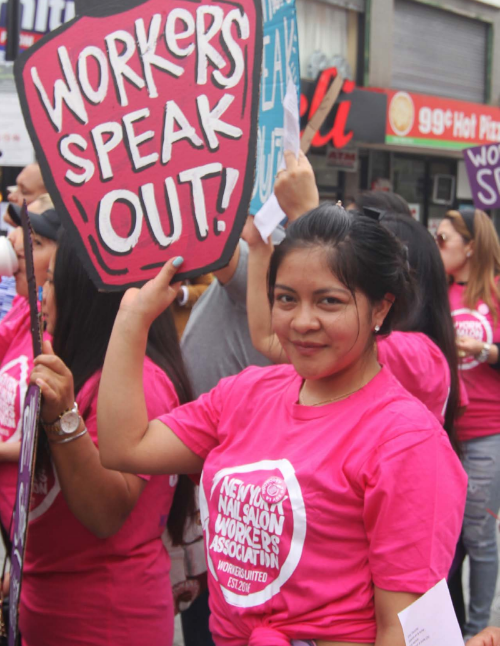
The relationship between nail salon workers and salon owners was not an equal labor relationship, but rather one built on economic dependence and power imbalance. The workers’ income, working hours, and continued employment opportunities are determined by the salon owner. When employees are unable—for various reasons—to secure alternative sources of income, this dependency makes it difficult for them to refuse unfavorable work arrangements, while simultaneously undermining their capacity to resist unfair treatment. Meanwhile, the salon owner can flexibly control labor costs by adjusting working hours, scheduling shifts, or changing employment arrangements.
Physical Distress
Manicurists work with nail paints that contain numerous amounts of toxic chemicals. Because of the long exposure times that these manicurists work, the improper ventilation of these salons, and the lack of safety equipment or ability to purchase it, these workers often bear negative side effects from their exposure (Nir, 2015). The instances of miscarriages, ectopic pregnancies, termination of fetuses in the womb, and developmental abnormalities in children are significant in the New York city manicurist population compared to the rest of the population in the city (Van Buren et al.). It is because of the traumas of disrupted pregnancies that many of these immigrant manicurists decided to speak out with New York Times reporters.
Dibutyl phthalate (DBP), toluene, and formaldehyde are three chemicals found in nail polish products that have been identified as toxic to human health (de Paula 3-4). However, they continued to be used at the time of the NYT story’s publication. Under the Federal Food, Drug, and Cosmetic Act of 1938, cosmetic products did not need to be approved by the FDA to be on the market (U.S. Food and Drug Administration). The cosmetic industry established its own review panel, claiming it was unbiased, but it was funded with the industry’s own lobbying group. Therefore, the panel only reviewed a few chemicals, determining they were safe in the manner in which they were used (Nir, “Perfect Nails, Poisoned Workers”). Efforts to increase regulation of chemicals in nail products had been unsuccessful because of industry lobbying.
Wage Theft and Labor Exploitation
Workers in the nail salons examined by the Times were found to be paid far below minimum wage and made to endure other illegal practices related to their pay. When starting a job at a nail salon, workers had to pay for their own supplies. They also paid a “training fee” on the order of $100 to begin working. Workers were not paid for their first few months and when their “training period” finally ended, their starting wages were illegally low: “At the two Iris salons on Madison Avenue on the Upper East Side, longtime workers described starting out at wages of $30 and $40 a day” (Nir, “The Price of Nice Nails”). Workers would “routinely work up to 12 hours a day, six or even seven days a week,” but overtime pay was rare (Nir). Illegal pay practices extended beyond these: “Tips or wages are often skimmed or never delivered, or deducted as punishment for things like spilled bottles of polish” (Nir). The Times article described one manicurist who was fired from her job and $270 taken from her paycheck after “a splash of nail polish remover marred a customer’s patent Prada sandals.” Workers also rarely had paid sick leave, and breaks during the workday were discouraged (West 40).
In order to receive higher pay, a common practice was to require workers to learn higher-end skills, but the workers would first need to pay to learn those skills. In one nail salon “$100 for eyebrow waxing, $100 to learn how to apply gel and cure it with ultraviolet light” was what was required of workers before they could be considered for a raise (Nir, “The Price of Nice Nails”).
Because of these wage practices, the living conditions for many immigrant manicurists were extremely substandard — the Times article described a manicurist sharing a one-bedroom apartment with seven other people at one point (Nir, “The Price of Nice Nails”). Nail salon owners, however, lived a very different life than the nail technicians they employed. The Times article details the lifestyles of some owners: one owned several properties including a luxury apartment over Columbus Circle and had her own art collection.
Racism and Discriminatory Practices
An ethnic hierarchy is also present in the nail salon industry which leads to discrimination at work and often worse working conditions for workers of “less desirable” ethnic backgrounds, the Times article found. “Seventy percent to 80 percent of salons in the city are Korean-owned, according to the Korean American Nail Salon Association,” and the Korean-owned salons very often imposed a hierarchy upon the workers. Korean employees were better treated and better paid — they would “routinely earn twice as much as their peers” — then Chinese workers were treated as next most valued, and strong prejudices kept Hispanic and other non-Asian workers at the lowest rung of the hierarchy. Due to racial prejudices, owners assigned more desirable tasks to workers of favored ethnicities and treated them better: “Ana Luisa Camas, 32, an Ecuadorean immigrant, said that at a Korean-owned Connecticut salon where she worked, she and her Hispanic colleagues were made to sit in silence during their entire 12-hour shifts, while the Korean manicurists were free to chat” (Nir, “The Price of Nice Nails”). Hispanic workers were often made to do less desirable tasks, such as cleaning jobs and pedicures, while Korean workers were taught more advanced work (West 44).
Human Trafficking Pressures
Along with the exploitation that many of these workers face, they must reconcile with the pressure from groups who’ve helped them reach the United States. These immigrant manicurists often owe large sums of money charged by trafficking groups that helped them and their family across the border (Duguid, 2015). This incentivizes the salon owners to continue their abuses since they know that these workers must maintain their jobs to dig their families out of these debts. Many immigrant workers at nail salons still fear losing employment, as that would lead them to financial uncertainty and a greater inability to pay off debts to trafficking groups.
Fear of Losing Everything
On the economic level, nail salon workers generally have low incomes and cannot save enough to deal with the risk of unemployment. Because of this lack of financial security, they often avoid conflict with employers.
“I also think it’s fear, because we depend a lot on work. Honestly, you can’t have any savings with low wages. I mean, you can’t say, ‘I’m going to quit this job. Sometimes it takes me a month to pay the bills and I can’t save anything.”
The perspective of nail salon workers in research conducted by the ILR and other organizations
Economics/Industry

The nail salon industry in the city benefits greatly from the labor of all types of immigrants, fulfilling the high demand but low supply of manicurists in the city along with the rest of the United States (Nir, 2015).

Federal Immigration Policies In The United States
The ability for immigrants to obtain these visas and maintain them while working in the United States is often determined by their ability to keep earning money and maintaining employment due to fees. Also, if an immigrant had come to the United States through being sponsored by their employees such as many of the New York City nail manicurists were, they must maintain this employment for their sponsorship to remain valid (Carnegie Corporation of New York). This situation has been primarily caused by the strict immigration laws implemented by the United States Federal Government. These immigrants face problems if they do not save enough money to undergo the process of maintaining a visa. In order to enter the United States legally one must obtain a temporary visa which can be acquired in numerous ways. An immigrant could get an asylum claim approved for political or religious prosecution, be sponsored by an employer or a family member that is a citizen, and apply as an individual with a special talent deemed valued by Federal law (Carnegie Corporation of New York).

Labor Laws
Prior to 2015, the legal structure for nail salons was composed mostly of federal wage and hour laws (U.S. Department of Labor). The Fair Labor Standards Act (FLSA) mandating the minimum wage and overtime, coupled with New York Labor Law on wage theft, offered legal safeguards for workers. Courts, in cases spanning decades, maintained that immigration status didn’t make a difference and that laws preventing wage theft were “all encompassing regardless of legal status” (U.S. Department of Labor). Violations persisted, however. Workers lacked the resources or were too scared to report abuses due to fear of retaliation or discrimination in an industry in which some fear going home would mean no job. Many weren’t able to speak English well or even at all. So, despite laws to the contrary, protections never materialized. This implies that a legal loophole, specifically depending on the affected person filing a claim, leaves immigrant workers and other undocumented immigrants and illegal aliens with few options. Without the capacity to report violations, they’ve limited to no legal protection against being victims.
Government Response
State Government Enforcement
Two days after the New York Times investigation was published, Governor Andrew Cuomo announced emergency measures to be taken to enforce workers’ rights at nail salons, make investigations into working conditions at salons, and institute new rules to protect workers (Nir, “Cuomo Orders Emergency Measures”). Salons were required to post signs in several languages informing workers of their rights, manicurists were required to wear protective equipment like gloves and masks, and salons needed to be bonded — contracting with a bonding agency to ensure that workers would be paid if the salon was found to be underpaying them (New York State). An education campaign would encourage workers to report mistreatment, and agencies would not inquire into the immigration status of workers when they reported on their conditions.
Enforcement of these new legal changes took place in several nail salons across New York State starting in July 2015, the same month as the emergency legislation came into force. This immediately resulted in hundreds of salons being investigated and nearly $300 million recovered for back wages owed to workers who typically made low minimum wages and were overworked and underpaid. However, these results also illustrated the sheer extent to which workers were being taken advantage of in the industry because laws had previously been seldom enforced (Nir, “Underpaid”).
Governor Andrew Cuomo (D-NY) pushed policies to crack down on NYC nail salons that didn’t have proper licensing and enacted a state of emergency so regulators could help enforce this new effort.

City Government Support
Former NYC Mayor Bill De Blasio (D-NY) responded within his jurisdiction which was to use city departments such as the Department of Immigrant Affairs to attempt to educate immigrants on their rights and encourage them to speak out against their abusive employers.
Effects Of Government Involvement
However, despite these extensive efforts these actions fell short on making a significant improvement in the lives of immigrant manicurists in New York City. This is because Governor Cuomo’s crackdown on nail salons actually caused many immigrant manicurists to lose employment directly or indirectly. This is because, many immigrant manicurists couldn’t afford proper licensing as individual manicurists and due to higher volumes of regulators numerous nail salon owners took action to “clean house” in order to avoid business shutdown which included firing employees without citizenship(Epstein,2015).
Bill De Blasio’s efforts wouldn’t amount to anything as manicurists wouldn’t speak to government officials fearing deportation if undocumented or retribution from their employers. This “retribution” from employers could mean anything from being physically assaulted or being fired from their job. Government leaders and regulatory officials in both the state and city level didn’t recognize the importance of immigrant manicurists maintaining employment to have a reasonable chance to become an American citizen (De Blasio announces effort).
So Was It Effective?
Though these new measures were a necessary response, they were met with varying successes and counter responses. Nail salon owners found ways to evade inspections or prevent workers from reporting conditions. A study in 2016 on nail salons in Manhattan found that a majority of nail salon workers were not wearing gloves, despite the new regulations (Basch 249).
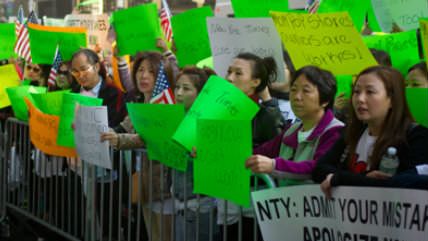
A group of Chinese- and Korean-American-owned nail salons tried to sue in response to the new law requiring wage bonds, claiming that the law discriminated against Asian immigrant business owners and forced them to shut down their businesses (Fuchs). However, the lawsuit was not successful (Supreme Court, Albany County).
Where Will the Next Shift Come From?
After regulatory measures were introduced, many salon owners did not choose to directly break the law. Instead, they reduced costs by adjusting working hours or classifying workers as independent contractors.
In a study by West et al., it is noted: “Among the focus group participants who were receiving the legally required minimum wage, many lamented that the implementation of the higher minimum wage had led employers to reduce their hours and/ or specifically to reduce or remove their overtime hours, leaving them with effectively no increase in their incomes despite the significant change in the law” (West, 33). This shows that many owners chose to pay the legal minimum wage but did not want to increase total labor costs, so they reduced workers’ hours. Employers also did not allow overtime because they did not want to pay extra overtime wages.
The introduction of the minimum wage law did have some positive effects, such as reducing workers’ dependence on tips. However, when employers are unwilling or unable to pay higher total wages, the amount they are willing to spend on labor remains fixed. As a result, when hourly wages increase, working hours are reduced accordingly, meaning that higher hourly pay does not necessarily lead to higher total income.
Another way to reduce labor costs is to classify workers as independent contractors. As stated in the same study: “In the Spanish focus group, participants said that workers who did not have a Social Security number were paid as independent contractors, and they were paid a lower wage than employees” (West, 43). Workers without a Social Security number are forced to work as independent contractors, receiving lower wages and without access to most employee benefits or insurance. This practice essentially reduces employers’ legal and financial responsibilities by redefining the labor relationship, thereby lowering labor costs further.
How are things now?
Even after new regulations were instituted by the state government, the situation of nail salon workers across New York City still needs work. Investigations continue to uncover instances of wage theft, including several in 2016 with the companies Ada Nails & Spa and Hai Hua Beauty Salon Inc. and with Envy Nails in 2023 (U.S. Department of Labor; Office of the New York State Attorney General). Workers are still facing the very same conditions in nail salons detrimental to their health and well-being, reminiscent of 2015 prior (Nieto).

Worker organization can play a role in change: Blanca Vidal, an immigrant from Mexico working at Vogue Nail & Spa in Staten Island, organized with her colleagues to file a complaint with the Department of Labor about their working conditions (Carrazana). However, many workers have a very limited ability to speak up for themselves, facing language barriers and economic barriers. This is why education of workers in their own languages, activism, and investigative journalism are essential in calling the public’s attention to an issue.
As seen, the nail salon industry has exploited immigrant workers and has taken advantage of their undocumented status, making it difficult for them to escape illegal working conditions and practices. Racial hierarchies present in the industry further entrap and complicate the situations of the workers. However, when these illegal practices were uncovered in 2015, immediate action was taken by the government. Although issues in the nail salon industry did persist after the New York Times piece was published, it did the key task of calling attention to a problem that was going unnoticed, demonstrating the power and the necessity of investigation and journalism to put pressure on the government and on the public.
Barker, Kim, and Russ Buettner. “Nail Salon Sweeps in New York Reveal Abuses and Regulatory Challenges (Published 2016).” Nytimes.Com, The New York Times, 19 Feb. 2016, www.nytimes.com/2016/03/01/nyregion/nail-salon-sweeps-in-new-york-reveal-abuses-and-regulatory-challenges.html.
Basch, Corey, et al. “Use of Protective Gloves in Nail Salons in Manhattan, New York City.” Journal of Preventive Medicine and Public Health, vol. 49, no. 4, 30 July 2016, pp. 249–251, https://doi.org/10.3961/jpmph.16.017. Accessed 19 Aug. 2020.
Brown, Elizabeth Nolan. “Asian Nail Salon Staff Demand Apology from the New York Times for Poverty-Porn Series That’s Costing Them Jobs.” Reason.Com, 8 Oct. 2015, reason.com/2015/10/08/nail-salon-workers-protest-new-york-time/.
California Environmental Protection Agency. Chemicals in Nail Products Background Document, 2022, https://dtsc.ca.gov/wp-content/uploads/sites/31/2022/07/Nail-Products-Background-Document_Final-accessible.pdf.
Carnegie Corporation of New York. “How People Immigrate Legally to the U.S.: Immigration.” Carnegie Corporation of New York, www.carnegie.org/our-work/article/how-people-immigrate-legally-to-the-us/.Accessed 27 Apr. 2026.
Carrazana, Chabeli. “New York’s Nail Salon Workers Have Spent Years Feeling Silenced. They’re Ready to Fight Back.” The 19th, 16 May 2022, 19thnews.org/2022/05/new-york-nail-salon-workers-overhaul-industry/. Accessed 5 May 2026.
CBS News. “N.Y. Governor Orders Emergency Measures for Thousands of Nail Salon Workers.” YouTube, 11 May 2015, www.youtube.com/watch?v=MzQBAZENHfc. Accessed 5 May 2026.
Cooper, David, and Teresa Kroeger. “Employers Steal Billions from Workers’ Paychecks Each Year: Survey Data Show Millions of Workers Are Paid Less than the Minimum Wage, at Significant Cost to Taxpayers and State Economies.” Economic Policy Institute, Economic Policy Institute , 10 May 2017, www.epi.org/publication/employers-steal-billions-from-workers-paychecks-each-year/.
Cooper, David. “The Policy Failures Exposed by the New York Times’ Nail Salon Investigation | Economic Policy Institute.” The Policy Failures Exposed by the New York Times’ Nail Salon Investigation, 13 May 2015, www.epi.org/blog/the-policy-failures-exposed-by-the-new-york-times-nail-salon-investigation/.
“De Blasio Announces Effort to Address Labor Abuses and Health Risks at City’s Nail Salons.” The Official Website of the City of New York, 15 May 2015, www.nyc.gov/site/dca/news/019-15/de-blasio-administration-multifaceted-effort-address-labor-abuses-health-risks-at.
de Paula, Aislana Cole, et al. “Nail Polishes: A Review on Composition, Presence of Toxic Components, and Inadequate Labeling.” Dermatology Research and Practice, vol. 2025, no. 1, 1 Jan. 2025, https://doi.org/10.1155/drp/6330337.
Duguid, Claire. “Nail Salon Workers: Labor Exploitation Reveals Gaps for Traffickers.” Human Rights First, 15 May 2015, humanrightsfirst.org/library/nail-salon-workers-labor-exploitation-reveals-gaps-for-traffickers/.
Enforcement Task Force Letter. New York State. https://www.ny.gov/sites/default/files/atoms/files/FINAL%20Salon%20Practitioner%20Letter%20PDF.pdf.
Epstein, Jim. “The New York Times vs. Nail Salons.” Reason.Com, 19 Nov. 2015, reason.com/video/2015/11/19/new-york-times-nail-salons-immigrants/.
Fuchs, Chris. “New York Nail Salon Owners Plan Lawsuit over “Wage Bond” Requirement.” NBC News, 14 Sept. 2015, www.nbcnews.com/news/asian-america/new-york-nail-salon-owners-plan-lawsuit-over-wage-bond-n426911. Accessed 5 May 2026.
Harris, Kathleen Mullan, and Ping Chen. “The acculturation gap of parent-child relationships in immigrant families: A national study.” Family relations vol. 72,4 (2023): 1748-1772. doi:10.1111/fare.12760
“Health Hazards in Nail Salons – Chemical Hazards.” Occupational Safety and Health Administration, www.osha.gov/nail-salons/chemical-hazards.Accessed 26 Apr. 2026.
Howell, Elizabeth A. “Reducing Disparities in Severe Maternal Morbidity and Mortality.” Clinical obstetrics and gynecology vol. 61,2 (2018): 387-399. doi:10.1097/GRF.0000000000000349
Huynh, Julie, et al. “Occupational Health and Safety in Nail Salons.” Journal of Community Health, 2018.
Kopstein, Julia, et al. “Absent Union Representation, NYC Nail Salon Workers Are Organizing Themselves.” Truthout, Truthout, 13 Feb. 2024, truthout.org/articles/absent-union-representation-nyc-nail-salon-workers-are-organizing-themselves/.
Maslin, Sarah. “The Price of Nice Nails (Published 2015).” The New York Times, 15 May 2015, www.nytimes.com/2015/05/10/nyregion/at-nail-salons-in-nyc-manicurists-are-underpaid-and-unprotected.html. Accessed 05 May 2026.
“Matter of Korean American Nail Salon Association of N.Y. Inc. v. Cuomo.” New York Supreme Court, 2015.
New York State Department of Labor. “Employer Misclassification of Workers.” 2026, dol.ny.gov/employer-misclassification-workers. Accessed 5 May 2026.
New York State. “Information for Nail Salon Owners.” www.ny.gov/nail-salon-safety-what-you-need-know/information-nail-salon-owners. Accessed 5 May 2026.
Nieto, B. “Nail Salon Employees Still Fighting Toxic Work Conditions, despite State Regulations – City Limits.” City Limits, 9 Oct. 2019, citylimits.org/nail-salon-employees-still-fighting-toxic-work-conditions-despite-state-regulations. Accessed 5 May 2026.
Nir, Sarah Maslin, and Paige Pagan. “Benefits, and Some Resistance, as New York Cracks down on Nail Salon Abuses (Published 2015).” Benefits, and Some Resistance, as New York Cracks Down on Nail Salon Abuses, The New York Times, 16 July 2015, www.nytimes.com/2015/07/17/nyregion/benefits-and-some-resistance-as-new-york-cracks-down-on-nail-salon-abuses.html.
Nir, Sarah Maslin. “At Nail Salons, Manicurists Are Underpaid and Unprotected.” The New York Times, 10 May 2015.
Nir, Sarah Maslin. “Cuomo Orders Emergency Measures to Protect Workers at Nail Salons.” The New York Times, 11 May 2015.
Nir, Sarah Maslin. “Nail Salon Workers in NYC Face Hazardous Chemicals.” The New York Times, 11 May 2015.
Nir, Sarah Maslin. “New York Nail Salon Workers Unite Against Job Abuses.” The New York Times, 11 Apr. 2012.
Nir, Sarah Maslin. “Perfect Nails, Poisoned Workers.” The New York Times, 8 May 2015, www.nytimes.com/2015/05/11/nyregion/nail-salon-workers-in-nyc-face-hazardous-chemicals.html.
Nir, Sarah Maslin. “The Price of Nice Nails.” The New York Times, 7 May 2015, www.nytimes.com/2015/05/10/nyregion/at-nail-salons-in-nyc-manicurists-are-underpaid-and-unprotected.html.
Nowrasteh, Alex. “Why Cuomo’s Nail-Salon Crackdown Will Hurt Immigrants.” Cato.Org, 13 May 2015, www.cato.org/commentary/why-cuomos-nail-salon-crackdown-will-hurt-immigrants.
“Notice of Adoption of Emergency Regulations and Notice of Proposed Regulations.” Department of State, dos.ny.gov/notice-adoption-emergency-regulations-and-notice-proposed-regulations. Accessed 05 May 2026.
Office of the New York State Attorney General. “Attorney General James Recovers $300,000 in Unpaid Wages for New York City Nail Salon Workers.” 16 Aug. 2023, ag.ny.gov/press-release/2023/attorney-general-james-recovers-300000-unpaid-wages-new-york-city-nail-salon. Accessed 6 May 2026.
Ramos, Jessica. Long-Awaited Ventilation Regulations in Nail Salons to Be Implemented October 4, 2022 | Nysenate.Gov, 4 Oct. 2022, www.nysenate.gov/newsroom/press-releases/2022/jessica-ramos/long-awaited-ventilation-regulations-nail-salons-be.
Seo, Jin Young, et al. “Factors Influencing Health Service Utilization among Asian Immigrant Nail Salon Workers in the Greater New York City Area.” Journal of Community Health, vol. 44, no. 1, 23 June 2018, pp. 1–11, https://doi.org/10.1007/s10900-018-0544-7.
Sharma, Preeti, et al. “Nail Files: Low-Wage Work in the National Nail Salon Sector.” Institute for Research on Labor and Employment, UCLA College of Social Sciences , 7 Nov. 2018, irle.ucla.edu/2019/12/19/qa-diana-marquez-2-2-2-2/.
Supreme Court, Albany County. “Matter of Korean Am. Nail Salon Assn. Of N.Y. Inc. V Cuomo.” Justia Law, 2026, law.justia.com/cases/new-york/other-courts/2015/2015-ny-slip-op-25412.html. Accessed 5 May 2026.
“The Overlooked Exploitation of Nail Salon Workers.” The 19th, 2022.
U.S. Department of Labor. “Workers in New York City Nail Salons Face Wage, Other Labor Violations.” 2021, www.dol.gov/newsroom/releases/whd/whd20160407-0.
U.S. Department of Labor. “US Labor Department Investigation Finds Wage Violations in Nail Salons.” 7 Apr. 2016.
U.S. Food and Drug Administration. “FDA Authority over Cosmetics: How Cosmetics Are Not FDA-Approved.” U.S. Food and Drug Administration, 2 Mar. 2022, www.fda.gov/cosmetics/cosmetics-laws-regulations/fda-authority-over-cosmetics-how-cosmetics-are-not-fda-approved-are-fda-regulated.
Van Buren, Kristen, et al. “Researching Risk of Birth Defects among Pregnant Nail Salon Workers and Hairdressers.” Centers for Disease Control and Prevention, Centers for Disease Control and Prevention, www.cdc.gov/niosh/bulletin/2021/birth-defects-nail-hair.html.Accessed 26 Apr. 2026.
West, Z., Weaver, R., and Wagner, K.C. Unvarnished: Precarity and Poor Working Conditions for Nail Salon Workers in New York State. Ithaca, NY: Cornell University, ILR School, The Worker Institute.


Leave a Reply