Category: Uncategorized

  • Identity Mask

    With this project I was able to reflect on who I am as a person. I am honestly a pretty simple person, so I created my mask without too much clutter. On the forehead I put my favorite Bible verse which says, “For we walk by Faith not by sight.” I really enjoy this verse because it means to live by trusting yourself and by believing that there is a reason for the path you are taking. Next to the verse I added a cross and a cowboy boot to emphasize the meaning of this verse. I added the cross because, for me, faith is a huge part of my life. The reason why I added the cowboy boot is because I love country music and western styles, so when I walk, I am “walking” in a cowboy boot. This is why I added the music notes and the title of one of my favorite songs, ‘Til You Can’t, which is about living your life to the fullest while you can. Then, I added a football and dance shoes to portray my passions. Lastly, I added the Italian flag over my mouth to not only show Italian heritage, but to poke fun at the Italian accent many of my peers have pointed out.

  • Identity Mask

    Description from STEAM:

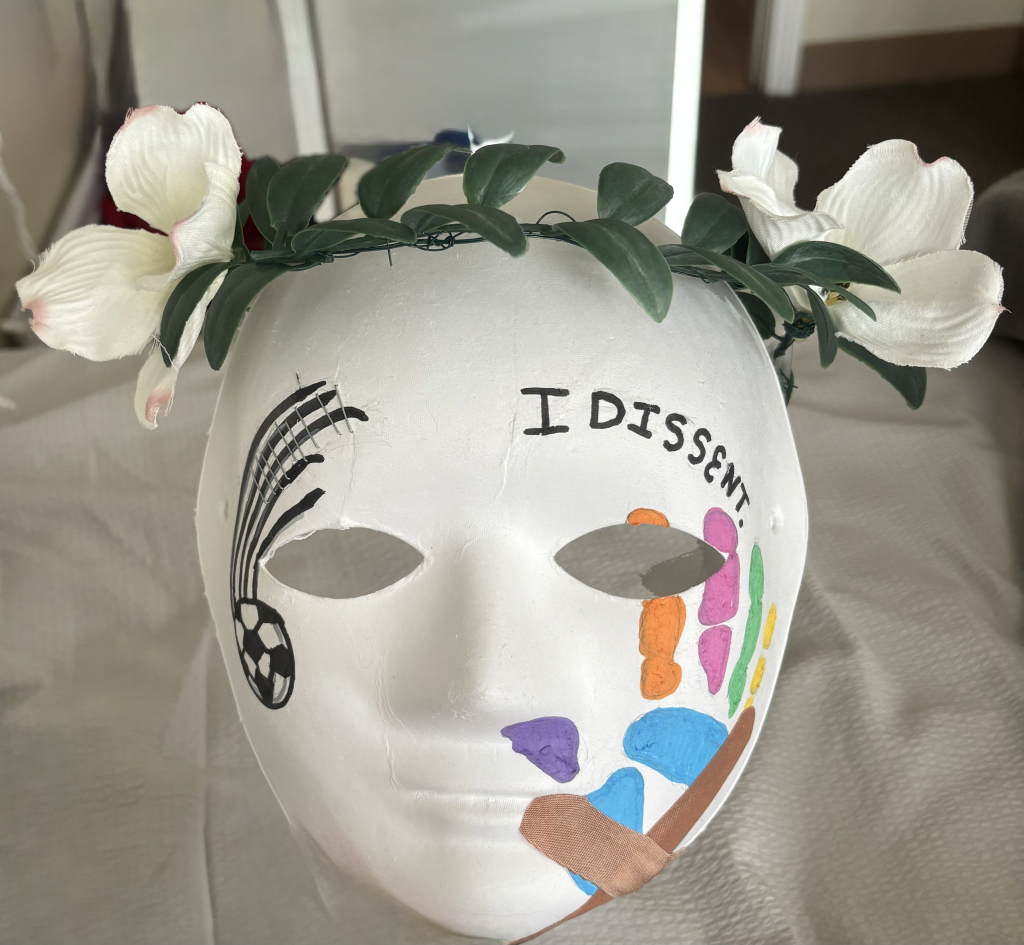
    Through this project I reflected who I am and the values I have on my mask. I created an “olive branch” halo around the top of my mask to represent my drive to promote peace and justice, while combing my interest in the law in general. I also included white dogwood flowers in the halo to represent the state tree of Missouri, as that is where i’m from. I included the quote “I Dissent” to represent my admiration for Ruth Bader Ginsburg and the beliefs she emitted. I also included a colorful handprint with bandaids across it to represent my desire to work in pediatrics, specifically as a Child Life Specialist. I added a soccer ball streaking down the right eyebrow, to symbolize my love for soccer and my injury as I added 9 staples for the 9 stitches I got there.

  • The Movie vs The Opera

    The movie starts with a not bad song. Then it starts romanticising people not paying rent. Very similar to the opera or the book, but for some reason in modern context it feels worse. There’s nothing cool in not being a contributing member of a society and saying “we won’t pay rent for last year, this year, and next year”. If you don’t want to pay for yourself you expect for someone else to cover you. Overall the movie is corny, not really a fan. Opera was also corny in some way, but it felt natural. The inclusion of vulgarity and profanity was forced and unnatural not giving any value to the movie, just highlighted its bad quality. The opera didn’t have any of it. Mimi in the movie, doesn’t really resemble Mimi from the opera (at all). I wouldn’t call the one from the movie modest. The movie also covered much more in slightly less time; it was more focused on protests and public involvment. Opera’s plot was very primitive, but the way it was set was great and captivating. Opera’s actors were also much better at singing than the ones in the movie, but I guess that’s the biggest point in opera. Overall, I think opera was an interesting new experience and much more enjoyable than the movie.

  • La Boheme vs. Rent; The Bohemian Showdown

    What an Italian experience at La Bohème! Sure was regretting years of Spanish whilst sitting in Lincoln Center squinting at the stage and the subtitles. The opera, set in 19th-century Paris, beautifully captures the struggles and passions of young, starving, broke artists. The absolutely magnificent live donkey and horse on stage were delightful surprises, adding a unique charm to the performance that I will never forget.

    Rent, a musical inspired by the same stories La Bohème is based on, attempts to modernize this classic story, placing it in the gritty landscape of contemporary New York City. While it portrays the trials of artists grappling with love and loss, I didn’t feel a complete connection between the musical and the opera. If I hadn’t known the source material, I wouldn’t have assumed they came from the same origins. Especially given the emphasis on tuberculosis in the opera vs the focus on HIV. Plus the fact that Mimi Márquez nearly dies, but survives, compared to the opera in which Mimi actually does die.

    Moreover, I wish Francine had a more prominent role in the opera rather than being merged with Mimi. Her character adds depth to the narrative, and it’s a shame to see it overshadowed. In the end, both works remind me of the short stories written long before these works, but they do have some key changes that give the artist their freedom to announce their “complete involvement in creating” a new loosely inspired work of art.

  • Rich Stremme

    What an interesting man… His passion for tattooing is remarkable. During the entire Zoom call, you could just feel the sense that he truly enjoyed what he does.

    His retellings of past tattoo requests that his boss denied were most definitely intriguing yet highly illegal today. Knowing allegations surrounding the “group for motorcycle enthusiasts,” I wasn’t surprised to hear about the ultimatum given to the man who got it tattooed without ever being a part of the gang. The more surprising part to me was actually the fact that some random dude one day said, “You know what would make me look badass, this winged-satanic-skull tattoo!” The permanence of tattoos should guide people to think and research their ideas before getting them tattooed. Clearly, some people just either don’t care or are just plain stupid.

    After hearing that he does not collect a lot of money when compared to others in his field, I was also not surprised to hear that he lives with his grandmother. I can appreciate the idea behind not accepting payment for art, but also, money is what makes the world go round. I think he would be better off sticking purely to his music and hiring someone to make his online presence more prominent.

  • Rich

    We had a talk over Zoom with Rich about tattoos. I honestly didn’t find it very interesting. I appreciated that he was passionate about what he does, but I have zero interest in tattoos. Other than that, I remember him saying about the situations when they would not agree to do a tattoo: 6 identical tattoos for 6 girls, swastika for a “white power” person, and a gang tattoo for a person who’s not in that gang. The last story was actually interesting. He said the person did the gang tattoo anyway in another salon. Then that gang caught him with the tattoo, and according to Rich gave him two options : either cutting off the arm with tattoo or having a cover-up tattoo, which was just a rectangle. It seems a bit weird in today’s somewhat lawful world, but I guess a person who wants to have a gang tattoo, without even being involved in that gang, is stupid and puts themselves in those kinds of situations.

  • Tattoo

    When you think of tattoos, you normally don’t think of its history or of it as an art form. You normally think of it as permanent images on your skin or as self expression, but on a zoom call last Friday with Rich Stremme I was introduced to tattooing as more than images on skin; he spoke about its history as an art form and as self expression.

    I enjoyed how excited he seemed to be to teach us about tattooing. From sailors to prostitutes, to anyone 18 and above, he told the history of who used to get tattoos and what they used to represent.

    I was shocked when he said Tattooing in Nyc was illegal from 1961-1997 because of how common it is to see a tattoo. 

    I liked how he spoke of his connection to tattooing. He enjoyed the older tools of the craft and appreciated the meaning of his craft, while also advising us on tattoos that we SHOULD NOT get.

    I think what he said and his life were great examples of doing what you love no matter when you start.

  • La Boheme/Rent

    Before last weekend I had never seen an opera, nor had I ever had any intention of seeing one. La Boheme is the first opera I have ever seen, and likely the only I will see because I have no interest in Opera. The opera itself wasn’t horrible. I was neither bored nor captivated; caught in between indifference and mild curiosity throughout the entire performance. The captions provided in front of us were the only thing that made the performance tolerable because I could at least have some clue as to what was going on beyond the general context of the performers’ movements and the performance pamphlet handed to us when we took our seats. 

    The cast was obviously very talented, learning how to pronounce and sing Italian. They also obviously put on a good performance and were very convincing of their actions when not singing, even the extras, especially when they were outside while Musetta was introduced (I watched the extras while they froze to see if anyone moved, only 1 guy did and it was seconds after they first froze).

    Even with subtitles and the play pamphlet, I was not able to 100% follow the plot due to the subtitles sometimes not displaying what was being said. I still was able to understand the general story of love, and I accidentally read the description of act 4 and spoiled Mimi’s death.

    In keeping with the tradition of the struggling Bohemian, I did NOT pay for the copy of Rent that I watched, and after watching, I can say that the movie is a decent modern take on a timeless struggle. The movie roughly follows the same plot of La Boheme; a group of aspiring artists who are dirt poor do whatever they can to make it another day.

    Rent, being only 30 years old, touches on many things that were relevant then and still are today. The Aids pandemic, homosexuality, drug abuse, gender identity, love, and poverty. 

    The movie did take some creative liberties, such as putting Collins(Colline) and Angel(Schaunard) into a romantic relationship, and having Angel be the one who dies instead of Mimi.

    Rent is a far more accurate and modern representation of struggling to survive, beyond being an artist. It showed how having people made life more enjoyable and was easier to connect to because it’s only about 30 years old, instead of nearly 200, like La Boheme.

    I think I would’ve enjoyed Rent more than La Boheme, no matter the quality of Rent, because Rent is much more relatable and is in English. Rent was actually enjoyable, though, with good music, and characters whose struggles, personally and communally, still persist even into today.

  • Le Boheme and Rent

    After watching both Le Boheme and Rent my overall opinion is that were both really good, but I like Rent more. Seeing Le Boheme was a great experience and the sets were amazing. However, it was very hard follow and to understand, not only because it was in Italian but because since we were so high up I couldn’t see there lips moving so most of the time I didn’t even know which character was speaking. The movie Rent was very enjoyable to watch. I was able to understand and see the relationships between the characters better. I think this is partly because the setting takes place in NYC in the 80s. I also really like the songs in movie becuase they really help me follow the story.

    Both the movie and opera had similaries to each other. Starting from the beginning when Mimi went to the man’s room with a candle. She went in needing her candle to be lit but then blew it out and “lost” something so that she can build a relationship with him. The background of the characters are also similar because they are both very poor and were behind on their rent. There were also a lot of differences. Since they were in a different time period, Mimi’s sickness were different. In the movie, Mimi was an addict and was dying from AIDS, while in the opera Mimi was dying from TB. Another difference was that in the movie Mimi was very close to death but then didn’t die, while she actually died in the opera.

    While both were very good to watch, I would watch the movie Rent again and not the opera. The movie was easier to follow and I was able to following the meaning of the story, while watching the opera I was lost majority of the time.