
This is a gallery curated by you, the students taking part in our Night at the Museum. Make it your own!
To have your own response appear on this page, form a group and submit a response.
-
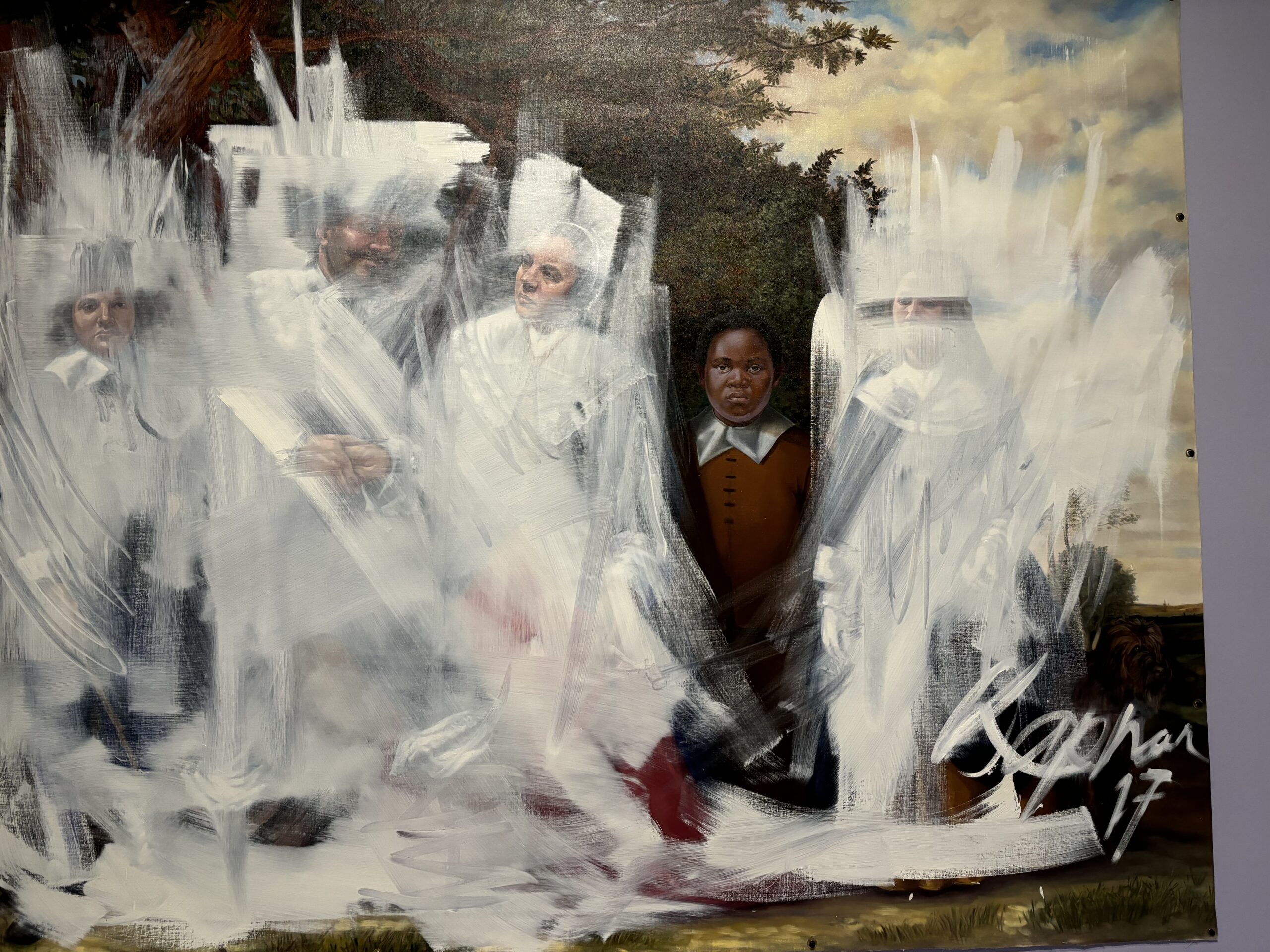
Shifting the Gaze
Titus Kaphar
2017
What do you see going on in this work of art? Is there a story depicted?
There’s 5 figures depicted (plus a dog), 4 of the figures are white and there’s a black child near the middle of the painting
What different visual elements (ie: line, color, light, proportions, scale, composition, media type etc.) do you notice, and how do they help you make sense of the artwork?
The white figures in the painting are occluded by white paint leaving just the black child in clear site. This helps draw the viewers eye to the child.
How does this object compare to other objects, stories, or ideas you already know about?
This reframes the story about how black figures in history were erased and covered up in paintings. Also the overlooked role of black domestic servants or salves in American history is called out my the painting. The effects is white colonialism is and the eraser of black history is flipped, the black figure being the only visible person in the painting is very ironic.
What choices do you think the museum made about the object’s display?
The painting is not set in a frame and is just the canvas which is less distraction from the painted subjects.
Group Members
Michele Wu, Max Tsigalnitsky, Chrystal Mallouras, Stephen Bogdan, Sreejita Roy, Maliha Chowdhury, Aaron James
-
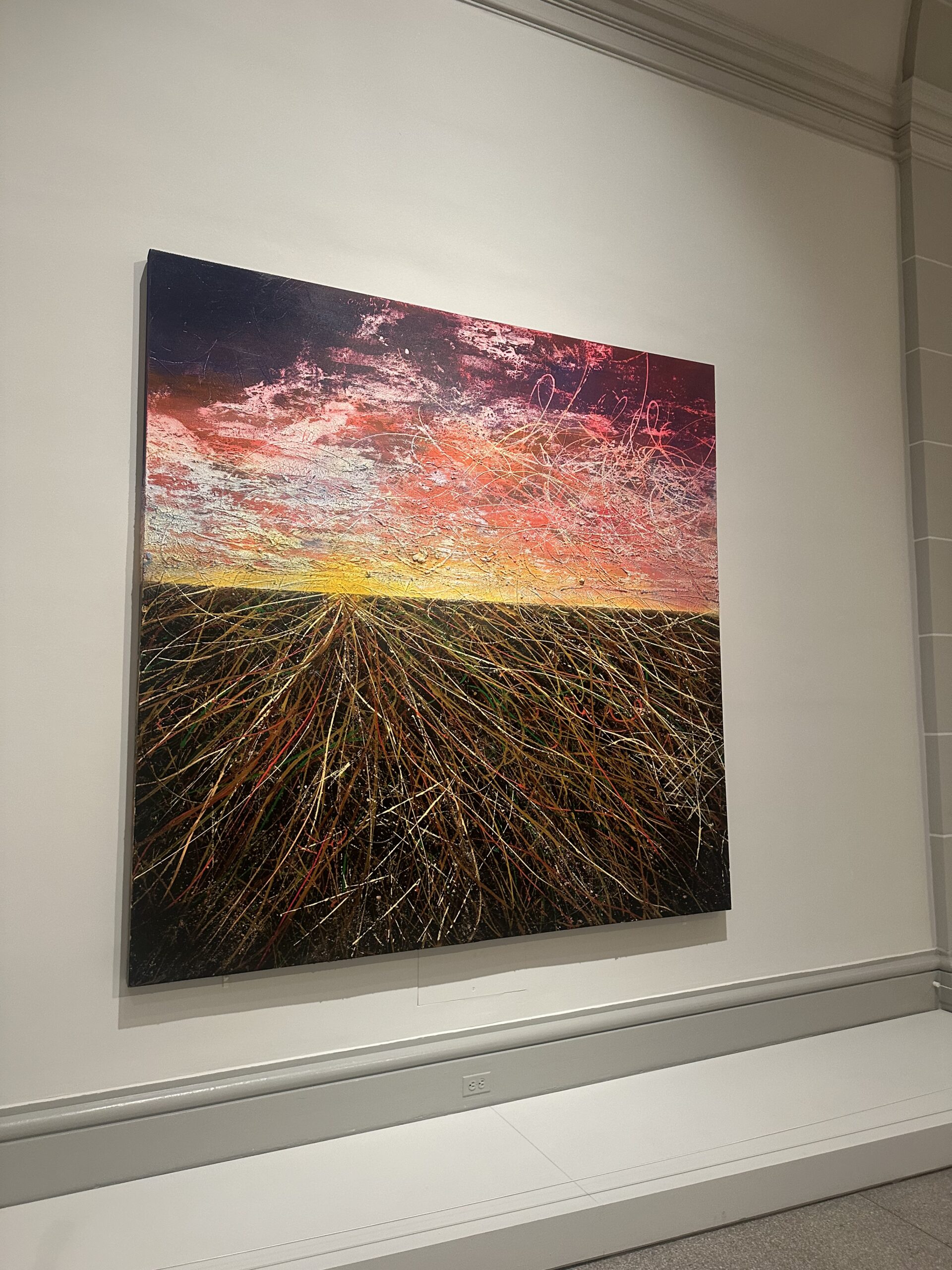
Sidney Sunset, from the Series CICLOS: Blooms of Mold
José Parla
2022
What do you see going on in this work of art? Is there a story depicted?
We see a sunset with a very obvious split of light and dark, sort of like a field. The warm colors from the “Sun” seem to be merging and dripping down into the fields. Giving the sense and made us think about how all of nature is reliant on the Sun and its energy/warmth.
What different visual elements (ie: line, color, light, proportions, scale, composition, media type etc.) do you notice, and how do they help you make sense of the artwork?
There are tons of visible splatter lines, as well as a very obvious tone shift from warm and bright colors on the top of the piece to dark brown on the bottom. They helped us make sense by quite honestly painting the picture (although very abstract) clearly, sort of as if it were jumping out to us!
How does this object compare to other objects, stories, or ideas you already know about?
We both decided that we have a love for taking pictures of sunrises and sunsets as they always make us feel grounded in the moment and appreciate the beauty of the world shifting around us every day. Seeing it on such a grand scale painting in a museum just made our niche love for these natural beauty moments all the more special.
What choices do you think the museum made about the object’s display?
All work of this artist is a mix of sunrises and sunsets therefore it makes sense for them to be next to each other. Although to us it was very obvious was the art was trying to communicate it makes sense to put it in the “abstract” exhibit/portion of the museum. We think they made an excellent choice ?
Group Members
Bianca Kaminski, Joshua Sterling- Tosado
-

Half Indian/Half Mexican
James Luna
1991
What do you see going on in this work of art? Is there a story depicted?
Picture of one man with the two halves of his face maintained differently, representing his mixed identity.
What different visual elements (ie: line, color, light, proportions, scale, composition, media type etc.) do you notice, and how do they help you make sense of the artwork?
It’s a black and white image, representing the two components of his identity and how they merge together to form one.
How does this object compare to other objects, stories, or ideas you already know about?
We have seen pieces of art representing mixed people, but this piece of art shows a stark contrast between the different parts of an identity.
What choices do you think the museum made about the object’s display?
By placing this piece in an exhibition in the middle of the exhibition, it commands attention to it.
Group Members
Rajit Ahmed, Shameel Khandokar, Winson Pan, Pema Green
-
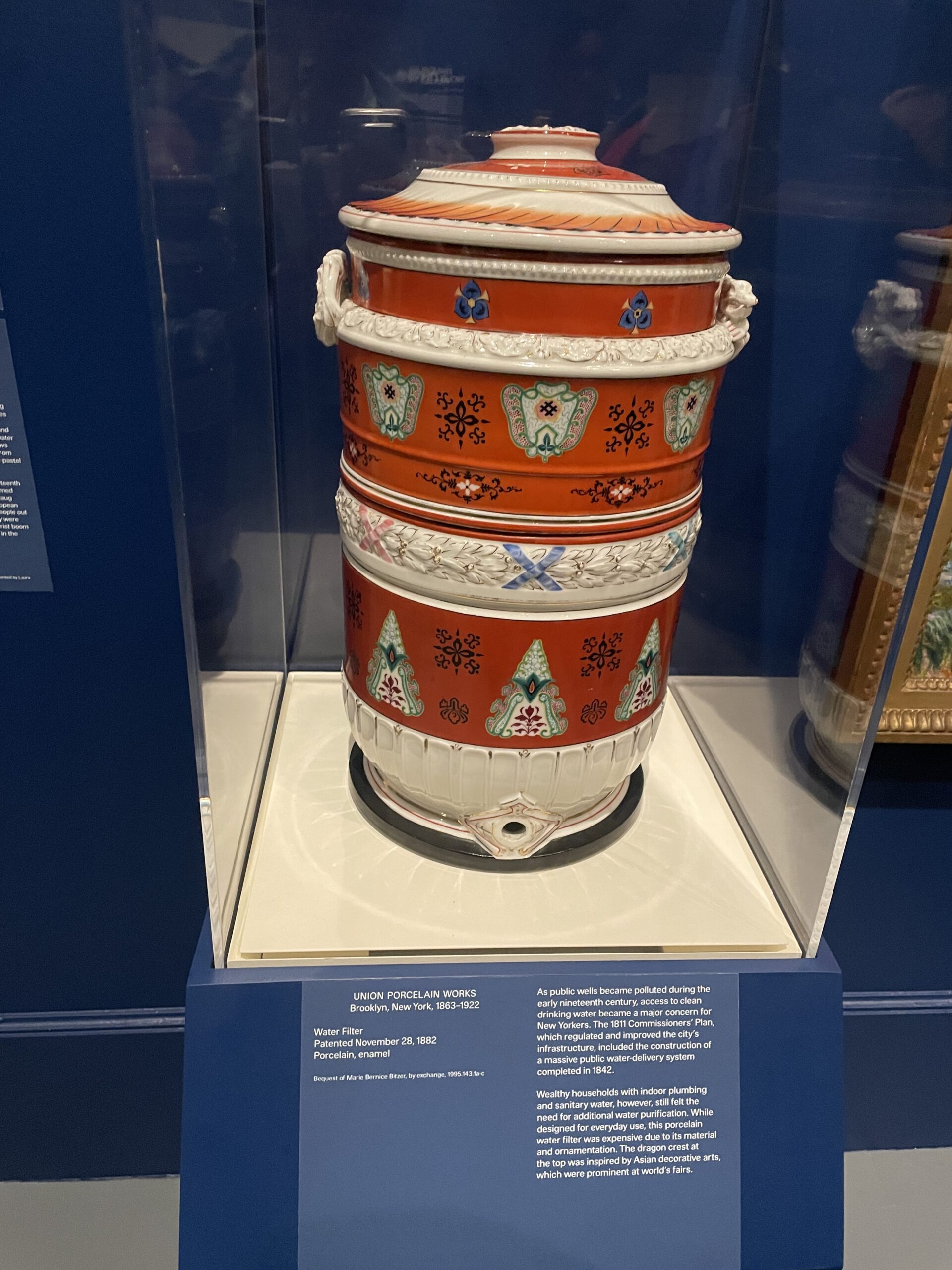
Union Porcelain Work
Marie Bernice Bitzer
1882
What do you see going on in this work of art? Is there a story depicted?
I picked this art piece since I feel like it represent my culture very well. It kinda reminds me of family and tradition values. Moreover the process of creating it was very diligent and there were a lot of minute details. The colors kinda remind me of a less flamboyant peacock.
What different visual elements (ie: line, color, light, proportions, scale, composition, media type etc.) do you notice, and how do they help you make sense of the artwork?
There are a myriad of different techniques used, like I saw a painting that was abstractly painting a portrait of the painter, but used geometric shapes that still somehow made sense in my head as a person. There are also gallery rooms with different wallpapers that also contribute to the vibe of the paintings and rooms, there’s a gothic like one, there’s a bright blue and warm color room, there’s a purple lavender room, etc which all give a backdrop to the experience that we take in when viewing the paintings and art work.
How does this object compare to other objects, stories, or ideas you already know about?
I think one of the objects this compares to is actually my carpet, which has patterns which are really familiar to this. It also looks a lot like other porcelain dishes like china from estate sales that I have attended. It also reminds me the idea of fractals where mathematical image that continues indefinitely, and it forms a similar pattern that looks very aesthetic like this.
What choices do you think the museum made about the object’s display?
Displaying a wide range of cultural work seemed to be a key goal of the museum which they accomplished greatly.
Group Members
Arthur Faynin, Jimmy Huang, Garson Guan, Kyle Hua, Shams Rary, Nathaniel Oumarjeet
-
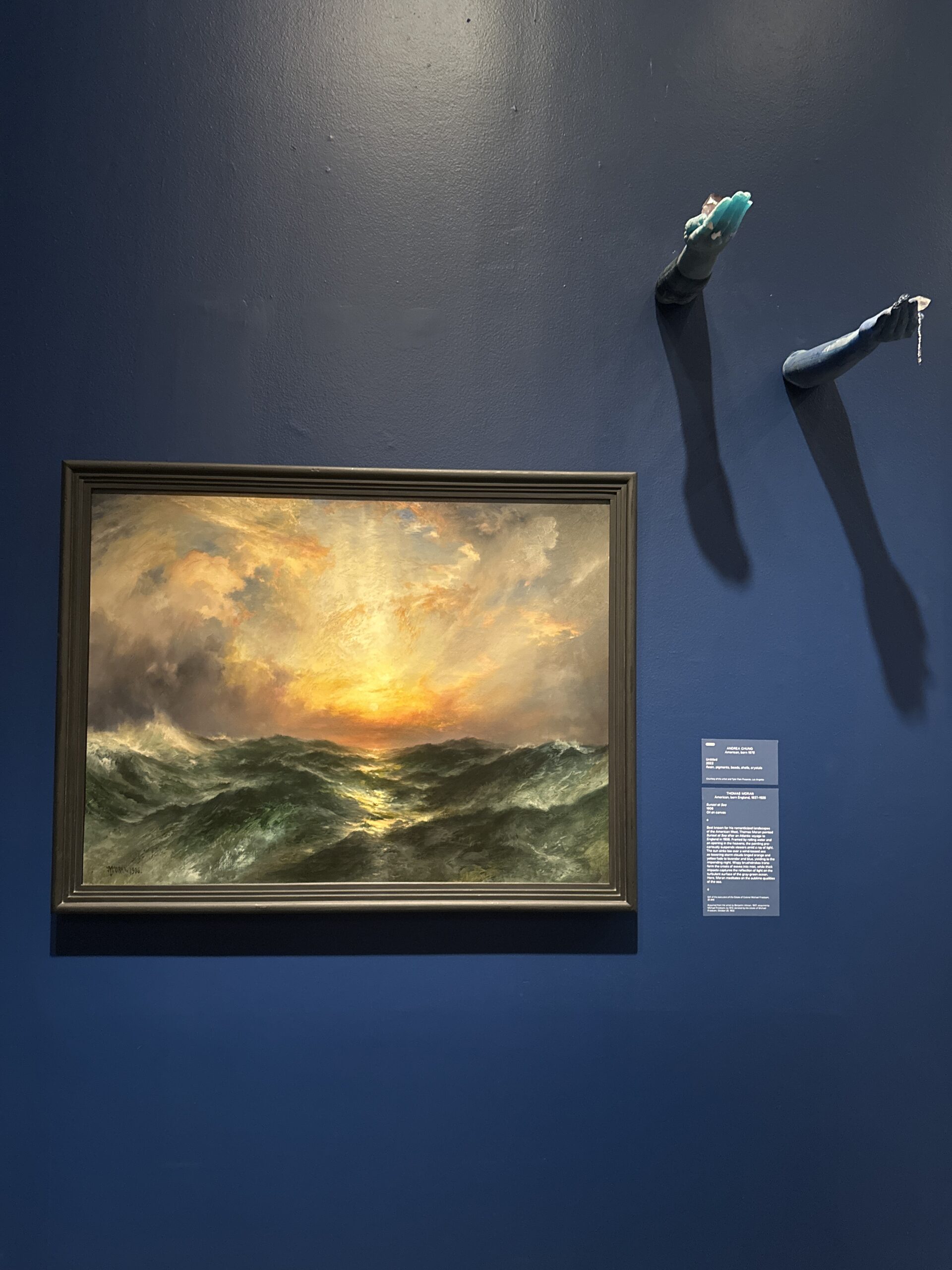
Sunset at Sea
Thomas Moran
1906
What different visual elements (ie: line, color, light, proportions, scale, composition, media type etc.) do you notice, and how do they help you make sense of the artwork?
There are many different visual elements that are seen, especially the central light of the sun in the middle which contrasts heavily from the cool colors of the water at the bottom. There are many different types of brush strokes, we see each stroke and carving and there is a heavy focus on each stroke which evokes many feelings. There is a lot of gravity, movement, and realism to the artwork, almost helping us hear exactly what is going on in the artwork.
How does this object compare to other objects, stories, or ideas you already know about?
This painting by Thomas Moran evokes the same enchantment as Transcendentalist paintings, their focus on and romanticization of nature, and their use of light. It reminds us of paintings at the time of Manifest Destiny, except instead of the west as a focus it has the ocean – a different kind of frontier.
Group Members
Enara Jayaweera, Aathira gugendiran, Saajed Yaseen, Ayesha Ilyas, Maryam Ilyas
-
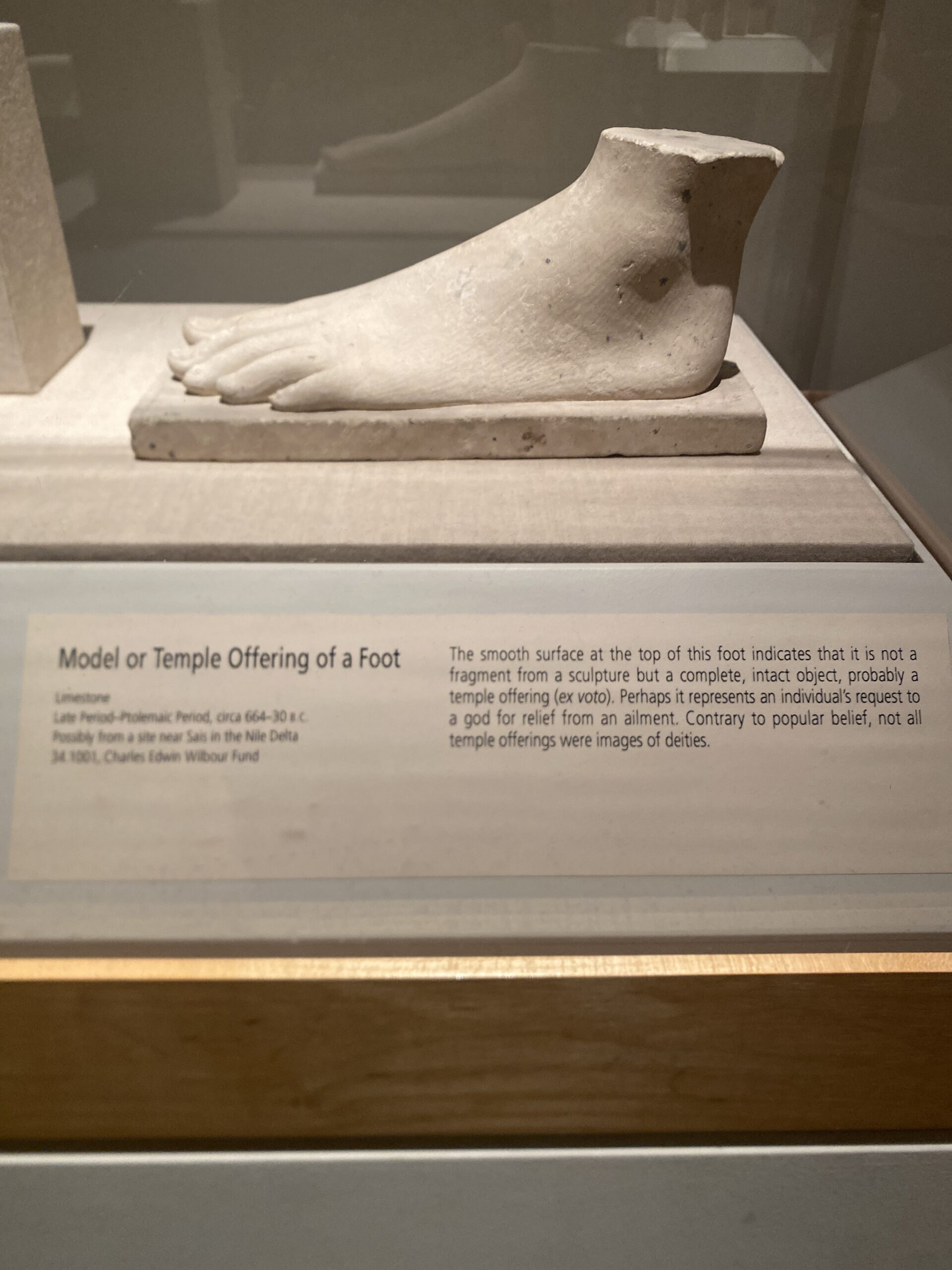
Model or Temple offering of a Foot
Charles Edwin Wilbour Fund
664-30 BC
What do you see going on in this work of art? Is there a story depicted?
We think that this foot is from the Statue next to it. Prior to death, this person probably asked for his foot to be sacrificed as a religious symbol.
What different visual elements (ie: line, color, light, proportions, scale, composition, media type etc.) do you notice, and how do they help you make sense of the artwork?
It has the beige and off white tone to the skin of the foot, so it gives ancient vibes
How does this object compare to other objects, stories, or ideas you already know about?
There are certain beliefs that people follow where they sacrifice certain things before they die or after they die. They strictly follow their religious or certain beliefs that are thrown at them after their birth.
What choices do you think the museum made about the object’s display?
They made it pretty minimalistic. They made it very easy to understand the sculpture
Group Members
Shadia Sultana, Yamaris Astorga
-
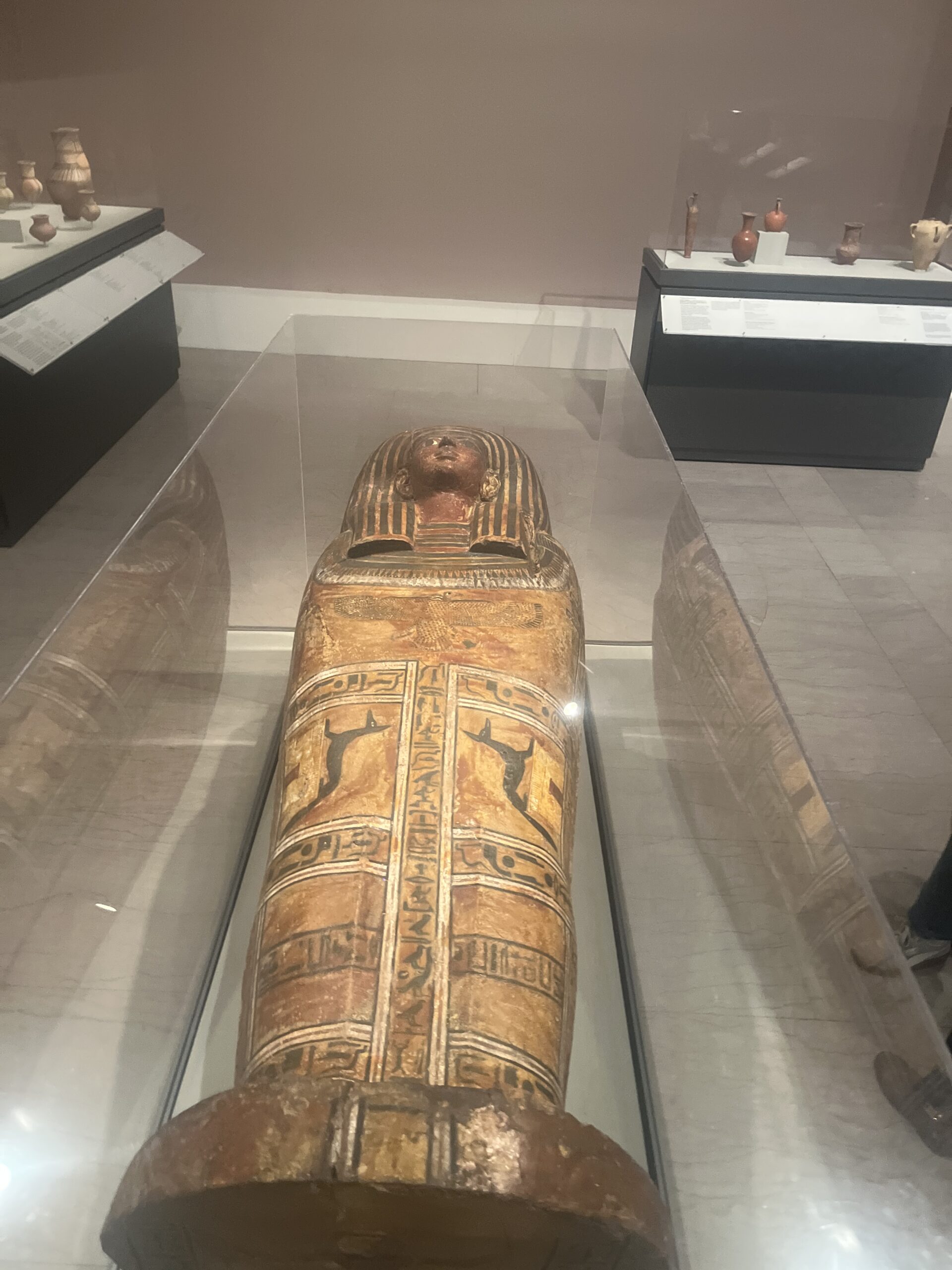
Anthropoid Coffin of Teti, Servant of the Great Palace
Charles Edwin Wilbour Fund
37.14e
What do you see going on in this work of art? Is there a story depicted?
There are a lot of intricate designs with hyroglyphics with multiple different designs of people and animals. There are also Egyptian gods like Anubis and it is made out of what appears to be wood.
What different visual elements (ie: line, color, light, proportions, scale, composition, media type etc.) do you notice, and how do they help you make sense of the artwork?
There are various differnet designs with stripes on heads and what appears to chips on the wooden material. There seems to be a story told in the paintings on the entombement.
How does this object compare to other objects, stories, or ideas you already know about?
It reminds us of king tut and his story. Also reminded us of the different ways bodies were preserved in Egyptian cultures
What choices do you think the museum made about the object’s display?
They probably have thought about whether to lie down the anthropoid of have it straight up. There also had to make the choice of whether or not to keep it open or closed.
Group Members
Najma Gure, Emily Duran-Parra
-
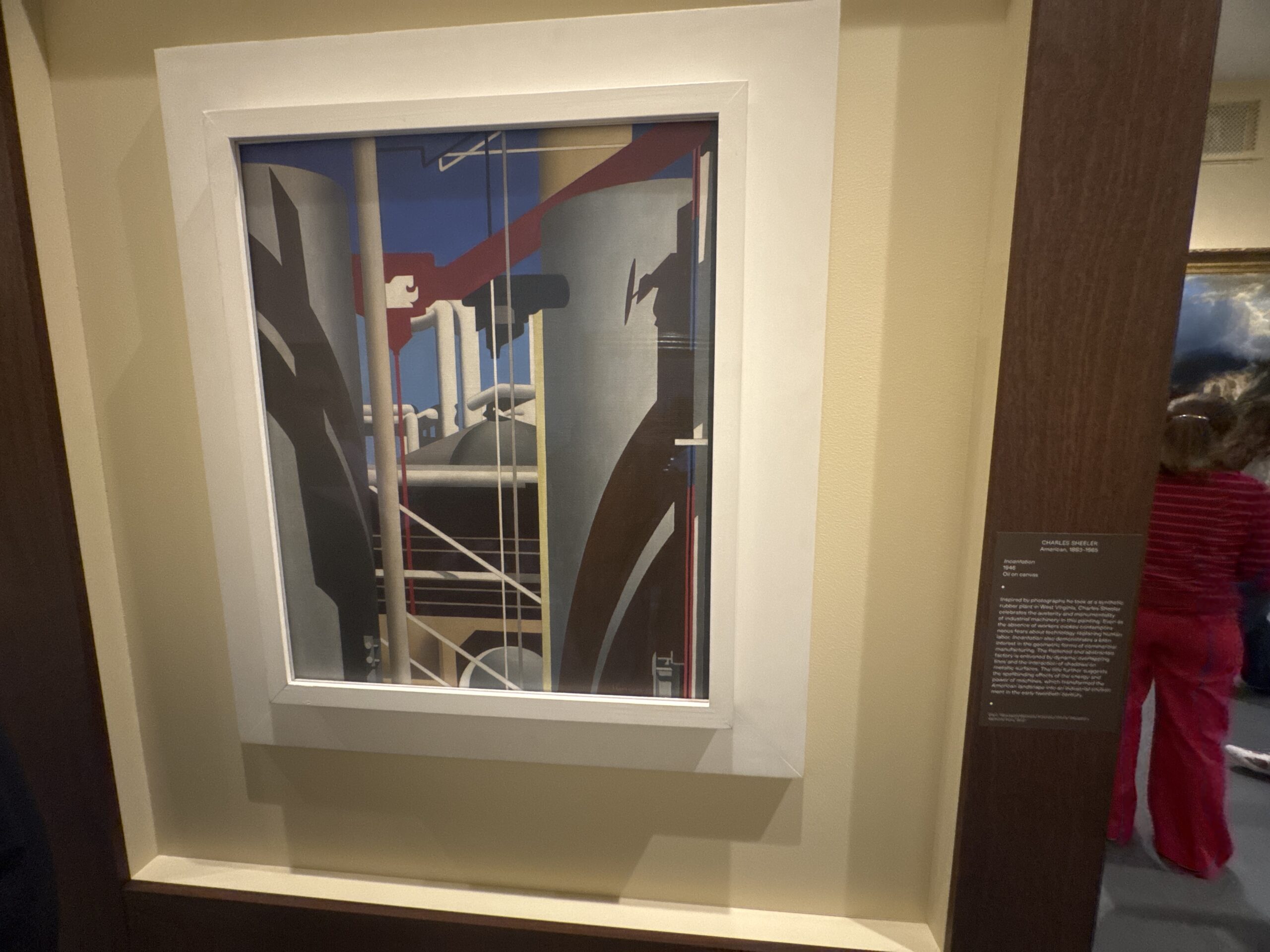
Incantation
Charles Sheeler
1946
What do you see going on in this work of art? Is there a story depicted?
Sheeler utilizes mute and dull colors, colors with low saturation, to portray an important message about industrialization. Before factories and machinery, products were unique, colorful, and bright. Life was full of energy when humans were present in factories, and goods were made with enthusiasm. However, with the addition of machinery and new gadgets, life is dull and drab. Everything is created equally. Humans brought a special aura and energy with them that machines cannot replicate. Light and creativity was sucked out of the world, and our lives transitioned to gray machinery that made everything dull and sharp. The washed-out colors show the effect machines have on our atmosphere and surroundings. Equipment used in factories- especially diesel machines like the one pictured here- burns waste and emits smoke. The use of bleak and lifeless colors to depict the tanks draws attention to the air pollution that these machines generate.
What different visual elements (ie: line, color, light, proportions, scale, composition, media type etc.) do you notice, and how do they help you make sense of the artwork?
When Sheeler depicts metal pipes and rods, he uses sharp, clean lines. The vertical orientation of the lines gives the image a sense of stillness and immobility. However, oil is continuously flowing via these tubes and machines. The plant lacks people because machinery replaces them, which is a sign of the modernization and transformation taking place during Sheeler's lifetime. The notion of rapid modernization is further enhanced by the vacant space filled with the shadows of metal tanks and equipment. Industrialization and modernization are all about precision and perfection, which sharp and rigid lines help convey.
Group Members
Eliyahou Saadia, Ezra Grazi, Marilyn Dweck, Esther Shemia, Leah Lati, and Merle Kassin
-
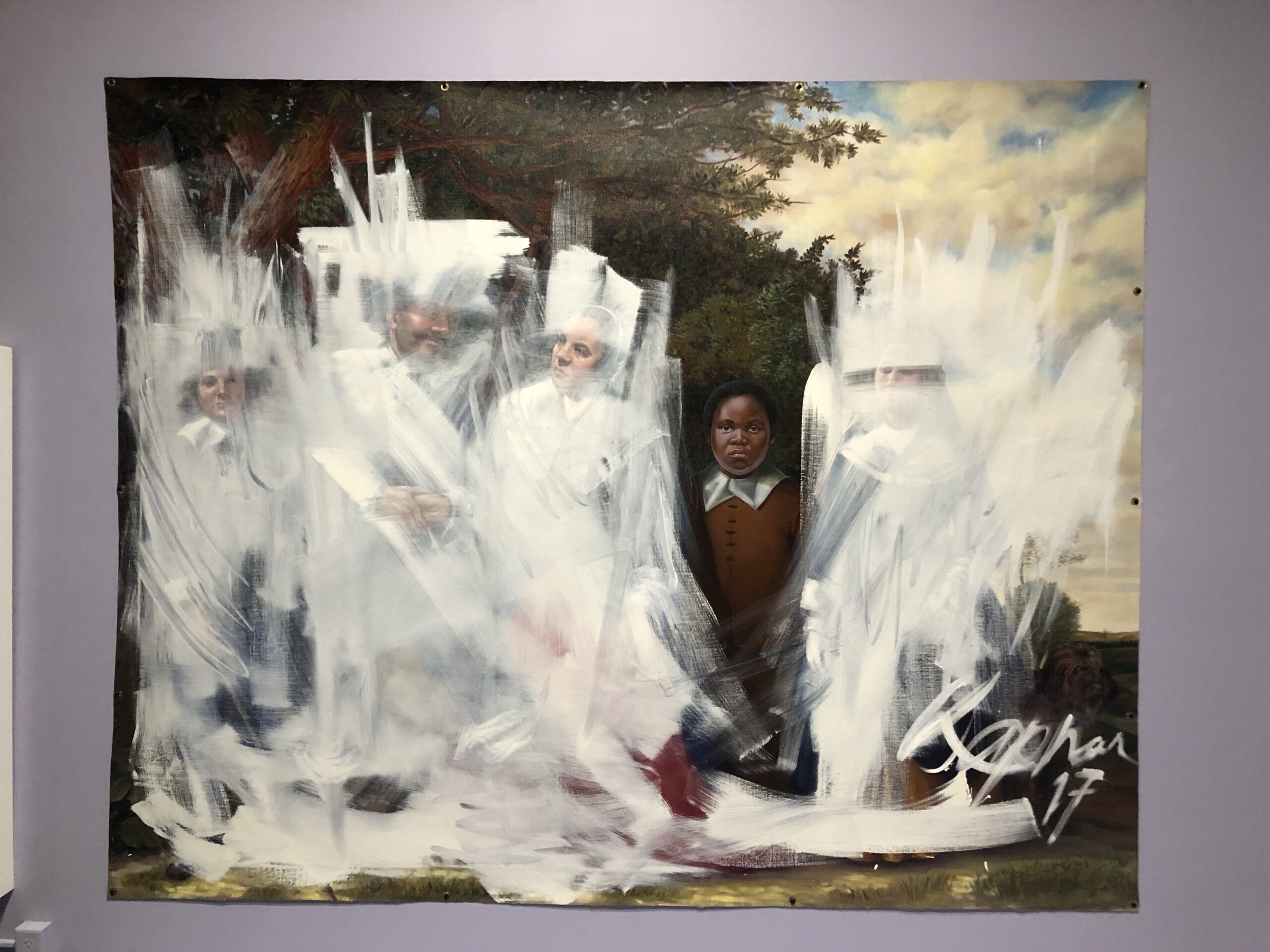
Shifting the Gaze
Titus Kaphar
2017
What do you see going on in this work of art? Is there a story depicted?
The artworks shows a family of white people with a Black boy thought to be their servant. The white people are painted over with white brushstrokes but you can still see their facial expressions. The Black boy is made the focus of the painting and not touched with any white paint. This artwork shows that society needs to highlight underrepresented communities and how history from a colonial perspective glosses over other people in the era who were not white.
Group Members
Rachel Malamud, Emma Moore, Gabriella Cota, Catherine Gardella
-

The First Harvest in the Wilderness
Asher b. Durand
1855
What do you see going on in this work of art? Is there a story depicted?
In this painting the scene is set on what appears to be a new settler colony. The town is teeming with new european families and the colony is under sunlight whilst the surrounding land is in the darkness. This intentional placement of light is representative of the fulfillment of manifest destiny and the bright future that comes with westward expansion.
How does this object compare to other objects, stories, or ideas you already know about?
This painting aligns with much of the history we learned about the early americas and the conquest for land. Manifest destiny played a prominent role in american history and this painting captured this ideal. The light being shone shows the europeans and the dark seems to represent the unknown or irrelevant happening around them.
Group Members
Isha Joseph, Zunairah Sikder

