

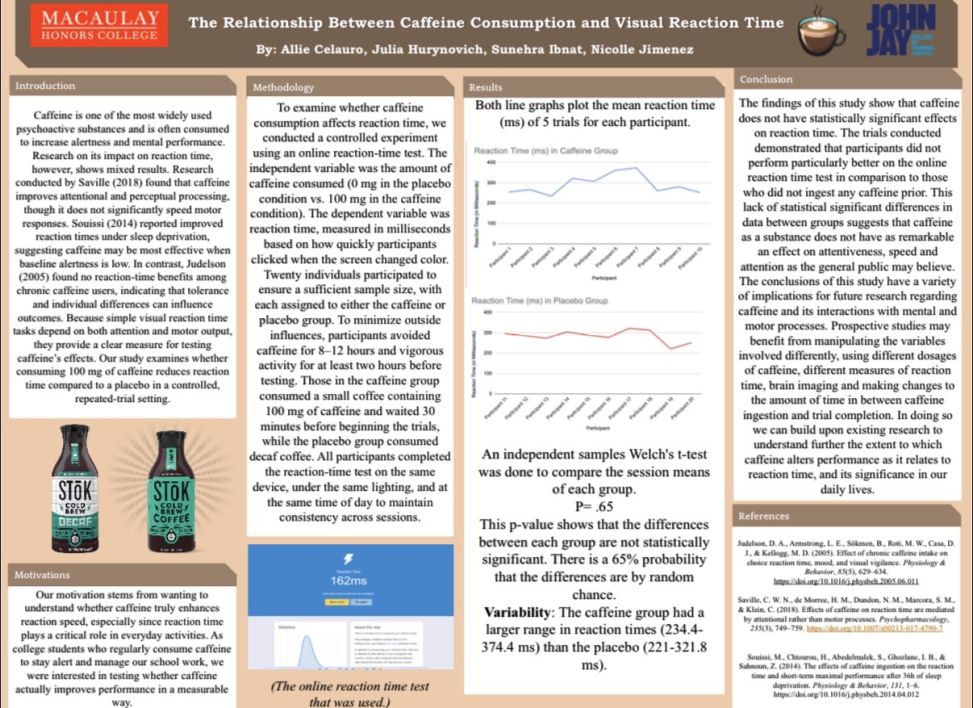
Our project investigated whether consuming 100 mg of caffeine improves simple visual reaction time compared with a placebo under controlled, repeated-trial conditions. Although caffeine is widely used to boost alertness and academic performance, scientific findings on its actual effect on reaction time are mixed. By testing 20 college students using a standardized online reaction-time task, we compared the performance of a caffeine group with that of a placebo group, keeping all testing conditions consistent. Our statistical analysis showed that although the caffeine group had slightly faster average reaction times, the difference between the two groups was not statistically significant (p = .65). This suggests that the improvement observed may be due to natural variation rather than a true effect of caffeine. The caffeine group also showed greater variability, suggesting individual differences in caffeine metabolism, tolerance, sensitivity, sleep, and baseline arousal all play a meaningful role in how caffeine influences performance. Our findings indicate that caffeine does not reliably enhance reaction time in a measurable way, which challenges the common belief that caffeine universally sharpens mental and motor responses. For college students who depend on caffeine to stay alert, it is important to recognize that its effects are not guaranteed and can vary widely. Our results encourage people to think more critically about when and how caffeine is actually helpful and to understand that feeling more awake does not always mean performing better.

