Protest Art – Gabriel Ubillus

For my collage, I am supporting more support for international students. I decided to choose this topic mainly because I can relate to it personally. This issue has affected me throughout my life, and even more since I moved to New York City almost a year ago. As international students, we struggle in many ways because, besides being students like everyone else, we also have to deal with academic pressure, financial stress, and legal responsibilities.

The images and words I included represent both the struggles and hopes of international students. The large word “SCHOOLS” and the phrase “FOR LEARNING” show that education should be inclusive for everyone. I added “NEW YORK CITY STUDENTS” and wrote “international” by hand to show that this issue affects students here in our city. The photos of students smiling and working together represent the community and sense of belonging that many international students look for, and they were taken from the article I used. The phrase “LET’S BUILD A FUTURE TOGETHER” reflects the importance of collaboration between schools, organizations, and students. I wanted to show the sense of community that international students have with each other because we are often the ones who understand each other best, especially when it comes to the complications and limitations we face.

The article I chose influenced the overall design of my collage. It discussed an organization that provides volunteer opportunities for international students, helping them gain experience and build connections for future work or study. This inspired the theme of opportunity and growth throughout my collage. If I had more time or more supplies, I would have added cultural symbols, country flags, or more quotes from international students to show diversity and personal experiences. I would also refine the layout to make the message clearer and more visually connected, showing movement toward a more supportive future.

Collage

Gabriel Ubillus – Public Art

On my way to Seminar 2 this past Thursday morning, I walked along Queens Boulevard toward Queens Plaza station, where I always pass a mural that covers the small bridge I have to cross. This public art feels special to me because I encounter it so often on my commute from LaGuardia to Queens Plaza, especially now that I’ve been traveling more for Macaulay seminars. I usually stop for a moment to look at it and notice how some sections are well cared for while others are worn down or covered with graffiti. Since there’s no placard or description, I often wonder who painted it and when. I even tried searching for information about it, but couldn’t find anything specific.

I’m drawn to how the colors contrast with the road and the surrounding concrete. I interpret the imagery as a kind of sun and moon theme: the dragons and what seems like the sun are painted in vibrant, energetic colors, while the mermaids in white feel calmer and more serene. All of it sits on a blue background that I imagine symbolizes the sky. Even though I don’t know the artist or the story behind it, the mural still manages to shift my mood every time I pass by.

To me, this shows the importance of public art overall. Public art interrupts the routine of daily life, it gives people something to think about, something to feel, even if they’re just rushing to class or heading to work. It makes shared spaces more human and more expressive, and it invites anyone, regardless of background or education, to interpret it in their own way. In a city like New York, where everything moves so fast, public art creates small moments of reflection and connection. Even a mural on a bridge can become part of someone’s personal landscape or rutine, shaping how they experience the place they live and move through every day.

Public ArtPublic Art

Gabriel Ubillus – Julio Anta

I have always liked comics since I was a kid, and I really enjoyed Julio Anta’s visit to speak about his work. I asked him a question about if he felt any kind of responsibility to fulfil in terms of representing the Latinx community. I was somewhat expecting his answer which was that he did feel some sense of responsibility as he is talking from experience with his kid mindset and as well his adult mind now which it comes with a mix of feeling and reflections mixed all together. His comics focus on immigration, identity, and the lived experiences of Latinx communities, especially young people navigating systems that misunderstand or marginalize them. His stories blend real‑world social issues, like family separation, border politics, and cultural belonging with supernatural or superhero elements to highlight resilience, hope, and humanity. Across his work, he explores how young people find their voice, confront trauma, and build community, while also challenging readers to rethink how policy and representation shape people’s lives.

After the discussion with him reinforced my interpretation of his work and my understanding of the artforms with which they work specially since I have never met any comic artist before as well as never read any similar comics that represent cultural difficulties like this. Also mentioning that I’m a Latino myself and seeing the representation of what my culture is being so recognized and respected it makes me feel some sense of pride and even more respect to his work. Something that I also really liked was that Julio writes the stories for himself and not especially for sales or to please an audience, which is something that I think is very different from many other writers and it was a highlight for me during the discussion.

Gabriel Ubilllus

My visit to the Society of Illustrators was a great experience, especially because before this assignment I had never heard of the museum. I went by myself on this past Saturday afternoon to enjoy the experience and focus take my time in what I liked. It’s a much smaller space compared to MoMA, which gives it a more enclosed, cozy vibe and creates a completely different environment. The size makes the artwork feel closer and more accessible, almost like you’re stepping directly into the world of the illustrators. In some ways, it reminded me of the Alice Austen House because both present art in smaller, more intimate settings rather than in large, overwhelming museums.

The Alice Austen House feels personal and warm. Since it’s a historic home, the space itself becomes part of the artwork. It highlights everyday life, community, and the personal stories behind the photos, and you can almost imagine what it was like to live there because it’s the same house Alice once lived in. The experience feels more emotional and grounded in real life. In contrast, the Society of Illustrators has a different purpose. It focuses on polished, professional pieces, and as their mission states, they aim to “promote the art and appreciation of illustration.” The exhibits feel more modern and connected to current artistic styles, trends, and themes, giving the space a more contemporary and professional atmosphere.

The piece that caught my eye was Realism by Tim O’Brien. This painting makes me feel curious and surprised every time I look at it. The water spilling out of the frame looks incredibly realistic, almost like the picture is coming to life right in front of you. It resonates with me because it shows something breaking out of its limits, literally going beyond the frame, and that idea really stuck with me. It’s different from most paintings, which don’t capture the same feelings this one gave me, especially because it portrays realism so well. The illusion of movement and the way the artwork challenges the boundary between the painting and the viewer is what made it stand out to me.

Society Ilustrators

Gabriel Ubillus

In our visit to the Alice Austen House, we recreated some of Alice’s pictures in the exact location they were taken. I chose in particurarly these two pictures as they resemble the best picture on how much does time changes the same place but still remembers the essence from the past. The picture with person sitting beneath the tree by the water feels reminiscent of Austen’s portraits of friends and community members in natural settings. She often photographed people in relaxed poses, emphasizing connection and presence rather than formality, which was one of the main aspects that made her pictures so unique.

The next picture of her house and the greenery, shows Austen’s sense of home and belonging. Many of her images at the Alice Austen House show how domestic and outdoor spaces intertwine. We tried to capture that with our picture and we can observe how the enviorment changed, such as the nature around it but we can see the general idea stays the same. It’s a portrait of community through environment, showing how places hold memory and meaning.

Beyond the visual similarities, these recreated photographs highlight how community itself evolves while still holding onto traces of the past. Standing in the same spaces where Alice once photographed her friends, her home, and her surroundings reminds us that places are shaped by the people who move through them. We became part of that ongoing story, another group engaging with the landscape, interpreting it, and leaving our own moment behind. In this way, the photos connect also to our community, showing how shared spaces become bridges between generations, preserving memory while welcoming new perspectives.

Alice

Alice Austen House

Gabriel Ubillus – My visit to the Museum of Modern Art

I visited the Museum of Modern Art (MoMA) this past Saturday, June 27. I walked around the museum by myself for about three to four hours and had plenty of time to explore most of it. It was my first time visiting MoMA, and I was quite impressed when I first arrived—especially by the structure of the museum, since it is built more vertically than horizontally. There are also many large community rooms where people gather for different activities or events.

My relationship with art and museums has grown as I’ve gotten older and developed a better understanding and appreciation for exhibits. At first, I didn’t enjoy museums as much as I do now because I didn’t think they were an activity that matched my interests; I didn’t feel like the intended audience. That has changed, especially now that I’ve gone to a museum by myself for the first time. I’m usually accompanied by family or friends, but spending time alone helped me enjoy and appreciate the experience more. I was able to explore almost every floor, and I prepared beforehand by deciding where to start based on the exhibits I was most interested in. The time I spent at each exhibit varied, especially because I enjoyed some more than others, so I believe I spent about three to eight minutes depending on the exhibit.

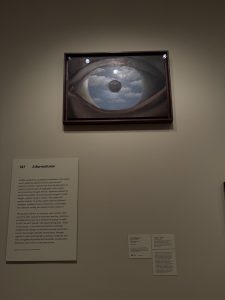
Recalling what I learned from Lindauer’s article, I incorporated being a critical museum visitor by observing beyond the exhibit itself. I paid attention to the positioning of artworks, the lighting, and even questioned why certain seats were placed where they were. I applied this especially to the exhibit that stood out to me the most: The False Mirror by René Magritte. I found it very interesting that the painting was placed well above eye level, making it seem as though it is looking down over everyone.

Exhibit that stood out for me the most