Emely Contreras Zendejas – Public Art

In the mornings at around 5:30-6AM, I love to go on walks when there aren’t many people out. The air always smells wonderful in the mornings, and even thought it’s the summertime, there is still a cool breeze early in the day. When I go on these walks, I refrain from using my phone and listening to music. I’d much rather immerse myself in my surroundings. I usually encounter squirrels running up trees, rats scurrying along the streets, pigeons walking idly by. This Friday, I witnessed something completely out of the ordinary. The sun was starting to rise and I was headed back home when I stumbled upon a man painting one of the buildings near my house. I’ve never seen someone painting publicly in my neighborhood before. It was such a shocker that I pulled out my phone as quickly as possible and took a picture.

painting
Screenshot

building

(24 Fort Washington Avenue)

My first thought was, who in the world was this artist, and why would he be painting something here? Is he someone who’s always lived on this block? Perhaps he is part of the influx of characters that have started to move in. How come he woke up so early in the morning to come paint? It’s such an odd thing to see around here in Washington Heights compared to other neighborhoods in lower Manhattan where you see artists on the streets, parks, everywhere. Perhaps he wanted to encapsulate the beauty of our architecture onto a canvas. I understand the man on that part. On my walks, the thing I do most is just look at the structure of the buildings, the details carved in, the moldings, garlands, everything. Most of the buildings around here were built in the 1900s, and it’s so interesting to examine the investment placed on making these apartments beautiful. I love architecture so much. His artwork is incredibly detailed as well. Although the photo I took wasn’t focused, you can see how amazing the painting is. I went deeper and found an archive on New York City’s 1940s tax department photographs. Amazingly enough, I found the same building.1940

I question where his art will go. When I think of public art, part of me thinks public performance. Someone is putting on a show, a live experience for others. But he’s painting at a time when there is nobody really outside. Is this still considered public if there is no audience around? If he was outside at around 2pm, then my brain would’ve thought he was doing this so that others could notice, look at the source material, and appreciate the building itself. But he’s not— it’s quiet outside save for the chirping of the birds. There aren’t people walking around to appreciate the appreciation of the everyday visuals around our neighborhood. But who is to say the people here don’t appreciate it all the same? I take notice of the buildings, but I’m not outside on the street painting them. Appreciation isn’t always expressed through creation. I don’t know whether everyone here acknowledges the buildings, whether they just give them a passing glance before continuing on with their busy days, not afforded the leisure to stop. He chose to externalize appreciation, leaving behind a physical record.

The public aspect isn’t having commuters stop to stand around, it’s the location. It’s a documentation of a piece of the neighborhood that may or may not be seen by everyone, but it will exist forever as a conversation between the artist and the place. And perhaps in the future, if this building were to someday changed in some way, there will be living proof of its existence, not just in the mind. This man could be just like a Steve Zabel through another medium. Zabel is a photographer I recently discovered who, along with capturing images of the subway station back in the day, also documented the streetscapes of Washington Heights in the 1980s. I’ve included a photo taken of one of those streets that I see every single day and how it’s changed since then. The structure is intact, but so much has transformed. It’s my normal now, but the image captured in 1983 was their normal too. What could’ve just been an ordinary photograph decades ago is now a historical record. The painter’s work might someday be the same.

How much of our city’s history has survived simply because someone thought it was beautiful enough to stop and look? I’ve realized public art doesn’t have to be loud, it can be as quiet as a pin drop. We all hold private connections with the places we inhabit. This painting isn’t special because he “cared” more than anyone else. It’s special because he turned this personal moment of appreciation into something that could be scared with others, both now and years onward.

1983
Screenshot

2026


Daniel Castro – Public Art

Bronx Mural by Paul Deo

I found this mural art near Montefiore Medical Center in the Bronx while I was visiting my former high school nearby. The mural immediately stood out to me given that its vast display of colors contrasted the brick walls of the hospital. Given the various plants and animals found in the mural, I figured it was a type of ecological piece, though I couldn’t discern the meaning on my own. While I at first thought it might represent a sort of “Save the Earth” campaign, I found it difficult to reconcile that idea with the presence of the other planets of the solar system as well.

The mural credited Paul Deo as the artist, so I found his website later. Deo is a primarily NYC-based artist who is especially known for his works in Harlem: his work “Planet Harlem” was highlighted in 2019 by New York Magazine. I saw on his website that his work is often psychedelic, which I thought did explain some of the imagery that I found confusing in his mural. I hadn’t experienced much psychedelic art prior to viewing this mural, so I briefly researched the process upon arriving back home. I also tried finding this specific art piece on Deo’s website, but I was ultimately unsuccessful.

I believe public art is important for a few reasons. Primarily, I believe that public art pieces do bolster community safety. It isn’t a perfect method, but it does have limited effects such as promoting a positive mentality among viewers. Public art can also breed intellectual discussion among the community rather easily given its public status, and while I struggle to find the meaning of this specific mural, many murals can promote discussions on political, social, or environmental topics.

Illan Grano

The piece of art I chose is located on 35 Allen street between Hester and Canal. It is a small hole in the wall approximately 3 feet by 5 feet that has a rotating exhibit behind a pane of glass. This “gallery” and the art it showcases has been a part of my life for the past couple of years. I have a friend in the neighborhood that I visit often, and my walk to their apartment always goes by this gallery. Every time I’ve walked by I always take a second to see what’s on display. The art forms vary from sculptures to paintings to decorative clothing. What I love about it the most is not knowing what to expect each time I pass by, what new colors or new form the art will take. This time, the gallery had a chair with a bag hanging from the back with a vase of flowers on the floor beside it. The only info about the showcase is that it is presented by American Standard CO. for Art and Design. However, I believe it is no longer owned by them and now under the name Wish Done Gallery. But I’m still uncertain if it is still occupied by Wish Bone, my best guess would be that different studios and galleries rent out the space and display all types of work. I feel that public art really brightens the mood of our daily lives. Similar to my experience, public art gives us a break from the monotony of our daily lives. When we pass art in the street we pause, even if just for a moment, and see what’s on display. Even if you have seen it a hundred times you can discover something new. Through this interaction with public and street art shows the value the art has on a city and a neighborhood. alt

Enrique Nunez – Public Art

graffiti 1 graffiti 2 graffiti 3

For this week, I took some photos of graffiti I see daily on my commute to John Jay. I take the QM2 which goes from Bay Terrace to Midtown (and vice versa) via the Whitestone Expressway, as well as the M57/M31, which takes me crosstown to campus. The first picture was taken from my commute back home on the QM2, which goes along Northern Boulevard. This graffiti is on the side of a corner store in Jackson Heights (where I grew up), and was created in such a way to where it acts as both a mural and piece of graffiti at the same time. The colors as well as the magnitude of the wall art really stood out to me, which prompted me to capture it for this week’s post. The second picture was also taken from my commute back home, this time in Whitestone. This, I believe, is a creative rendition of an artist’s tag; what really interested me was the funny face inside of what I believe is the letter O. I can’t provide much insight as to why I felt the need to capture this art for this week, other than the fact that the face looks a little bit like Mario and I thought it was funny. The last picture is on my commute to campus, on the Jackie Robinson Parkway. This one sticks out to me the most visually because of the placement; it was created in such a way to where you are left wondering how the artist even pulled it off (suspension cord? rope and harness?) and I think that’s the beauty of it, as well as the artist’s intention. One of the whole points of tagging is to get your name and your art out there in circulation, and especially get people talking about it, because if they’re talking about it, they’re recognizing you. The location does a lot of heavy lifting because it gets people talking about the art and spreads that knowledge around. I think the act of creation is the most important thing about public art, and the most important thing for us as the audience is to share the love and passion that comes with creating art with each other by sharing art and their artists alike with one another, and bonding over creating art in general as a community.

Evan Truskalo – Public Art


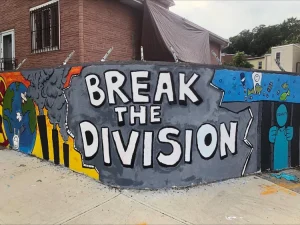
Everyday while commuting to the College of Staten Island, where Victory Boulevard and Westervelt Avenue intersect, I see a painted mural that sprawls along a brick wall. It pops visually, with many different colors, shapes, and art styles, but also symbolically. It’s a mural that serves as a protest against gun violence first and foremost, and also has many other pieces of symbolism about matters of racial equality, social unity, and concern over the environment. I wanted to discuss it because I’ve always enjoyed passing by that mural, and at least off the top of my head, I haven’t seen much else on Staten Island like it.

Public Art Evan TruskaloPublic Art Evan TruskaloPublic Art Evan Truskalo

As a quick aside, I also think it’s really great how the project came to be. It was effectively sanctioned and started by Canvas Institute, a youth-engagement non-for-profit, but it was 25 middle-school students that actually made the mural itself. I think that’s amazing, because from a young age, it teaches how social awareness can combine with art and one’s community. Even in a small way, it encourages advocacy and initiative in these students’ communities.

I do also really enjoy the piece aesthetic-wise. It’s varied and dynamic; there are multiple different colors, styles, and pieces of symbolism for the issues that it’s representing. The “BREAK THE DIVISION” written on the wall not only draws you in, but also portrays the central idea of the piece: to “take action against the world’s problems” and “to end the division among us”. The intent of the mural is to protest gun violence, but you can also see how it evolved to contain more ideas and pieces of symbolism: Racial equality, climate change, social unity, political advocacy, and I love how all of these ideas all tie back into the core themes of community awareness and “breaking the division”. There’s great, impactful imagery. The direct imagery of the mural, like the silhouette of a person with “EQUALITY” written on their face while locked in a cell, as well as the hands holding the protest signs, stands out a lot and it leaves a long-lasting impression.

I also think that the mural shows some of Staten Island’s, and New York City’s, culture and youth. There’s a tapestry of different colors, shapes, symbolism, and social commentaries, and it’s all wrapped together in a way that really stuck with me, honestly. It sets a mood of optimism, hope, and positivity that the newer generations are fighting back against all of these issues. Considering how Staten Island is a fair bit more conservative compared to the rest of NYC, it’s a pleasant surprise to see art like this. Because, really, this mural is a major example of why public art is so important, and should never be censored. A mural like this shows the unity and coming-together of a community, and how the members of that community want to show their passion for societal issues and concerns. It sets an inspiring example for everybody else in their community. Of course, there are people who don’t approve of this form of artistic protest— they may say it’s too political, controversial, or divisive. But to me, that’s all part of the point of public art: Certain styles, social commentaries, or themes, may be divisive or make us feel uncomfortable; they may challenge certain ideas or feelings we have, either towards the art itself, or what the art represents. And yet, challenging ideas is how we grow as both people and communities. Public art makes us reflect and think, whether it’s about something fairly minor, such as which art styles we like or dislike, or something as significant as the social, racial, and political issues of today.

Gabriel Ubillus – Public Art

On my way to Seminar 2 this past Thursday morning, I walked along Queens Boulevard toward Queens Plaza station, where I always pass a mural that covers the small bridge I have to cross. This public art feels special to me because I encounter it so often on my commute from LaGuardia to Queens Plaza, especially now that I’ve been traveling more for Macaulay seminars. I usually stop for a moment to look at it and notice how some sections are well cared for while others are worn down or covered with graffiti. Since there’s no placard or description, I often wonder who painted it and when. I even tried searching for information about it, but couldn’t find anything specific.

I’m drawn to how the colors contrast with the road and the surrounding concrete. I interpret the imagery as a kind of sun and moon theme: the dragons and what seems like the sun are painted in vibrant, energetic colors, while the mermaids in white feel calmer and more serene. All of it sits on a blue background that I imagine symbolizes the sky. Even though I don’t know the artist or the story behind it, the mural still manages to shift my mood every time I pass by.

To me, this shows the importance of public art overall. Public art interrupts the routine of daily life, it gives people something to think about, something to feel, even if they’re just rushing to class or heading to work. It makes shared spaces more human and more expressive, and it invites anyone, regardless of background or education, to interpret it in their own way. In a city like New York, where everything moves so fast, public art creates small moments of reflection and connection. Even a mural on a bridge can become part of someone’s personal landscape or rutine, shaping how they experience the place they live and move through every day.

Public ArtPublic Art

Isabella Castillo – Public Art

I think New York City is one of the few places where a piece of art can completely change your day. A single work can transform your commute by affecting your emotions or even the thoughts that stay with you throughout the day. Sometimes a piece of art resonates with you for only a few minutes, while other times it stays with you for weeks, years, or even a lifetime. I also believe that every person experiences art differently because each piece creates a different kind of inner response depending on where you are in life, your past, your passions, and the things that bring you joy, worry, or sadness.

For that reason, and many others, it was difficult for me to choose just one example of public art. Art appears in so many different forms. It can be a beautiful sculpture or mural that suddenly makes you stop in the middle of your walk, demanding your attention. It can also be one of the poems displayed on the subway, reflecting exactly what you are feeling in that moment and inviting you to think more deeply or even write pages about an emotion you did not realize you were carrying. But my favorite form of public art is the art created by people themselves.

I have always loved art expressed through human beings. There is something beautiful and intimate about watching people freely share their creativity. They create not because they have to, but because it fulfills something within them, brings joy to their everyday lives, and allows them to be seen, heard, and appreciated. That honesty and vulnerability make it possible to connect sincerely with others.

The public art I chose was a jazz band I came across during a walk in the park. There was no placard or description because the performance itself was the artwork. Seeing how much they were enjoying themselves and the genuine smiles on their faces reminded me that sometimes all we need to do is slow down long enough to truly experience the moment we’re in. Their joy spread naturally throughout the crowd as people smiled, stopped to listen, and even danced. Everyone there had arrived with a different story. Some may have been having one of the best days of their lives, while others may have been having one of the worst. Yet, for a few moments, they all shared the same experience through music.

To me, that’s the importance of public art. It interrupts our routine and asks something of us. It asks us to pay attention, to reflect, and to become more intentional with our day. Every person walks away from the same piece of art carrying something different because each of us brings a different story to it. Whether it’s a mural, a poem on the subway, or a jazz band in the park, public art creates a conversation between the artwork and the person experiencing it. To me, that’s what art is: something that creates an inner response, connects us with ourselves and with others, and quietly changes the way we experience an otherwise ordinary day.

Jazz

Slowing Down at 14th Street- Mazen Mohamed

On my way home from class one afternoon, I stepped off the A train at 14th Street and stopped to look at the small bronze figures scattered around the station. The piece is called “Life Underground” by Tom Otterness, installed in 2001. I have walked past these sculptures dozens of times without paying attention, but this week I finally slowed down and took photos.

The figures are tiny cartoonish characters made of bronze. Some climb pillars, others carry giant bags of money, and a few are being eaten by alligators crawling out of manhole covers. One of my favorites shows a small man sawing through a subway bench. The whole scene feels playful and a little dark at the same time.

There is signage near the mezzanine explaining the artwork, and the MTA Arts and Design website has more background. Otterness spent about ten years on the project and installed over one hundred figures throughout the station. The piece comments on class, money, and power in New York City. The alligator coming out of the sewer references an old urban legend about pet alligators flushed down toilets, which I found hilarious.

What drew me in was how the sculptures reward you for looking carefully. Most riders rush past without noticing, but if you slow down you find small stories hidden in corners of the station.

Public art matters because it gives everyone access to something creative during ordinary moments. You do not need a museum ticket or an art background to enjoy a sculpture in a subway station. For someone like me who commutes daily, running into art like this turns a boring transfer into something worth remembering. It also makes you feel like the city itself is trying to tell you something, if you are willing to pause and listen. That is a rare feeling in  , and worth holding onto.
.

Blog Post #5 – Kamila Ibanez

PlacardArtwork

The public art that stood out to me is a stained glass installation located in my home station at East 233rd Street in the Bronx, which I never noticed was there before. There was a small placard next to the artwork with the title A Secret Garden: There’s No Place Like Home. It listed the artist, Skowmon Hastanan, and noted that Derix Studio fabricated the work.

I found that the artist was inspired by a garden she left behind in Bangkok; after settling in the Bronx, she was also inspired by the botanical gardens.   The colorful flowers, fish, fruits, and plants are meant to transform the station into a calmer, more welcoming environment where commuters can briefly escape the monotony and chaos of daily commuting.

I think its importance comes down to three things: respect, legacy, and beautification. Public art shows that a neighborhood is worth investing in and caring for. When a government agency like the MTA commissions artwork for a station, it sends the message that the people who use that space deserve more than concrete walls. If we looked at it from a purely utilitarian perspective, public art could seem like a waste of money. Outside of possible benefits, like making an area feel safer or encouraging people to take more care of their neighborhood, it doesn’t serve a practical function. But I think the things that seem unnecessary are often what make a place meaningful. Taking the time to beautify our environment demonstrates admiration and pride rather than simply focusing on efficiency.

Public art also leaves behind a legacy. We remember cities like Rome because t they invested in architecture, sculpture, and public spaces that reflected the values and ambitions of their society. Today, so much is measured by whether it is profitable or efficient. I think artistry, craftsmanship, and beauty have become undervalued. What tends to be prioritized is how practical this can be, how profitable it can be, and how appealing it can be to most people.