

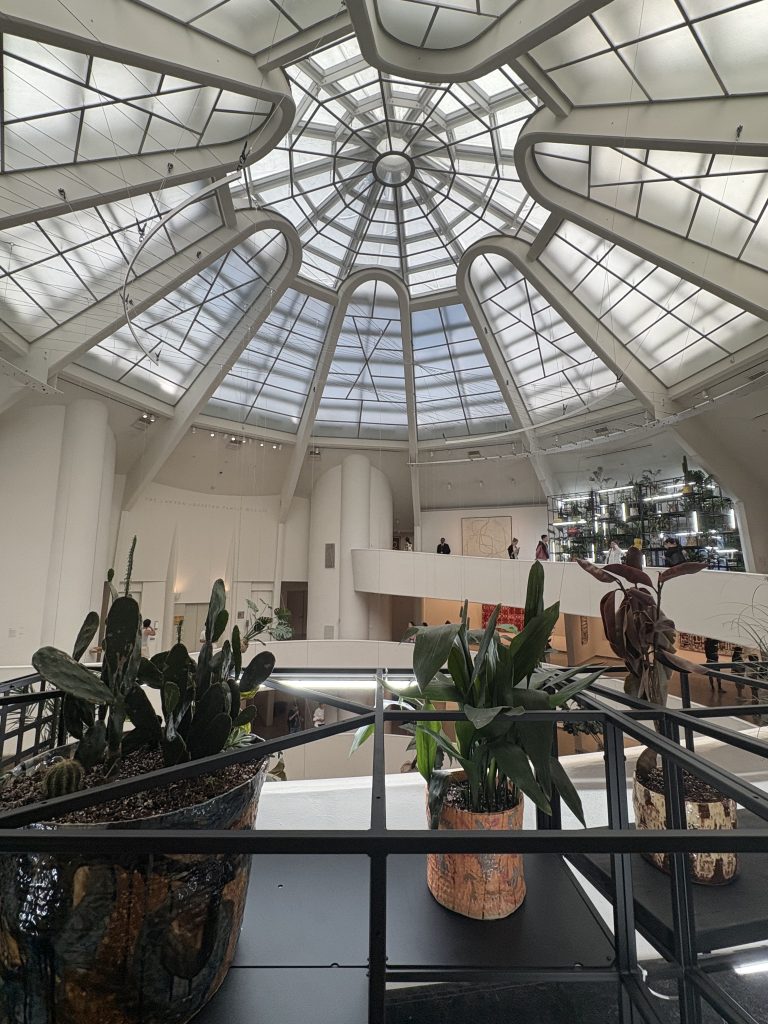
My visits to the Guggenheim were…an experience, to say the least. They ended up being far more draining, confusing, and, in a strange way, uncanny than I ever would have anticipated. My first journey began with a crammed bus ride directly from CSI’s campus that left me exhausted before I even made it into Manhattan, coupled with a ride in an old “6” train car with barely any functioning air conditioning. Notwithstanding, I made it and was shocked by how small and unimposing the museum’s building was compared to what I had pictured in my head, albeit its architecture was every bit as stunning. Upon my entry, I was pleasantly surprised to find out that my ticket was free per the words of my vendor (I’m happy to say that the entire admission process went smoothly and felt more like stepping into a 5-star hotel than a half-baked mega sized seashell), and, on that note, I rode the elevator to the 6th floor and began my journey.
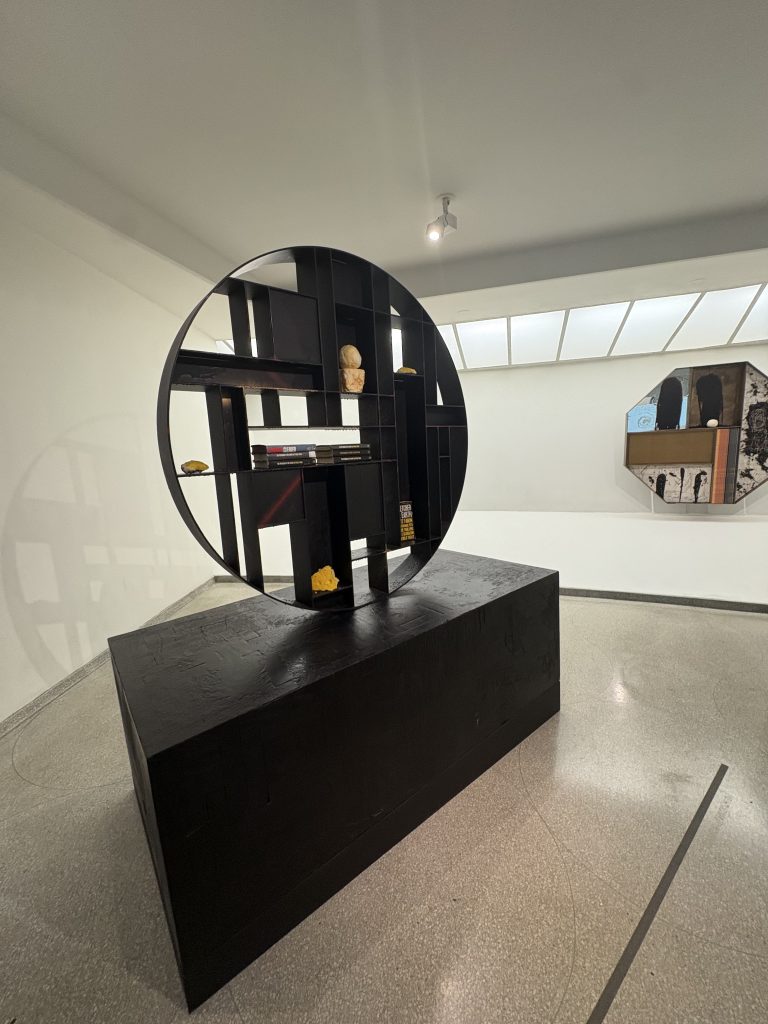
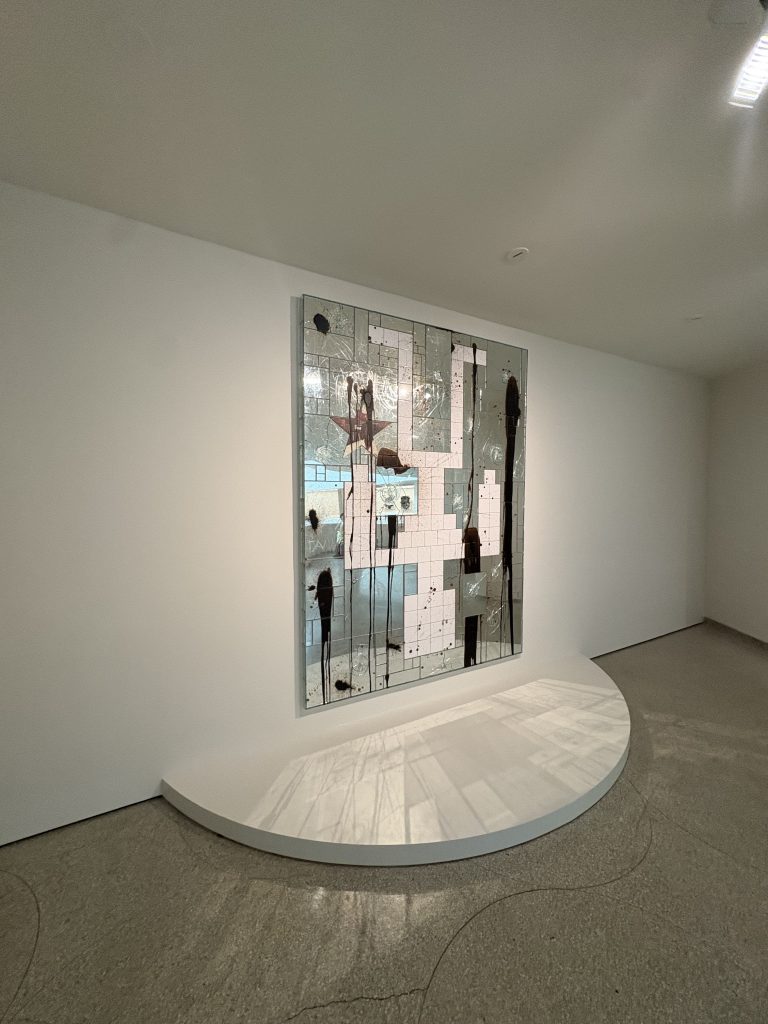
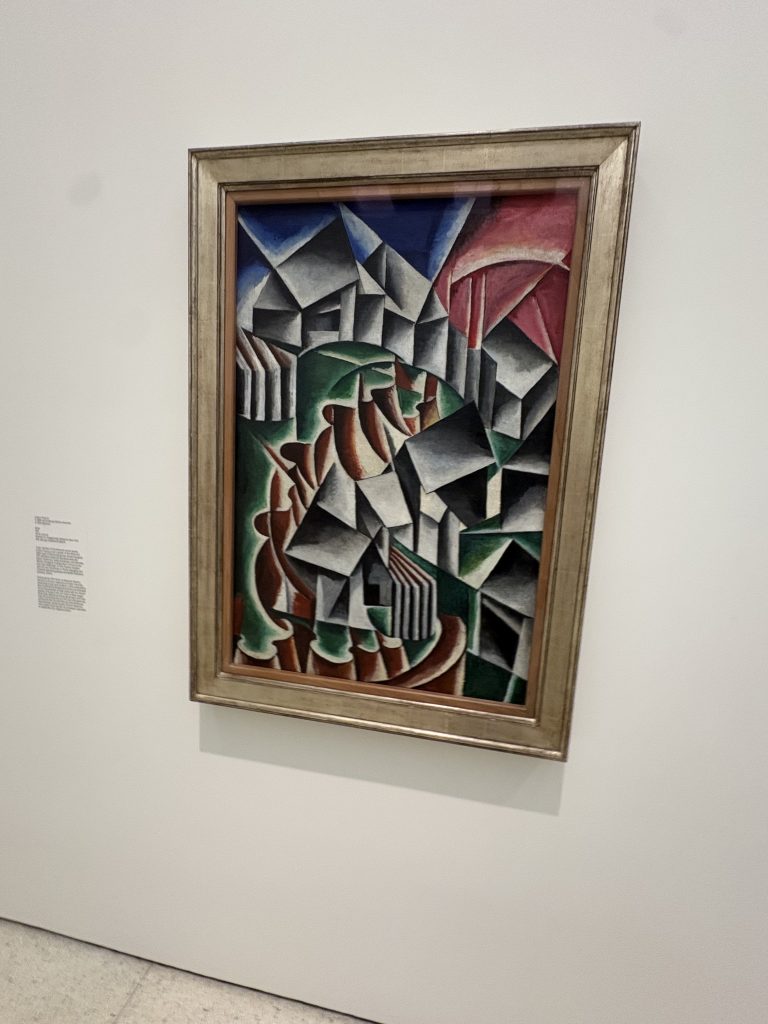
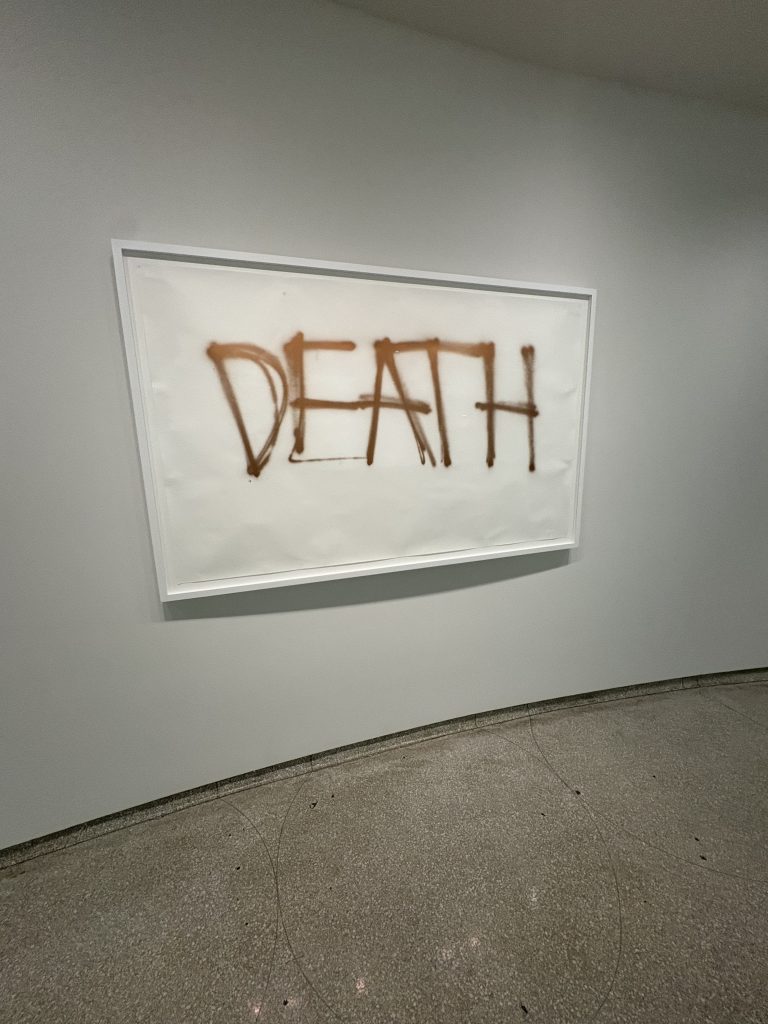
On my first visit, to be perfectly honest, the art didn’t particularly resonate with me on any level, and it immediately struck me as very abstract, with an extremely limited amount of people on all level outside the one closest to the ground floor, which features a figure staring (judgmentally) at the viewer. It’s completely unchronological to mention the bottom floor before where I originally started, in the same way the building’s immediate beauty stands juxtaposed with its deeply underwhelming artwork. However, there were a few works that stood out to me amidst the sea of cryptic or outright nonsensical works in the Guggenheim, one of which seemed to be a kind of Paleolithic leather hide or mud-like surface. Whereas most works were eerie messages or displaced furniture, the hide deeply resonated with me as, thanks largely to its littered human-like remains, I was instantly able to clock it as a kind of graveyard, perhaps symbolizing the dirty nature of death. The museum also happened to have plenty of distorted paintings that, for some reason, vaguely reminded me of traditional African works. That’s about where the human and “living” aspect of the museum ended; whatever was left felt sterile, or, at most, unsettling, including the various array of vandalized mirrors with cryptic messages like “RUN”. There also happened to be a variety of desecrated furniture such as flipped tables or outright ruined shelves. Whatever furniture wasn’t destroyed felt deeply unhuman (such as the 3d diamond-shaped cabinet with copies of the same book stacked on top of each other), but there was very little room for interpretation besides “You don’t belong here”, and that message seemed to be a constant theme throughout my first visit. The only artwork in the entire museum that I could say I enjoyed with conviction would be the section littered with a vast array of Futurist artwork, but that’s only out of a deep fascination for the context in which it was developed (Italian Futurism in the prelude to WW1 and Russian Futurism in the 1910s-20s). If not previously alluded to already, I didn’t care much for the Guggenheim’s artwork, as it seemed to be in constant revolt against my very being, with its vindictiveness against my humanity being ever-present and facing me through the building’s circular, inward-facing design. Although I could forgive that vindictiveness if it felt readily applicable directly towards me, it more so just felt like the museum was being spiteful against anyone who dared to enter its doors and looked inside of it past its elaborate outside design. I struggled to find any deeper meaning besides a collective ugly rage against the visitor, shown in the copy-and-pasted spray paints of words on mirrors trying to signal urgency.
My second visit wasn’t much better, and mainly just felt the same, except my lazy confusion was mixed in with that of the two classmates who I had gone with. Originally, we planned on going to the Met under the presumption that it, like the Guggenheim, was free for CUNY students or even anyone living in the Tri-State area. I also personally felt unfulfilled after my first visit to the Guggenheim and was looking towards a fresh start. That quickly evaporated once we met one of the vendors, who seemed deeply uninterested in explaining the museum’s policy towards visitors and would much rather fan us out of his presence like a collective of annoying fruit flies. Out of what I got to see in the Met before ushering myself out, the architecture seemed rather elaborate and much more pleasant to the eyes as opposed to the Guggenheim’s sterile insides, though I wouldn’t get to know that architecture’s connection to the Met’s real artwork…because I didn’t bring 17 bucks. We walked roughly 4-5 blocks uptown and went to the Guggenheim, and, although my classmates initially cheered due to the lack of an admissions fee for us as CUNY students, those cheers of excitement quickly evaporated and were replaced by grumbles and confusion. If you were expecting an awakening in which I discovered what the Guggenheim really wanted me to know about it and the work inside of it, you’re wrong. I did get to uncover a few new rooms I hadn’t previously gotten to witness, but nothing about them could be tied back to the broader uncanny feeling I got in the main 6-floor circular structure. Those works weren’t really in sync with that broader unwelcome/unnatural theme and felt largely like filler, so I can’t say I’m able to tie them back to what I principally felt in that museum. Were they appealing to the eyes? Sure. Did I manage to uncover a broader theme that woke me up from my near slumber derived from my second commute? Nope. Overall, my second experience wasn’t anything to gloat about to friends or even mention in casual conversation, much like my first.
As much as I’d like to say I found something remarkable about the Guggenheim, I can’t really say that. The cryptic messages and hastily desecrated pieces of furniture were….alright, I guess? They made sense in contrast to the outer beauty and spiraling warmth of the Guggenheim’s design, but outside of that, I didn’t find anything that had a “wow” factor. I can’t say I outright hated it, but the collections were limited, unremarkable, and often out of sync with the central message I got from the museum. I probably would have had more to write about if I wasn’t cheap and paid for the Met.


Leave a Reply