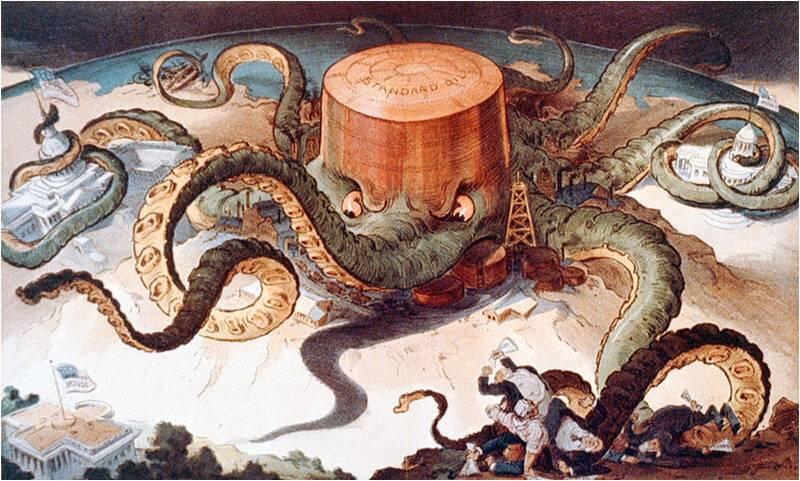
This is an anti-trust art. This one specifically protests against Rockefeller’s standard oil published on September 7, 1904. The image claims that Standard Oil grew to such extent to be able to control the government shown by its tentacles holding the capitol. Standard Oil controlled about 90% of the U.S. oil industry, and Rockefeller was the richest man at the time. Today, there’re anti-trust laws, but this picture may be still relevant today because new monopolies may emerge at any time. On top of that, lobbying is still present and tolerated in the U.S, and large companies can still influence government decisions.
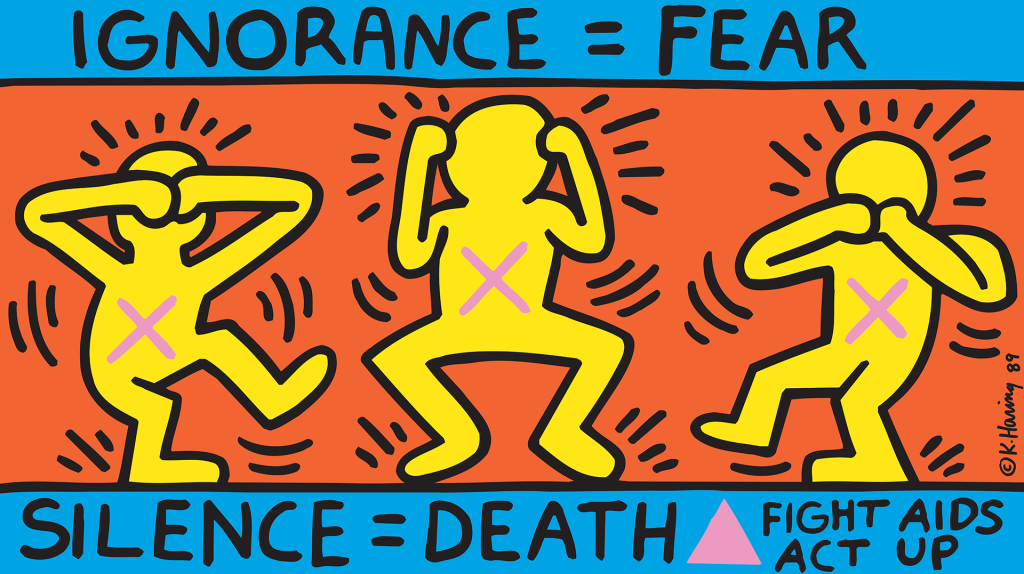
This piece “Ignorance=Fear, Silence=Death,” was made by Keith Haring in 1989, during the AIDS crisis. HIV was a deadly disease that emerged in the early 1980s, primarily affecting gay men. The disease caused rapid immune system failure, and over 700,000 individuals died from AIDS. HIV was transmitted through the sharing of needles, sexual contact, and from mother to child transmission. There was widespread misinformation about the disease leading people to avoid even touching someone with the diagnosis. It led to the isolation and discrimination of people with AIDS, often paired with intense homophobia. Keith Haring was an openly gay man who contracted HIV during this epidemic, two years after his diagnosis he died of the disease. This piece was a deeply personal way of illustrating how misinformation and biased hatred impacts the human soul more than any disease.The big red X’s one the characters illustrates that when someone is diagnosed with the disease they are turned into a target for dehumanization. Act Up was an AIDS activist group during the time period. The piece was to encourage the public to stay informed because ignorance kills.
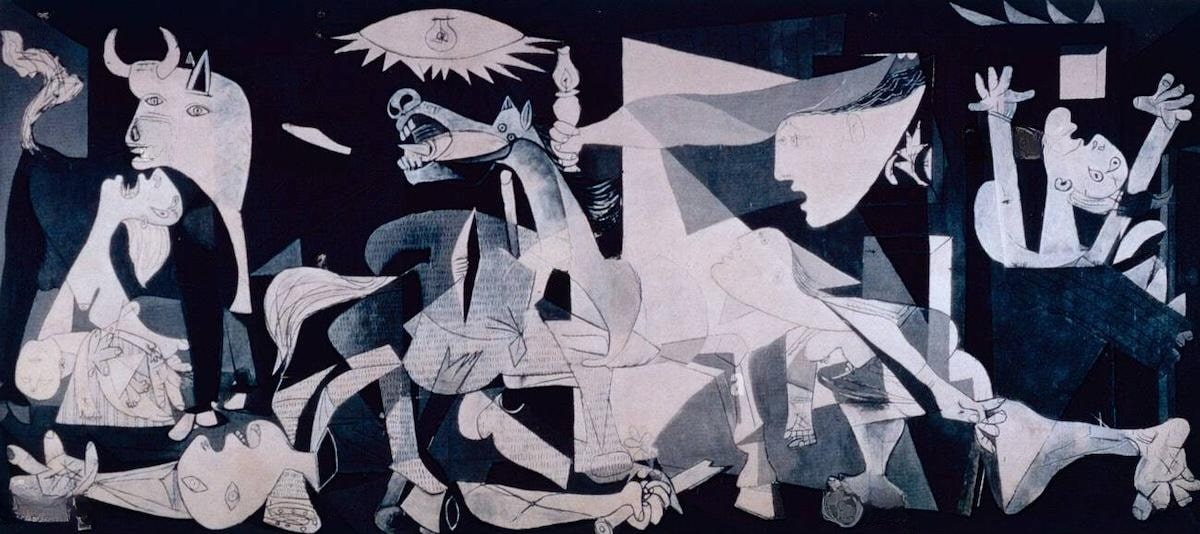
The image above is a photo of “Guernica.” This is a piece by Pablo Picasso and it is meant to be an anti-war piece, highlighting the terrors of war. Picasso painted this as a reaction to the Nazi bombings on the town of Guernica during the Spanish Civil War. This became one of Picasso’s most famous and influential works, even becoming one of the most famous anti-war art pieces in history. The lack of color and chaotic arrangement of the piece is meant to show the brutal reality of war. I think this piece is very relevant in today’s world as political and social unrest of very heightened, which can easily lead to war, something that has already happened in certain parts of the world.
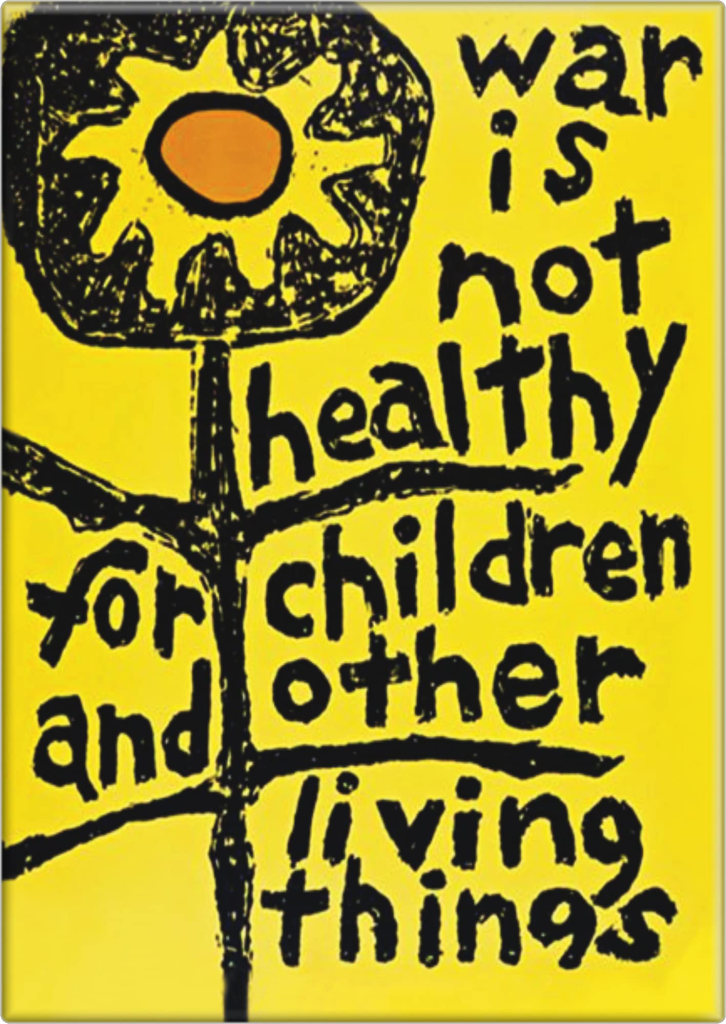
This poster was created in response to the Vietnam War. The way that the words are written and the sunflower was drawn, was done to resemble a child-like creation. This style was intentional to gain a stronger grasp on the audience as children are seen to be vulnerable and worthy to protect.
This poster was made by Lorraine Schneider, who was a part of an organization called ‘Another Mother for Peace.’ This organization sought out to educate women about taking an active role in eliminating war. This piece is a product of Schneider’s participation in the association.
I think this poster is highly relevant today because of the amount of war and conflict around the world. Similar to the reaction to the Vietnam War, there is an immense amount of opposition to the violence and division that’s occurring. I think this poster can still have a major effect on society because it calls to action issues happening in current events.
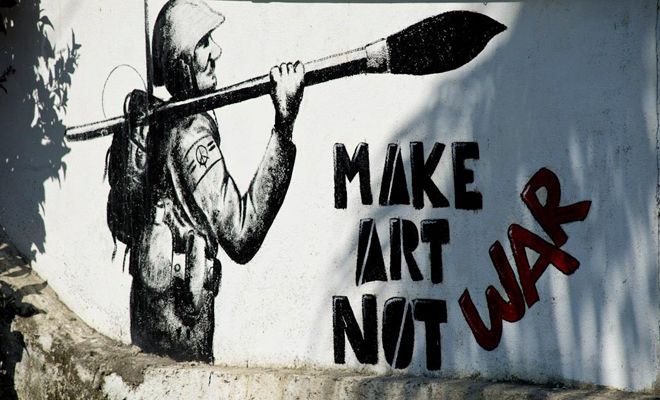
This art work is more of a graffiti/mural style piece. The phrase plays on the words “make love not war” that was a very popular slogan in the 1960s. The protest itself is against the Vietnam War. The artist is trying to portray the soldier, who is usually a symbol of war and aggression, as someone who can use his “weapon” as a tool for positive creation. The paintbrush, which used to be a rocket launcher, painted the word “war” in red to show urgency, while painting “make art” in black to make it calmer. The artist did this because counterculture at the time believed in carrying guitars, paintbrushes, and spray cans rather than guns. This protest art sent a powerful message of investing time into beauty and imagination rather than death and destruction.
I believe that this protest art can still be relevant today. Whether you are talking about a physical war between countries, or an internal war within our own country, many believe that we should focus on peace. Today, it can be used to show that we could fight battles with expression and creativity rather than with violence and death. The world today continues to face violent conflict and political unrest just like it did during the Vietnam War. Artists today use their art to protest the detestation costs of militarism in the Middle East and Ukraine.
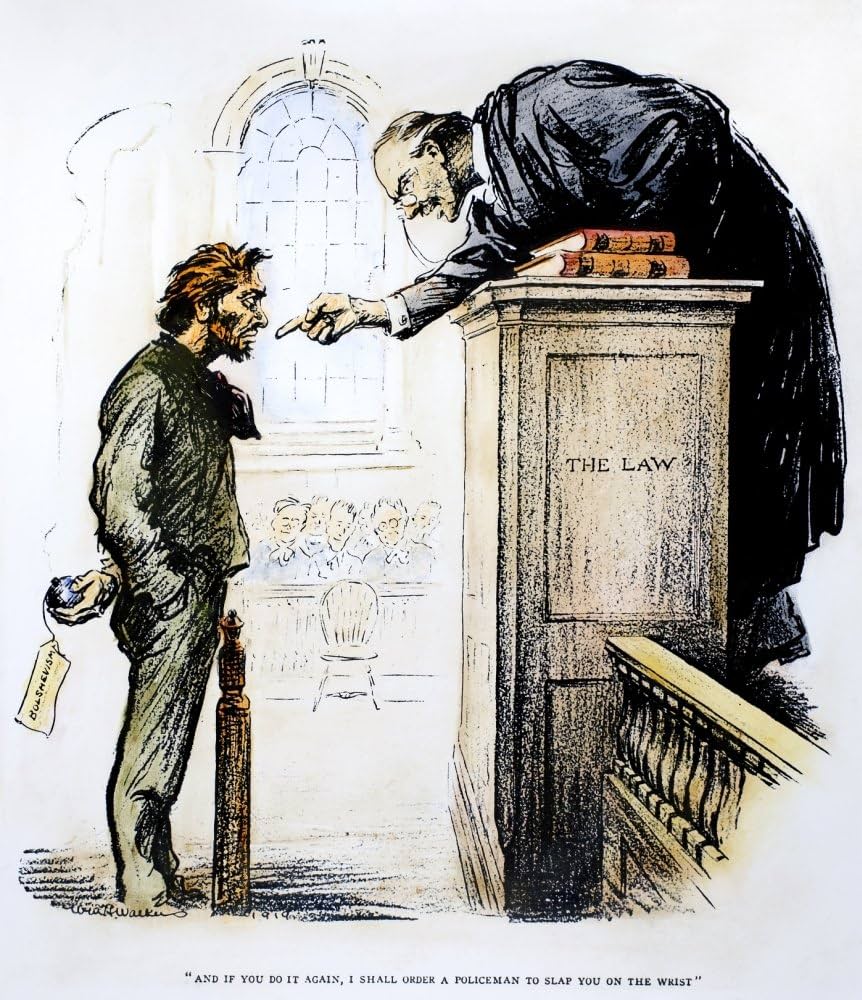
The image I have attached below depicts a pro-communist protester being given a light sentence while concealing a bomb with name “bolshevism” behind the individual, hidden such that the judge cannot see it.
This artwork was published either at the beginning or height of the Red Scare of the late 1910s, in which there was mass upheaval inside the United States due to the sudden rise of marxism-leninism in Eastern Europe; there were riots and counter-riots fought between anarchists, communists, police, and those who believed that any of the previously listed groups posed an existential threat to the United States’s way of life. The artwork shown fits directly into this context; an individual who clearly has some involvement in pro-communist terror, fake or real as it may be, being given a punishment that is incredibly light (literally a slap on the wrist). This artist is clearly dissatisfied with the state of affairs in courts, and likely aims to further fuel the Red Scare in order to trample out any supposedly bomb-wielding communists.
This theme is readily applicable to the modern American political climate and our nation’s present state, as people from both sides believe that their opposition, often portrayed as violent and radical, is not being punished enough and poses an existential threat to the United States’s cohesion and wellbeing. As the magnitude of our nation’s polarization increases, so too does the call for overwhelming, often extrajudicial, force to quell any opposition (for fear of the future danger it may pose).
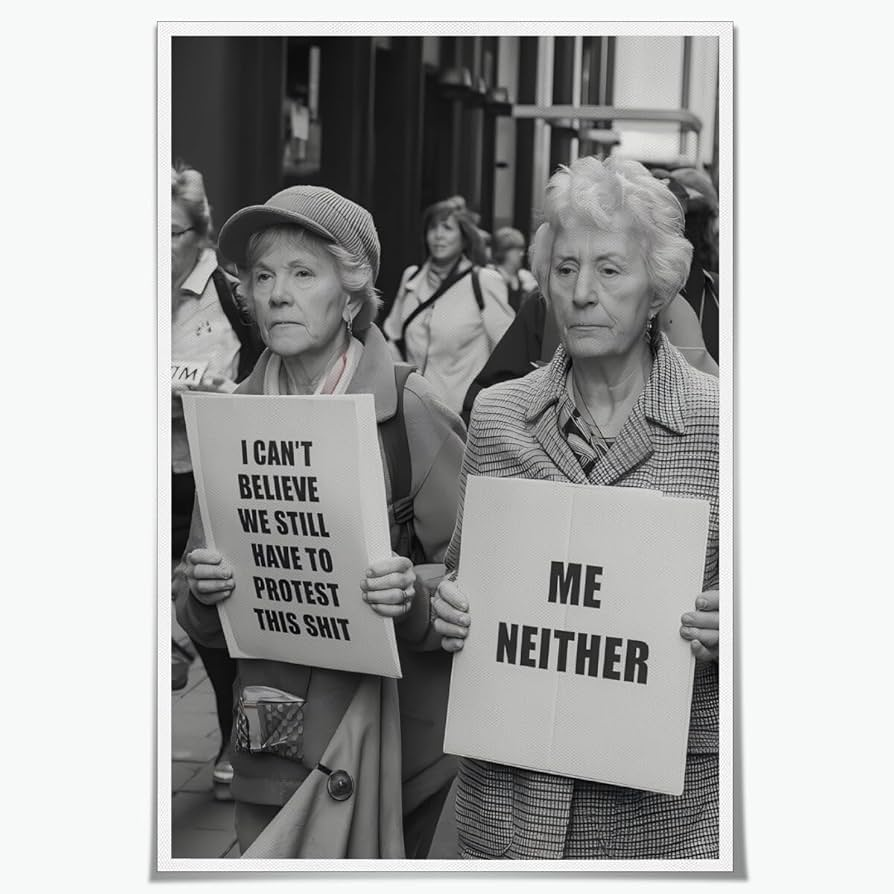
I couldn’t find the context surrounding this image because it wasn’t linked to an article and didn’t have a full description. I’ve seen it before and believe it’s to do with a feminist cause. Regardless of its context though, I think the meaning is applicable to almost every issue concerning our world today.
This shows how many issues (not just concerning women) took a long time to actually be resolved. Some are still being fought for today or they have to be all over again. I think this is still relevant because there’s so many injustices concerning all marginalized groups that are so deeply rooted. I also feel like recently, we’ve taken a couple steps back. People have been fighting for this change for a long time before we were born and probably will still be while we’re here too.
For this art trip I chose the Art lab open lab in snug harbor for many reasons. Firstly, it was free! You know the saying, if it’s for free it’s for me. Also, it was much closer than the art on paper fair located in Manhattan. In fact, it’s about a 30-minute drive from my house. Compared to the art on paper fair which would have taken me 2 hours by public transportation. I truly loved the concept of the Art Lab open lab. Not only do you get to see cool art, but you also get involved and try making art yourself. Another aspect of this that I loved is that the art labs are guided and that was very cool to me. The first station that I came across was the ceramics station. I have always seen people online effortlessly make mugs and vases and beautiful pottery. This was definitely not the case. Making pottery is a lot harder than it seems. It gets very messy and it is much harder to make a perfectly round bowl than it looks. The next station I saw was the art of gelli plate printing. I didn’t even know what gelli plate printing was until I saw this. Apparently, it is a technique that allows you to transfer images or leaves or whatever you want onto a soft jelly plate/surface by using acrylic paint. This technique reminded me of that hack that lets you do french nails by painting some nail polish onto a jelly like sphere and just pressing your finger into it. It was the same idea of image transferring. I also came across a station about painting. It was basically just a lady explaining the fundamentals of painting which was nice. The t-shirt station I passed by also looked awesome. I saw some kids coloring in their t-shirts that said “Art Lab” on the front with markers and I thought it was very cute. I really liked that this lab was open to everybody, people of all ages. Overall, I really liked this fair. While there was art on the walls, I didn’t pay much attention to it due to the interactive nature of the lab. The lab allows those who would like to just come and see art to see it and enjoy it, but it also introduces people to techniques and art that they may not have encountered or tried before.
On Saturday, September 13, I had the opportunity to do and experience new things about art that I had never had the chance to do before. These experiences were are the Art Lab Open House at Snug Harbor, which had so many amazing opportunities in art. As someone who doesn’t know much about art and is not very creative or artistic, it was honestly a very fun experience and made me want to branch out and try more creative and artistic things.
In order to arrive early and find parking at Snug Harbor, I arrived around 10:40 AM, early enough to find a singular open parking spot in the many parking lots of Snug Harbor. Best of all, the person parked next to me was crossing over the line, so I had to pray and hope that the person next to me would not scratch or dent my car (they didn’t 🙂). I arrived to the Art Lab Open House around 11 AM, and I was able to join into the growing group of students who were also attending the Art Lab.
We began our time at the Art Lab by choosing to do ceramics. The teacher was a very nice and funny person who made soooo many cool pieces of art. I wish I took a picture, but he made a very cool ceramic frog. The purpose of the class was to learn how to make a basic bowl out of clay, which I ended up half doing. At first, my bowl seemed more like a wobbly plate, but I ended up being able to make it into a stable bowl. I purposefully did not take a picture because my creation was horrendous.
After ceramics, the group separated and went into different partsof the Art Lab. A couple other students and I decided to go see the darkroom photography. The teacher was also a very nice person, he was very well educated on topic and had many cool photographs around the tiny studio that is hidden from the rest of the rooms in that building. He showed us his darkroom photography is done, which is basically through being in a room that is free from light and photographic films and paper, which are sensitive to light, are produced. I really enjoyed the part in which he put the photographic paper, which was blank after taking a photo to reproduce an image, in different solutions, and how the image would be formed in a matter of a few minutes.
Although there was a painting lesson, I chose not to as to not embarrass myself, but it was fun to watch what the other students were painting. Instead, I decided to go see the gallery that was created. The gallery consisted of artworks done by the artists that led the lessons at the Art Lab. There were so many artworks, including tiny sculptures and paintings. There were lots of paintings depicting Staten Island, which I have never seen before. One of my favorite pieces from that gallery was one that reminded me of Staten Island, especially the marina and the shores at Great Kills Harbor, which was a spot that my friends and I liked to hang out after school a lot, so it reminded me of high school and the fun memories I made.
That was the end of my experience at the Art Lab at Snug Harbor. It was a very fun and interesting experience, as it made me want to immerse myself in the world of art. When we left the building, my mom called me and informed me to pick up my sister from Polish school, which cut my time from being with the rest of the group, which went to go see the Fence Show. However, when I got to go pick up my sister, she decided to let me know (after I got there) that she is going to her friend’s house, so my time was wasted and could’ve been more valuable at the Fence Show. But it’s okay because I got home and took a very good and very much needed nap.
On Saturday, September 13th, Snug Harbor hosted a fence show and open house for their Art Lab. The open house had many different demo classes that were open to the public and free to take. They had a class for you to paint still-life, sculpt ceramics, learn about dark room photography, and lots more.
When I got there, I saw many others from my group. We all walked in together, signed up, and went to take our first class, ceramics. The teacher was really nice. He walked us through every step that we needed to do. He taught us how to work with clay and create a base which can be used for many different projects. I really enjoyed this becuase it was fun molding the clay and creating something from my hands. It didn’t turn out the best but I didn’t care. Below is a picture of a bowl I made.
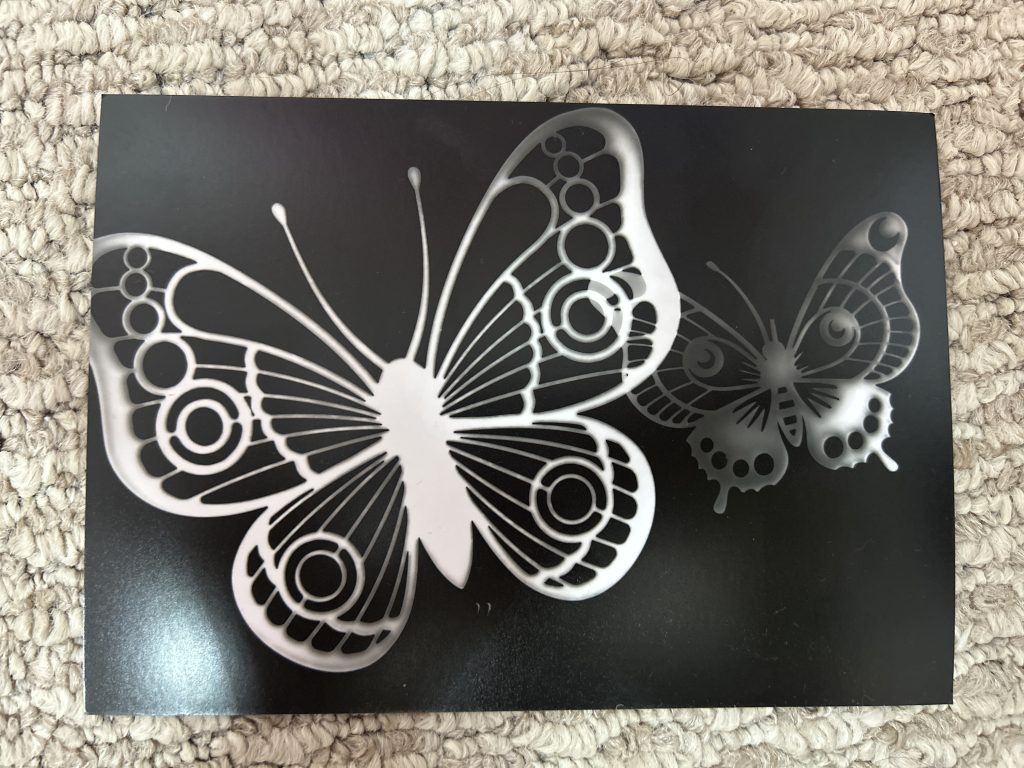
After ceramics, I went into a class that taught us about dark room photography. The room seemed empty whenever I passed it but then when me and a couple others from our group went in another group entered and it was crowded. The instructor taught us that the photo is created by exposure to light so you create a negative which is a film with the photo inverted and expose it to light, the time that the photo is exposed to the light varies from photo. Then you put the photo in a chemical bath and stop solution that will develop the photo. At the end, we were able to create our own photos with wooden sencil of butterflies.
After the open house was over, I walked around the fence show. I was amazed seeing all of the art hanging up and the different pieces and styles that people had created.