
This is a gallery curated by you, the students taking part in our Night at the Museum. Make it your own!
To have your own response appear on this page, form a group and submit a response.
-

Niagara
Louis Rémy Mignot
1831-1870
What do you see going on in this work of art? Is there a story depicted?
The things we see going on in the art work is the Niagara falls and at the top of the falls we see waves crashing. In the background we also see a sunset that makes the sky appear orange. When the waves are crashing and the falls are descending it Emmits an illusion of a small cloud. The story being depicted is that life can be unpredictable at times and even though life can come crashing down on us it expresses to us that sometimes we need to focus on the small good things while facing obstacles since it will remind us that there is a end goal.
What different visual elements (ie: line, color, light, proportions, scale, composition, media type etc.) do you notice, and how do they help you make sense of the artwork?
Some visual elements we noticed was the lighting was different in the sunset while the lighting of the waves was darker compared to the lighting in the sunset. This caught our attention our attention because it highlighted the way chaos and peace can be represented. The scale of painting captured a huge and significant part of Niagara falls. Even though the scale failed to capture all of Niagara falls it did depict the important feature such as the sunset, waves crashing, the water fall and the small clouds moving in.
How does this object compare to other objects, stories, or ideas you already know about?
Compared to other nature paintings this one revealed more clearer messages than other paintings. This was the painting in where we can see the lighting between half the painting was different compared to the other half. This painting was also well placed underneath the picture of the Brooklyn Bridge because it depicted the difference in nature after civilization was established and before it was established
What choices do you think the museum made about the object’s display?
The choices the museum made for this display was the lighting since it helped the audience pay attention to the differences in the lighting of different part of the painting. The placement of the painting was well executed because it revealed a real life problem of how civilization has affected how much nature has changed due to the establishment of cities
Group Members
Ronald Orellana, Natalie Narine
-

Shoe shine
Ernest crichlow
1953
What do you see going on in this work of art? Is there a story depicted?
Although this piece is simple in its nature, depicting a boy staring off I t
Group Members
Areeba Ali
-

Woman with Bouqet
Laura Wheeler Waring
1940
What do you see going on in this work of art? Is there a story depicted?
In this work of art I can see a portrait of a black woman looking to the side. She has her right arm on her waist almost as if she’s just waiting for the portrait to be over. Or something else that may not be so apparent at first glance. In her left hand she holds a bouquet of zinnias. The vibrant colors of the flowers which are red, yellow and orange are also apparent in her blue sundress. Poking out of the bouquet is a single pink flower that matches the also pink draped fabric in the background of the portrait. There is definitely a pattern visible in this piece. And with the facial expression the woman exudes, there is a story being portrayed.
What different visual elements (ie: line, color, light, proportions, scale, composition, media type etc.) do you notice, and how do they help you make sense of the artwork?
There is a lot of vibrant color in this piece. The red, yellow, and orange color of the flowers that are repeated as a pattern on the woman’s dress easily stands out. The only single pink flower that matches with the fabric in the backdrop stands out. All these colors that pop out isolates the pendant the woman wears as well as her gaze into the distance. Focusing on these two factors significantly help me understand the story being told here.
How does this object compare to other objects, stories, or ideas you already know about?
This work of art compares to other stories and ideas I know about in terms of the way the flowers are actually symbolism and the gaze expresses a thousand words.
What choices do you think the museum made about the object’s display?
The museum was definitely meticulous in how they put this art work on display. Not only are the colors on the wall that this painting is placed on matches the color in the art work. But also, a deliberately placed explanation of what it means to “give flowers” to the left of the painting. The color of the wall enhances the art’s beauty overall, as it blends in and extends the art to the entire side of this wall. And the explanation helps convey the overall message of this work.
Group Members
Me, myself, & I. (Nana Boateng)
-

The Great Deep
Frederick J. Waugh
1909
What do you see going on in this work of art? Is there a story depicted?
The artwork depicts uneven waters deep in the ocean with nothing else around.
What different visual elements (ie: line, color, light, proportions, scale, composition, media type etc.) do you notice, and how do they help you make sense of the artwork?
There is a good use of perspective and depth in this painting that makes it look very realistic. The hyper accuracy of detail shows the flow and violence of the water while not adding additional outside elements to the piece
Group Members
Maxim Korobov & Emmanuel Nudelman
-

Écorché
Daniel Huntington
1848
What choices do you think the museum made about the object’s display?
This piece of art is situated beneath two others that complete a series. It displays one of three layers of the human body: skin, muscle, bone. Each piece of art is impressive on its own, but come together to form a rather cohesive whole. The artist intended the three pieces to go together which is why they are positioned in this sequential format. In the top piece, which focuses on the skeletal layer, we can see an outline of the skin layer which proves connection between each layer. Most surprising was the fact that the pieces are all made using crayon.
Group Members
Uyen Pham, Elizabeth Guerrero
-

Bound
Kehinde Wiley
2014
What do you see going on in this work of art? Is there a story depicted?
In this work of art, three different statues of women are all intertwined with their hair. The story that it depicts is that they are interconnected with each other and with nature. It also depicts stoicism.
What different visual elements (ie: line, color, light, proportions, scale, composition, media type etc.) do you notice, and how do they help you make sense of the artwork?
The triangular positioning of the women portrays a strength, as the triangle is the strongest shape, and their positioning with their backs to each other demonstrates unity and community protection. The material, bronze, maintains the sculpture for centuries, showing generations of Black women the respect they should give themselves & their hair.
How does this object compare to other objects, stories, or ideas you already know about?
This object is more interactive compared to other pieces of art like paintinga. It has moving pieces, is more modern and our group believes it connects to Medusa and a tribute to the feminist movement.
What choices do you think the museum made about the object’s display?
The museum placed this object at the entrance of the room, captivating the attention of the passers. Just like we mentioned medusa earlier, this statue freezes you in your tracks so you can appreciate the power of femininity in different cultures.
Group Members
Kaliopi Tsiros, Ekaterinburg Vasiuk, Maya Ford
-

The Acadians in the Achafalaya, “Evangeline”
Joseph Rusling Meeker
1871
What do you see going on in this work of art? Is there a story depicted?
This painting gives us the feeling of looking into a paradise. There is a mysterious haziness behind the painting.
What different visual elements (ie: line, color, light, proportions, scale, composition, media type etc.) do you notice, and how do they help you make sense of the artwork?
The most prominent element in this painting is the color. On the right side of the painting, the colors are brighter and more vibrant, while on the left side, the colors are darker and a bit eerie. In addition, the light colors in the back give off a sense of mystery. We believe that the depth of color can, to a certain extent, convey the meaning of the painting.
How does this object compare to other objects, stories, or ideas you already know about?
Compared to the paintings we know and have seen, it is actually difficult for us to judge them because each painting is unique and exquisite. To be honest, my friend and I had different views when we first saw this painting. I saw a bright and beautiful paradise, while she saw the gloomy other side.
What choices do you think the museum made about the object’s display?
The museum may have made some strategic choices about the display of the exhibits to enhance visitor engagement and comprehension. They may have chosen a prominent location for optimal visibility and accessibility, ensuring that the exhibits capture visitors’ attention as they move through the space. Accompanying text and labels may have been carefully crafted to provide context, offering historical context and meaning without overwhelming visitors. Overall, these choices reflect a balance between aesthetics, education, and preservation.
Group Members
Zhenhua Tan, Jiahe Xu
-
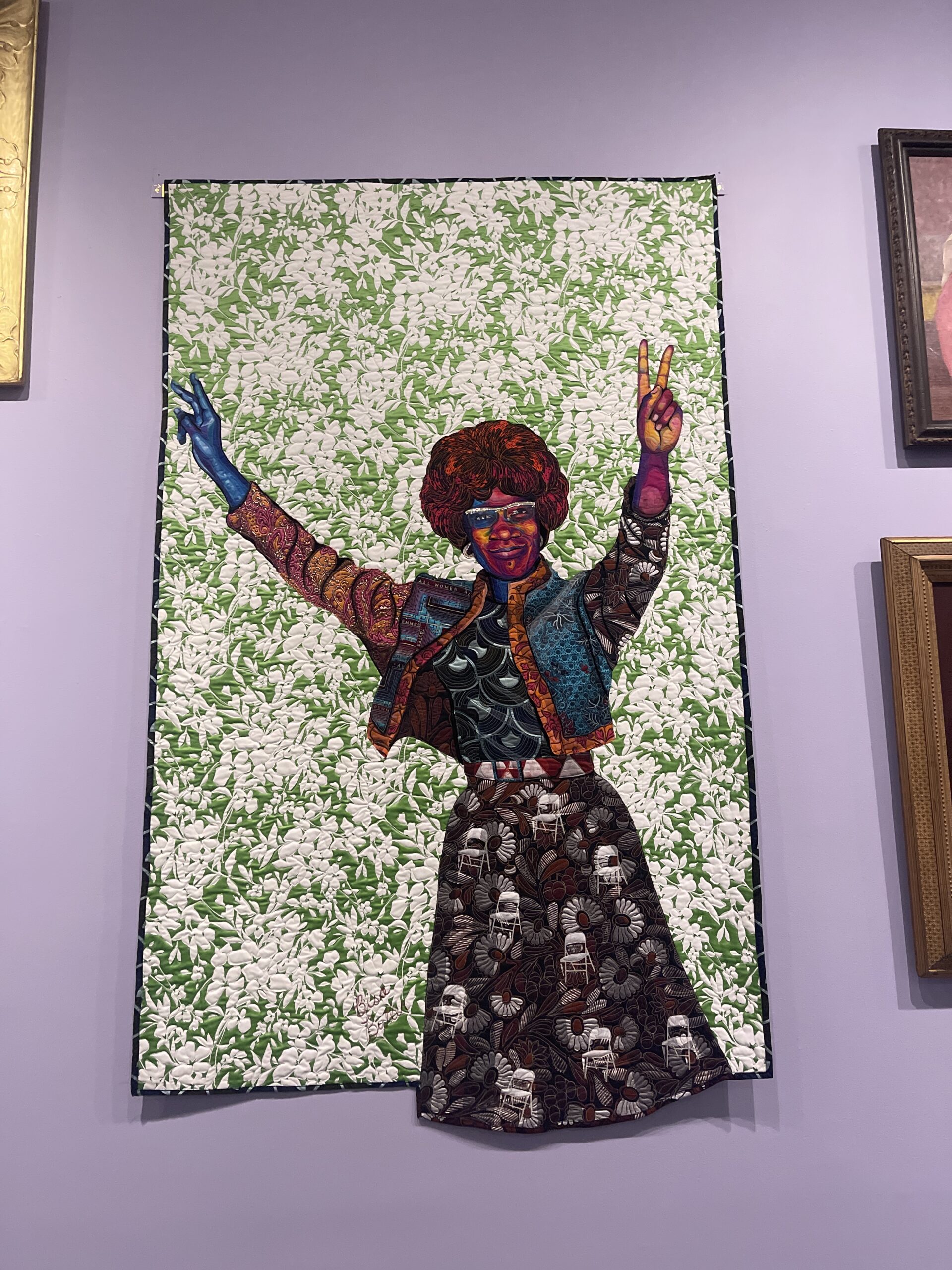
Bring a Folding Chair: A Portrait of Shirley Chrisholm
Bisa Butler
2024
What do you see going on in this work of art? Is there a story depicted?
There is an African-American woman with her hands in the air, wearing sunglasses and a skirt that comes out of the portrait. There are folding chairs on her skirt, and a variety of textures on her clothes, and general body.
What different visual elements (ie: line, color, light, proportions, scale, composition, media type etc.) do you notice, and how do they help you make sense of the artwork?
There are many colors and patterns, especially on her outfit. The background has a splotchy pattern, with white and green. The woman is big in proportion to the canvas size.
How does this object compare to other objects, stories, or ideas you already know about?
This seems related to the folding chair that is also in the exhibit. The story here is to demonstrate the lack of rights that black Americans had in the United States, going as far as to deprive them of sitting privileges.
What choices do you think the museum made about the object’s display?
It is surrounded by other portraits, but speaks out the most in terms of color and size.
Group Members
Kejsi Metko, Samira Hasan
-
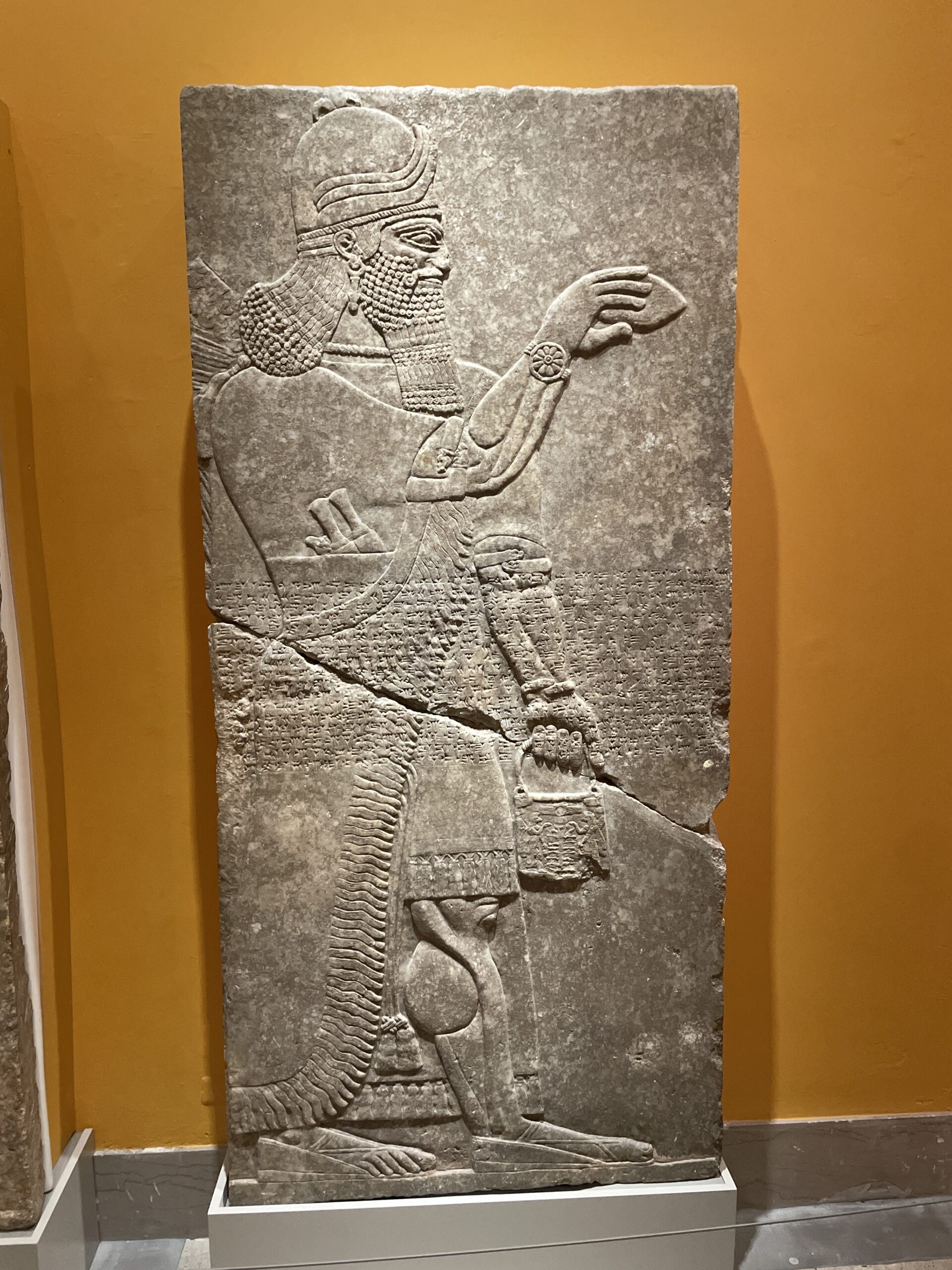
Apkallu-figure with Armlets
N/A (Neo-Assyrian Period)
883-859 B.C.E.
What do you see going on in this work of art? Is there a story depicted?
We believe that the carvings depict the ancient Assyrians performing religious rituals to their gods.
What different visual elements (ie: line, color, light, proportions, scale, composition, media type etc.) do you notice, and how do they help you make sense of the artwork?
We noticed lines across the tablets which we hypothesize to be an ancient text – a language spoken by the Assyrians. The text likely resembles a mythological story or historial event. It seems like we are standing in the temple itself.
How does this object compare to other objects, stories, or ideas you already know about?
We first heard of the Assyrians through the Torah/Bible. It’s interesting to see them in a different light.
What choices do you think the museum made about the object’s display?
We think it was good choice to take this to the museum because the remaining palace reliefs were destroyed by ISIS in 2015.
Group Members
Batya Yelloz, Jason Chen, Daniel Bahr
-
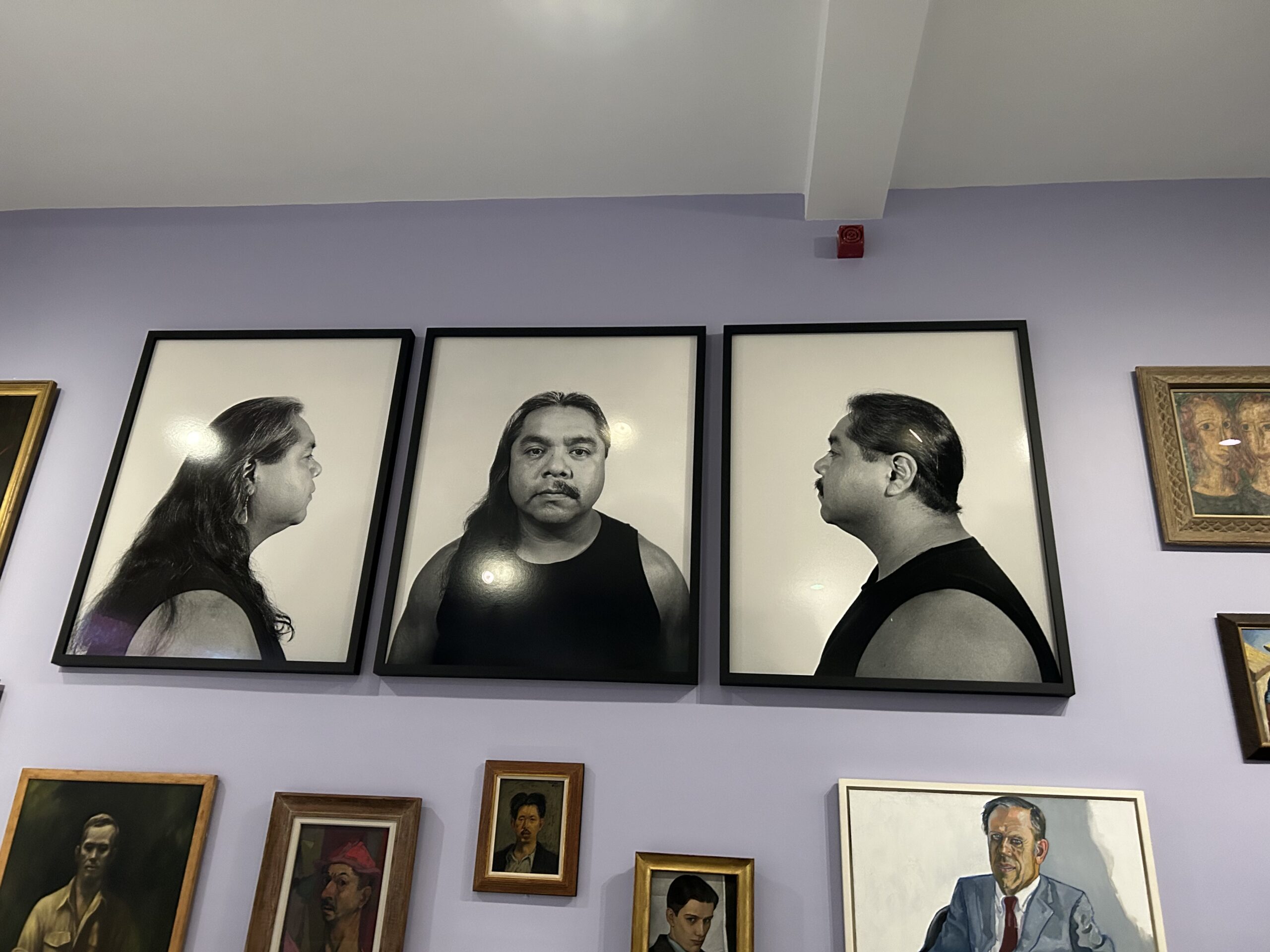
Half Indian/Half Mexican
James Luna
1991
What do you see going on in this work of art? Is there a story depicted?
Luna makes an astounding commentary on the duality that is possible of man. Luna shows us two sides of the same face, one side his Native background and one side his Mexican background. The sides look like two different people, so Luna ties them together in the middle, with a photo of the subject looking right at the viewer. It’s less of a story, more of a social commentary on the ‘norms’ we set and how easily they can be shattered.
What different visual elements (ie: line, color, light, proportions, scale, composition, media type etc.) do you notice, and how do they help you make sense of the artwork?
The black-and-white palette highlights the blend of identities. Bold lines define cultural symbols, showing both separation and connection. Without color, the focus shifts to essence.
How does this object compare to other objects, stories, or ideas you already know about?
This artwork highlights how perspective is key in understanding complex situations. Just as you might think you see the whole story by viewing only part of it, true understanding often requires seeing the complete picture, like the forward-facing image in the center.
What choices do you think the museum made about the object’s display?
By placing the images at the center of the room and making them large, they immediately draw viewers' attention upon entry. This positioning encourages visitors to engage with the piece from multiple angles, reinforcing the idea that understanding is shaped by perspective.
Group Members
Kayla Wang and Aliza Zilberberg

