

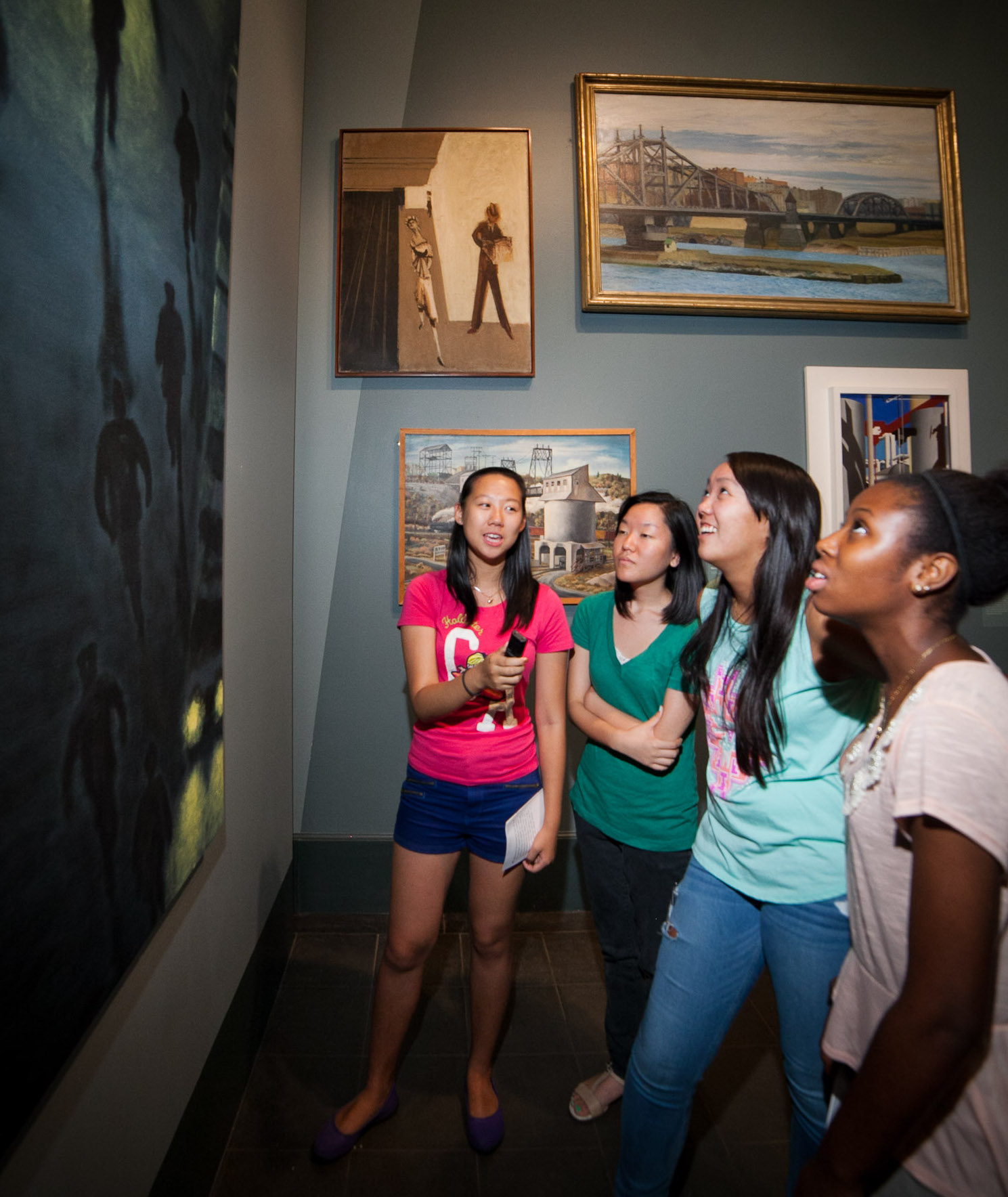
This page compiles your reflections on art, community, museums, and more, informed by your time at Night at the Museum.
To have your own reflection appear on this page, submit a reflection of your own.
Analog fan? You can also respond to these prompts on paper and peruse the responses of others. Come find our table on the third floor.
-
Choose a piece of art you saw that invoked strong feelings for you. Describe the response you had and why. (Don’t forget to include the title and artist.)
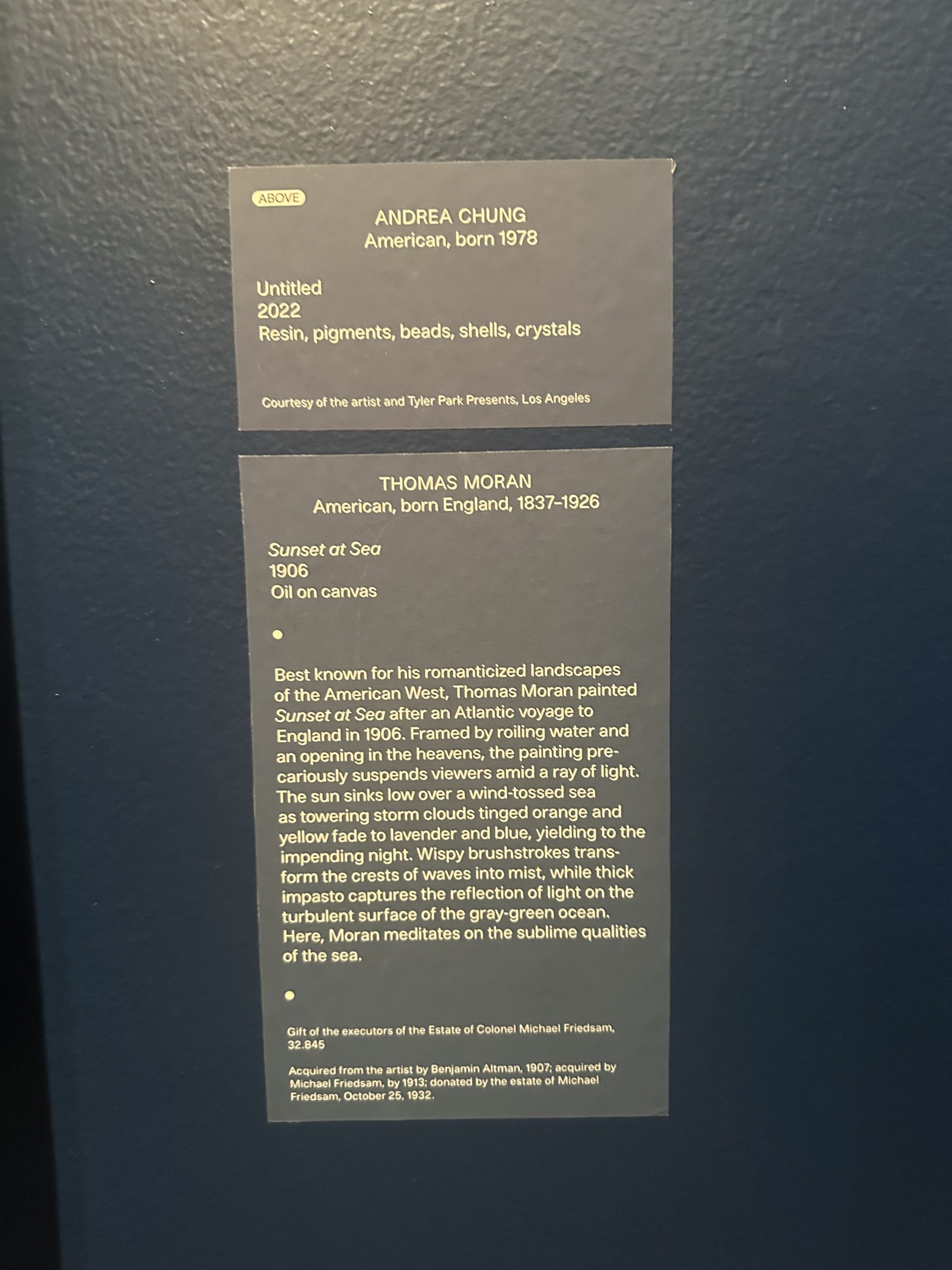
The piece of art that stood out to mee the most was Sunset at Sea by Thomas Moran. When I first saw the painting, I felt a deep sense of peace and calmness. The way Moran painted the waves and ocean made me feel like I was right there, watching the water move gently under the glowing light. The sunset in the background adds warmth and creates a feeling of hope, as if the light is shining through after a long storm. The mix of dark waves and bright sky reminded me that even in rough times, there’s always light ahead. This painting made me stop and think about the beauty and power of nature.
Osmar Mendez
Lehman College
-
Choose a piece of art you saw that invoked strong feelings for you. Describe the response you had and why. (Don’t forget to include the title and artist.)
A piece of art that invoked strong feelings for me was Faith Ringgold’s “For the Women’s House.” The painting was created for women incarcerated on Rikers Island. In her painting she depicts women as different professions. The mural was created in an attempt to make these incarcerated women feel that after prison there is hope. For me, this image did a great job at conveying this idea of hope as it was really powerful to see. It shows positive representations of women and is really telling of the year it was made, 1971. Women had been in an ongoing fight for equality and I see that displayed here. This painting shows that women are capable of anything. Through Ringgold making this for incarcerated women, it’s actually quite powerful as it reveals they still have the opportunity to achieve greatness despite the current situation they are in. The colors of the painting also drew me in and made each woman stand out more. Overall, the piece really stuck with me.
Shivani Hardat
Baruch College
-
Where and how do you see yourself, your communities, and/or New Yorkers in this museum?
I believe that many of the art pieces in the museum showed people who look like me and other people of different backgrounds and communities. Which allows for me and other people to fill the inclusivity. I was able to see paintings of Black people, and there were many paintings created by people of color.
Queens College
-
Compare how this experience reinforced or challenged your previous ideas about museums. Would you encourage other Macaulay students to visit museums?
Before high school I wasn’t interested in museums because I thought they were a hassle to reach and required a level of intellectual thinking I did not want to engage in. But in high school I was often encouraged (with extra credit) to visit and by being more exposed, exploring, and participating in other fun events in my own time (like the MET TEEN TAKE OVER) I’ve become more excited about them. This visit further reinforced this because of all the cool art I could reexperience/relate to other art and new art to dissect. I would 100% encourage ANY person to visit a museum.
Natalie Parong
Hunter College
-

Where and how do you see yourself, your communities, and/or New Yorkers in this museum?
I see myself, my community, and New Yorkers reflected in the museum through the Portrait of Henry Abbott because the painting represents a deep respect for learning and cultural preservation. Like Abbott, who collected and shared pieces of ancient Egypt with the public, we too are passionate about understanding where we come from and honoring the diverse stories that shape our identities. The painting stands as a symbol of curiosity and admiration for the past, which mirrors how my community explores different cultures and histories, not just our own, with an open mind and appreciation.
In a city as diverse as New York, the museum becomes a shared space where people from many backgrounds can find connection through these stories and artifacts. Abbott’s portrait, though depicting a 19th-century collector, reflects a broader spirit of the drive to learn a wide range of cultural heritages and show not just the past, but also mirror the present.
Zara Gingishvili
Brooklyn College
-
Compare how this experience reinforced or challenged your previous ideas about museums. Would you encourage other Macaulay students to visit museums?
Honestly, I have never been a fan of Museums. I think they are a waste of time. If I wanted to go look at art, I could always just search it up on Google and look at pictures online. However, I think my issue was that I never went with the right people. Tonight I honestly had a lot of fun at the museum, even if my friends and I were making fun of the pieces of artwork. It got us to look at them more deeply, and a new perspective, even if it was just to find a different way to make fun of the artwork. It was a great experience, and overall, I had a lot of fun. The Brooklyn Museum has a great array of artwork that was truly amazing to look at.
Thomas Solimeo
Baruch College
-

Choose a piece of art you saw that invoked strong feelings for you. Describe the response you had and why. (Don’t forget to include the title and artist.)
Sarah Cowell LeMoyne, painted by Jane E. Bartlett invoked strong feelings because her assertive gaze initially caught me off guard. After reading the description, her confident posture made sense in the context of an uprising female celebrity in the 1870s. Her expression reflects a sense of individuality that was uncommon for women of her era, challenging traditional expectations of femininity.
John Jay College of Criminal Justice
-
How would you relate your current major or field of study to your experience at Night at the Museum? What connections can you see?
I could see my intended field reflected everywhere throughout the museum. I intend to go into law, specifically civil rights law. One of the biggest reasons I want to enter this field is to advocate for people who have been marginalized, misrepresented, or forgotten. The entire gallery was, in a way, advocating for these groups by exposing the truth of their history, contributions, and cultural significance. One piece I think did this well was the “Cultural Burdens Basket” by Carol Emarthle-Douglas, which acknowledges the importance of native women in preserving native culture.
Maria Syville
John Jay College of Criminal Justice
-
How would you relate your current major or field of study to your experience at Night at the Museum? What connections can you see?
As a computer science student, my experience during Night at the Museum made me realize how technology can work towards making history feel interactive. While passing through each exhibit, I noticed a tablet with art and information displayed, which really surprised me because I’ve never seen technology like this at museums, let alone museums allowing photography. It also reminded me of the common misconception people have about computer science being strictly about numbers, but creativity and storytelling are huge parts of it.
Atiqa Ullah
Hunter College
-
Choose a piece of art you saw that invoked strong feelings for you. Describe the response you had and why. (Don’t forget to include the title and artist.)
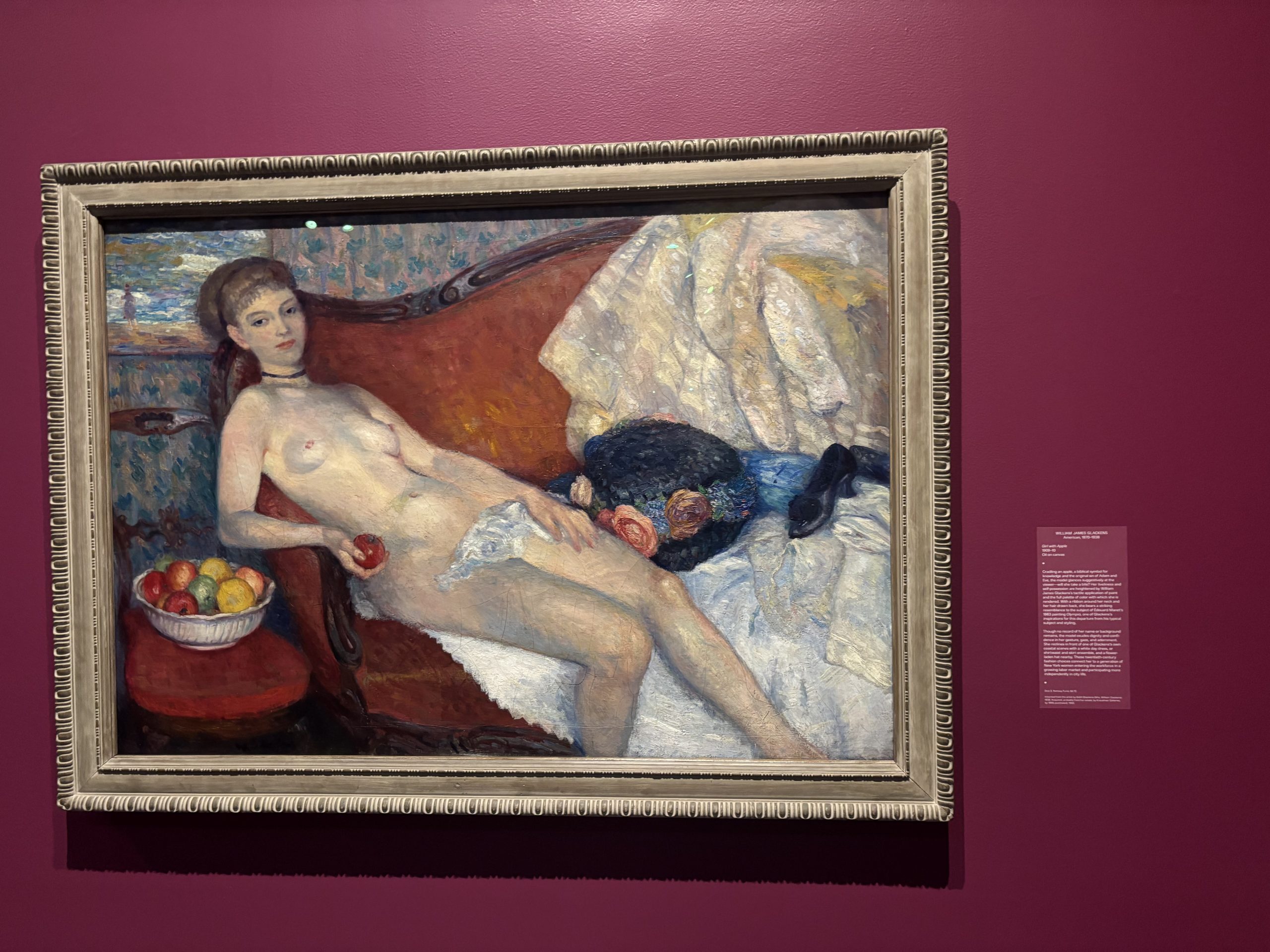
William James Glackens’ Girl with Apple transfixed me because I originally thought it was Manet’s Olympia. Her pose and choker reminded me of Olympia. Unlike Olympia, though, the girl with the apple is not to remain nude. The girl portrayed in this painting seems more independent, even more departed from the Birth of Venus than Olympia was. While Olympia was implied to be a prostitute, the girl with the apple has her clothes laid out beside her. After reading the painting’s plaque, the aforementioned ideas became even more apparent to me. The apple she holds symbolizes knowledge and the clothes are those of a New York woman entering the workforce. The nude woman that started this chain of paintings, Venus, stood shamefully in front of the male gaze, concealing what parts of herself she could. She was painted to look innocent and vulnerable, and Olympia contrasted this by being painted to look confident and confrontational. Both Venus and Olympia were sexualized, but one was fantasy and the other reality, and seeing the latter painted made many viewers uncomfortable. To me, it felt as though both images were made for the male gaze, with the former catering to it and the latter challenging it. The image of the girl with the apple seems to be more empowering for women, her nudity transformed into a prideful and comfortable gesture, for once. She barely bothers to conceal herself, a cloth instead doing it for her. She seems to encourage female viewers to do whatever they want (work, learn, be naked) in a time when women were beginning to gain more freedom and enter the workforce. It is up to her what happens after the moment depicted in this painting, and unlike in the two that precede it, the girl is not vulnerable to men in any way.
Vivienne
Queens College

