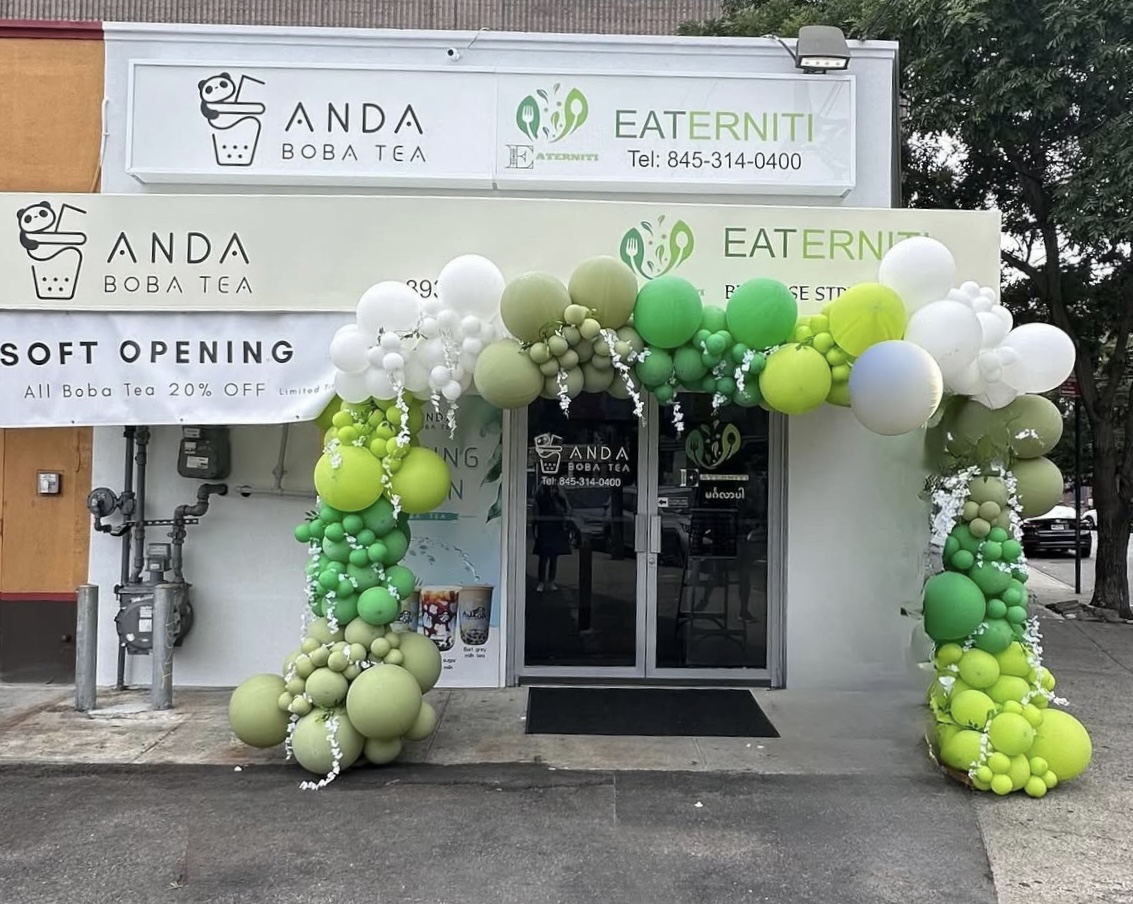
On the bustling edge of Elmhurst, across the ever-so-busy Queens Center Mall on Queens Boulevard, emerges a new small-scale restaurant that serves authentic Burmese food alongside a franchise of bubble tea. Inside, you’ll find a line of only six chairs facing the window, a charmingly decorated serving counter, and an open kitchen where customers can watch their food meticulously prepared by the owners, Amber and Frank.
Amber and Frank, two of the four owners, have been lifelong best friends and were the original planners of Eaterniti that launched its drinks menu, the Anda Boba Tea franchise, in July 2024 and the food in late October of the same year. Both having grown up in the Yangon region, the former capital of Myanmar, they chose to serve food that is widely recognized by the whole country.1 Myanmar, whose name was changed from Burma in 1989 (hence, the term Burmese), consists of many different ethnic groups that each have unique practices and cuisines.2 Eaterniti’s menu unites these differences into a generally popular and known selection of food regularly eaten by Burmese people back home, while simultaneously offering an enticing set for first-time tryers. The menu, although small, was mindfully selected and includes: street food starters, most notably the Burmese falafel and rice pancake balls; salads like the tea-leaf salad and ginger salad; noodles, such as the garlic oil noodle with chicken (SiChat Khao Sway) and the rice noodle salad with chicken (Nan Gyi); and desserts like the traditional Burmese pancake.
Eaterniti’s History
Amber initially moved to Maryland to continue her college education after an uprising in Myanmar, and returned in 2015 when the country reopened its borders after years of government conflict. Meanwhile, she looked into opening a restaurant in home region to represent her passion for cooking; however, during the following years, further violence within the country’s borders prevented her from continuing to pursue the restaurant business. The 2021 military coup ignited the present-day civil war between the government and the resisting pro-democratic force, which resulted in the displacement of millions of Burmese people.3 Amber, like many others, decided to move abroad for safety and better opportunities. She moved back to the United States, to Texas this time, and lived with her family members. In addition to the distress caused by war and the readjustment to a new country, Amber shares, “I was not planning on opening a restaurant, but I was always looking for opportunities. Then, me and Frank started talking again…Then, we decided to start small.”
Her business partner, Frank, has lived in the United States for over 30 years and is an experienced restaurant owner. He opened and managed a widely successful restaurant in Myanmar before moving to the United States, where he then opened a restaurant in Pennsylvania. Unfortunately, the second wave of the Coronavirus pandemic affected the restaurant and led to its closure. Frank, afterward, decided to move to New York City where he now works as an MTA driver. After a series of months and endless conversations with Amber, they both agreed to brave the New York restaurateur scene. While recalling this, Amber shares, “We did not know what to expect with the New York market,” and continues, “but we determined that New York has more demand for new cuisines, and that’s how we decided to start a small restaurant here.”

Risks Taken
Eaterniti emerged as one of the only two Burmese restaurants in the Elmhurst area and of only about 34 in the whole of New York City, according to a Google search. With a Burmese population of about 6,500, half of which is in Queens, according to the 2020 census, New York City initially does not seem to have a high demand for Burmese food.4 “I noticed there were many people who cook at home and do catering unofficially, but then there are not that many restaurants around here,” says Amber. “It’s a risk also. Especially with the food business after the pandemic, you never know what’s going to happen.”
The pandemic indeed had a dire impact on Asian cuisines as a whole, especially on East Asian and Southeast Asian food. Aside from the lack of foot traffic and customers eating at restaurants during the years of the pandemic, there was also a surge in harmful ideologies and stereotypical thinking about Asian food. A study conducted by New York University researchers found that during the months following the outbreak of Coronavirus, the resurgence of the ideology that “Asian cuisine is unclean and disease-bearing” caused Asian restaurants in New York City to receive more health citations than normally predicted based off the previous years.5 From heightening judgments and discrimination, a 56-fold increase occurred in unemployment claims filed by Asian Americans, mostly restaurant owners, during the peak of the pandemic.5 Dismayed and with fear, starting a new restaurant business, especially for Asian restaurateurs, has been considered drastically riskier after the pandemic.
There were more complexities to consider: how to effectively source the ingredients to make Eaterniti’s food as authentic as possible. “We try to get as much of the ingredients from here, but for some dishes, it’s just impossible,” shares Amber. For example, the ginger and mixed beans they use for the ginger salad must be imported directly from Myanmar. Amber emphasizes,“I mean, you can get ginger here, but the ones from back home, they are just different. We still like the ones from over there the best, even after we explored all the sources possible here.” Among the other ingredients they need to import from Myanmar include the roasted chickpea flour, which is one of the staple ingredients in their best-selling dish, the rice noodle salad. “Over here, you can get the ground chickpea flour at the Indian stores, but not the roasted one,” says Amber, “It’s also just very different.”
With the political situation in Myanmar, it was only recently that they were able to source their ingredients locally and import them here, albeit still with difficulty. Due to the protests and the military coup in February of 2021, shipping lines were suspended because of power shortages, and there was a significant decrease in the number of workers in the ports.6 The following month, Myanmar’s exports decreased by about 70 percent, which continued through the second quarter of 2023. This made it exponentially difficult for the current and prospective Burmese restaurant owners to deliver the authenticity of their food. If importing from Myanmar remains unreliable, how will they be able to continuously acquire their ingredients to follow the rigor of the restaurant business? This is a challenge that Amber and Frank, among many other Burmese restaurateurs, continue to face. Amber shares, “It’s hard to get [the ingredients] from back home, and it takes a while… Unlike Thai restaurants that have their own sauces and can actually import them here.”
This is one of the reasons why Thai food became one of the most well-known and sought-after Asian cuisines in the United States, among Chinese and Japanese food. Compared to the Myanmar government’s focus on the civil war, the Thai government “train[s] chefs and export[s] them everywhere around the world to open and work in restaurants…to stimulate tourism in Thailand… and standardize Thai taste around the world.”7 With plenty of trained professionals around the world, more Thai restaurants are able to open and garner success, especially in the densest cities like New York City and even the smallest towns. Not only are professionals migrating, but so are the regular Thai people, especially students, who are seeking better opportunities and education in the United States. Following that, many Thai markets have opened where restaurants and Thai folks can source their ingredients easily and more efficiently, instead of having to individually import them themselves. On the other hand, less prominent cuisines that cater to smaller populations within the United States have not been as privileged.
Perseverance into the Future
Although New York City is indeed a mosaic of cuisines from across the globe, many internal and external factors have inhibited the deserved growth of Burmese cuisine here. Amber and Frank’s leap of faith into this unfamiliar scene is an incredible testament of their passions and dreams, which is shared in similar ways by many Burmese cooks and restaurateurs. However, the city’s demand for authenticity, yet recognition is the ultimate challenge they face. Burmese restaurateurs, already treading the difficulty of acquiring ingredients directly from Myanmar, must deliver food that appeals to the palette of New Yorkers to ensure their success. From food descriptions stemming from similarities with other well-known cuisines, such as Thai and Japanese, to thorough explanations of their dishes, Burmese restaurateurs like Amber and Frank are unnecessarily held to a double standard.
In Anda Boba Tea and Eaterniti, Amber emphasizes, “Our goal is to introduce our authentic Burmese food with good taste and a good environment.” In the years to come, Amber is optimistic that Burmese cuisine will persevere and grow in popularity in New York City, despite the challenges they continue to face now. From the sheer risks taken across the globe in Myanmar to the navigation of the unknown and unexpected, Burmese cuisine is building its foundations and marking its place in the growing mosaic of New York City.

Witness the magic in Elmhurst’s new open-kitchen restaurant and transport yourself into the busy streets of Myanmar bite after bite of their famous street food.
Campus: Hunter College
Professor: Mike Benediktssen
References: @eaterniti_eats. Instagram https://www.instagram.com/eaterniti_eats.
Cherng, Hua-Yu, Martha Moreno, and Jia-Lin Liu. “Health Inspector Ratings of Asian Restaurants during the Early COVID-19 Pandemic.” Ethnicities 24, no. 1, November 2022. https://pmc.ncbi.nlm.nih.gov/articles/PMC9713539/
Lam, Francis. “How Thai Food Took Over America.” The Splendid Table, January 2019. https://www.splendidtable.org/story/2019/01/10/how-thai-food-took-over-america.
Lwin, Amber. Interview, March 2025.
McKenna, Amy, and Ethan Teekah. “Myanmar Civil War.” Britannica, February 2025. https://www.britannica.com/event/Myanmar-Civil-War.
Raussen, James, et al. “Navigating Myanmar’s Maritime Challenges: Insights for International Shipping.” Universal Cargo, January 2024. https://www.universalcargo.com/navigating-myanmars-maritime-challenges-insights-for-international-shipping/.
Tong-Hyung, Kim. “Myanmar, Burma and Why the Different Names Matter.” AP News, February 2021. https://apnews.com/article/myanmar-burma-different-names-explained-.
“Total Population Data in New York City of Detailed Race and Ethnicity.” NYC Planning Population FactFinder, 2020. https://popfactfinder.planning.nyc.gov/explorer/cities/.
- Amber Lwin. (Interview, March 2025) ↩︎
- Kim Tong-Hyung. “Myanmar, Burma and Why the Different Names Matter.” (AP News, February 2021). https://apnews.com/article/myanmar-burma-different-names-explained-. ↩︎
- Amy McKenna and Ethan Teekah. “Myanmar Civil War.” (Britannica, February 2025). https://www.britannica.com/event/Myanmar-Civil-War ↩︎
- “Total Population Data in New York City of Detailed Race and Ethnicity.” (NYC Planning Population FactFinder, 2020). https://popfactfinder.planning.nyc.gov/explorer/cities/. ↩︎
- Hua-Yu Cherng, Martha Moreno, Jia-Lin Liu. “Health Inspector Ratings of Asian Restaurants during the Early COVID-19 Pandemic.” (Ethnicities 24, no. 1, November 2022). https://pmc.ncbi.nlm.nih.gov/articles/PMC9713539 ↩︎
- James Raussen, et al. “Navigating Myanmar’s Maritime Challenges: Insights for International Shipping.” (Universal Cargo, January 2024). https://www.universalcargo.com/navigating-myanmars-maritime-challenges ↩︎
- Francis Lam. “How Thai Food Took Over America.” (The Splendid Table, January 2019). https://www.splendidtable.org/story/2019/01/10/how-thai-food-took-over-america. ↩︎

