
No matter the level of cooking expertise you may possess, hotpot is one the types of dishes that are impossible to do incorrectly. Chinese hotpot has a rich history, which does not start within China, but with the Mongols. It is said that the earliest forms of hotpot consisted of Mongolian soldiers simmering meats and broth in their helmets while trying to cross into northern China. You would think that the Great Wall would keep China’s culture isolated, on the contrary, they adapted this early “helmet-hotpot” from the Mongolians and added Chinese flavors such as Sichuan, Zhīmajiàng, Guizhou, as well as various other additives that contributed to the diversity of hotpot in China (Scott).
Hotpot has traveled quite a distance from ancient Mongolians to our present-day Chinatown, located in New York City. Chinatown originated during a period after the California Gold Rush, the rule of the Taiping Rebellion, as well as the construction of the Transcontinental Railroad (Department). All these push and pull factors led Chinese citizens to immigrate to the Americas and seek a better future for themselves and their future generations. With a growing population, the little “China” we know today, grew to the point where businesses needed to spring up to support families, both in America and in their home country. One of the easiest ways to deliver an “exotic” product to the unseasoned pallet of an American was through food and that was exactly what Asian cuisine became known for. As a branch of these ethnic dishes, hotpot sprung up during the late 2010s and 2020s (Koetse). It was kept preserved within China for decades before it became popular, unlike the common General Tso’s chicken. This was most likely because authentic Chinese cuisine was more than what a common American could handle, making them resort to takeout.
Traveling to a Savory Location: LaoJi
To understand the true flavors of authentic Chinese hotpot, I decided to take myself to LaoJi Hotpot, located in Chinatown. It only required a bus ride from the M15 line, and within a couple of stops, I found myself in front of two glass doors with a sign that said 老街火锅. For foreigners like me, the translation of this phrase is LaoJi (or Old Street) Hotpot. I opened the door and stepped in to be greeted by a friendly woman who asked, “For how many?”. Shyly, I said I only needed a table for one, although every other table was filled with at least two or more people, smiling and drinking their broths. As I waited to be directed to a booth, I looked around at the decor and realized this restaurant was meant to give a homey, retro feeling. The small booths were meant for four friends at once, the old televisions hung up on walls, as well as the style of the kettles (made with gold brass and long spout) showed that hotpot was traditionally eaten in the vicinity of a few people, like a niche coffee shop nested in between two apartments.

Flavors of LaoJi
Hotpot is known for its variety of flavors that can be mixed and match based on your preference- sweet, sour, spicy- you name it. As an Asian myself, I always go for extra spice with whatever I eat, so I decided to challenge myself and find the broth packed with the most heat possible. As a waitress named XiuQing sat me down, I carefully looked around to see the delectable dishes different customers had chosen, making a mental note as to which appetized me the most.

She sat me down, passed me a menu, and gave me a few seconds to decide whether or not I would like their hotpot “All-you-can-eat” or other premade dishes. To answer your question, yes I chose the hotpot! I recently had a stomach virus that was just relieved, so of course, I had to stuff myself with the most delicious foods. I then asked XiuQing what she would recommend because a lot of the meats and flavors were new to me. “The select fatty lamb as well as udon and Enoki mushrooms. Reminds me of my hometown”.
XiuQing used to live in the southern part of China, where hotpot thrived and was a comfort food to eat with her family. She moved to the United States in her late 20s, much like many of her friends who worked with her at LaoJi. Along with supporting herself, she sends money back home to help her family, in hopes of bringing them to New York City and LaoJi especially. “About every other day, we would sit in a circle with my mother’s homemade broth and boil the lamb meat to perfection. The enoki would provide spice to eat with the noodles.”
I decided to trust her recipe and ordered one plate of udon, lettuce, lamb, as well as beef to add a touch of Indian cuisine, all together in the Spicy Tallow broth. Beef is one the main sources of protein I eat every day, so being able to combine it with the unique flavors of the broth would give me the twist for my own hotpot experience.
Personalization: Saucy
As I waited for my ingredients to be delivered to my table, as well as the broth to melt into the watery base, XiuQing told me to make my sauce dish. As if these flavors weren’t enough!
Like snowflakes, hotpot sauces are all individually unique and never replicate with the same ratio of each sauce. With the four main components of hotpot- broth, vegetables, meats, and addons- the sauce ties the umami of hotpot all together by adding a pinch of flavor at the very end (ChinYu). There were a variety of flavors that could be chosen, such as Sacha sauce originating in Taiwan, sesame oil, oyster paste, and many more that could be combined to your liking.
Personally, I am not much of a seafood lover, so I avoided the sauces that had a fish flavor and went for more tangy combinations. I used sesame oil, garlic, scallions, rice vinegar, soy sauce, and the LaoJi sauce they made for the day. I know it’s a lot in one tiny bowl, however, the flavors blew me away when I tasted it!
Boils and Broth
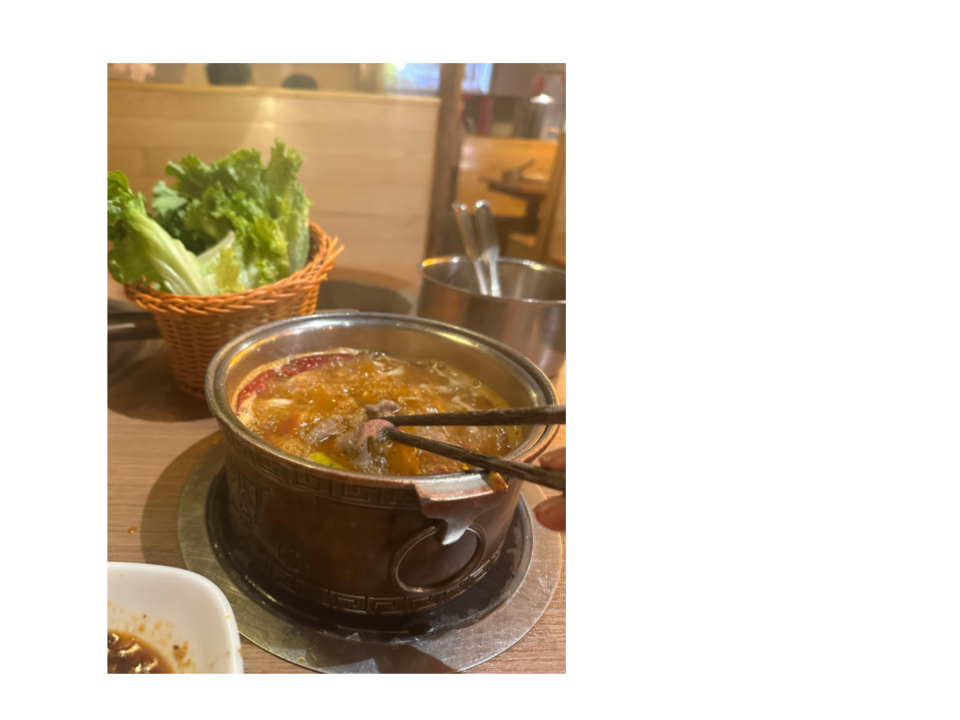
Once I returned from making my sauce, my broth started boiling in the pot, giving me the green light to start cooking the meat and add-ons. With my chopsticks, I carefully maneuvered the udon noodles and well as enoki into the broth and let that simmer and absorb flavor. While I waited, I took my first piece of fatty lamb, placed it into the bubbling pot, and waited for approximately 126 seconds (yes, I timed it). The meat came out cooked to perfection: a dark brown color in contrast to the original bright pink. Since the meat slices are so thin, they can be cooked within minutes and consumed safely (Stefanie Y.).
Taste Testing My Hotpot
As I impatiently waited for the noodles and enoki to cook, I decided to taste the lamb dipped in the sauce and placed it in my mouth. The tang of the vinegar and soy sauce combined with the chewiness of the meat created a savory taste that could not be replicated in any other cuisine. It was hot, spicy, and made me want more and more!
The noodles eventually became soft and the enoki started getting soggy and I placed them onto my plate to cool down. Combining all the components made me realize the reason why there were regulars here and hotpot was a comfort food for XiuQing and many others. It created a sense of home with the warmth of the steam coming from the hot, as well as your surroundings. People chatting, catching up, the dimmed lights, and being able to recreate a recipe passed down in generations is something I realized I could do at a hotpot.
I felt at home even though I had never been to China or tasted this cuisine before. Hotpot does not just save time from cooking but preserves the friendships you have and lets you try flavors from the Chinese past.
Have you ever craved a juicy slab of steak on your barbecue, waiting for it to grill to perfection? Has that ever taken you hours and possibly an overcooked waste of veal? Don’t fret, there’s still a chance for you to understand the grill and satisfy your tastebuds with a specific cuisine: a traditional hotpot.
Campus: Hunter College
Professor: Micheal Benediktsson
Location: 105 Bowery, New York, NY 10002
References: Scott, D. N. and A. (2016, July 14). Chinese hot pot: A history and how-to. G Adventures Blog. https://www.gadventures.com/blog/chinese-hot-pot-history-and-how-/#:~:text=Hot%20pot’s%20roots%20can%20be,of%20meat%20in%20that%20broth.
U.S. Department of the Interior. (n.d.). Chinatown and Little Italy Historic District New York, New York (U.S. National Park Service). National Parks Service. https://www.nps.gov/places/new-york-chinatown-and-little-italy-historic-district.htm#:~:text=The%20Chinatown%20neighborhood%20was%20formed,to%20New%20York%20seeking%20opportunity.
Koetse, B. (2022, February 20). The 8 hotpot styles to know. Hotpot Ambassador. https://hotpotambassador.com/hotpotambassador/the-8-hot-pot-styles-to-know/
ChihYu. (2024, December 10). Hotpot dipping sauces with 5 different flavors!. I Heart Umami®. https://iheartumami.com/hotpot-sauces/
Y., S. (2024, October 26). Hot pot recipe: Everything you ever wanted to know about hot pot. i am a food blog. https://iamafoodblog.com/hot-pot/#:~:text=When%20is%20it%20cooked?,as%20little%20as%20you%20like.

