

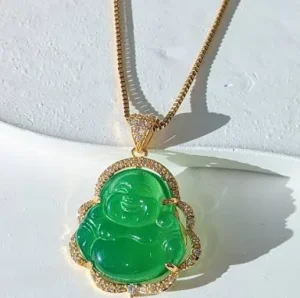
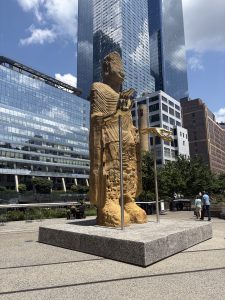
The piece I chose is the 25 foot Buddha statue which can be replicated in many different ways. To give a bit of background, the statue is a symbol of peace and compassion for people to let go of suffering in their lives. Buddhism itself explores the nature of the mind to help individuals overcome conflict and chaos in order to reach enlightenment. With Buddhism being the fourth largest religion in the role, it is easy to see how this statue can be replicated in many different forms. Anecdotally, I have seen some of my Chinese friends who are Buddhists wear the Buddha pendant around their neck in traditional green Jade. In addition, when researching, I discovered that there is an Ancient Sculptural Gallery that sells oriental Chinese Buddhist statue reproductions at varying price ranges.
Seeing this in person was a breathtaking experience as it is not everyday that you see such a large detailed work of art. Seeing it in person made me think about the process behind importing this work of art and how much time and dedication that went on behind the scenes to bring this work to life. A replication would certainly not have the same effect or impact in the way that a 25 foot statue in the middle of Manhattan would. A replication would not be able to do it justice to the craftsmanship of the artist behind the original piece. In this case of art, replication is a tall task both literally and figuratively speaking due to the sheer size and complexity behind this work of art. It is not any ordinary piece that we see in everyday life such as poetry in motion on a subway. This piece is unique in that way. Moreover, this sculpture cannot directly be replicated in the way that paintings can be as we discussed in class with Berger’s Ways of Seeing.

