Reproductions

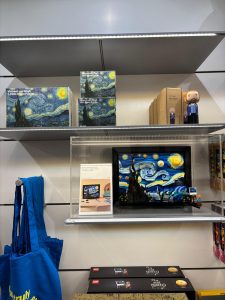
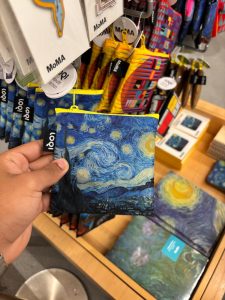
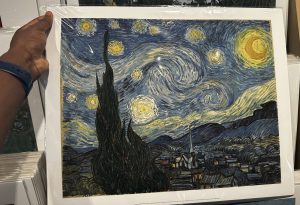
In my trip to MoMA, before going inside the galleries to find the paintings, first I went to the gift shop in front of it to see what paintings I would be looking for. I was surprised to see how many reapropiations where they on starry night. It’s crazy to think how when Van Gogh painted this it was considered a really weird painting, but now it is totally main steam and people gather around in big groups taking pictures around it just to admire its beauty.


photo of starry nightI don’t believe the impact of the original piece of art changes because of it’s adaptations, but I do believe that both Starry night other Van Gogh’s pieces are perceived as more valuable because of these merchandise. I’m not saying that the works by themselves are not worthy of the fame they got, but they are definitively more known and have a bigger reach than if the pieces of art were by themselves in the museum. I can relate it to the Jordan sneakers, even tough Jordan was an incredible player, I believe that the Jordan sneakers multiplied his reach at least a 3x . It’s like the people can have a little piece of the person they admire. You could be a Lebron fan ,but I haven’t heard anyone complain about how someone stepped on their LeBrons compared to the Jordans.


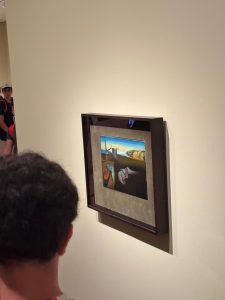
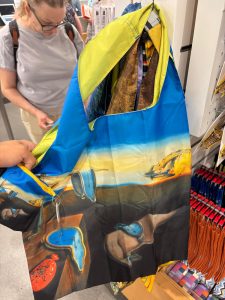
When I was walking around MoMA I saw a group of people around a tiny painting but I never imagined it would be The Persistence of Memory, I was surprised to see how tiny it was. On the images I’ve seen at class, it’s easy to look at all the details but when you are actually in person it’s kinda hard to appreciate the details, maybe because of the continous group of people around it or it’s size . But overall I would consider it is different feeling seeing it in person, when you see the texture, you can imagine the artist painting it, compared to when you see it in a picture or in these case a key chain or a vest that just reminds you that piece of art.

key chain


An Endless Sea of Urinals

If I’m being honest, I had never heard of Marcel Duchamp until the first day of class when we were asked if his work was considered art or not. Of course, I had heard of the boundaries of what is and isn’t art being pushed, but I had never put an image behind the idea. So imagine my surprise when I walked into the MoMA and saw his name splattered all over the museum. It was like looking at images of steganography for hours and only seeing it until someone in the comments circles it in red.

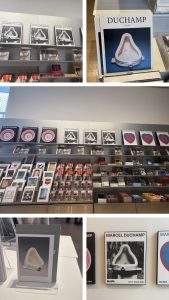
Images of Duchamp memorabilia in MoMA gift shopAfter spending hours at the other exhibits, I finally made my way to the final floor of the MoMA, where Duchamp had his very own exhibit. I was greeted by a gift shop before entering. Before I could even see any of his work, I was already flashed with images of his art like a movie spoiler. The images repeating themselves over and over, in the form of books, postcards, and posters. The repetition seemed almost intentional, as if the museum was writing its own blog post to this prompt.

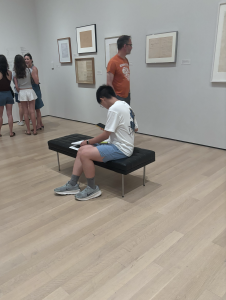
Finally making it past the sea of repeating images, I made it inside. I saw a guy flipping through the book at the shop. I found it interesting how he bought it before viewing the exhibit, or maybe this was his second time seeing it. Nonetheless, there he was in front of all the art and choosing to look at the images of it. It reminded me of the video in class we watched where it explained how the camera changed the way art was seen. He brought himself to the art and then still chose to bring the art to himself–––I thought it was sort of meta.Guy looking at Duchamp book he bought in gift shop

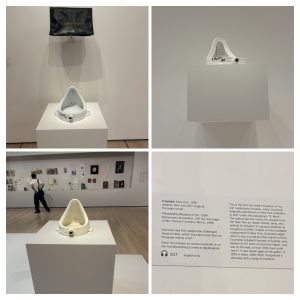
I walked through looking at all the pieces but in search of the one I saw all over the shop. After walking through 2 rooms “I finally made it,” I thought. Then I read the description “Replica.” I thought the urinal in the museum would be the original from Duchamp–––how silly of me. Unbeknownst to me, beyond the sea of pictures of urinals there was a sea of urinal replicas. I counted three in total, excluding the hundreds of prints and books in the shops. I’m surprised they didn’t sell the replicas in the shop too. I questioned why there were so many replicas out on display, perhaps one would’ve sufficed. But then it dawned on me that perhaps once one was reproduced and out on display then the following iterations became progressively less taboo. Replicas of Duchamp's Fountain

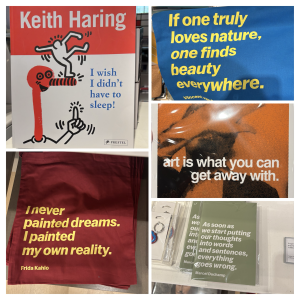
The manipulation didn’t stop with the physical replicas, though. Walking back out, I noticed an endless array of canvas tote bags plastered with quotes from the artists. I find this incredibly weird. Their visual art didn’t have words–––it spoke for itself. Reflecting on our class discussion on the video we watched, the video stated that art is inherently silent and unmoving, meaning that the easiest way to manipulate an image is through movement and sound. But in the MoMA gift shop, that “sound” is just words. The museum takes an artist’s personal words completely out of context, slaps them on a canvas tote, and sells them for the sake of “aesthetic.”

Images of totes and books with the words of artists

By adapting and reappropriating the work like this, the museum completely flips its original impact upside down. Duchamp’s Fountain was a literal middle finger to the snobbery, commercialization, and institutional gatekeeping of the 1917 art world. But when you strip away that aggressive, anti-capitalist rebellion and package it into a $75 book ($67.50 if you’re a MoMA member) or a catchy slogan on a tote bag, you get a textbook case of commodity fetishism. The museum removes the history and the labor, replacing it with pre-packaged consumer identity.

The art used to speak for itself; now a tote bag speaks for the consumer. It mirrors the exact museum-goer I can’t stand: the ones treating the gallery like a personal photoshoot just so people online can validate them. The art is reduced to a prop, an extension of a curated, performative personality that lacks any real depth. People buy the “magic” they think the object holds, paying a premium to turn art into a shortcut to looking intellectual.

Ultimately seeing Fountain reproduced and commercialized in this new way completely shifted what it meant to me in person. Expecting a profound historical artifact and instead being met with a replica, surrounded by a gift shop full of paper replicas being sold for profit, made the entire gallery experience feel silly. As for the museum’s intentions, it seems as though they aren’t actually celebrating Duchamp’s philosophy, but instead they’re franchising it. I think recreations like this are a bit insulting to the artist, unless he’s Andy Warhol. I mean, if my art were to be recreated and then sold for profit, I’d hate capitalism more than I already do.

Blog 3

The Starry Night by Vincent Van Gogh

I believe that a piece of art belongs simply to the author of it. Of course, you might take pictures, put it up in a museum, and depict every element for its study. I’m not trying to advocate for keeping art away from the eyes of the world. After all, pieces of art can inspire others to create their own art, and I think that inspiration or even devotion from someone else’s art is healthy. I myself have fallen in love many times with artwork from others. Notwithstanding, when I visited the MoMA museum gift shop, I left with a bittersweet feeling, and my sentiment about art belonging and existing simply to represent the author’s point of view grew stronger.

I stood in front of The Starry Night by Vincent van Gogh. I have seen it a couple times, but it never fails to amaze me. The vibrant colors of the night that sit above the quiet town. The stars shine bright, and the sky fuses in different colors to create an illusion of movement or, better said, activity. This painting, for me, represents the beauty of staying up to watch the night go by, and I thought this is how Vincent da Vinci gave life to the painting. Instead, as he lived in an asylum and would only paint in his studio during the day, this painting came to life from his memories. It’s a collection of what he would see through his window and during his outings. To me, it’s a direct path to understand the world through his eyes. Thus, art, and especially this painting, is a window into understanding the artist’s life. Why would we create pieces that reappropriate an original piece? Aren’t we losing the initial point of what the painting is about?

The Starry Night Miffy Gift SetI think the impact of the piece did change for me by being adapted into a Miffy gift set. I understand that Miffy is an adorable bunny who should have different outfits to enhance the personality of its owner. But why The Starry Night? Van Gogh painted this beautiful piece of art to illustrate his statement about the night being more vibrant than the day and it being reduced to an outfit. I believe this is the problem with adaptations; it’s a reduction of the artist’s work not only for profit but also an attempt to make a piece of art transcend every aspect of life, and it just doesn’t work. Vincent van Gogh had hardships in his life; he cut his left ear after an argument. He had struggles with his mental health and self-registered in an asylum. He found structure, discipline, and purpose by painting. In a way, painting literally saved him, and it’s his paintings what keeps him alive after centuries.

Thus, I believe his work shouldn’t be replicated or adapted in any way; instead, it should be left alone for others to feel inspired and create their own versions rather than buying a replica or a plushie outfit. It just feels disrespectful, and if I were in his shoes, I would feel sad that others would replicate my work to create things that will mostly likely end up in the garbage. This is my work and is personal to me; please have some respect for my point of view. Lastly, as I scanned the gift shop, I observed every element that referred to The Starry Night, and my admiration for the painting died with every element I encountered. It felt as if the painting had lost all personality, and I couldn’t appreciate it anymore. I mourned what the MoMa gift shop had done to the painting and felt heavy to know that what was once a collection of memories for van Gogh is now everywhere, but these gifts are no memories of a visit. To me, these gifts are a bullet to the artist, who dies every time a replica or appropriation is created


Thomas – BlogPost #3 – The MoMA

As many of us know, Vincent van Gogh’s The Starry Night is pretty popular. I had seen it countless times, especially online. I even saw it on the wall at a friend’s house when I was invited home for thanksgiving.  Before visiting the MoMA, I thought I already knew everything about it. Because I am familiar with the image, I assumed seeing the original painting would not feel much different. I guess I was wrong.

1

First of all my perspective of the art changed completely when I saw many groups of visitors trying to see and take photographs of the original art. In my mind I was like, but we see this daily online, in homes and offices. But then I reminded myself that this was actually the painting that Van Gogh created in 1889. Then, my attention got drawn even more. I realized I was not looking at a digital image or a printed reproduction at that point, I was experiencing the artwork itself.

 From a look, the texture seemed thick, well layered, and well colored. At least different from the reproductions I have seen in the past and even at the gift shop.   

In class last week, due to poor sound quality, I struggled to fully understand John Berger’s video as he explained his ideas on art reproductions and how they make artwork more accessible. However, the few I was able to grasp seemed really interesting, and experiencing both original and reproduction art at the MoMA made the ideas much more clearer and meaningful. Although I initially learned about The Starry Night through reproductions, the original painting had a presence that my experience with printed images had never captured. 

1 1

After I left the gallery and walked into the museum gift shop, I immediately noticed The Starry Night everywhere. Of course it is popular. The painting appeared on notebooks, postcards, tote bags, puzzles, and other souvenirs. Then I fully understood that the reproductions do not replace the original. Instead, they allow visitors like me to take a small piece of the museum experience home with them. Now I see how reproductions help make art part of everyday life, even in cases when we do not have museum access or the original arts.

1

Blog Post #3 – MoMA


black and white paint splatter - Jackson Pollackdeck of cards with painting

The first artwork that stood out to me at the MoMA was a canvas covered in paint splatters. It wasn’t because it evoked any strong emotions or filled me with awe. Instead, I found myself wondering how it ended up in a museum. As I continued through the galleries, I came across more pieces that made me ask the same question. How is this art? One painting was a canvas that was painted half black and half gray. Nothing more, nothing less. Another was an entirely blue canvas. Surprisingly, I stood in front of that painting for nearly fifteen minutes attempting to understand the purpose of this blue canvas. It looked like less of a masterpiece and more like a paint sample I could find in the Home Depot paint aisle. I couldn’t help but wonder if perhaps I was too stupid for modern art because I just couldnt understand what some of these artworks were made for. While I comtemplated my thoughts, I overheard two men dressed in suits with fancy watches (and rich vibes) discussing how stunning the blue painting was. In that moment I thought to myself, maybe I’m just too broke for modern art. I couldn’t help but think that I could buy a canvas, a bottle of royal blue paint, and recreate the exact same painting for less than five dollars in under five minutes. As I continued to wander through the museum, I eventually found a dark room where visitors sat watching a film installation on modern art. In that room, a man had fallen asleep and was snoring loudly. I couldn’t help but relate to him. After spending an hour trying to make sense of the exhibits, I realized I was beginning to feel the same way. My visit to the MoMA left me wondering whether modern art is meant to be understood, questioned, or simply experienced. Was my confusion a part of the experience all along?

multiple images of artwork displayed in MoMAman asleep in MoMA

Before I left the MoMA, I was determined to see Vincent van Gogh’s The Starry Night. It was surprisingly difficult to find, but eventually I noticed a crowd gathered around a single painting and realized I had finally found it. Seeing The Starry Night in person felt surreal because of its immense popularity and the countless times I had seen it reproduced elsewhere. It was truly beautiful. On my way to the gift shop, I couldn’t help but notice that The Starry Night was everywhere. It appeared on notebooks, reusable bags, decks of cards, Legos,  Barbie dolls, and even Miffy merchandise. Seeing Van Gogh’s masterpiece printed on so many products made the painting feel less like a work of art and more like a brand. When people see The Starry Night, they immediately recognize it as one of Vincent van Gogh’s paintings. Yet during his lifetime, Van Gogh struggled financially and lived with mental illness. He died before his work received the admiration and recognition it enjoys today. Now, companies profit from reproducing his art on countless products, basking in his glory while earning money from a legacy he never had the chance to benefit from himself. It almost felt like an example of consumerism at its finest. As if the message was, “You love this painting? Then we’ll put it on everything so you’ll buy it and we the company’s make an easy buck.” Instead of simply celebrating the artwork, its constant reproduction made me question where appreciation for art ends and commercialization begins. It left me wondering whether these products honor Van Gogh’s legacy or reduce one of the world’s most celebrated paintings to just another marketable image.

Vincent van Gogh, The Starry NightCollage of items with the starry night

Blog Post 3

Frida Kahlo

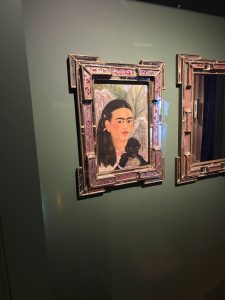
During my visit to the Museum of Modern Art, what caught me eye was a self-portrait of Frida Kahlo, a Mexican-American artist who explores themes of identity. I was strolling through exhibits and when I reached the third floor in the Phillip Johnson Galleries, I took one look at Frida’s pieces and headed inside the gallery to explore more about her. Going into the museum of Modern Art, I was expecting to see many paintings and pieces that I was familiar with so I decided to make things a bit more interesting by exploring the unknown. I read a bit into Frida’s life and was shocked to find out that her path to artwork was far from ordinary. She had experienced a tragic accident on a bus in 1925 that led to her beginning her journey of artistry leading to her world famous works that explore her own creative mind.  That crash left Frida with many injuries including a broken spine which caused her to be bedridden for months on end where she spent a lot of time finding ideas for her art. Learning about Frida’s story to me was inspiring to see the resilience of a woman who turned her life around despite the many challenges she faced.

Moving into the piece that I chose, Frida is seen pictured with a monkey who she kept as a pet. To me, this was interesting to see and certainly not an ordinary self portrait that you would see in any typical gallery. In addition, Frida is seen with a unibrow  and a light mustache which was unique to her image and spoke volumes about the strong sense of self that Frida possessed. During that time, this kind of a look was frowned upon and did not meet the beauty standards of a woman. However, Frida had the strength and courage to defy beauty standards and go against social norms which is what I admire about her as an artist. Moreover, when looking at this piece, onlookers have to stop and reflect and contemplate on the piece and really break it down to fully understand the meaning behind this self-portrait. On the other hand, the mass reproduction of this art as 884-piece puzzle in the gift shop removes that sense of viewership and rather turns the piece into a playful image for leisurely purposes.

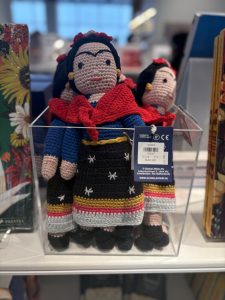
With the art being reproduced as a puzzle, it takes away from the original art and now changes the focus onto Frida as a marketable figure rather than her original artistry. In addition, when seeing a crocheted doll version of Frida Kahlo being sold at $42.99, it now becomes a matter of profitable business and loses the original intended purpose of the art. The puzzles and dolls of Frida market her to children and turn her into a playful icon as opposed to an artist who faced struggles and overcame difficulties to contribute to her creative expression. Furthermore, by altering the self-portrait of Frida along with her other works into puzzles and dolls, it takes away from the meaning of Frida’s work by introducing Frida as a marketing tool rather than as an individual artist with creative talent.

Frida Kahlo Gift Shop

Relating back to what we had spoken about in class when it comes to the mass production of certain pieces and whether or not they lose their meaning, I believe that a piece does lose a part of its meaning when mass produced. The reason for this being that when I had initially walked through the Phillip Johnson Gallery and viewed Frida Kahlo’s pieces, I was intrigued and really took the time to find the meaning behind her work and do my own research on how she came to be as a creative. However, when visiting the gift shop, I could see that people would walk by and look at these mass produced pieces with a consumerist view. People would take a look at a puzzle or doll and look at the price and move to the next item. Simply put, the experience in the gift shop showed me that the original meaning of the work was reduced to a marketing strategy. Alternatively, different adaptations outside of a gift shop setting such as the ones that were shown in class may have a different outcomes such as, Andy Warhol with the Marilyn Monroe pop art screen prints.


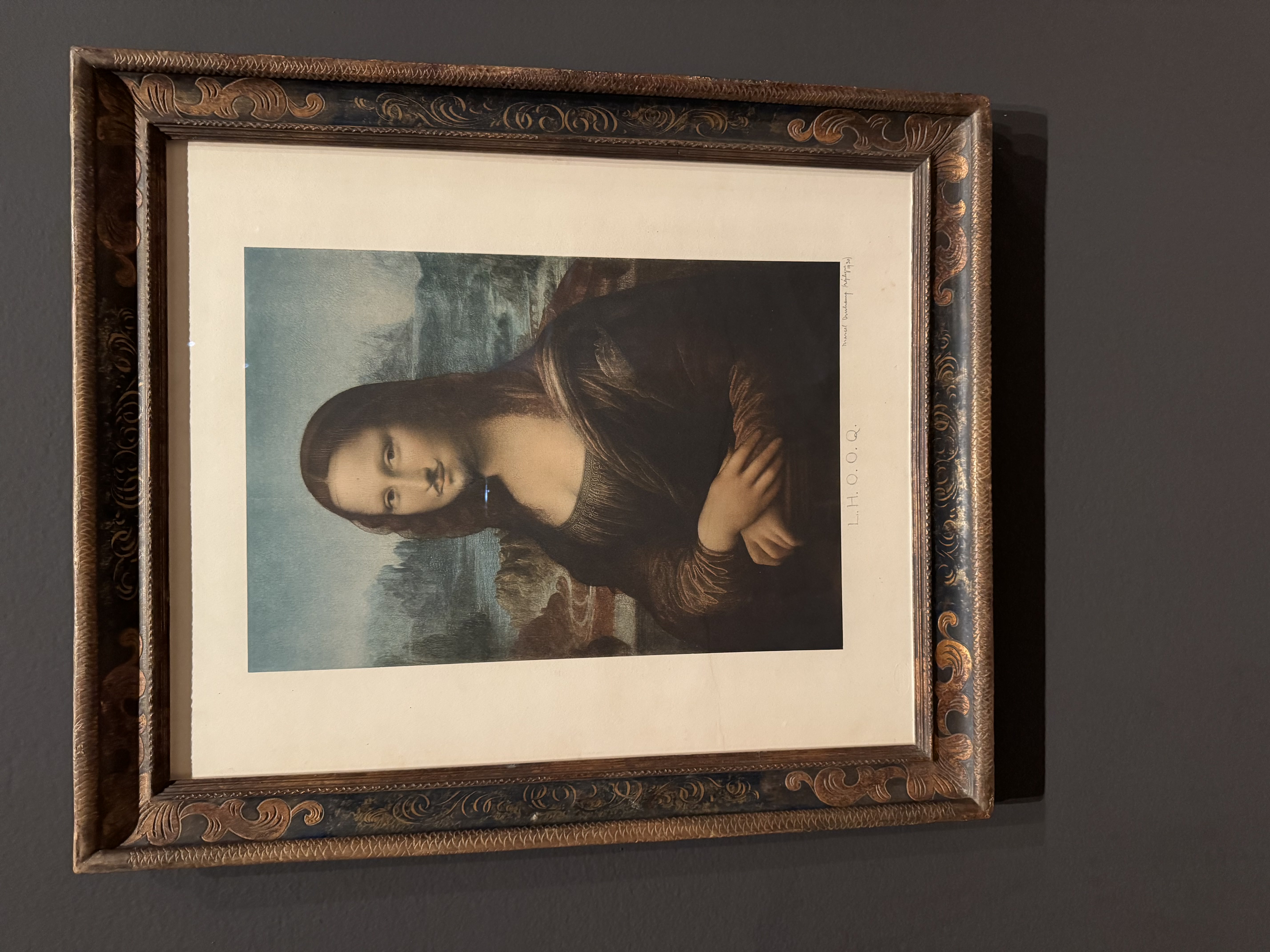
L.H.O.O.Q.

Marcel Duchamp's L.H.O.O.Q. 1930 at MoMA: a print of the Mona Lisa with a hand drawn mustache and goatee penciled onto her face.
Marcel Duchamp, L.H.O.O.Q., 1930 replica of the 1919 original. On view at MoMA.
     The plan going into MoMA was pretty simple, pick a piece I liked, find the copy of it in the gift shop, and compare the two. I tried to game the system and do the assignment backwards. Duchamp foiled that plan almost immediately, because it turns out L.H.O.O.Q. has no original seemingly anywhere in the building. What’s on the wall is a replica from 1930 that Duchamp made of his own 1919 piece. A few feet away, there’s a 1942 version that Francis Picabia reproduced, a signed edition from the 60s, and then a 1965 piece where Duchamp glued a completely untouched Mona Lisa playing card to a dinner invitation and called it “L.H.O.O.Q. Shaved.” I came looking for an original and its copies, and instead I found a room full of copies pointing at each other spider-man meme style.
     Duchamp’s style impacted me in stages. When you first see it, you’re kind of taken aback, because it really does just look like the Mona Lisa. Then you look closer, notice the mustache and the goatee, and realize this is a remix/sampling of the original. Your first instinct is that it’s sacrilegious, maybe even disrespectful, to do that to a masterpiece. Then you take into consideration who Duchamp was and how he looked at art, and you realize the whole thing is a dare. He’s challenging your conception of what art is, what it could be, and what it has been. Once that clicks, you’re sort of in on the joke with him. The wall text has an interesting quote, “I have forced myself to contradict myself in order to avoid conforming to my own taste.” For Duchamp, nothing was sacred except the concept of art itself.
    How did it’s meaning change? Honestly, through repetition. As you walk through the exhibit, the same image just keeps showing up. On paper, on playing cards, attached to envelopes, he mailed out. At some point, you can’t tell which one is the original, or if any of them are. The one that really got me was L.H.O.O.Q. Shaved. By 1965, the mustached version was so famous that Duchamp could put up a totally normal Mona Lisa, and everyone would read it as the altered one. She looks “shaved” because his conceit is that the facial hair is the original now. The reproduction basically overwrote the original in our heads. It reminded me of what Berger said in the video we watched, that reproduction detaches an image’s meaning and lets it travel and get manipulated. Most artworks lose something in that process. L.H.O.O.Q. is enhanced.
     As for seeing it in person versus reproduced, the meaning changed for me in two ways. The small way is the details. In person, you can see the pencil grain, the tape holding the postcard down, and a handwritten note on the 1942 version that says Picabia forgot the goatee when he copied it, so Duchamp came back 22 years later and drew it in himself. A correction to a copy of a copy, made by the original vandal.
     His readymades keep popping up right next to famous traditional paintings, and it starts to feel like he’s daring you in real time. Like, yeah, here’s this really famous piece of art, but hey, here’s mine too. Remember me? Like the meme “is he in the room with us right now?” Duchamp was in the room with me the entire visit. You read a label saying the thing you’re looking at isn’t even the original, so you’re in on the joke again, and then two rooms later it’s reproduced even more. His art is multiplying. For lack of a better term, it’s an infection, and what it infects you with is the question of what art is.

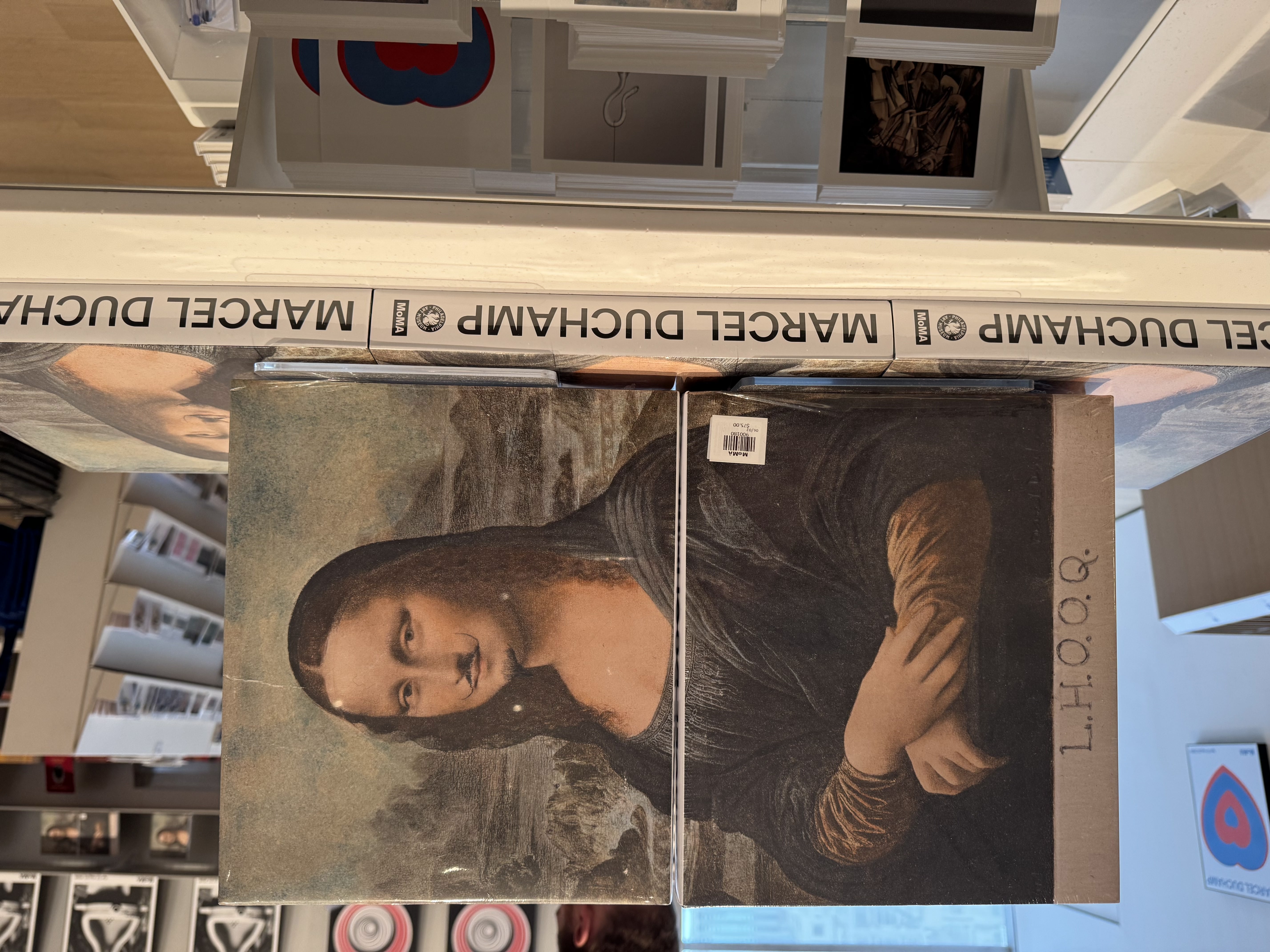
Shrink wrapped Duchamp exhibition catalogs in the MoMA gift shop, with the mustached Mona Lisa from L.H.O.O.Q
L.H.O.O.Q. reappropriated one more time: the exhibition catalog in the gift shop, $75.

Then there’s the gift shop, where the same defaced Mona Lisa is shrink-wrapped on a $75 catalog with a barcode on her sleeve. A piece that was made to make fun of the art market, being sold back to me at an art market.

By the time I was trying to leave the Duchamp galleries, it honestly felt like I couldn’t bear the weight of it and had to escape. What is the actual art, the object itself or the idea it imparts to us? I walked out past a hundred people taking phone pictures of pictures, and realized all of us were making more copies of L.H.O.O.Q.

Sergei_Markelov_Assignment#3

Following the statement made by John Berger in his video, as well as in his work Ways of Seeing, I picked the pretty mainstream artwork, though I made this decision after I took the photo of the masterpiece. It was a line of people trying not only to take a picture of this small piece, but also to capture themselves with the original work, as usual in a museum. As soon I aimed my phone and got the photo of the Persistence of Memory, I realized how the intentional meaning of this work by Salvador Dali shifted by connecting with other layers of meaning: a girl is posing (on the right side of the photo), and at the same time the guy with his phone is trying to capture them (on the left).
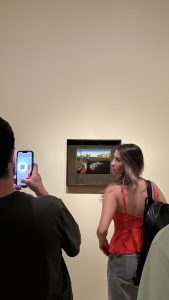
people with Dali painting

At that moment, I realized how, actually doesn’t matter for people in this line the artistic value of this picture compared to the hype it has. And every next person was trying to make either a selfie, or capture someone with the picture, or just capture the picture as if they also came to make a college assignment.

Dali’s The Persistence of Moment

I saw this picture previously, though more as an element of Dali’s famous collaboration with Disney called Destino. This surrealist animation was something connecting two narratives: a pop-culture element with Disney cartoons and art, before I even watched some of the great works in museums. And with all these kinds of works, seeing them in real life, we are fading, trying to capture their significance.

I remember the woman crying in the Louvre in a crowd embracing the Mona Lisa; she whispered, barely staying on her feet: Oh God, I dreamt about this moment for all my life. I think I captured that moment with much more clarity and favour than this small DaVinci’s masterpiece, barely seen under the thick layer of bulletproof glass with all those people around.

I think this is kind of a similarity I got when I faced the line of people with smartphones capturing this little work by Salvador Dali one by one, and the next, and another one again.

It would not be a surprise if I say that the vibe of this painting was moving away from me as I found it in different books, or reproductions in a gift store, and towards the full breakup in a bookmark captured just a piece of the painting.
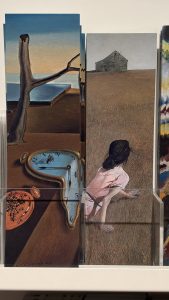
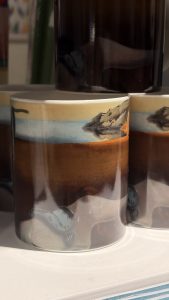
gift shop souvenir gift shop souvenir gift shop souvenir gift shop souvenir

However, I keep thinking about the meaning. There was a doll, a Barbie in a dress made with another famous picture by Van Gogh at a gift shop. Two significant representations of the mass products connected together, like Disney+Dali. And I imagined if someone put this doll on the fifth floor in MoMA, on a stand, with a sign that it was a Marcel Duchamp work, and I would have a chance to stop by without a crowd – what would be the effect?

Doll in a dress as a painting of Van Gogh

The knowledge that we are in a museum, the understanding that we are observing the painting collection of significant artists, the explanation notes near these pictures, the inspired and spiritual faces of the audience around making up our impression of the works we are observing. And at the end of the exposition, we are feeling like these kids.
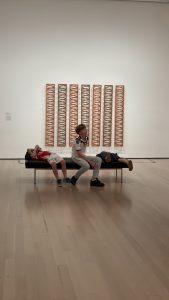
kids in a museum

However, to have a chance for reflection, it needs to be prepared for considering art, to be able to read it by applying previous experiences of watching, even though some of the exhibited works are arguably subjective. It is a language we are probably getting less and less able to understand, and in such a museums era we prefer the philistinism way of art: picking up souvenirs in a gift shop rather to explore these narratives? I know that the picture in a gift shop is just a print of the famous painting, but this painting can be turned to the masterpiece if someone would have a chance to sell the vibe of this print – we get the art. At the end of the day, for me the result is that the art is a unique piece of artistic view rather than a mass product, though even a piece of art can be the mainstream if the line of people is lining up to take a picture of their appearance near the art.

Blog Post 3 – Tucker Loth

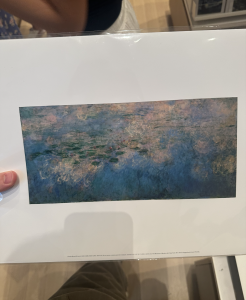
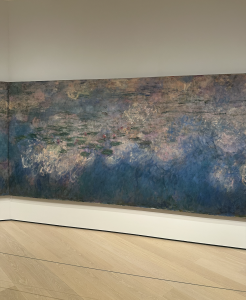
Monet's Water Lilies Print Monet's Water Lilies Painting


For my artwork I chose Claude Monet’s Water Lilies 1914-26. Rather than first finding a piece of artwork on display, I started this assignment by looking at what works were being recreated in the gift shop. They had many pieces to choose from but, being a fan of his work, I was drawn to the Monet prints. I selected the piece Water Lilies 1914-26 and found it to be quite similar to many of the other works done by Monet. That is, a serene painting of nature in an impressionist style. With my photo captured I moved on to find the original work and WOW! When I walked in the room I immediately realized that the print I selected did very little to capture what was so awesome about the original work. The print was actually just a photo of one out of three massive paintings that take up an entire wall. Monet’s intention with this work was to give a panoramic view that immerses the viewer in an impressionist depiction of his lily pond. When you are viewing this work on a small print, it loses its grandeur. It goes from feeling like you’re watching a concert live to feeling like you’re listening to a concert on your iPhone speakers. I think that the print is a nice souvenir to remember the original work but it does very little to capture the actual meaning of the painting.