Blog Post #4 – Thomas

Meeting and talking to the co-founders of Queer Van Kult in person was really amazing. And the experience of listening to people articulate something they are desperately passionate about feels really different.  I think conversations with them were great.  Especially given that I had the opportunity to ask two questions. My first question was why they decided to create Queer Van Kult instead of joining existing arts organizations with similar goals. My second question asked about the kind of community they hoped to build through their work.

Nicie explained that they wanted to create an organization they could truly call their own. Rather than working within an existing organization and constantly answering to others, they wanted the freedom to take action on the issues they saw affecting their community, and they seem very much unapologetic about it. Although they acknowledged that starting and sustaining Queer Van Kult has been challenging because of limited financial support and other obstacles, they believed that creating their own collective would allow them to remain true to their vision and respond directly to the needs of the community they hope to impact. 

Through them I was able to understand why community is such an important part of Queer Van Kult’s mission. Before meeting them in person, I understood from the readings that the collective was created to support queer artists and provide opportunities for creative expression. Hearing them explain made me realize that Queer Van Kult is about more than producing art. It is also about creating a space where artists have the freedom to express, support one another, and build something that reflects their own values.

I also loved that they were open and honest about the difficulties of running an arts organization. It would have been easy to focus only on their successes, but they openly discussed the financial and organizational challenges they continue to face. That honesty made me appreciate their work even more because it showed that Queer Van Kult exists not because it is easy, but because they believe their community deserves better. It was great learning from them. 
Blog Post #6: Gospel Night at SummerStage Harlem

For the past three years, I have always walked past the Summer Stage in Harlem events but I never stopped by to check it out. This event comes every summer and it happens just a few blogs away from my home. I always thought it was interesting and wanted to check it out some times. However, Assignment #6 provided the perfect opportunity to finally learn what the event is all about. 

1 2

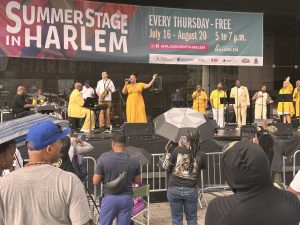
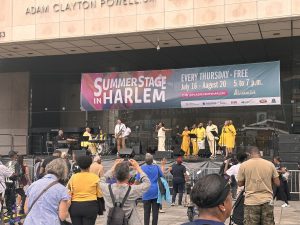
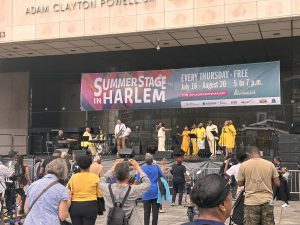
I attended SummerStage in Harlem’s Gospel Night last Thursday, and the event  featured TJ Reddick & Chosen and Anthony Evans with the Harlem Praise Singers. I expected to simply listen to live gospel music. I love gospel music. I was ready to have a great time. However there was more to the event: the songs, performances, and Audiences seemed to be perfectly aligned. I felt a strong sense of community that extended far beyond the stage.

The audience reflected Harlem’s diversity. There were older adults, families, young people, and visitors from different backgrounds, etc.. What stood out most were the visual signs of their connection to the music. The performers dressed in a way that reminded me of traditional church services, showing the event’s connection to black gospel culture and faith. People raised their hands, sang along with the performers, clapped to the rhythm, and swayed together. They appeared completely immersed in the music. It was interesting to watch. 

22 3

The music was clearly attached to the gospel subculture, but it also felt welcoming to people who were not necessarily part of that tradition. Especially when they sang the famous supergroup USA for Africa charity single “We Are The World“, the crowd went crazy! Then, it felt less like a concert and more like a shared experience. They sent out messages of hope that created an atmosphere that made everyone participate, regardless of their background.

My overall impression of the event was positive. I realized the sense of unity it created among strangers. Everybody clapped, sang, and responded together, showing the power of live music in community building. 67

I felt connected to a community, shared the same experience with others, and responded to the music together even though I was there as a first-time visitor. I loved it!

7

Thomas Mawolo – Visit To The High Line

Last Wednesday, my group explored the High Line between 14th street and the entrance of the Hudson Yard. The most outstanding artwork to me was the 25-foot Buddha sculpture. This being my first ever visit to the High Line and I was curious to see in person the  25-foot Buddha sculpture as I have seen it only online. At first glance, I was wowed by its size and the contrast between the ancient-looking figure and the modern skyscrapers surrounding it. Although the sculpture can certainly be photographed, I do not think it can truly be replicated in the same way that a painting can. It felt different walking around it, and actually experiencing it firsthand. 

Buddha Statue

Per our classroom discussion, John Berger argues that paintings can be reproduced through photographs, books, and digital media, making them accessible almost anywhere. So, a photograph of the Buddha sculpture can show its appearance, but it cannot recreate the experience of standing beside it. Seeing the sculpture in person allowed me to appreciate its large size, its weathered texture, and the way its golden hands shine in the sunlight. One cannot experience these details by viewing only a photograph. These details made the work feel much more powerful than any image could communicate. A photograph captures only one angle and one moment, while seeing it in person allowed me to walk around it, observe it from different perspectives.

I think this visit to the High Line further helped me better understand Berger’s argument that reproductions change the way we experience art.

Thomas – BlogPost #3 – The MoMA

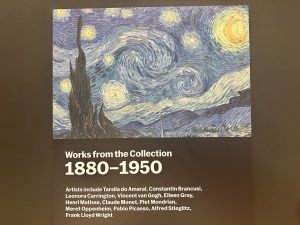
As many of us know, Vincent van Gogh’s The Starry Night is pretty popular. I had seen it countless times, especially online. I even saw it on the wall at a friend’s house when I was invited home for thanksgiving.  Before visiting the MoMA, I thought I already knew everything about it. Because I am familiar with the image, I assumed seeing the original painting would not feel much different. I guess I was wrong.

1

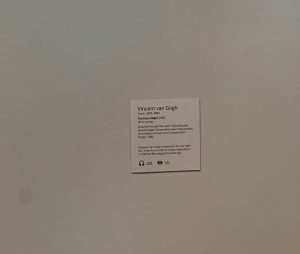
First of all my perspective of the art changed completely when I saw many groups of visitors trying to see and take photographs of the original art. In my mind I was like, but we see this daily online, in homes and offices. But then I reminded myself that this was actually the painting that Van Gogh created in 1889. Then, my attention got drawn even more. I realized I was not looking at a digital image or a printed reproduction at that point, I was experiencing the artwork itself.

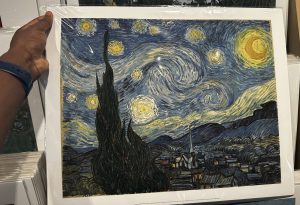
 From a look, the texture seemed thick, well layered, and well colored. At least different from the reproductions I have seen in the past and even at the gift shop.   

In class last week, due to poor sound quality, I struggled to fully understand John Berger’s video as he explained his ideas on art reproductions and how they make artwork more accessible. However, the few I was able to grasp seemed really interesting, and experiencing both original and reproduction art at the MoMA made the ideas much more clearer and meaningful. Although I initially learned about The Starry Night through reproductions, the original painting had a presence that my experience with printed images had never captured. 

1 1

After I left the gallery and walked into the museum gift shop, I immediately noticed The Starry Night everywhere. Of course it is popular. The painting appeared on notebooks, postcards, tote bags, puzzles, and other souvenirs. Then I fully understood that the reproductions do not replace the original. Instead, they allow visitors like me to take a small piece of the museum experience home with them. Now I see how reproductions help make art part of everyday life, even in cases when we do not have museum access or the original arts.

1

Thomas Mawolo – Blog Post 2

Alice's     Ours

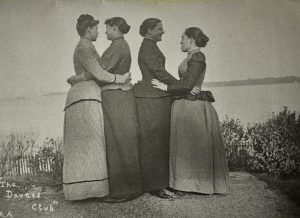
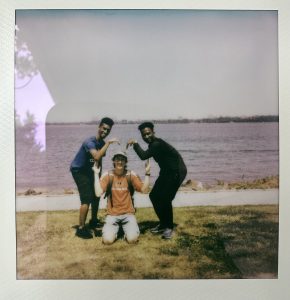
Both photos were taken more than a century apart, but this experience personally taught me how photography can preserve meaningful moments, connections, and community. My group took this photo on the same lawn where Alice Austen photographed four other people expressing closeness and connection. We tried to capture a similar scene, but ended up doing something slightly different. Same location, but instead of four people in the original Alice Austen’s photograph, we were only three. Some of our group members claimed the pose was too intimate. In our picture, we are smiling and trying to make a heart shape together, capturing a moment of connection and shared experience. However, our middleman, Tucker messed it up. hehehe! 

To me, both photos reflect community. Alice’s image represents people who were probably part of her everyday life and home, while ours represents the connection and community we are building as Fridman scholars.

Thomas Mawolo – Visit to The MET


Diana  DianaTabernacle t

I know this will surprise you, but this was my first ever Museum visit. As someone who lived almost all of my life abroad, visiting museums was one thing that just was not part of my early experience; I never had the chance to see one, and in fact I did not know why they are important. Therefore, before visiting the MET, I did not know what to fully think, meaning I did not have a huge preexisting idea of art. Don’t get me wrong, I have read books about art, I have written papers about art base on that I had learned from reading art related materials. But to physically interact with it, I have always lacked such experience. My visit to the MET yesterday changed that.

I usually thought art was just something created primarily to be admired for its beauty, and with a meaning of course. So, I expected to see impressive paintings and sculptures. In short, all my anticipation was tied to beauty. I WANTED TO SEE BEAUTIFUL WORKS, that’s it!  I did not expect works to make me think about history, culture, and NYC’s role in preserving art from around the world. 

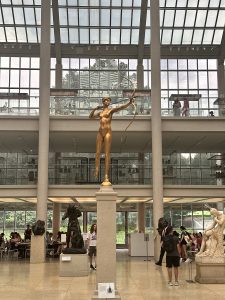
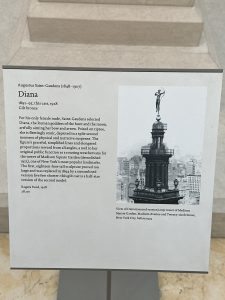
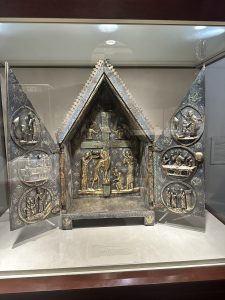
Diana by Augustus Saint-Gaudens and the Tabernacle of Cherves, two pieces that stood out to me. From their informational cards, they were created in different centuries and for very different purposes, but both challenged my understanding of what art can represent. They were not just solely for beauty. 

Diana                        Diana

Diana.  At first glance, I was already drawn to the sculpture because of its graceful pose and the incredible sense of movement. It appears balanced on one foot while drawing her bow, making the sculpture seem almost alive. I immediately went reading the information card and learned that this sculpture originally served as a weathervane on the tower of Madison Square Garden before the building was demolished in 1925. That detail changed how I viewed the work. Thinking for a second that this piece was originally designed as part of New York City’s skyline, and that at one point New Yorkers could look up and see Diana watching over the city wowed me. 

Tabernacle                      t

The Tabernacle of Cherves, a French religious object made around 1220-1230 also really captured my attention as I read the info card. I grew up being religious, therefore as I saw that these images were most appropriate for a cupboard intended for storing the bread consecrated as Christ’s body during the mass, I wanted to learn even more. I appreciated the amount of skill, symbolism, and storytelling packed into this small object. Every part of it seemed to communicate an important religious event. And I began to also see that art was also a way to educate, inspire, and express faith. 

At this point, after first museum visit, I think I am leaning a little more towards Marcel Duchamp’s idea of what art is. In my ENG 101 class, I wrote a whole project challenging Duchamp’s claim of art in his readymade, Fountain. I was more with Leo Tolstoy’s arguments that art must express sincere feelings that produce empathy and social cohesion, excluding utilitarian texts such as business documents and schoolbooks unless they can transmit authentic feeling. But my visit to the MET changed the way I think about art. I no longer see museums simply as places that store beautiful objects. Instead, I see them as places where history, culture, religion, identity, and more come together through artistic expression.