Blog 2

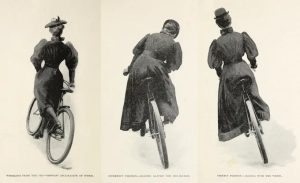
The picture that Marisol took of me getting on the bike was an active moment rather than a staged picture. We were discussing how Alice took pictures that were later published in 1896 by Violet Ward in her book “Bycicling for Ladies.” The images were set on the lawn of Clear Comfort and were meant to instruct women how to ride bikes at that moment in history. While, we were scouting the museum to recreate other pictures that Alice had previously took, we came across a bike. One of my teammates thought it would be clever to get on the bike and recreate the picture Alice took for the book. However, we were nervous because the bike didn’t belong to any of us, and what if someone got angry for using their bike? Completely worried for the Photo of Display Byclying for Ladies.repercussions of using an unknown bike for artistic purposes, I decided to let the fear behind by getting on the bike and that led to the photo. But, the photo doesn’t do any justice to our discussions prior.  


While visiting the museum, I struggled to connect with Alice’s work, and I think that’s because I couldn’t hear what the pictures were trying to tell me. I failed entirely at understanding her photography, especially those that pertain to the Larky Life. However, after the discussion we had previous to taking the picture. I slowly understood why Alice took her pictures; even though it captured a single moment that belonged to a whole concept, she knew the context behind these pictures. In other words, I think Alice found purpose in her pictures because she and those who accompanied her knew the meaning behind the photos. As viewers, we can interpret and assume safely based on clues and reliable data about her life. However, we don’t know for certain what happened behind the scenes of the many pictures she took.

What we do know is that she created a community by bringing women into her home and having them pose to create all these singular pictures that were out of the ordinary for her time. These unique moments were captured in photos and brought her closer to her art. I think Alice’s work meant a lot to her because of the community she created, and while we were taking our picture, it felt like we were also coming closer as a community because we understood what happened behind the picture. Almost as an intimate moment that lives between the group I was in. Even though I’m alone in the picture, there is a community behind me witnessing a single shot that might not necessarily speak a thousand words but that hides emotions that only we know, and I think that brings us closer.

The pictures brought us closer, and every time I look at them, I can remember vividly our conversations. Lastly, I think Alice would be happy to know that our picture hides an intimate moment between our group because it’s a reflection of her own photographs that also hide intimate moments many years ago that was captured by a single shot.
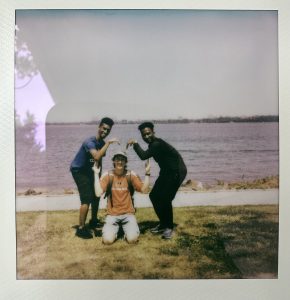
Thomas Mawolo – Blog Post 2

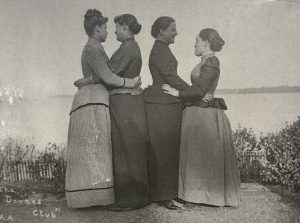
Alice's     Ours

Both photos were taken more than a century apart, but this experience personally taught me how photography can preserve meaningful moments, connections, and community. My group took this photo on the same lawn where Alice Austen photographed four other people expressing closeness and connection. We tried to capture a similar scene, but ended up doing something slightly different. Same location, but instead of four people in the original Alice Austen’s photograph, we were only three. Some of our group members claimed the pose was too intimate. In our picture, we are smiling and trying to make a heart shape together, capturing a moment of connection and shared experience. However, our middleman, Tucker messed it up. hehehe! 

To me, both photos reflect community. Alice’s image represents people who were probably part of her everyday life and home, while ours represents the connection and community we are building as Fridman scholars.

Repatriating the Light

I began to feel a shift in energy as soon as I left to embark on my journey down to Staten Island. A commute that was over 2 hours, on one of the warmest days this summer, felt like the breeze that caressed my face as I watched the water sway us onto the dock. Alice’s house wasn’t as extravagant as I had expected; hearing of her fame and fortune, I expected to be met with lavish displays of wealth, as expected during the Gilded Age. Instead, her home was rich in intimacy and simplicity, a luxury rarely afforded even to the wealthiest of people. I sat on her porch and looked onto the water, a quiet sense of calm filled my body as I closed my eyes and began to imagine her life––the Larky Life.

Classmate, Paula, getting on a bike at the Alice Austen House
Marisol Rodriguez, Paula on Bike, 2026

My group and I used up all of our film as we attempted to follow the assignment, but a burst of creativity overtook me at times, something I think Alice would’ve encouraged. One of the images in particular was of my classmate, Paula, on a bicycle. In the exhibit there was an image of Alice’s ex-girlfriend, Gertrude Tate, showing the proper way for women to ride a bike at the time. As we explored the grounds of Alice’s house we saw a bicycle sitting parked under the bright summer sun. I thought it would be a good idea to take an image of someone getting on the bike to show how far women’s right’s have come. At the time, it wasn’t even normal for women to wear pants let alone jeans––funny enough all the women in my group wore jeans that day.

Image captured bt Alice Austen of Gertrude Tate showing women how to ride a bicycle.
Illustration from Bicycling for Ladies based on Alice Austen’s photographs

A feeling of wonder actually loomed over me throughout the exhibit. Alice hid away this intimate side of her from the public, one that is being celebrated now by so many. I can’t help but wonder what her life would’ve been like if she was born at a different time, what she could’ve accomplished if the expectations of society didn’t weigh her down. Yet, her life was a protest against social norms, and the images an immortal heirloom she left us all. To feel the sense of freedom behind these images is a reminder to all queer people, like myself, that our joy has always existed, quietly carving out spaces of radical love long before the world was ready to name it. Alice’s lens didn’t’t just capture her present. She developed a blueprint for our future. We are the continuation of her unyielding spirit, living openly in the very light she spent a lifetime capturing.

Through Glass and Screens

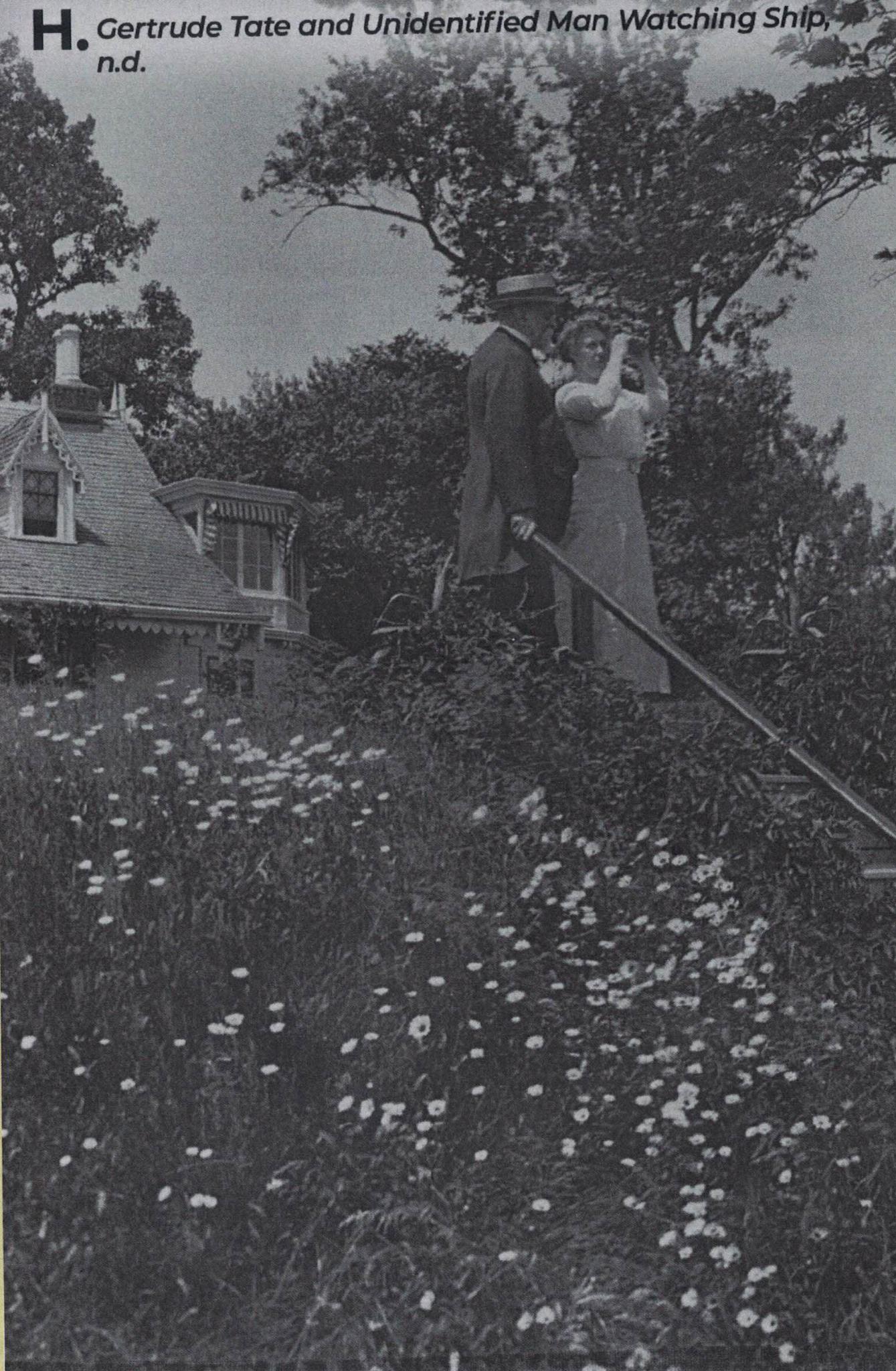
Black and white photograph by Alice Austen of Gertrude Tate and an unidentified man standing at the top of a staircase
Alice Austen, Gertrude Tate and Unidentified Man Watching Ship, n.d.

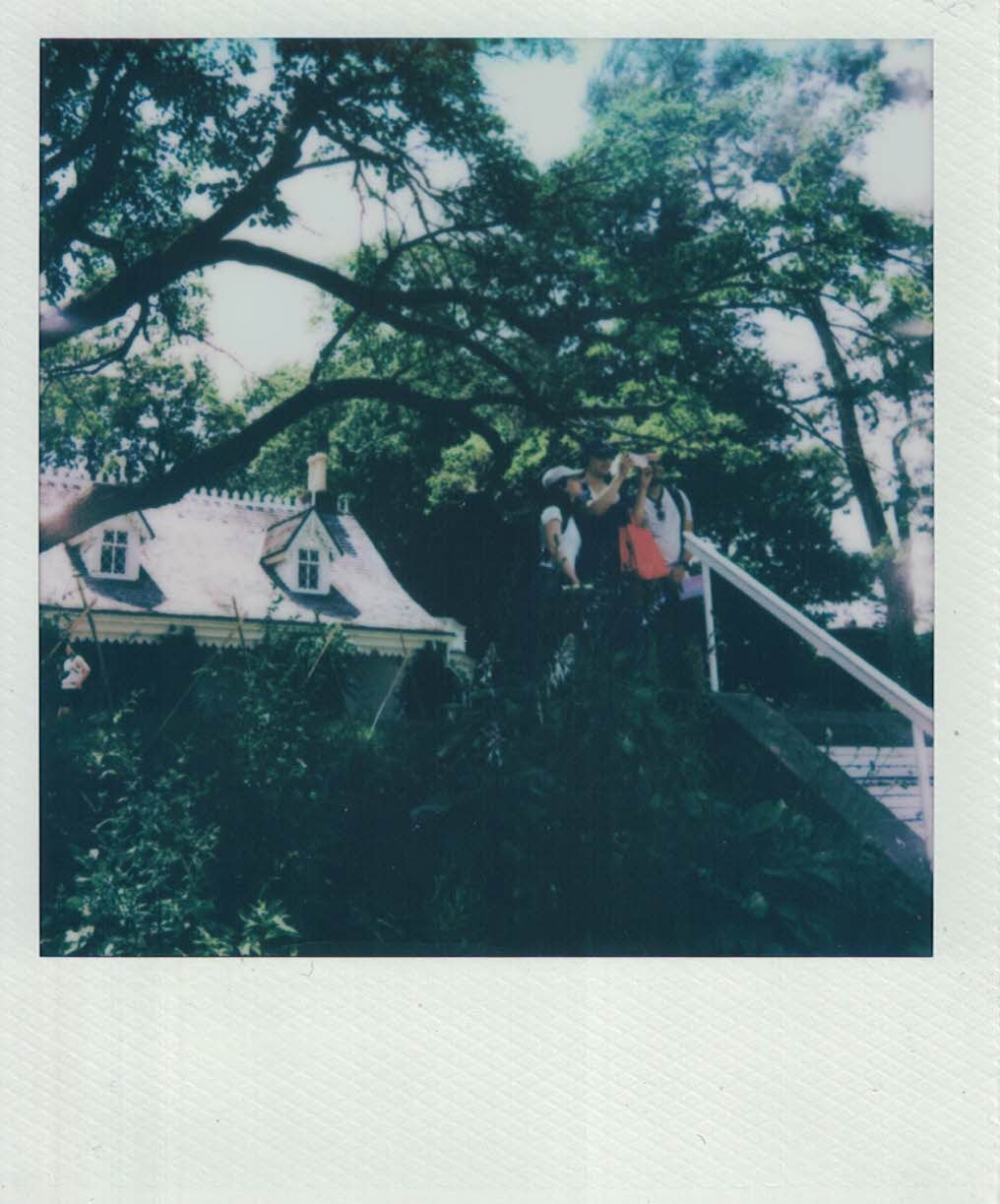
The photograph I am sharing is a recreation of photograph H on the map, Gertrude Tate, and the unidentified man watching ships. The photo was taken close to the shoreline, looking up toward the staircase, and in the background, you can see the rooftop of Clear Comfort. We attempted to match the low angle of the original Alice Austen photo as best as possible. Gertrude was using binoculars to spot the ships, so as our modern day equivalent, we used our phones to get the same effect.

Polaroid photo of three people standing at the top of an outdoor staircase
Our recreation, July 2026

Something that interested me was what could not be captured by our photo. We could match the composition, but not the moment. Gertrude was holding binoculars while we were using phones. We can do everything to copy the frame, but the century in between is still apparent. The wildflower hillside in the original is now denser garden growth, the Polaroid appears washed out, while Alice’s is sharp black and white, and her subjects looked through glass while we look through a screen.

That gap is really the difference between what this photo meant to her and what ours means to us. This was Alice’s home. In taking that picture of Gertrude, Alice was documenting her daily life and her most important relationship, at a time when such a relationship could not be openly named. Her photos were meant to be private, for her and those close to her to reminisce over. Ours is the opposite: visitors to a museum, imitating her, knowing these images would be shared and discussed.

Even so, the activity ended up capturing community in its own way. To recreate her photo, we had to work together, figure out the angle, decide who would stand where, and pose for each other, and in the process, we got to know one another better as classmates. In that sense, our Polaroid does what Alice’s photos did, it captures the people we spent the day with, in a place that mattered to us for that afternoon. Her photo preserved her community, and ours preserved the start of one. I think that is something Alice would have liked.

Blog post #2


5 people sitting on stairs a woman sitting on stairs with a pug and chihuahua


The photo my group took during our workshop at the Alice Austen House made me think about how different life is today compared to when Alice Austen lived. Even though my groups photo and Alice’s photos were taken in the same place, they have very different meanings because of the different time periods. Our photo shows a group of people smiling and laughing while Alice’s photo shows a woman (Katie, who was one of the Austen’s live in maids) by herself sitting on the stairs of her porch with two dogs (punch the pug and Chico the chihuahua). To me our photo represents community, friendship, and also the freedom to be ourselves while Alice’s photo focuses on her dogs and her maid Katie.

Alice Austen house was more than just her home, it was a place where she felt safe to express who she really was. Often taking photos of herself and her friends in drag which included wearing clothes like top hats, fake mustaches, and pant suits, even though women were expected to wear dresses and follow strict gender roles. She also shared her life with the woman she loved at a time when being openly gay was not accepted. Because of that, I think her home became a safe space where she could be herself without fear of being judged by society.

As a visitor, I see the Alice Austen House as a museum that teaches people about history of NYC but also the LGBTQ+ community. For Alice it was a place where she created memories and built a community with the people she cared about most. Looking at our photo and comparing it to hers made me realize how much has changed. Today, many people have the freedom to wear what they want, love whoever they want, and express themselves more openly. While there is still much progress to be made in our societys today, our photo reflects a world with more freedom than the one Alice Austen lived in. Being at her house helped me appreciate not only her photography but also the courage it took for her to live as authentically as she could during her time.

Blog 2- Kelvin

Photo reassembling Alice’s

This is a photo that reassembles the one taken by Alice in which we can see a woman sitting with some puppies on a staircase in Alice’s House. Instead of real puppy I had a photo of my dog in my phone,  and I would say Alice’s photo still connects with the community of dog owners.

For Alice this photos were just a form of expression (art) or just a way of having fun with her friends at the time, but for me personally as a visitor of the museum, taking the photo in the same spot after 100+ years later means and shows that history tends to repeat itself.

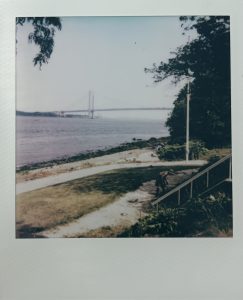
Woman is working in a garden in front of the Verrazano Bridge

If to consider the photography as an art medium between the empirical world and captured representation of reality as a existential essence of the photography, as a trace, a captured moment in a time and space as it was considered by Roland Bard in his work Camera Lucida, beyond from the consumerist agenda of current foreseen by Susan Sontag in her On Photography work, those pictures had have captured by Alice Austen was, keeping in mind her queer perspective was both the way to reconsider the narratives being actual for her period of time by shifting the perspective of how her society applied to the daily values, and at the same time, also the way to capture the time, to safe some very important, intimate, gentle moments of the queer life created by ad hoc The Darned Society.

That same perspective I was trying to apply to the picture I took at Alice Austin’s House, trying to connect both the intimacy of the Larky Life still in the air in this place, and capturing the moment of House dailies. There weren’t a try to revise the current notion as it is no longer a necessary at least in such a community, however, I like the juxtaposition of the senses in the picture I took with both touch of something impressionistic and old, when that community took a place, and with the new inclination like the thick line of Verazzano Bridge symbolised of the passed time as it was builded up much later. This is actually what might simultaneously being included in a photo as a unique medium if to considering this elusive narrative juxtaposition in the picture, the juxtaposition of even controversial meanings with the same time literally the capturing the reflection of light on a silver halide crystals I assume still being a part of the Polaroid film chemical structure which is itself unique, as it was same uniqueness of the picture of Roland Bard’s mother being a little girl he found and turned it to the Camera Lucida work. With such a narrative in mind, I took this picture when I’d obtained a few free moments with Polaroid at this cozy Austin’s House water edge follow a significant shape to the modern Manhattan.

Blog Post 2 – Tucker Loth

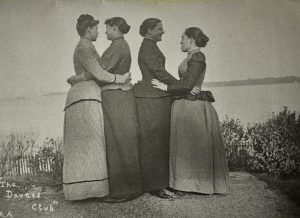
Alice Austen Photo of women holding eachother

In the most simplistic of terms, the photo I chose to share shows my group having fun. Alice Austen had two distinct styles of expression with her photography. One side was that of the documentarian, in which she showcased everyday life with photos of people and communities on the street. The other was an expressionist window into her personal life. The ladder example is closer to what my group attempted to recreate. In Austen’s original photograph she set up a shot of her and her three friends hugging each other in a somewhat intimate way. When I saw this photo it struck me by how contemporary it felt. The photo closely resembled a group photo that I would take with my friends during a night out. This personal resonance was the reason I selected it for my photo reenactment. In my group we attempted to have the same framing as the original photograph, the major difference is that we attempted to make a heart shape with all three of our arms (I ended up botching the heart shape because I didn’t put my elbows together </3 ). We did this in part because we were just having fun, but also because we wanted to recreate Austen’s free spirited style. Our reenactment illustrates community because it shows how human relationships are, in the most basic form, about spending time with one another.

Blog Post 2

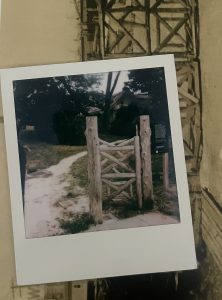
These photos connect to Alice’s community because they represent her living space and where most of her work was done. These photographs effectively capture how the rest of the community and townspeople viewed Alice because of the values of Victorian people at this time who placed immense emphasis on appearance.  The people at this time made sure to uphold their outward appearance in order to maintain the status quo and appear as though they are upper class. Furthermore, Alice’s estate is in relatively good condition with a well kept property and positive outlook for the townspeople/ community in the area.

In regards to what the photos mean to me vs. what they mean to Alice when taking them may be different. I view the photos as Alice being a very well off individual due to size of her estate and the means needed to maintain such a large house with a location right next to the beach and waterfront. In addition, the gates outside of the house tell me that Alice is a person who values her privacy which could be a result of some of her work that is very personal to her in many ways. Alice was a very eccentric woman who pushed social norms in the Victorian Era and challenged many of the ideas surrounding women at this time. On the other hand. Alice may have viewed these photos differently or the same depending on her perspective. Alice may have taken these photos of her estate and gate as a way to capture the home that she grew up in and to keep it as a sentimental piece as her childhood home. Alternatively, Alice may have taken these photos to show people outside of her area when she traveled where she grew up and her origins or just to simply keep it as a memory for wherever the future may take her.

Overall, the visit to Alice Austen’s house was a great learning experience that taught me a lot about some of the history behind the LGBTQ and gave me insight into some preservation sites in Staten Island. This was a new experience for me because I do not frequently visit this area of NYC and found it very informative to learn more about some of the artichectual history in the city.


Alice Austen Estate Front Gate