Sergei_Markelov_Blog_Post#6

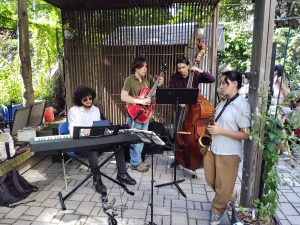
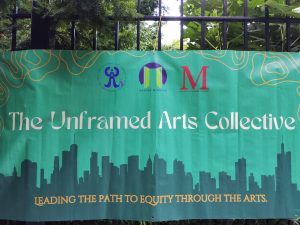
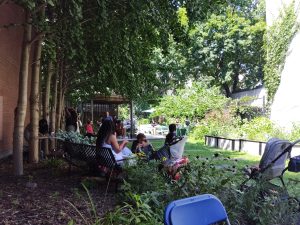
All right, the live-music event I attended wasn’t actually a live-music event, though it was a band providing musical accompaniment for the event put on by UAC (Unframed Arts Collective) as their annual fundraiser, Where Art Takes Root, where I was volunteering toward Macaulay mandatory volunteering hours. The event took place at Jane Bailey Memorial Garden, in Brooklyn.

jazz-band

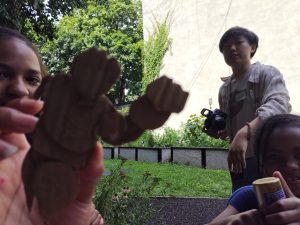
UAC is a non-profit that “transforms unconventional spaces into artistic vehicles for healing, resource-sharing, and community-building for low-income and migrant New Yorkers with sensitivity to the needs of the unhoused community” – as it says in their brochure. For the event they set up art workshops as an Air-Dry Clay Coaster Activity, Seedling Starter Station, Build a Cardboard Insect Station, and Mini Dried Flower Bouquet Station as well as a music performance.

a banner

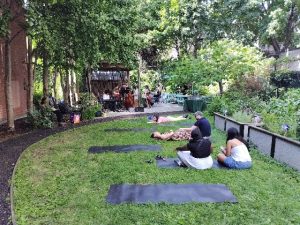
The attendees were people from the neighbourhood presumably parents with kids who did have a chance to participate in workshops with a musical accompaniment from 1 pm. The Band (I don’t know their name) was performing some famous jazz miniatures for about three hours.

people on an event

This type of entertainment highlights the New York vibe where you can face the musical performance anywhere from the porch in the West Village to the local pubs or parks. In regard to this particular performance and other events happening around simultaneously, music accompaniment is a great solution to connect with the community’s social initiatives and enjoyment of the workshops in an open space.

kids in a workshop

Even though it was not a live-music event in total and people didn’t look like they came to listen to the music, the jazz performance was a great addition to the non-profit initiative space created to connect the community members together with art and music.

people on an event

Sergei_Markelov_Blog_Post#5

In order to discuss the possibility of replicating the art exhibited on a High Line, it is enough to stop by the marketplace located down the way in this linear park. Unfortunately, I did not take a picture of the pieces I want to talk about, though the piece of art used to be on a High Line no longer exists — it’s been replaced by the Buddha’s statue. But this sculpture with archaeological and biological subtext, ironically called Dinosaur, represents “a large, hyper-realistic cast-aluminum sculpture of a feral pigeon, by Colombian artist Iván Argote, installed since October 2024 at New York City’s High Line”.

pigeon Dinosaur sculpture on a High Line

(It is a photo of mine I took about a year ago). 

The pigeon was highly observed from 10th Ave while you navigating you way by highway reaching 30th St. Personally, I like this enormous sculpture more as it is also multicultural and represents New York for certain point more than Buddha, though I’d rather seen this sculpture from the High Line, more often from the highway level driving around New York, with also capturing series of sculptures of humans parts with their dissolving, disappeared parts located on a Park Ave and representing immigrants, though being replaced by different kind of animals. They were kind of my daily mates as I often took those roads during my job shifts.

Going back to Berger’s statement about ways of seeing, even if the Dinosaur sculpture is being replaced, traders are still selling merch with Pigeon on the High Line – tote bags, T-Shirts, etc. Again, unfortunately I didn’t take a picture of the merch itself, though I found a picture on the web. And this is even more interesting because the sculpture itself no longer exhibits on a parkway, but replicas of the sculpture, its recognizable image still available for tourists.

pigeon tote-bag
Screenshot

For me, of course, while navigating a truck through New York in a jam on 10th Ave, this sculpture represented the emotional connection with those days and gave me some joy in harsh moments; it’s connected with my memory, with, again, an attachment to my emotional sphere rather than an empty representation of those moments by taking a tote bag with its replica. However, even the tote bag with Pigeon’s image might stimulate the memory and feelings connected with the sculpture that no longer exists, and probably this kind of representation doesn’t make any sense if applied to the initial sculpture, though the tote bag is more of a shell being brought from the summer vacation rather than the initial copy. But in a way of possibilities to replicating art, even the sculptures no matter where they are located, in this way we, I think, living in a world with high level of blurred artistic value as soon as basically any kind of piece of art might be replicated, multiplied, and being sold in a souvenir store or even curbside near by the famous sculptures like Charging Bull etc.

Still, the possibilities of replication today with 3D printing and AI are limitless. Any kind of art might be turned into something smaller, bigger, find its place on a mag or token, or take the same scale and dimension in another place, even giving different senses simultaneously while connecting two controversial patterns together like juxtaposition of pigeon and Dinosaur in a gigantic representation. However, if following Berger’s statements I found the main litmus test personally is the definition of emotional connection with this piece of art, as if that emotion appeared in the way of seeing the original work, no token or tote bag can replace it.

It is like watching the Goodby Language by Jean-Luc Godard when you can watch this movie on DVD hundreds of times, but the initial emotional connection with the exact author’s idea you can achieve only by observing this film in 3D in a movie theater or in a VR projector at least. Same, I assume, with highly debated Nolan’s The Odyssey – there is a limited number of theaters in the world where you can watch this movie as it is, with no way of achieving the same IMAX 70mm experience at home, and in this way even the movie-blockbuster becomes a piece of art even if you can replicate it in an eternal amount of copies.

Sergei_Markelov_Blog_Post_4


The first time I got into the performing arts, like the Queer Van Kult, was in Finland, where people from a particular neighborhood put on a theater performance on a playground, with an open invitation to join. From this point, I found the way Zoë and Nicie do, turning the space around or non-obvious spaces like a U-Haul truck into the stage, also using the unexpected but at the same time daily tools as performance objects and artistically reconsidering all of this, is outstanding for New York and Staten Island personally. Also keeping in mind the queer narration and the project they put together from scratch, it turns out to be a really great artistic startup.

However, I was interested in figuring out, are they have a plans not only making kind of a moving or open performances with such a bring the art outside, but also turn people to be a part of the artistic narrative in a way it was made in a Marina Abramovich Institute or Slava Polunin’s Moulin Jaune house where audience experiences catharsis by not only the visual interaction with art but with deep immersion through experiencing insightful turmoil what actually dates back to the ritual traditions representing the initiation rites when people getting out of this experience completely changed (the borderline might be the Iowaska). I asked this question, though they not yet ready or have a chance for such complicated artistic methods as I understand, also considering the price of such a project and the responsibility they need to take on.

I also asked if they have been experiencing any corrections regarding the queer community due to the significant changes in a politician field, and I think they did not answer this question directly, but I got that we are living in a but less liberal times where maybe in the New York area there might still be mote safety spaces for LGBTQ+ events. And I think this is an another challenge we all need to faced with and considering how to be prepared for possible shifts in a agenda of the political events as soon as the society also getting under these shifts – in my opinion, if after the queer performance people around spreading the words about the Satanic cult using a pigs blood, this might be a slight bells about something in the air, and it is better to understand these such a chops and changes to protect yourself and your community.

Sergei_Markelov_Assignment#3

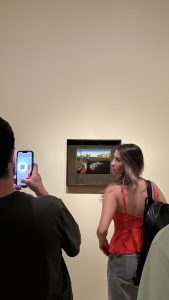
Following the statement made by John Berger in his video, as well as in his work Ways of Seeing, I picked the pretty mainstream artwork, though I made this decision after I took the photo of the masterpiece. It was a line of people trying not only to take a picture of this small piece, but also to capture themselves with the original work, as usual in a museum. As soon I aimed my phone and got the photo of the Persistence of Memory, I realized how the intentional meaning of this work by Salvador Dali shifted by connecting with other layers of meaning: a girl is posing (on the right side of the photo), and at the same time the guy with his phone is trying to capture them (on the left).
people with Dali painting

At that moment, I realized how, actually doesn’t matter for people in this line the artistic value of this picture compared to the hype it has. And every next person was trying to make either a selfie, or capture someone with the picture, or just capture the picture as if they also came to make a college assignment.

Dali’s The Persistence of Moment

I saw this picture previously, though more as an element of Dali’s famous collaboration with Disney called Destino. This surrealist animation was something connecting two narratives: a pop-culture element with Disney cartoons and art, before I even watched some of the great works in museums. And with all these kinds of works, seeing them in real life, we are fading, trying to capture their significance.

I remember the woman crying in the Louvre in a crowd embracing the Mona Lisa; she whispered, barely staying on her feet: Oh God, I dreamt about this moment for all my life. I think I captured that moment with much more clarity and favour than this small DaVinci’s masterpiece, barely seen under the thick layer of bulletproof glass with all those people around.

I think this is kind of a similarity I got when I faced the line of people with smartphones capturing this little work by Salvador Dali one by one, and the next, and another one again.

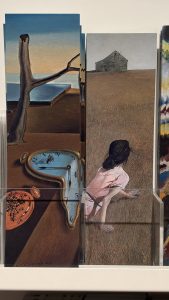
It would not be a surprise if I say that the vibe of this painting was moving away from me as I found it in different books, or reproductions in a gift store, and towards the full breakup in a bookmark captured just a piece of the painting.
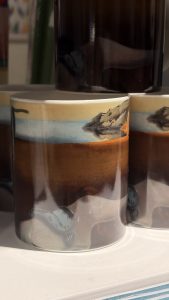
gift shop souvenir gift shop souvenir gift shop souvenir gift shop souvenir

However, I keep thinking about the meaning. There was a doll, a Barbie in a dress made with another famous picture by Van Gogh at a gift shop. Two significant representations of the mass products connected together, like Disney+Dali. And I imagined if someone put this doll on the fifth floor in MoMA, on a stand, with a sign that it was a Marcel Duchamp work, and I would have a chance to stop by without a crowd – what would be the effect?

Doll in a dress as a painting of Van Gogh

The knowledge that we are in a museum, the understanding that we are observing the painting collection of significant artists, the explanation notes near these pictures, the inspired and spiritual faces of the audience around making up our impression of the works we are observing. And at the end of the exposition, we are feeling like these kids.
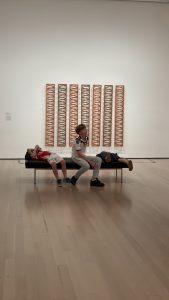
kids in a museum

However, to have a chance for reflection, it needs to be prepared for considering art, to be able to read it by applying previous experiences of watching, even though some of the exhibited works are arguably subjective. It is a language we are probably getting less and less able to understand, and in such a museums era we prefer the philistinism way of art: picking up souvenirs in a gift shop rather to explore these narratives? I know that the picture in a gift shop is just a print of the famous painting, but this painting can be turned to the masterpiece if someone would have a chance to sell the vibe of this print – we get the art. At the end of the day, for me the result is that the art is a unique piece of artistic view rather than a mass product, though even a piece of art can be the mainstream if the line of people is lining up to take a picture of their appearance near the art.

Woman is working in a garden in front of the Verrazano Bridge

If to consider the photography as an art medium between the empirical world and captured representation of reality as a existential essence of the photography, as a trace, a captured moment in a time and space as it was considered by Roland Bard in his work Camera Lucida, beyond from the consumerist agenda of current foreseen by Susan Sontag in her On Photography work, those pictures had have captured by Alice Austen was, keeping in mind her queer perspective was both the way to reconsider the narratives being actual for her period of time by shifting the perspective of how her society applied to the daily values, and at the same time, also the way to capture the time, to safe some very important, intimate, gentle moments of the queer life created by ad hoc The Darned Society.

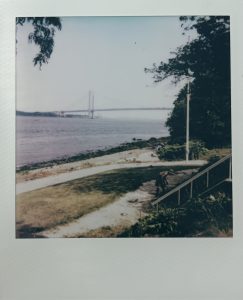
That same perspective I was trying to apply to the picture I took at Alice Austin’s House, trying to connect both the intimacy of the Larky Life still in the air in this place, and capturing the moment of House dailies. There weren’t a try to revise the current notion as it is no longer a necessary at least in such a community, however, I like the juxtaposition of the senses in the picture I took with both touch of something impressionistic and old, when that community took a place, and with the new inclination like the thick line of Verazzano Bridge symbolised of the passed time as it was builded up much later. This is actually what might simultaneously being included in a photo as a unique medium if to considering this elusive narrative juxtaposition in the picture, the juxtaposition of even controversial meanings with the same time literally the capturing the reflection of light on a silver halide crystals I assume still being a part of the Polaroid film chemical structure which is itself unique, as it was same uniqueness of the picture of Roland Bard’s mother being a little girl he found and turned it to the Camera Lucida work. With such a narrative in mind, I took this picture when I’d obtained a few free moments with Polaroid at this cozy Austin’s House water edge follow a significant shape to the modern Manhattan.

Sergei Markelov_Blog post 1

I’ve been to Ermitage and seen El Greco, I’ve seen Raphael’s Madonna del Granduca in a Pushkin Museum, I’ve seen Mona Lisa in a Louvre, Munk’s The Scream in a Munk Museum, Rotko in the Museum of Art in DC, I am still wish to visit the Venece where the Tintoretto was working and Florence famous from being a lullaby of DaVinci and Buonarroti. But what might I get from the Metropolitan Museum of Art? Raphael again, why not?

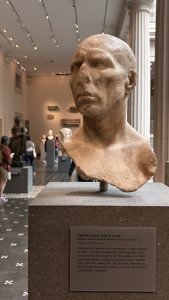
But first it was a hall of butts, many-many ancient Greek and Roman butts (I wonder who decided to position them in such a manner) with the most powerful Hercules’s.

ancient statues Hercules

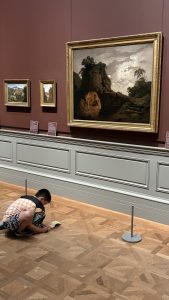
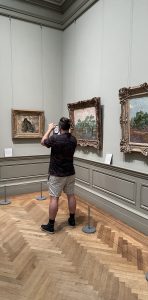
I am not a big fan of ancient sculpture, though, and moved directly to the painting area. There are, of course, more than enough significant paintings, but first I was admitted and first touched me was not even Virgil’s Tomb by Moonlight, with Silius Italicus Declaiming, 1779 by Joseph Wright, but the kid, about 10 years old, with utter devotion drawing this picture. It is the most amusing to watch how the art applies to people’s emotions, especially if it is a child’s mind. God knows why this little boy was so affected by this painting with an ancient poet’s tomb, and if he even knows who that guy is who accidentally got reincarnated in a Divided Comedy.

Boy with the picture Boy with the picture Boy with the picture Painting description

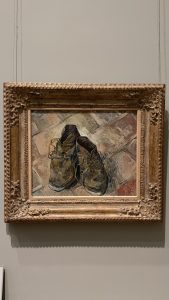
I am also aimed to the French art, Impressionism, though I like this sense of simplicity. Shoes by Vincent van Gogh was this type of art hiding some mystery beneath. They say, Van Gogh “painted several still lifes of shoes or boots during his Paris period” and this picture, “painted later, in Arles, evinces a unique return to the earlier motif” but mow being placed in within a specific spatial context: namely, the red-tile floor of the Yellow House”. Shoes “may have been those of Patience Escalier, whose portrait Van Gogh executed around the same time, late summer 1888”. I like such types of stories beyond the picture itself, and its simple big sense makes me remember it.

Van Gogh’s The bootsI am shooting the painting

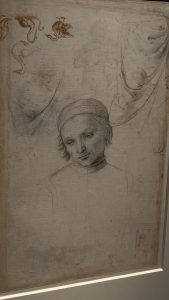
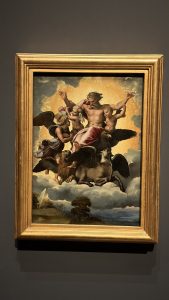
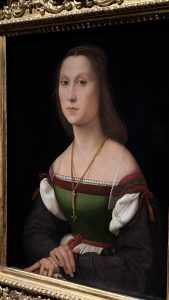
And the third, and actually the main pleasure, was again Raphael with exclusive exhibition-tour Sublime Poetry as a view on his career, with unique “drawings, paintings, prints, and tapestries on view present a portrait of his dashing artistic personality and astonishingly creative mind”. It is significantly attributed to how future masterpieces are basically developing through the sketches as a film photo, as you can easily recognise these future well-known canvases. It is nonetheless intriguing to observe how this, basically one of the Renaissance establishment’s paintings, had been developing from his contemporaries like Perugino, who were applying the same motives you can find in the exhibition as well, or how his own painting developed to become more dramatic and reach beyond earlier portraits.

Raphael’s drawingRaphael’s drawingRaphael’s drawingRaphael’s painting Raphael’s drawingRaphael’s woman

With this actual point when I face Raphael’s paintings 10 years after our first meeting, I realized that art is stretched out over time experience which developing simultaneously with you. Same as aiming the simplicity of the complication of Raphael’s works, aiming to the point upfront. My first experience of that was in Moscow, and now it is in New York, which is kind of symbolic though I haven’t decided why yet.

Ancient man