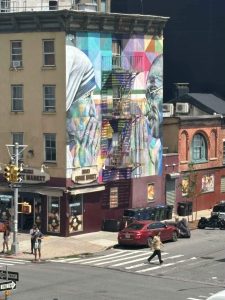
The mural I selected depicts Mother Teresa and Gandhi staring at one another while holding their hands in prayer. The mural is painted with multiple colors and intricate patterns, creating a kaleidoscope-like effect that symbolizes unity between the two figures. Although this mural could technically be replicated as a painting or photograph, I do not believe a replication would evoke the same emotions as seeing it in person. As John Berger discusses in Ways of Seeing, viewing a work through a screen is different from experiencing it in its original setting. When I saw the mural in person, I felt a sense of awe because of its grand scale, complexity, and the amount of detail that cannot be fully appreciated through a screen. The mural’s location also contributes to its impact. Because it is painted on the side of a building above a food market, it becomes part of the neighborhood and its surroundings. Seeing it in its actual location allows me to experience not only the artwork itself but also how it interacts with the community around it. If the mural were reproduced as a painting and displayed somewhere else, it would lose some of that connection to its original environment. Therefore, while the image of the mural can be replicated, the experience of standing in front of the original cannot be fully reproduced.
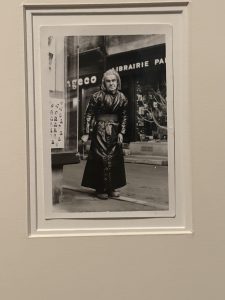
The first piece I’ve chosen to highlight is a choreographed self portrait by Marcel Bascoulard. The series showcases multiple self portraits taken between the 1940’s up until 1978 with Marcel posed in dresses and Victorian style wear. I chose to highlight this piece due to the authenticy that bleeds through the frame. Something I realized about the concept of being punk is that it can be exhausting if its not innately apart of who you are. You can look at Marcel and just know that he couldn’t be anybody else even if he tried. To me that is the very definition of punk.
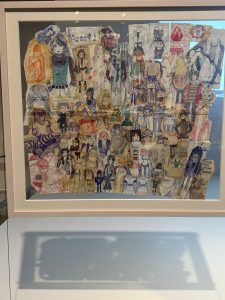
The next piece I’ve chosen to highlight is by Ariane Bergrichter. This piece showcases a collage style series of fashion outfits, all seemingly made for a particular character/individual. Some of the outfits actually look like outfits worn during the core “punk” time period. Others are seemingly “regular” but still somehow manage to feel one of one. Each outfit seems like it would empower somebody to simply exist in the world and take up space. To the average individual this may seem easy but for many its not. Punk as a culture and philosophy provides its people with an armor that allows them to do this exact act, and live their lives the way they truly desire, not how society tells them to.
I don’t think either artist intended for the work to read as punk. I think they were both just being themselves and creating what felt true to them. There’s nothing more punk than that.
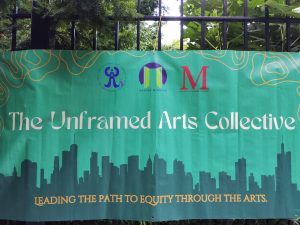
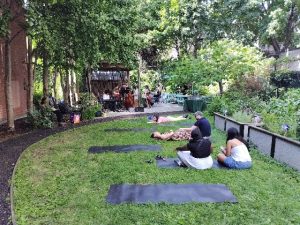
All right, the live-music event I attended wasn’t actually a live-music event, though it was a band providingmusical accompaniment for the event put on by UAC (Unframed Arts Collective) as their annual fundraiser, Where Art Takes Root,where I was volunteering toward Macaulay mandatory volunteering hours. The event took place at Jane Bailey Memorial Garden, in Brooklyn.
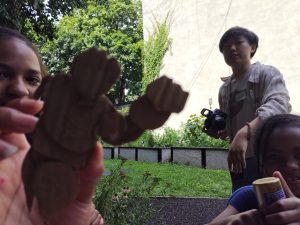
UAC is a non-profit that “transforms unconventional spaces into artistic vehicles for healing, resource-sharing, and community-building for low-income and migrant New Yorkers with sensitivity to the needs of the unhoused community” – as it says in their brochure. For the event they set up art workshops as an Air-Dry Clay Coaster Activity, Seedling Starter Station, Build a Cardboard Insect Station, and Mini Dried Flower Bouquet Station as well as a music performance.
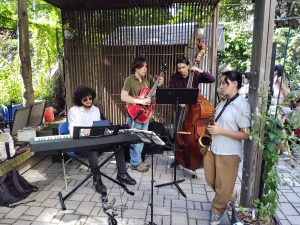
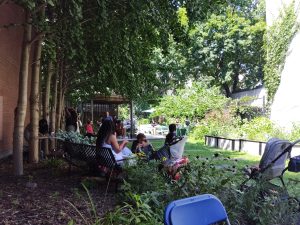
The attendees were people from the neighbourhood presumably parents with kids who did have a chance to participate in workshops with a musical accompaniment from 1 pm. The Band (I don’t know their name) was performing some famous jazz miniatures for about three hours.
This type of entertainment highlights the New York vibe where you can face the musical performance anywhere from the porch in the West Village to the local pubs or parks. In regard to this particular performance and other events happening around simultaneously, music accompaniment is a great solution to connect with the community’s social initiatives and enjoyment of the workshops in an open space.
Even though it was not a live-music event in total and people didn’t look like they came to listen to the music, the jazz performance was a great addition to the non-profit initiative space created to connect the community members together with art and music.
In order to discuss the possibility of replicating the art exhibited on a High Line, it is enough to stop by the marketplace located down the way in this linear park. Unfortunately, I did not take a picture of the pieces I want to talk about, though the piece of art used to be on a High Line no longer exists — it’s been replaced by the Buddha’s statue. But this sculpture with archaeological and biological subtext, ironically called Dinosaur, represents “a large, hyper-realistic cast-aluminum sculpture of a feral pigeon, by Colombian artist Iván Argote, installed since October 2024 at New York City’s High Line”.
(It is a photo of mine I took about a year ago).
The pigeon was highly observed from 10th Ave while you navigating you way by highway reaching 30th St. Personally, I like this enormous sculpture more as it is also multicultural and represents New York for certain point more than Buddha, though I’d rather seen this sculpture from the High Line, more often from the highway level driving around New York, with also capturing series of sculptures of humans parts with their dissolving, disappeared parts located on a Park Ave and representing immigrants, though being replaced by different kind of animals. They were kind of my daily mates as I often took those roads during my job shifts.
Going back to Berger’s statement about ways of seeing, even if the Dinosaur sculpture is being replaced, traders are still selling merch with Pigeon on the High Line – tote bags, T-Shirts, etc. Again, unfortunately I didn’t take a picture of the merch itself, though I found a picture on the web. And this is even more interesting because the sculpture itself no longer exhibits on a parkway, but replicas of the sculpture, its recognizable image still available for tourists.
Screenshot
For me, of course, while navigating a truck through New York in a jam on 10th Ave, this sculpture represented the emotional connection with those days and gave me some joy in harsh moments; it’s connected with my memory, with, again, an attachment to my emotional sphere rather than an empty representation of those moments by taking a tote bag with its replica. However, even the tote bag with Pigeon’s image might stimulate the memory and feelings connected with the sculpture that no longer exists, and probably this kind of representation doesn’t make any sense if applied to the initial sculpture, though the tote bag is more of a shell being brought from the summer vacation rather than the initial copy. But in a way of possibilities to replicating art, even the sculptures no matter where they are located, in this way we, I think, living in a world with high level of blurred artistic value as soon as basically any kind of piece of art might be replicated, multiplied, and being sold in a souvenir store or even curbside near by the famous sculptures like Charging Bull etc.
Still, the possibilities of replication today with 3D printing and AI are limitless. Any kind of art might be turned into something smaller, bigger, find its place on a mag or token, or take the same scale and dimension in another place, even giving different senses simultaneously while connecting two controversial patterns together like juxtaposition of pigeon and Dinosaur in a gigantic representation. However, if following Berger’s statements I found the main litmus test personally is the definition of emotional connection with this piece of art, as if that emotion appeared in the way of seeing the original work, no token or tote bag can replace it.
It is like watching the Goodby Language by Jean-Luc Godard when you can watch this movie on DVD hundreds of times, but the initial emotional connection with the exact author’s idea you can achieve only by observing this film in 3D in a movie theater or in a VR projector at least. Same, I assume, with highly debated Nolan’s The Odyssey – there is a limited number of theaters in the world where you can watch this movie as it is, with no way of achieving the same IMAX 70mm experience at home, and in this way even the movie-blockbuster becomes a piece of art even if you can replicate it in an eternal amount of copies.
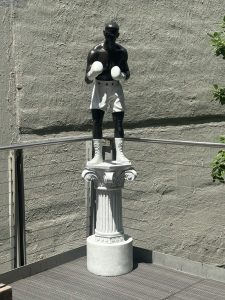
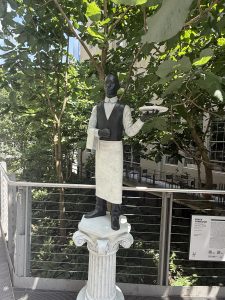
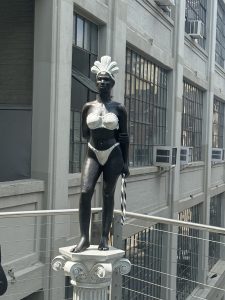
The piece or pieces rather that caught my eye the most at the High Line were Derek Fordjour’s ARCHETYPES series. The sculpture based installation focuses on three entertainment/service based archetypes that Black people have fulfilled: the burlesque dancer, boxer, and waiter. Each role is embedded in themes of empowerment and exploitation, and showcases a fraction of what Black people have had to endure to advance in society.
What caught my eye most about these pieces was their strategic location. They weren’t placed near a highly favorited tourist view, but in a seemingly “normal” positioning in comparison to the rest of the art installations on the High Line. Despite their positioning, they still forced you to stop and engage, coming closer to truly look at and appreciate the piece.
I don’t think it would be possible to replicate these pieces and truly capture their essence 100%. Not just because of the weight the bronze originals carry, but because of even where they were installed. Some people might ignore them on their High Line stroll, others migjt stop and stare enamored. That is one of the key common through lines of the Black experience in America. By replicating the piece without replicating the installation location, you lose an element of the story being told.
During the visit from Queer Van Kult, I asked if they would describe themselves as successful. Zoe responded and said that she wouldn’t yet described the collective as such and went on to describe other milestones that needed to be reached before they could claim the term. It was interesting to me because from the outside looking in, I would’ve disagreed.
I believe that when asked about success a lot of times people focus on the pinnacle of it versus seeing it as a journey, that still allows them to claim success even when things haven’t full peaked yet. I’m beginning to realize that collectively, we don’t give ourselves enough credit or grace when it comes to realizing our accomplishments. It’s very easy to complete one goal and move on to the next. It’s a lot harder to sit in the success of your foundational goals, even when a previous version of you could only see the next step. I think that through Zoe’s answer along with my own reflections on success, I’m learning to view success a bit differently. Accomplishments are fleeting, but the journey to get there is what actually lasts.
The first time I got into the performing arts, like the Queer Van Kult, was in Finland, where people from a particular neighborhood put on a theater performance on a playground, with an open invitation to join. From this point, I found the way Zoë and Nicie do, turning the space around or non-obvious spaces like a U-Haul truck into the stage, also using the unexpected but at the same time daily tools as performance objects and artistically reconsidering all of this, is outstanding for New York and Staten Island personally. Also keeping in mind the queer narration and the project they put together from scratch, it turns out to be a really great artistic startup.
However, I was interested in figuring out, are they have a plans not only making kind of a moving or open performances with such a bring the art outside, but also turn people to be a part of the artistic narrative in a way it was made in a Marina Abramovich Institute or Slava Polunin’s Moulin Jaune house where audience experiences catharsis by not only the visual interaction with art but with deep immersion through experiencing insightful turmoil what actually dates back to the ritual traditions representing the initiation rites when people getting out of this experience completely changed (the borderline might be the Iowaska). I asked this question, though they not yet ready or have a chance for such complicated artistic methods as I understand, also considering the price of such a project and the responsibility they need to take on.
I also asked if they have been experiencing any corrections regarding the queer community due to the significant changes in a politician field, and I think they did not answer this question directly, but I got that we are living in a but less liberal times where maybe in the New York area there might still be mote safety spaces for LGBTQ+ events. And I think this is an another challenge we all need to faced with and considering how to be prepared for possible shifts in a agenda of the political events as soon as the society also getting under these shifts – in my opinion, if after the queer performance people around spreading the words about the Satanic cult using a pigs blood, this might be a slight bells about something in the air, and it is better to understand these such a chops and changes to protect yourself and your community.
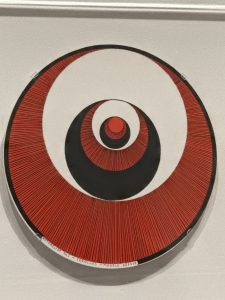
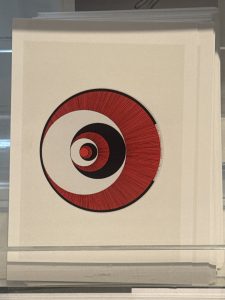
I chose to analyze on of Marcel Duchamp’s Rotoreliefs (Optical Disks) made in Paris, 1935. The impact of this piece is changed when it becomes a print, because it can no longer serve its’ original purpose as a toy. However, when looking at it as just a piece of art, the copy can be enjoyed just as much as the original.
Seeing the print of the piece made me realize that sometimes its easier to own the copy rather than the original. The print becomes a memory of your first interaction with the original, while the original sits as its’ own being, adorned with the energy of its’ creator and all hands that have touched it. Consequently, I believe that the memory you hold on to through the print can be just as important as having an attachment to the original.
Seeing and understand the connection that people can hold to both an original piece of art and its’ adaptations/replicas showed me that you can’t fairly the two. It’s like comparing apples to oranges.
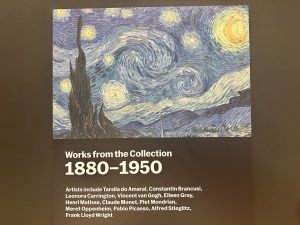
As many of us know, Vincent van Gogh’s The Starry Night is pretty popular. I had seen it countless times, especially online. I even saw it on the wall at a friend’s house when I was invited home for thanksgiving. Before visiting the MoMA, I thought I already knew everything about it. Because I am familiar with the image, I assumed seeing the original painting would not feel much different. I guess I was wrong.
First of all my perspective of the art changed completely when I saw many groups of visitors trying to see and take photographs of the original art. In my mind I was like, but we see this daily online, in homes and offices. But then I reminded myself that this was actually the painting that Van Gogh created in 1889. Then, my attention got drawn even more. I realized I was not looking at a digital image or a printed reproduction at that point, I was experiencing the artwork itself.
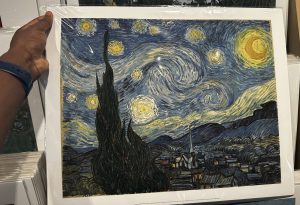
From a look, the texture seemed thick, well layered, and well colored. At least different from the reproductions I have seen in the past and even at the gift shop.
In class last week, due to poor sound quality, I struggled to fully understand John Berger’s video as he explained his ideas on art reproductions and how they make artwork more accessible. However, the few I was able to grasp seemed really interesting, and experiencing both original and reproduction art at the MoMA made the ideas much more clearer and meaningful. Although I initially learned about The Starry Night through reproductions, the original painting had a presence that my experience with printed images had never captured.
After I left the gallery and walked into the museum gift shop, I immediately noticed The Starry Night everywhere. Of course it is popular. The painting appeared on notebooks, postcards, tote bags, puzzles, and other souvenirs. Then I fully understood that the reproductions do not replace the original. Instead, they allow visitors like me to take a small piece of the museum experience home with them. Now I see how reproductions help make art part of everyday life, even in cases when we do not have museum access or the original arts.
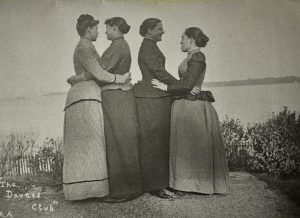
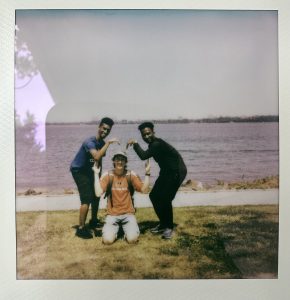
Both photos were taken more than a century apart, but this experience personally taught me how photography can preserve meaningful moments, connections, and community. My group took this photo on the same lawn where Alice Austen photographed four other people expressing closeness and connection. We tried to capture a similar scene, but ended up doing something slightly different. Same location, but instead of four people in the original Alice Austen’s photograph, we were only three. Some of our group members claimed the pose was too intimate. In our picture, we are smiling and trying to make a heart shape together, capturing a moment of connection and shared experience. However, our middleman, Tucker messed it up. hehehe!
To me, both photos reflect community. Alice’s image represents people who were probably part of her everyday life and home, while ours represents the connection and community we are building as Fridman scholars.