Visit to The MET

Before my visit to The MET or any other occasion, I barely remember questioning myself about art or how I feel towards it. Up until now, art to me was something precious and therefore untouchable, as if it were meant to be exercised by those who capture only good feelings: happiness, joy, and peace. I guess the art I have observed never made me question anything. I had consumed art to delight my eyes but not to feed my mind. It was interesting to wander around the MET and observed many pieces of art that were far from what I was expecting to see. Some pieces didn’t invoke joy or happiness, and I had to stop more than once to carefully observe all the elements involved instead of quickly passing by and nodding to assert likeness. 

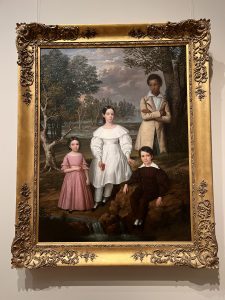
During my visit, I stopped to observe Bélizaire and the Frey Children. I was quickly intrigued because it was the first non-white person I found in a painting while wandering around the American Identities hall. It’s a nondebatable fact that America is a country built on multiple identities; whether all identities are mentioned and recognized is up for discussion, and nowadays there is a stronger push to exalt one specific identity, the “true” American identity. Because of such unique times we are living through, stopping to analyze the painting was necessary. 


I saw Bélizaire, an enslaved Afro-Creole teenager, simply resting against the tree trunk. In front of him were three white children that were part of the family that owned him. This painting was particularly impactful for me because it challenges both of my ideas about art. I looked at it and didn’t feel joy, and I couldn’t simply nod in the spirit of likeness while moving on to the next, so I stood in front of it. I felt heavy as I looked at Bélizaire’s expression and the overwhelming pain of his condition. It got worse when I found out he was painted over, as if removing him out of the picture would eliminate a part of history, a selfish action to remove his history. Thankfully, through conservation efforts it was restored. Moreover, his expression is distinct in comparison to the other children. You could say that at his short age, he has lived through things that a child shouldn’t have. Sadness and regret filled the room, and I swallowed once again the painful truth about the history of America. It doesn’t matter how many times I have read it or seen pictures of atrocities committed towards minorities in the name of “God,” “values,” or many other nonsense explanations. I would never fail to be utterly saddened by the past that hurt millions. Lastly, I believe this painting relates to New York City, as the history of this city has been configured, hidden, concealed, restructured, torn apart, and made new throughout the years. This relates to Bélizaire being painted over to perhaps (and what I think is the reason) remove a part of history because it also happened in New York City. In this case it wasn’t a painting; it was a neighborhood. Seneca Village, home to one of the city’s largest concentrations of free African American property owners, was seized by the city centuries ago to create what we now know today as Central Park (the west side). 

Belizaire and the Frey Children

Description of Bélizaire and the Frey Children


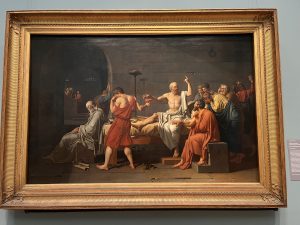
Another painting I found impactful was The Death of Socrates. Again, I didn’t feel happy, nor did I quickly look away to see something else. I actually felt refreshed; I think it’s funny to simply read it but imagine the feeling of seeing someone you know in a place where you don’t know anybody. Socrates was one of the very first things I learned when I went to high school, and the endless debates about whether “you know something or you don’t” flooded my mind with a familiarity I didn’t know art could evoke. All of a sudden, I was transported back in time to my 15-year-old self, who was on YouTube looking for people that could explain Socrates’s philosophy. I think now that art can make you feel at home. Lastly, I’m Death Of Socratesnot completely sure of how it relates to New York City, as Socrates’ death is something he could have avoided by simply leaving Athens, but I think he considered staying as a final act of love towards what he had believed throughout his life. But. I think there could be a small relationship, as there are people who are so deeply intertwined with the city that it seems impossible to leave.

Death Of Socrates Description

Fashion as Art

I spent the latter half of my Saturday at the MET, sheltered away from the light summer rain. I had only toured the museum once before despite living here all my life, though I wouldn’t really count it since it was near closing and in a rush. This time around I had much more time to take in a lot of the pieces. Each room had its own unique atmosphere, making the staging and design feel like an art form in and of itself. In one room you were in Ancient Byzantine, seeing the tools used to hunt prey, while in the next room you were transported to the avant garde glamour of the museum’s world-renowned fashion exhibit.

Titled “Costume Art,” the exhibit propped up beautifully thought-provoking garments next to the art they resembled, connecting two art forms in a visually concrete manner. At one point I seriously considered pursuing a degree in Fashion Design but ultimately succumbed to practicality. Yet, fashion is something I still follow closely today. There’s plenty of discourse on whether or not fashion is art, so to see this exhibit so firmly juxtapose traditional art and fashion together was very admirable.

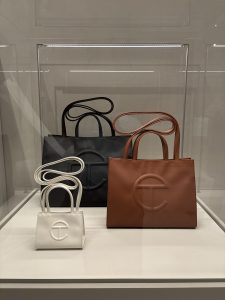
Two pieces in particular caught my attention. The first being a display of 3 Telfar tote bags, each in a neutral shade and all of different sizes. It was actually a bit amusing to me since I had brought my own Telfar medium tote bag to the museum with me, except mine is made of a cherry patent faux leather. I felt a quiet sense of pride, not because I was one of the first few that bought a Telfar bag when they first were selling out at every drop, but more-so for what the brand stood for. Telfar is a New York City based brand centered around uplifting and featuring black and brown LGBTQ+ people of color, and in return we uplifted and featured the brand in our day to day fashion. I felt a sense of pride similar to that of New Yorkers celebrating the Knicks winning the NBA finals, a pride you feel when you see someone that comes from the same place as you make it––a quiet reassurance that you can one day make it too. 3 Telfar faux leather tote bags in cream, tan, and black"TELFAR (American, founded 2005) Telfar Clemens (American, born 1985) Purses 2022 White, brown, and black polyurethane polyester blend. The Telfar shopping bag represents a significant cultural intervention in contemporary fashion. Telfar Clemens redefined the meaning of luxury by creating gander-neutral and widely accessible clothing, encapsulated in its stogan "Not for you for you–for everyone." Introduced in 2014, the tote drew aesthetic inspiration from department store shopping bags. Its more popular moniker "Bushwick Birkin" coined by makeup artist Xya Rachel, contrasts the exclusivity of the Hermes Birkin with the cutrural diversity of the Brooklyn neighborhood. Through affordable pricing, unisex design, ethical materials, and a range of sizes and colors Telfar advances a model of democratized luxury that upends entrenched hierarchies of prestige and consumption."
Please excuse the blurry picture of the description and instead read it down below: 

“TELFAR (American, founded 2005)
Telfar Clemens (American, born 1985)
Purses 2022
White, brown, and black polyurethane polyester blend.

The Telfar shopping bag represents a significant cultural intervention in contemporary fashion. Telfar Clemens redefined the meaning of luxury by creating gender-neutral and widely accessible clothing, encapsulated in its slogan “Not for you for you––for everyone.” Introduced in 2014, the tote drew aesthetic inspiration from department store shopping bags. Its more popular moniker “Bushwick Birkin” coined by makeup artist Xya Rachel, contrasts the exclusivity of the Hermes Birkin with the cultural diversity of the Brooklyn neighborhood. Through affordable pricing, unisex design, ethical materials, and a range of sizes and colors Telfar advances a model of democratized luxury that upends entrenched hierarchies of prestige and consumption.”

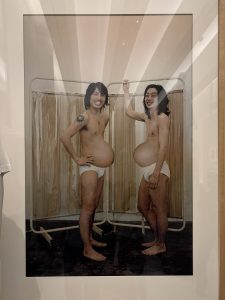
The other piece that stayed with me was from the same exhibit. What seemed like a simple white t-shirt with black text paired with jeans, was actually one of the most thought-provoking pieces for me. Behind the mannequin was an altered image depicting two pregnant men. What once seemed like a preposterous idea is now a political one. While the image’s goal was to comment on possible medical advances in the future, the fashion made a statement on the present reminding the public that pregnant men already exist––they’re just trans. In a political climate that seems so unsure for my trans brothers and sisters, I find comfort in knowing that New York has vowed to defend us so fiercely. Being one of the only cities that provides free gender-affirming care, New York has been a beacon of light that many trans people from all over the world flock to. To have these two pieces included in the exhibit gives trans people like me the ability to dream of a future where we won’t be shackled by the limitations of our bodies.Mannequin with prosthetic silicone pregnant belly wearing a t-shirt reading the text "NEW WORLD BABY"two men in an altered image to show them pregnant description of images: "XANDER ZHOU (Chinese, born 1982) Ensemble, spring/summer 2019 Shirt of white cotton-modal-silk knit printed with the words New World Baby; belly of cream silicone; trousers of blue cotton twill Gift of Xander Zhou, 2026(2026.31a-g) Hiroko Okada (Japanese, born 1970) Future Plan #2, 2003 Chromogenic photograph Brooklyn Museum, Gift of the artist and Robert A. Levinson Fund (2008.25) Hiroko Okada's digitally manipulated photograph of two men simulating advanced gestation shifts pregnancy discourse from biological essentialism to a speculative interrogation of reproductive futurity. Against a backdrop of declining birthrates and recalcitrant family structures in contemporary Japan, Okada's work lampoons bureaucratic strategies by presenting a plan that is simultaneously surreal and technologically radical. Since the spring/summer 2018 season, Xander Zhou's collections have been grounded by fictional storylines titled "Supernatural, Extraterrestrial & Co." The adjacent ensemble features a T-shirt printed with the words New World Baby and a prosthetic pregnant belly, evoking male pregnancy. While it conveyed the designer's utopic vision of a gender-fluid future, it is already a state familiar among trans men in present-day society."

These pieces ultimately reaffirmed my idea that fashion could be art, something that I not only knew but felt all those years ago when I sketched. Yet, it once again brought up questions about when it stops being art and where that line lies.

Blog Post #1 – The MET


Stained glass display


detailed picture of displayed stained artautumn Stained glass window

During my first visit to the MET I came across multiple pieces of artwork that stood out to me especially these two stained glass windows made from Tiffany Studios, designed by Agnes Northrop. As a little girl I had always admired stained glass windows. However these two pieces are some of the best stained glass windows I have ever seen. The details in these pieces is extradorinary and truly highlights the beauty of nature. I couldn’t help but notice how the glass almost blends together to create a vibrant image. Ive always believed that there are many different forms of art and that art doesn’t necessarily need to be a painting or a sculpture but can be expressed in many different forms. These stained glass windows re-enforced my idea of art.  As much as I loved the stained glass windows I also couldn’t help but notice the pillars and and lamps around the stained windows which I believed complimented the stained artworks beautifully. While looking at the Autumn Landscape Stained artwork it reminded me of when I would walk through Kissena park in Queens, NYC,  during the fall and the trees would begin to change colors.

description of stained art description of stained glass


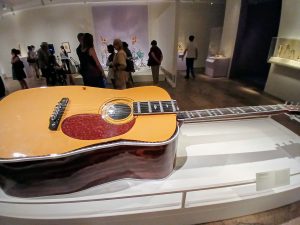
Another piece of artwork that left an impact on me was this casket in the shape of a guitar.

guitar casketguitar casket description plaque

A musician spends much of their life with their instrument, and music often becomes a defining part of who a person is. The idea of a musician being laid to rest in the very thing that shaped and defined their life felt deeply beautiful to me. I also play the guitar and at times playing my guitar was the only thing that brought me comfort in life. The thought of that same instrument continuing to provide me comfort even in death was truly impactful. Music is present in NYC in many different ways. For example, waiting for the train station and someone playing the drums or singing or walking down the streets and someone is throwing a barbeque blasting their favorite music.

Blog 1- Kelvin

I personally found impacting these two pieces:

  • Ancient egyptian paintings/representations
  • A garden landscape


Egyptian PaintingsDescription of egyptian paintings

These pieces of art were trully exciting to see. When you see the egyptian art through the TV you don’t really connect with it, but when you see it in person (even though it’s a replica) you can feel how long the human kind story really is. I didn’t know art could be from that far back, and I was surprised to see how well the egyptians painted.


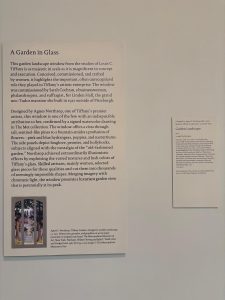
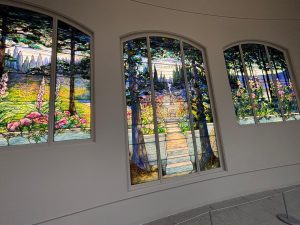
Garden landscape descriptionGarden landscape

This was one of the most beautiful pieces of art I saw at the museum. Tyffany Studios made these landscapes for a woman called Sarah Cochran that wanted to see her garden blossom in every season, which was in Long Island. I went with a guide and at this part she explained how these were made by a woman group called “The tyffany girls” and it had over 10,000 pieces of glass which seems crazy to me. As the light went through the glass at different angles it changed the colors. I though art had to be a painting or a sculputure, I didn’t know It could be made out of glass.


Sergei Markelov_Blog post 1

I’ve been to Ermitage and seen El Greco, I’ve seen Raphael’s Madonna del Granduca in a Pushkin Museum, I’ve seen Mona Lisa in a Louvre, Munk’s The Scream in a Munk Museum, Rotko in the Museum of Art in DC, I am still wish to visit the Venece where the Tintoretto was working and Florence famous from being a lullaby of DaVinci and Buonarroti. But what might I get from the Metropolitan Museum of Art? Raphael again, why not?

But first it was a hall of butts, many-many ancient Greek and Roman butts (I wonder who decided to position them in such a manner) with the most powerful Hercules’s.

ancient statues Hercules

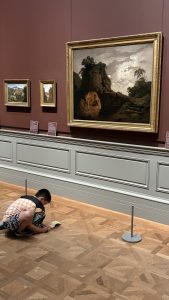
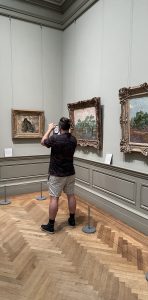
I am not a big fan of ancient sculpture, though, and moved directly to the painting area. There are, of course, more than enough significant paintings, but first I was admitted and first touched me was not even Virgil’s Tomb by Moonlight, with Silius Italicus Declaiming, 1779 by Joseph Wright, but the kid, about 10 years old, with utter devotion drawing this picture. It is the most amusing to watch how the art applies to people’s emotions, especially if it is a child’s mind. God knows why this little boy was so affected by this painting with an ancient poet’s tomb, and if he even knows who that guy is who accidentally got reincarnated in a Divided Comedy.

Boy with the picture Boy with the picture Boy with the picture Painting description

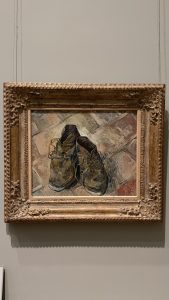
I am also aimed to the French art, Impressionism, though I like this sense of simplicity. Shoes by Vincent van Gogh was this type of art hiding some mystery beneath. They say, Van Gogh “painted several still lifes of shoes or boots during his Paris period” and this picture, “painted later, in Arles, evinces a unique return to the earlier motif” but mow being placed in within a specific spatial context: namely, the red-tile floor of the Yellow House”. Shoes “may have been those of Patience Escalier, whose portrait Van Gogh executed around the same time, late summer 1888”. I like such types of stories beyond the picture itself, and its simple big sense makes me remember it.

Van Gogh’s The bootsI am shooting the painting

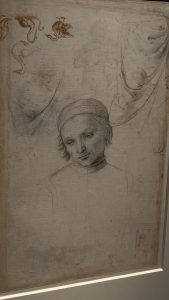
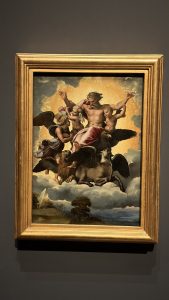
And the third, and actually the main pleasure, was again Raphael with exclusive exhibition-tour Sublime Poetry as a view on his career, with unique “drawings, paintings, prints, and tapestries on view present a portrait of his dashing artistic personality and astonishingly creative mind”. It is significantly attributed to how future masterpieces are basically developing through the sketches as a film photo, as you can easily recognise these future well-known canvases. It is nonetheless intriguing to observe how this, basically one of the Renaissance establishment’s paintings, had been developing from his contemporaries like Perugino, who were applying the same motives you can find in the exhibition as well, or how his own painting developed to become more dramatic and reach beyond earlier portraits.

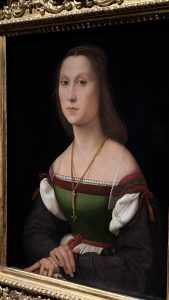
Raphael’s drawingRaphael’s drawingRaphael’s drawingRaphael’s painting Raphael’s drawingRaphael’s woman

With this actual point when I face Raphael’s paintings 10 years after our first meeting, I realized that art is stretched out over time experience which developing simultaneously with you. Same as aiming the simplicity of the complication of Raphael’s works, aiming to the point upfront. My first experience of that was in Moscow, and now it is in New York, which is kind of symbolic though I haven’t decided why yet.

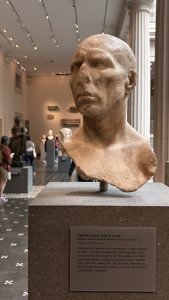
Ancient man

Friday @ The Met

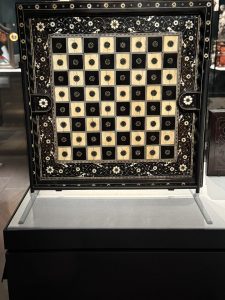
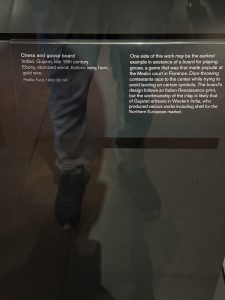
Close-up of chessboard at the Met, with black and cream squares.The goose board side of a gaming table on display at the Met.Museum label for the Chess and Goose Board.

     During my visit to the Met this past Friday, many different pieces of art spoke to me. The first one to showcase is the Chess and Goose Board, a piece I had never seen or even heard of before this visit, made in Gujarat, India, in the late 16th century out of ebonized wood, historic ivory, horn, and gold wire. I’m a person who believes in function over form, but when the function has the form, it gives it extra sauce. This piece breaks the mold of my preexisting ideas about art, in the sense that during our seminar, we discussed that all art is inherently useless, this piece is not only striking in its form, but also functions as a goose game board on one side and a chess board on the other. Overall, my beliefs were challenged by how ornate the goose board is. Every time I look at the photo, I find a new detail that I had not noticed previously. The chessboard specifically reminds me of the many concrete chessboards that are found all throughout NYC parks. Come to think about are those pieces of art that will be housed in museums 1000 years from now?

William Orpen's "Self-Portrait (Leading the Life in the West), an oil painting in a gold frame.Museum label for William Orpen's "Self-Portrait (Leading the Life in the West)

     Another piece that caught my attention was William Orpen’s Self-Portrait (Leading the Life in the West), a piece I was seeing for the first time, painted around 1910 in oil on canvas. This piece confirms my preexisting concept of art, as it is a traditional framed painting. It is also inherently useless in the fact that it serves no other function other than to be observed and thought about. The painting’s first public showing was right here in New York, at a gallery on Fifth Avenue in 1914, the same year the Met brought it into the collection, and it’s been resurfacing in New York exhibitions on and off ever since. Taking out the context or the original intention of the artist, I feel like I see a lot of New York in this piece. This feels like a native New Yorker, through and through, a person on the move, getting ready to rejoin the hustle and bustle of the city. Doing a last phone, keys, wallet check. His walking stick could also be observed as a leash, perhaps his dog is just out of the frame within the frame. Some might say that he is too overdressed for such occasion, but here in the city, people tend to slightly overdress for every occasion when compared to more suburban environments.

Blog Post 1 – Tucker Loth

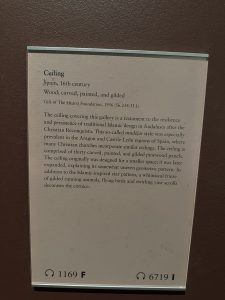
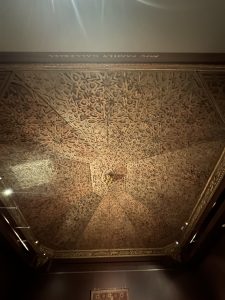
For my visit to the Met I chose two pieces of artwork that spoke to me. First, an ornamental ceiling with no other title than “Ceiling” given on the placard. I recalled in our first class meeting, when discussing “The Creation of Adam” in the Sistine Chapel, that humans tend to have a feeling of awe when looking up. This fact was confirmed to me by the amount of time I spent observing the complexities and subtle details in this ceiling. After walking away and massaging my sore neck I considered one of the questions for the blog post: does this support my idea of art? For this piece my answer was an easy “yes, of course!” The level of human talent and creativity that goes into creating a piece like this, and the fact that it was designed to be viewed by many all contribute to my assessment that this is clearly a piece of art. When considering how this piece relates to the city I deferred to the placard for context. Apparently this piece is from a Christian church in Spain however the design is clearly Islamic. The story is that during Christian conquests against Muslim rule a new art style known as mudéjar was born, in which many christian churches blended their artistic styles with Islamic influences. This blending of cultures, although somewhat violent in this context, reminds me of how art and style in NYC has blended with many different cultures around the world.

A ornamental ceiling in the mudéjar style

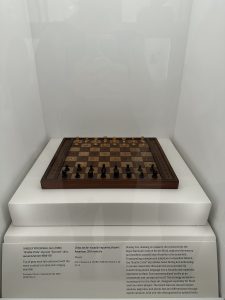
For my next piece I chose a chess board that was on display in the new costume exhibit. This piece was meant to be an addition to a costume that displayed the word “untitled” written in braille; however, I found this chessboard more interesting. It featured raised squares and tactile playing pieces in order to facilitate the game of chess for blind and low vision players. When asking the question of whether or not this is art the answer becomes more difficult. This piece displays a nice craftsmanship and thoughtful design although it was likely mass produced for a utilitarian purpose. Does that objectively disqualify this as art? I’m honestly not sure, but I do find beauty in its purpose and design, so to me, I would consider it art. When relating this piece to NYC I think about the people playing chess in parks and how a board like this could increases the accessibility to many others. Its inclusion of disabled players reminds me of the ethos of acceptance shared by many New Yorkers.

A chess board designed for the visually impaired

Blog Post 1

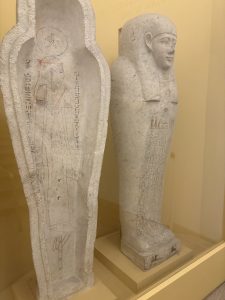
The two pieces that I chose were from the Egyptian Art Exhibit on the second floor of the Metropolitan Museum. I have always been particularly interested in ancient Egypt and knowing more about how they were such an advanced civilization. Seeing these works of art gave me a bit of insight on some of their customs and traditions that governed their lives. The Sarcophagus of Payuhor caught my eye due to the sheer amount of detail and precision that had gone into the craftsmanship. Upon seeing this work of art, I took a couple of minutes to really stop and appreciate the inscriptions said to contain magical formulas for reunifying the spirit with the body after death. This unique way of thinking really challenged my preexisting ideas of art by broadening my definition of what art really is. I feel as though many of us, myself included, look at art as a visual experience of oil or paint on a canvas but when I took a closer look at some of these pieces, I took a deep dive into the culture, creativity, and beliefs of a civilization.

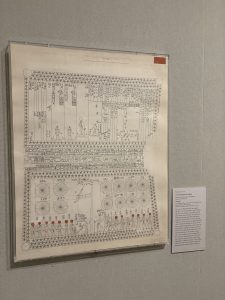
The second piece titled An Astronomical Ceiling was very fascinating to me to read about and explore the concept of Astronomy through this piece. I found it interesting how the Ancient Egyptians were such a complex and advanced civilization that found meaning in things that the average person today would not even think twice about. The suns, stars, and planets being seen as divine manifestations really explores the Ancient Egyptian belief of life after death which is another thing that I found very interesting.  Relating back to New York City, we have such a diverse population of people coming from many different walks of life with strong belief systems and forms of public expression. People display their beliefs and values all across the city in forms of art murals, graffiti, stickers, spray paint, etc. I believe that in New York City almost everyone has a story to share and that is similar to the Ancient Egyptians where they too have their own unique forms of expression where they put their beliefs on display for the world to see in the form of pyramids, sarcophagi, inscriptions, etc.

Overall, I thoroughly enjoyed this first assignment visiting the metropolitan museum because it really gave me an opportunity to learn more about not only the Ancient Egyptians but also take a look at the Arms & Armor exhibit, the Japanese art, Roman Art, and many more. I look forward to more of these assignments and to exploring more of what Art in New York City has to offer.


Anthropold Sarcophagus of Payuhor