A Tale of Two Rooms

Like so many nights out in New York, this one started on Instagram. Scrolling through stories, my feed was a steady stream of friends hosting or DJing across the city. Ome specific post caught my attention; a close friend of mine was spinning a set at Elsewhere in Brooklyn for a Latinx queer party. I slid into their DM’s to get on the guest list and made my way out to Bushwick.

My night almost ended before it began. After making longest commute from the Bronx to Bushwick, I realized I had forgotten my ID at home. Elsewhere i notoriously strict regarding their Id policy, so I began to lose hope after pleading with three security guards back-to-back. After explaining to them that I was on the list and promising them it won’t happen again, they finally let me through.

Inside, the atmosphere instantly shifted. My friend met me near the door, handed me a drink ticket, and I made my way toward the bar. The main room was flashing lights in neon pink and light blue, in sync with the hyperpop beats that filled the room. The music was fast, energetic, and slightly bubbly.

9d302cd59dde4a5d8fb2f697cd71c9b2

After getting my drink I headed over to my friend at the DJ booth and was able to get a better view of everyone’s outfits. It was a reflection of the rave aesthetic mixed with the relentless heat of NYC: deconstructed pieces. bold makeup, ans akin-forward looks designed for dancing in a crowded room. Bright nenon colors, body glitter, and vibrant textures signaled a subculture rooted in joy, self-expression, and queer Latinx pride. Everyone contributed to the vibe of the room with their energy and style.

I was curious about how the rest of the venue felt, so I hopped around it. I walked through the other rooms and met so many people that were just so nice and easy to talk to, something that is so common in these spaces: you walk in alone and leave with tens of people’s instagrams. The outside space is where usually all of the socializing happens, where the music isn’t muffling everyone’s voices. I actually really love when clubs have outside spaces, socializing is what makes the night the most memorable. After talking to a few people and catching up with some of my friends, I headed into the other rooms.bags of friends

The contrast was immediate. Though the lights were flashing similar colors, the larger room hosting a more mainstream event had more muted fashions. It leaned into standard nightlife streetwear and understated tones. While people were having a great time, the visual dialogues were different; the expression felt more passive compared to the vibrant subculture in the first room.

c3d3f057f46f46aa9693e873888fba56

Comparing these two spaces highlighted how deeply music and community shape an environment. The music itself is the baseline, but the crowd’s shared identity turns the beat into a subculture. Being in the first room surrounded by familiar faces, high tempo, hyperpop, and uninhibited expression offered a genuine connection to a distinct community that knows how to claim space and celebrate itself.

The Anaconda River

The piece I chose was the film playing in the Southern half of the High Line. It’s actually two films by Laura Huertas Millán titled The Anaconda River where from noon-10pm the films are shown to the public. During the trip, I wasn’t able to stand and watch them as we were under a time constraint, but the description was enough to pique my interest. There, in an empty corridor of the High Line, a series of visuals haunt the atmosphere. The films, Aequador (2012) and The Labyrinth (2018), center around Latin American ideas of utopia and rewritten history as a tool for social commentary regarding the native-futurism and colonialism.Projector screen image of The Anaconda River

I tried watching the films at home, but it seems as though only snippets are publicly available online, making the screenings at the High Line that much more  coveted. Regarding replication, new advances in Artificial Intelligence suggest that film can be replicated much more easily than before. But when taking a closer look, these films aren’t only original, they carry a weight only a human with lived experiences can convey. That, coupled with the screenings at the High Line makes for an irreplaceable experience. Not only is the art itself irreproducible, but the feeling of standing on the High Line on a warm summer day with the breeze drifting by you and occasionally cooling you down as you stand and watch these films about Latin life is a feeling you can’t even reproduce if you go again on another day. Given that it is a film being projected onto a wall, I can’t even imagine the experience when the sun goes down and the visuals can shine in their full glory.description of The Anaconda River

Yet, it makes me question John Berger’s arguments regarding the camera and how its introduction transformed narratives combined with visuals into a distinct art form. The images from the film aren’t original, they’re technically reproductions–––captured by the camera and displayed to the viewer through a fixed narrative. If seen without the context, passersby might see them and think they’re just displays of nature. That’s where Berger’s argument comes into play. Millán’s display of these visuals along with the narrative allows for the art to take shape. What could simply be a video transforms into a commentary on the lived experiences of Latin American people and what could’ve been if Native civilizations were left alone to flourish.Empty corridor of where The Anaconda River was being screened

Curating Authenticity

During our visit with the cofounders of Queer Van Kult (QVK), I was delighted to gain deeper insight into their curation process. What surprised me most was how closely their workflow mirrors planning a party—from conceptualizing decorations and managing setup, to welcoming and hosting guests, all the way through tear-down and cleanup. I deeply appreciated their commitment to keeping almost everything in-house; taking complete ownership of the process ensures an artistic vision remains grounded, pure, and authentic.

This focus on intentionality led directly to the question I asked them: Has QVK ever hosted an event explicitly centered on trans experiences, and if not, would they be open to letting trans creators take the reins to guarantee the messaging stays true to an authentic trans voice?

When I first heard the name Queer Van Kult, my mind immediately looked beyond sexual orientation, envisioning a broader, gender-bending collective. QVK shared that while they haven’t hosted a strictly trans-centered event yet, elevating trans creators is integral to their work—citing their recent feature of trans Brazilian artists. It was also reassuring to learn that cofounder Jenno (who unfortunately couldn’t join our session) is non-binary.

This reflection began to shape the vision for my final presentation. There is profound beauty, complexity, and pain within the trans experience—realities that transcend the limited narratives often portrayed in mainstream media. QVK’s dedication to telling their own stories authentically inspired me to step up and tell mine.

An Endless Sea of Urinals

If I’m being honest, I had never heard of Marcel Duchamp until the first day of class when we were asked if his work was considered art or not. Of course, I had heard of the boundaries of what is and isn’t art being pushed, but I had never put an image behind the idea. So imagine my surprise when I walked into the MoMA and saw his name splattered all over the museum. It was like looking at images of steganography for hours and only seeing it until someone in the comments circles it in red.

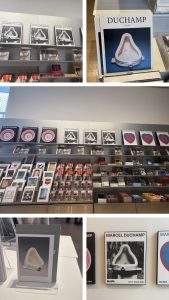
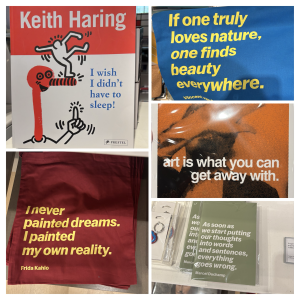
Images of Duchamp memorabilia in MoMA gift shopAfter spending hours at the other exhibits, I finally made my way to the final floor of the MoMA, where Duchamp had his very own exhibit. I was greeted by a gift shop before entering. Before I could even see any of his work, I was already flashed with images of his art like a movie spoiler. The images repeating themselves over and over, in the form of books, postcards, and posters. The repetition seemed almost intentional, as if the museum was writing its own blog post to this prompt.
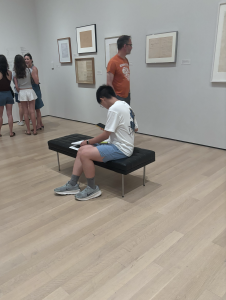
Finally making it past the sea of repeating images, I made it inside. I saw a guy flipping through the book at the shop. I found it interesting how he bought it before viewing the exhibit, or maybe this was his second time seeing it. Nonetheless, there he was in front of all the art and choosing to look at the images of it. It reminded me of the video in class we watched where it explained how the camera changed the way art was seen. He brought himself to the art and then still chose to bring the art to himself–––I thought it was sort of meta.Guy looking at Duchamp book he bought in gift shop

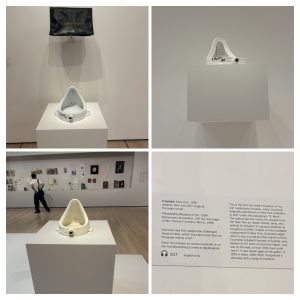
I walked through looking at all the pieces but in search of the one I saw all over the shop. After walking through 2 rooms “I finally made it,” I thought. Then I read the description “Replica.” I thought the urinal in the museum would be the original from Duchamp–––how silly of me. Unbeknownst to me, beyond the sea of pictures of urinals there was a sea of urinal replicas. I counted three in total, excluding the hundreds of prints and books in the shops. I’m surprised they didn’t sell the replicas in the shop too. I questioned why there were so many replicas out on display, perhaps one would’ve sufficed. But then it dawned on me that perhaps once one was reproduced and out on display then the following iterations became progressively less taboo. Replicas of Duchamp's Fountain

The manipulation didn’t stop with the physical replicas, though. Walking back out, I noticed an endless array of canvas tote bags plastered with quotes from the artists. I find this incredibly weird. Their visual art didn’t have words–––it spoke for itself. Reflecting on our class discussion on the video we watched, the video stated that art is inherently silent and unmoving, meaning that the easiest way to manipulate an image is through movement and sound. But in the MoMA gift shop, that “sound” is just words. The museum takes an artist’s personal words completely out of context, slaps them on a canvas tote, and sells them for the sake of “aesthetic.”

Images of totes and books with the words of artists

By adapting and reappropriating the work like this, the museum completely flips its original impact upside down. Duchamp’s Fountain was a literal middle finger to the snobbery, commercialization, and institutional gatekeeping of the 1917 art world. But when you strip away that aggressive, anti-capitalist rebellion and package it into a $75 book ($67.50 if you’re a MoMA member) or a catchy slogan on a tote bag, you get a textbook case of commodity fetishism. The museum removes the history and the labor, replacing it with pre-packaged consumer identity.

The art used to speak for itself; now a tote bag speaks for the consumer. It mirrors the exact museum-goer I can’t stand: the ones treating the gallery like a personal photoshoot just so people online can validate them. The art is reduced to a prop, an extension of a curated, performative personality that lacks any real depth. People buy the “magic” they think the object holds, paying a premium to turn art into a shortcut to looking intellectual.

Ultimately seeing Fountain reproduced and commercialized in this new way completely shifted what it meant to me in person. Expecting a profound historical artifact and instead being met with a replica, surrounded by a gift shop full of paper replicas being sold for profit, made the entire gallery experience feel silly. As for the museum’s intentions, it seems as though they aren’t actually celebrating Duchamp’s philosophy, but instead they’re franchising it. I think recreations like this are a bit insulting to the artist, unless he’s Andy Warhol. I mean, if my art were to be recreated and then sold for profit, I’d hate capitalism more than I already do.

Repatriating the Light

I began to feel a shift in energy as soon as I left to embark on my journey down to Staten Island. A commute that was over 2 hours, on one of the warmest days this summer, felt like the breeze that caressed my face as I watched the water sway us onto the dock. Alice’s house wasn’t as extravagant as I had expected; hearing of her fame and fortune, I expected to be met with lavish displays of wealth, as expected during the Gilded Age. Instead, her home was rich in intimacy and simplicity, a luxury rarely afforded even to the wealthiest of people. I sat on her porch and looked onto the water, a quiet sense of calm filled my body as I closed my eyes and began to imagine her life––the Larky Life.

Classmate, Paula, getting on a bike at the Alice Austen House
Marisol Rodriguez, Paula on Bike, 2026

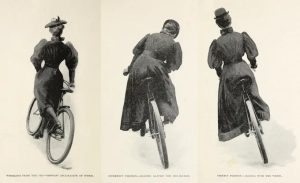
My group and I used up all of our film as we attempted to follow the assignment, but a burst of creativity overtook me at times, something I think Alice would’ve encouraged. One of the images in particular was of my classmate, Paula, on a bicycle. In the exhibit there was an image of Alice’s ex-girlfriend, Gertrude Tate, showing the proper way for women to ride a bike at the time. As we explored the grounds of Alice’s house we saw a bicycle sitting parked under the bright summer sun. I thought it would be a good idea to take an image of someone getting on the bike to show how far women’s right’s have come. At the time, it wasn’t even normal for women to wear pants let alone jeans––funny enough all the women in my group wore jeans that day.

Image captured bt Alice Austen of Gertrude Tate showing women how to ride a bicycle.
Illustration from Bicycling for Ladies based on Alice Austen’s photographs

A feeling of wonder actually loomed over me throughout the exhibit. Alice hid away this intimate side of her from the public, one that is being celebrated now by so many. I can’t help but wonder what her life would’ve been like if she was born at a different time, what she could’ve accomplished if the expectations of society didn’t weigh her down. Yet, her life was a protest against social norms, and the images an immortal heirloom she left us all. To feel the sense of freedom behind these images is a reminder to all queer people, like myself, that our joy has always existed, quietly carving out spaces of radical love long before the world was ready to name it. Alice’s lens didn’t’t just capture her present. She developed a blueprint for our future. We are the continuation of her unyielding spirit, living openly in the very light she spent a lifetime capturing.

Fashion as Art

I spent the latter half of my Saturday at the MET, sheltered away from the light summer rain. I had only toured the museum once before despite living here all my life, though I wouldn’t really count it since it was near closing and in a rush. This time around I had much more time to take in a lot of the pieces. Each room had its own unique atmosphere, making the staging and design feel like an art form in and of itself. In one room you were in Ancient Byzantine, seeing the tools used to hunt prey, while in the next room you were transported to the avant garde glamour of the museum’s world-renowned fashion exhibit.

Titled “Costume Art,” the exhibit propped up beautifully thought-provoking garments next to the art they resembled, connecting two art forms in a visually concrete manner. At one point I seriously considered pursuing a degree in Fashion Design but ultimately succumbed to practicality. Yet, fashion is something I still follow closely today. There’s plenty of discourse on whether or not fashion is art, so to see this exhibit so firmly juxtapose traditional art and fashion together was very admirable.

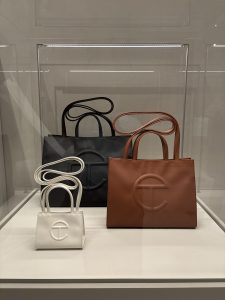
Two pieces in particular caught my attention. The first being a display of 3 Telfar tote bags, each in a neutral shade and all of different sizes. It was actually a bit amusing to me since I had brought my own Telfar medium tote bag to the museum with me, except mine is made of a cherry patent faux leather. I felt a quiet sense of pride, not because I was one of the first few that bought a Telfar bag when they first were selling out at every drop, but more-so for what the brand stood for. Telfar is a New York City based brand centered around uplifting and featuring black and brown LGBTQ+ people of color, and in return we uplifted and featured the brand in our day to day fashion. I felt a sense of pride similar to that of New Yorkers celebrating the Knicks winning the NBA finals, a pride you feel when you see someone that comes from the same place as you make it––a quiet reassurance that you can one day make it too. 3 Telfar faux leather tote bags in cream, tan, and black"TELFAR (American, founded 2005) Telfar Clemens (American, born 1985) Purses 2022 White, brown, and black polyurethane polyester blend. The Telfar shopping bag represents a significant cultural intervention in contemporary fashion. Telfar Clemens redefined the meaning of luxury by creating gander-neutral and widely accessible clothing, encapsulated in its stogan "Not for you for you–for everyone." Introduced in 2014, the tote drew aesthetic inspiration from department store shopping bags. Its more popular moniker "Bushwick Birkin" coined by makeup artist Xya Rachel, contrasts the exclusivity of the Hermes Birkin with the cutrural diversity of the Brooklyn neighborhood. Through affordable pricing, unisex design, ethical materials, and a range of sizes and colors Telfar advances a model of democratized luxury that upends entrenched hierarchies of prestige and consumption."

Please excuse the blurry picture of the description and instead read it down below: 

“TELFAR (American, founded 2005)
Telfar Clemens (American, born 1985)
Purses 2022
White, brown, and black polyurethane polyester blend.

The Telfar shopping bag represents a significant cultural intervention in contemporary fashion. Telfar Clemens redefined the meaning of luxury by creating gender-neutral and widely accessible clothing, encapsulated in its slogan “Not for you for you––for everyone.” Introduced in 2014, the tote drew aesthetic inspiration from department store shopping bags. Its more popular moniker “Bushwick Birkin” coined by makeup artist Xya Rachel, contrasts the exclusivity of the Hermes Birkin with the cultural diversity of the Brooklyn neighborhood. Through affordable pricing, unisex design, ethical materials, and a range of sizes and colors Telfar advances a model of democratized luxury that upends entrenched hierarchies of prestige and consumption.”

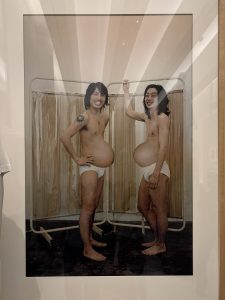
The other piece that stayed with me was from the same exhibit. What seemed like a simple white t-shirt with black text paired with jeans, was actually one of the most thought-provoking pieces for me. Behind the mannequin was an altered image depicting two pregnant men. What once seemed like a preposterous idea is now a political one. While the image’s goal was to comment on possible medical advances in the future, the fashion made a statement on the present reminding the public that pregnant men already exist––they’re just trans. In a political climate that seems so unsure for my trans brothers and sisters, I find comfort in knowing that New York has vowed to defend us so fiercely. Being one of the only cities that provides free gender-affirming care, New York has been a beacon of light that many trans people from all over the world flock to. To have these two pieces included in the exhibit gives trans people like me the ability to dream of a future where we won’t be shackled by the limitations of our bodies.Mannequin with prosthetic silicone pregnant belly wearing a t-shirt reading the text "NEW WORLD BABY"two men in an altered image to show them pregnant description of images: "XANDER ZHOU (Chinese, born 1982) Ensemble, spring/summer 2019 Shirt of white cotton-modal-silk knit printed with the words New World Baby; belly of cream silicone; trousers of blue cotton twill Gift of Xander Zhou, 2026(2026.31a-g) Hiroko Okada (Japanese, born 1970) Future Plan #2, 2003 Chromogenic photograph Brooklyn Museum, Gift of the artist and Robert A. Levinson Fund (2008.25) Hiroko Okada's digitally manipulated photograph of two men simulating advanced gestation shifts pregnancy discourse from biological essentialism to a speculative interrogation of reproductive futurity. Against a backdrop of declining birthrates and recalcitrant family structures in contemporary Japan, Okada's work lampoons bureaucratic strategies by presenting a plan that is simultaneously surreal and technologically radical. Since the spring/summer 2018 season, Xander Zhou's collections have been grounded by fictional storylines titled "Supernatural, Extraterrestrial & Co." The adjacent ensemble features a T-shirt printed with the words New World Baby and a prosthetic pregnant belly, evoking male pregnancy. While it conveyed the designer's utopic vision of a gender-fluid future, it is already a state familiar among trans men in present-day society."

These pieces ultimately reaffirmed my idea that fashion could be art, something that I not only knew but felt all those years ago when I sketched. Yet, it once again brought up questions about when it stops being art and where that line lies.