
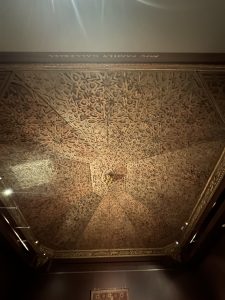
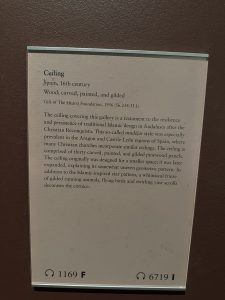
For my visit to the Met I chose two pieces of artwork that spoke to me. First, an ornamental ceiling with no other title than “Ceiling” given on the placard. I recalled in our first class meeting, when discussing “The Creation of Adam” in the Sistine Chapel, that humans tend to have a feeling of awe when looking up. This fact was confirmed to me by the amount of time I spent observing the complexities and subtle details in this ceiling. After walking away and massaging my sore neck I considered one of the questions for the blog post: does this support my idea of art? For this piece my answer was an easy “yes, of course!” The level of human talent and creativity that goes into creating a piece like this, and the fact that it was designed to be viewed by many all contribute to my assessment that this is clearly a piece of art. When considering how this piece relates to the city I deferred to the placard for context. Apparently this piece is from a Christian church in Spain however the design is clearly Islamic. The story is that during Christian conquests against Muslim rule a new art style known as mudéjar was born, in which many christian churches blended their artistic styles with Islamic influences. This blending of cultures, although somewhat violent in this context, reminds me of how art and style in NYC has blended with many different cultures around the world.
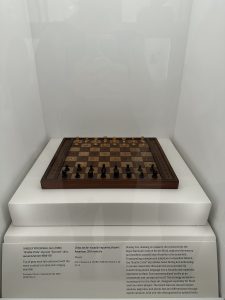
For my next piece I chose a chess board that was on display in the new costume exhibit. This piece was meant to be an addition to a costume that displayed the word “untitled” written in braille; however, I found this chessboard more interesting. It featured raised squares and tactile playing pieces in order to facilitate the game of chess for blind and low vision players. When asking the question of whether or not this is art the answer becomes more difficult. This piece displays a nice craftsmanship and thoughtful design although it was likely mass produced for a utilitarian purpose. Does that objectively disqualify this as art? I’m honestly not sure, but I do find beauty in its purpose and design, so to me, I would consider it art. When relating this piece to NYC I think about the people playing chess in parks and how a board like this could increases the accessibility to many others. Its inclusion of disabled players reminds me of the ethos of acceptance shared by many New Yorkers.