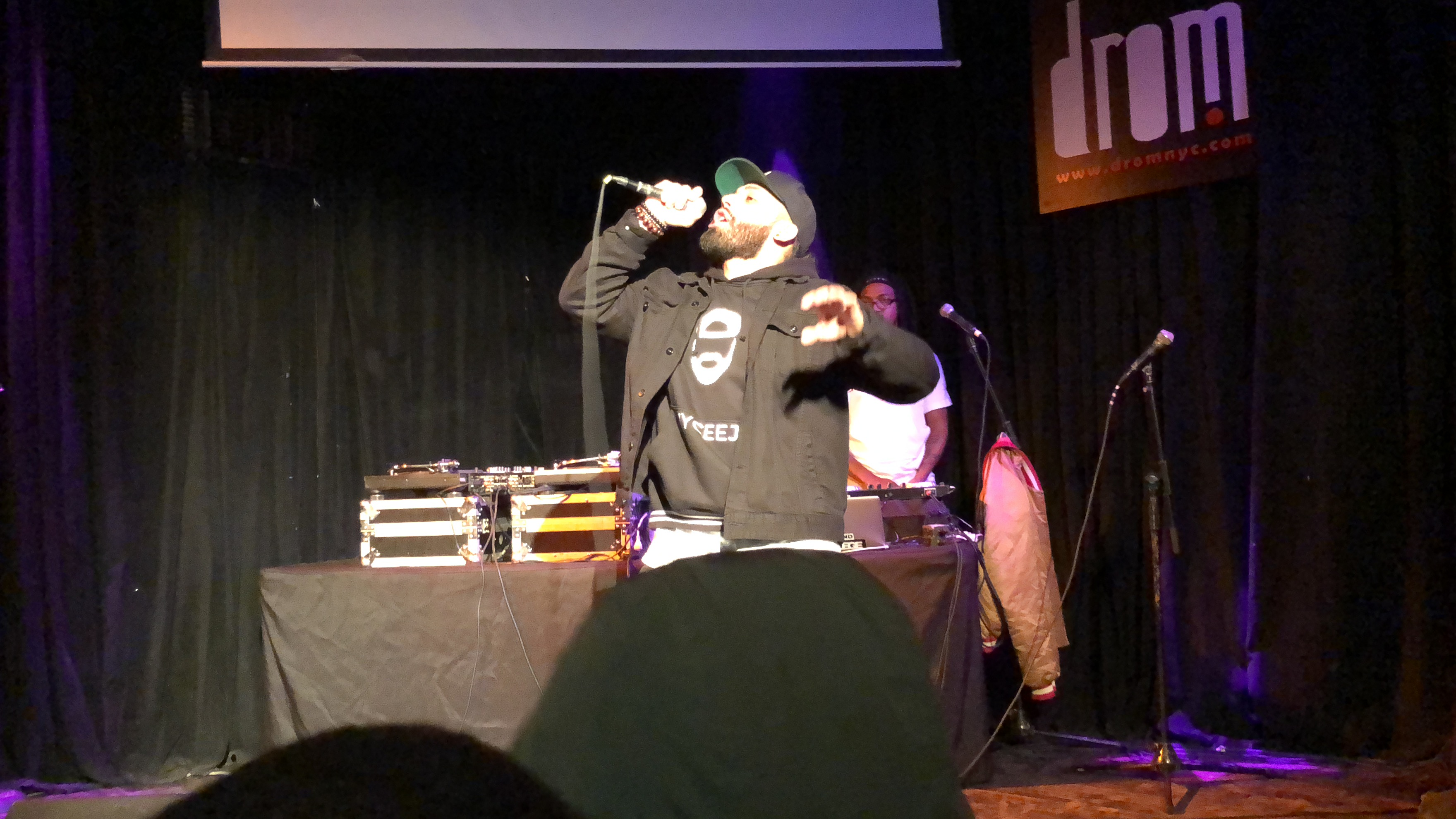
I caught a hip hop show at Drom, a smallish venue in the East Village. It was a showcase show for some up and coming artists. I went there to support my friend who had gotten the call to fill in for an act that was not going to make it. Nevertheless, I got there a bit late and missed the first act, but in time to see my friend NYCEEJ perform. He was accompanied by a DJ who worked off some turntables, a Pioneer mixer, and a MacBook. CEEJ paced the stage wearing his own merch. A hoodie and hat with his own logo, a stylized bearded face, on it.
The room was modest in size, but there was a nice turnout overall. What stood out to me was that the crowd wasn’t necessarily dancing. It was more of a subdued hype. People were moving rhythmically to the music, feeling it more than anything. The ones who knew his lyrics would complete bars, and those that learned the hooks performed along with him. The crowd’s look was what would be expected for members of this scene. Oversized shirts, sneakers, fitted hats, snapbacks, and other types of streetwear. One guy sitting near the stage off to the side had a shirt on with “PE$O” on it in a similar style to NYCEEJ’s hoodie.
Overall, I had a fun time out and listening to the music live. It’s always been fun to hear big speakers feel like they are going to change the rate that your heart beats in. It did make me feel connected to the other people in attendance that were enjoying the show. It’s the type of feeling that can lead to live performances feeling like a religious experience when they are on a grander scale.
The piece I picked is on a brick wall visible from the High Line. It is a face in white spray paint, no plaque, no signature, no artist I could find. Under the chin it says YOUNG VEEZY, and someone else tagged ADEK further down the same wall. Nobody curated or approved any of it, probably.
Could it be replicated the way a painting can? It’s complicated.
We said in class that even paintings are hard to replicate. A print flattens the brushwork, and you would need something like a 3D scan and printer to lay the paint back down at the right depth. This is harder. The paint seeped into the brick unevenly and the mortar lines create a grid across the face. That grid is now a part of the mural. To copy the mural you would have to copy the wall.
Berger says images, like paintings, used to be made for one specific building, like a church, and its original meaning was tied to that unique place. He also said that the invention of the camera broke that by turning art into something portable and sellable, destroying their original meaning, but now allows the art to mean many different things. This piece undoes that. It cannot be moved, sold, or authenticated, but it still suffers from all the issues that the camera introduced. Yet the mural exists in one place, illegally, (again) probably.
My photo keeps the composition and the lettering. It loses the texture and the grit. It freezes the light, since the wall will read differently at 1 PM than it does at 9 PM. It loses everything around it too, the foreground of the High Line itself, the other commissioned artwork in the space, etc. Standing on the High Line, you see sanctioned and unsanctioned art in the same line of sight. Cropped into a photo, that comparison disappears.
Here is where Berger’s idea potentially fails. He assumes the original stays put and the copy travels. Graffiti gets buffed, painted over, or torn down with the building, the paint is already fading away. In a few years my photo may be the only version left. With a painting in a museum, the reproduction sends you back to the original. With this, it eventually replaces it.
The question that I asked QVK mainly had to do with logistics. What happens to the art after a show ends? Does it go into storage? Does it sell? I figured I had a general sense of how things went, but in truth, it’s a lot like life, messy. Guest artists who are invited to participate in the shows take their work with them if it doesn’t sell. Some art ends up in family members’ basements, while some ends up on the street. One of the members of QVK mentioned that some of their pieces end up at various businesses and in their neighbors’ homes. Some are a bit too provocative and need to be tweaked before being publicly displayed in a non-show setting.
Their answer was surprising because it highlighted the realities that artists face after a show. When creating large pieces of artwork, installations, or sculptures, logistics must be taken into consideration when it comes to a piece’s life after the show. Is there a buyer? Do we have a place to store it? Can we safely transport it? What is the price, if any, to do so?
QVK made me think of all the different factors that one should consider. The outcomes that I thought were the only ones, in reality, were just the obvious ones. While creating art, especially large works, it’s important to take into account the logistics of it all.
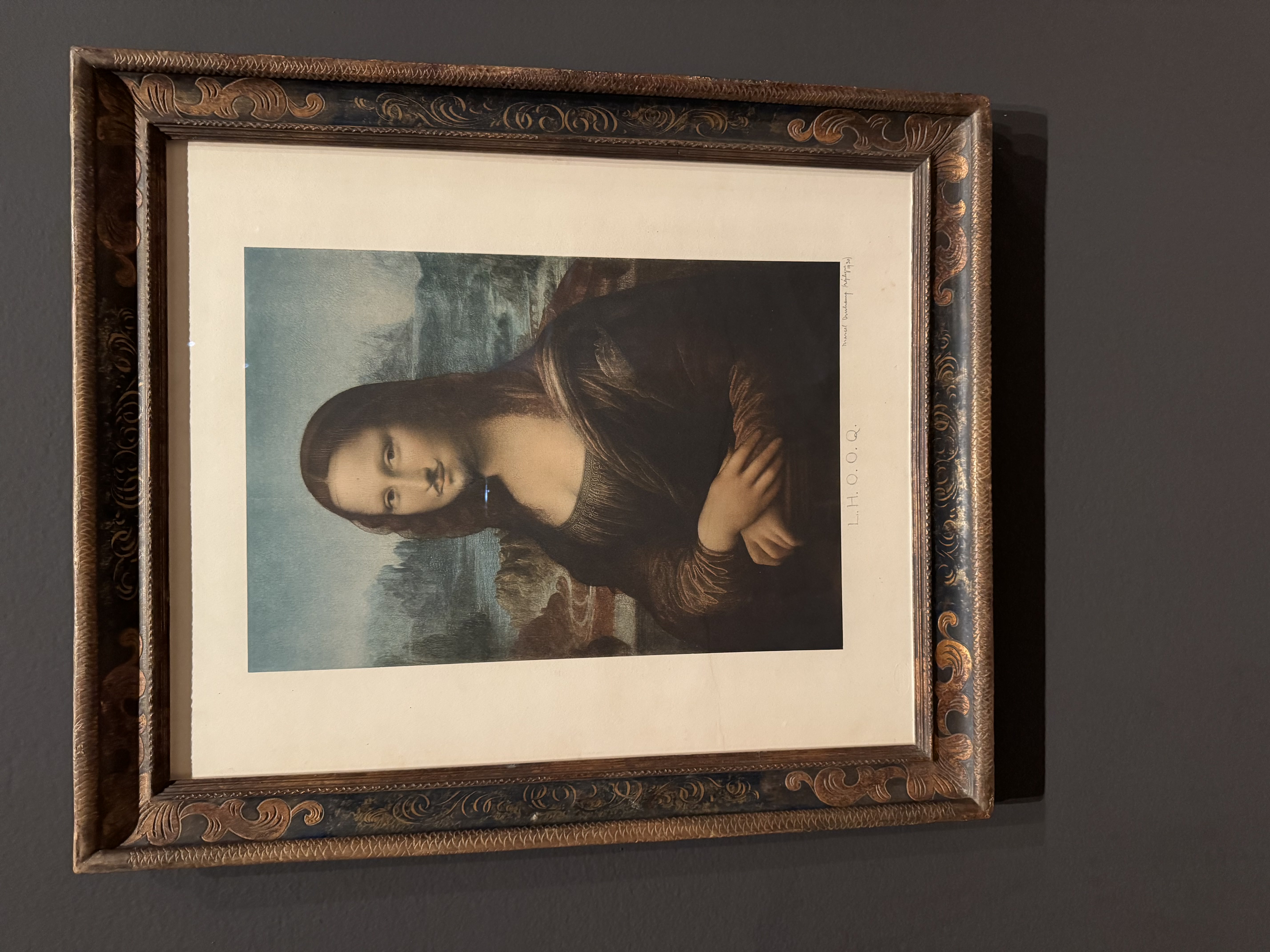
Marcel Duchamp, L.H.O.O.Q., 1930 replica of the 1919 original. On view at MoMA.
The plan going into MoMA was pretty simple, pick a piece I liked, find the copy of it in the gift shop, and compare the two. I tried to game the system and do the assignment backwards. Duchamp foiled that plan almost immediately, because it turns out L.H.O.O.Q. has no original seemingly anywhere in the building. What’s on the wall is a replica from 1930 that Duchamp made of his own 1919 piece. A few feet away, there’s a 1942 version that Francis Picabia reproduced, a signed edition from the 60s, and then a 1965 piece where Duchamp glued a completely untouched Mona Lisa playing card to a dinner invitation and called it “L.H.O.O.Q. Shaved.” I came looking for an original and its copies, and instead I found a room full of copies pointing at each other spider-man meme style.
Duchamp’s style impacted me in stages. When you first see it, you’re kind of taken aback, because it really does just look like the Mona Lisa. Then you look closer, notice the mustache and the goatee, and realize this is a remix/sampling of the original. Your first instinct is that it’s sacrilegious, maybe even disrespectful, to do that to a masterpiece. Then you take into consideration who Duchamp was and how he looked at art, and you realize the whole thing is a dare. He’s challenging your conception of what art is, what it could be, and what it has been. Once that clicks, you’re sort of in on the joke with him. The wall text has an interesting quote, “I have forced myself to contradict myself in order to avoid conforming to my own taste.” For Duchamp, nothing was sacred except the concept of art itself.
How did it’s meaning change? Honestly, through repetition. As you walk through the exhibit, the same image just keeps showing up. On paper, on playing cards, attached to envelopes, he mailed out. At some point, you can’t tell which one is the original, or if any of them are. The one that really got me was L.H.O.O.Q. Shaved. By 1965, the mustached version was so famous that Duchamp could put up a totally normal Mona Lisa, and everyone would read it as the altered one. She looks “shaved” because his conceit is that the facial hair is the original now. The reproduction basically overwrote the original in our heads. It reminded me of what Berger said in the video we watched, that reproduction detaches an image’s meaning and lets it travel and get manipulated. Most artworks lose something in that process. L.H.O.O.Q. is enhanced.
As for seeing it in person versus reproduced, the meaning changed for me in two ways. The small way is the details. In person, you can see the pencil grain, the tape holding the postcard down, and a handwritten note on the 1942 version that says Picabia forgot the goatee when he copied it, so Duchamp came back 22 years later and drew it in himself. A correction to a copy of a copy, made by the original vandal.
His readymades keep popping up right next to famous traditional paintings, and it starts to feel like he’s daring you in real time. Like, yeah, here’s this really famous piece of art, but hey, here’s mine too. Remember me? Like the meme “is he in the room with us right now?” Duchamp was in the room with me the entire visit. You read a label saying the thing you’re looking at isn’t even the original, so you’re in on the joke again, and then two rooms later it’s reproduced even more. His art is multiplying. For lack of a better term, it’s an infection, and what it infects you with is the question of what art is.
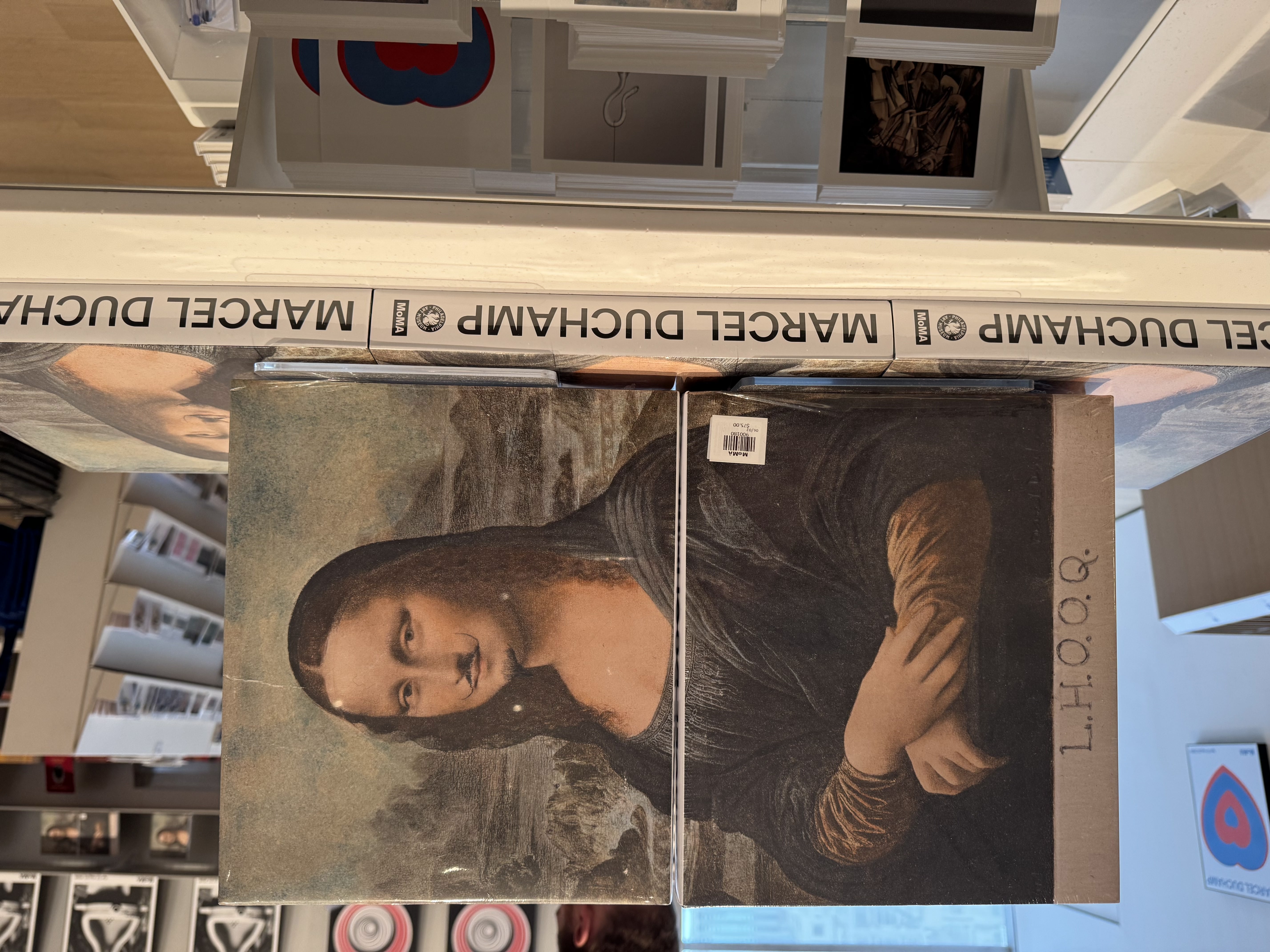
L.H.O.O.Q. reappropriated one more time: the exhibition catalog in the gift shop, $75.
Then there’s the gift shop, where the same defaced Mona Lisa is shrink-wrapped on a $75 catalog with a barcode on her sleeve. A piece that was made to make fun of the art market, being sold back to me at an art market.
By the time I was trying to leave the Duchamp galleries, it honestly felt like I couldn’t bear the weight of it and had to escape. What is the actual art, the object itself or the idea it imparts to us? I walked out past a hundred people taking phone pictures of pictures, and realized all of us were making more copies of L.H.O.O.Q.
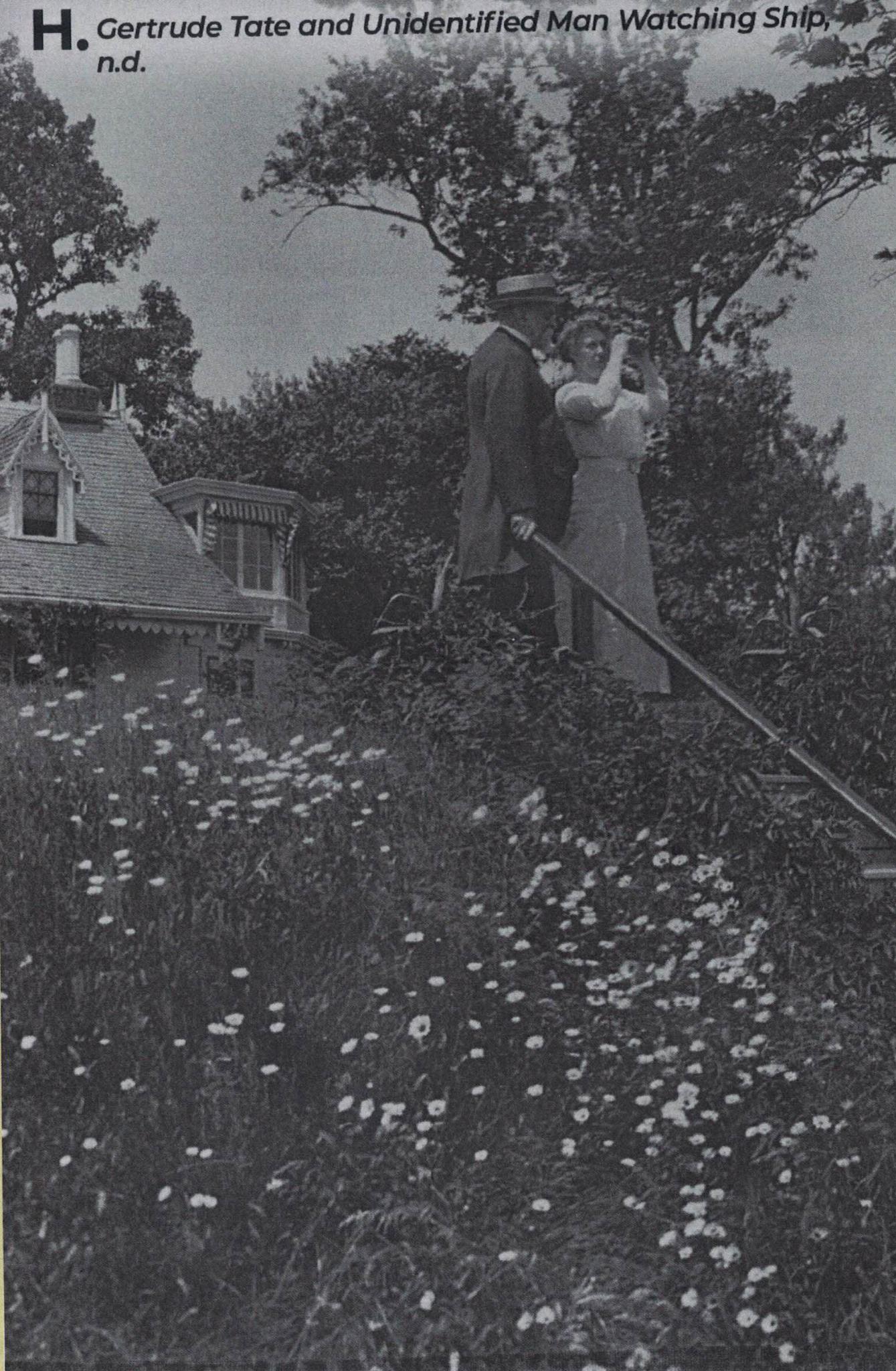
Alice Austen, Gertrude Tate and Unidentified Man Watching Ship, n.d.
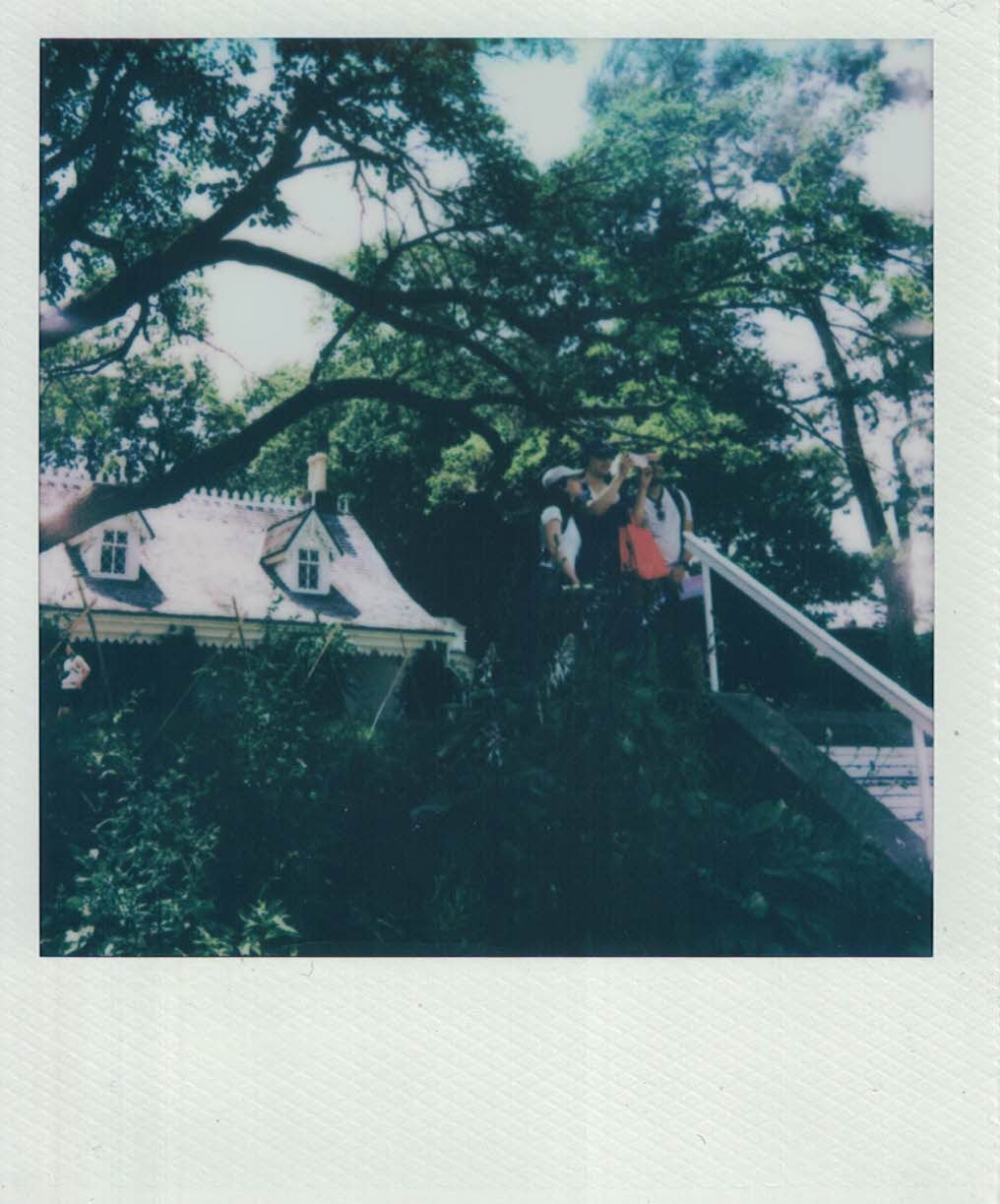
The photograph I am sharing is a recreation of photograph H on the map, Gertrude Tate, and the unidentified man watching ships. The photo was taken close to the shoreline, looking up toward the staircase, and in the background, you can see the rooftop of Clear Comfort. We attempted to match the low angle of the original Alice Austen photo as best as possible. Gertrude was using binoculars to spot the ships, so as our modern day equivalent, we used our phones to get the same effect.
Our recreation, July 2026
Something that interested me was what could not be captured by our photo. We could match the composition, but not the moment. Gertrude was holding binoculars while we were using phones. We can do everything to copy the frame, but the century in between is still apparent. The wildflower hillside in the original is now denser garden growth, the Polaroid appears washed out, while Alice’s is sharp black and white, and her subjects looked through glass while we look through a screen.
That gap is really the difference between what this photo meant to her and what ours means to us. This was Alice’s home. In taking that picture of Gertrude, Alice was documenting her daily life and her most important relationship, at a time when such a relationship could not be openly named. Her photos were meant to be private, for her and those close to her to reminisce over. Ours is the opposite: visitors to a museum, imitating her, knowing these images would be shared and discussed.
Even so, the activity ended up capturing community in its own way. To recreate her photo, we had to work together, figure out the angle, decide who would stand where, and pose for each other, and in the process, we got to know one another better as classmates. In that sense, our Polaroid does what Alice’s photos did, it captures the people we spent the day with, in a place that mattered to us for that afternoon. Her photo preserved her community, and ours preserved the start of one. I think that is something Alice would have liked.
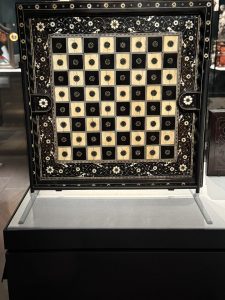
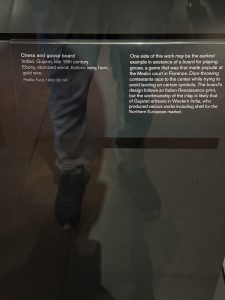
During my visit to the Met this past Friday, many different pieces of art spoke to me. The first one to showcase is the Chess and Goose Board, a piece I had never seen or even heard of before this visit, made in Gujarat, India, in the late 16th century out of ebonized wood, historic ivory, horn, and gold wire. I’m a person who believes in function over form, but when the function has the form, it gives it extra sauce. This piece breaks the mold of my preexisting ideas about art, in the sense that during our seminar, we discussed that all art is inherently useless, this piece is not only striking in its form, but also functions as a goose game board on one side and a chess board on the other. Overall, my beliefs were challenged by how ornate the goose board is. Every time I look at the photo, I find a new detail that I had not noticed previously. The chessboard specifically reminds me of the many concrete chessboards that are found all throughout NYC parks. Come to think about are those pieces of art that will be housed in museums 1000 years from now?
Another piece that caught my attention was William Orpen’s Self-Portrait (Leading the Life in the West), a piece I was seeing for the first time, painted around 1910 in oil on canvas. This piece confirms my preexisting concept of art, as it is a traditional framed painting. It is also inherently useless in the fact that it serves no other function other than to be observed and thought about. The painting’s first public showing was right here in New York, at a gallery on Fifth Avenue in 1914, the same year the Met brought it into the collection, and it’s been resurfacing in New York exhibitions on and off ever since. Taking out the context or the original intention of the artist, I feel like I see a lot of New York in this piece. This feels like a native New Yorker, through and through, a person on the move, getting ready to rejoin the hustle and bustle of the city. Doing a last phone, keys, wallet check. His walking stick could also be observed as a leash, perhaps his dog is just out of the frame within the frame. Some might say that he is too overdressed for such occasion, but here in the city, people tend to slightly overdress for every occasion when compared to more suburban environments.