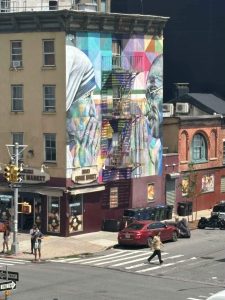
The mural I selected depicts Mother Teresa and Gandhi staring at one another while holding their hands in prayer. The mural is painted with multiple colors and intricate patterns, creating a kaleidoscope-like effect that symbolizes unity between the two figures. Although this mural could technically be replicated as a painting or photograph, I do not believe a replication would evoke the same emotions as seeing it in person. As John Berger discusses in Ways of Seeing, viewing a work through a screen is different from experiencing it in its original setting. When I saw the mural in person, I felt a sense of awe because of its grand scale, complexity, and the amount of detail that cannot be fully appreciated through a screen. The mural’s location also contributes to its impact. Because it is painted on the side of a building above a food market, it becomes part of the neighborhood and its surroundings. Seeing it in its actual location allows me to experience not only the artwork itself but also how it interacts with the community around it. If the mural were reproduced as a painting and displayed somewhere else, it would lose some of that connection to its original environment. Therefore, while the image of the mural can be replicated, the experience of standing in front of the original cannot be fully reproduced.
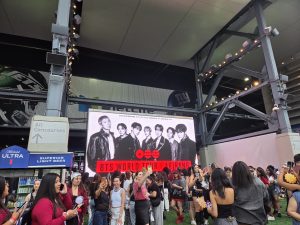
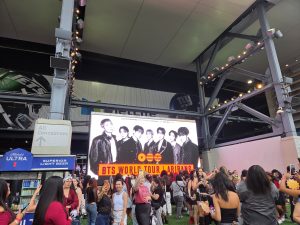
This week I attended BTS Arirang Tour Day 2 at MetLife Stadium. The tour marks their return after completing their military service, and six years since they last went on tour because of the COVID-19 pandemic. BTS is a K-pop boy group that has achieved worldwide success and sold out stadiums across the globe.
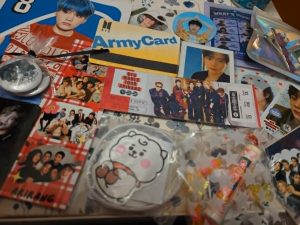
At K-pop concerts, most fans do not arrive just an hour before the show begins. Instead, many arrive early in the morning to buy merchandise and interact with other fans. One of the most special parts of K-pop concerts is the tradition of freebies. Freebies are small keepsakes that fans make and give away to other fans to celebrate the concert. They usually include photocards of the group members, which are printed selfies of the members, but they can also include stickers, keychains, decorated hairpins, bracelets, fans, and many other handmade gifts. Fans hand out these items without expecting anything in return, creating an atmosphere of generosity and kindness.
Here are some of the freebies I got 🙂
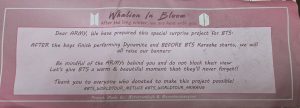
Another tradition that makes K-pop concerts unique is fan projects. Fans create banners with heartfelt messages for the artists and distribute them throughout the venue. During the concert, everyone holds up their banners at the same time so the artists can read them from the stage. K-pop groups also have official lightsticks that are unique to each fandom. BTS’s lightstick is called the ARMY Bomb, and their fans are known as ARMY.
This was the fan project for MetLife D2
These are BTS’s lightsticks, called the ARMY Bomb. The one on the right is the newest version of the ARMY Bomb.
At the concert, many fans dressed in red, white, and black because those are the colors of BTS’s newest album, Arirang. Others wore sailor-inspired outfits because of the title track, “Swim.” Many people also decorated their ARMY Bombs with bows, charms, and rhinestones to match their outfits. K-pop concerts have often been described as mini fashion shows because fans put so much creativity and effort into expressing their love for the group through their clothing and accessories.
Throughout the performance, fans chanted the members’ names in rhythm with the music. BTS’s fan chant is: “Kim Namjoon, Kim Seokjin, Min Yoongi, Jung Hoseok, Park Jimin, Kim Taehyung, Jeon Jungkook, BTS!” K-pop fan chants always begin with the group’s leader and continue from the oldest member to the youngest, also known as the maknae. During a short intermission, fans’ signs were displayed on the stadium screens. One sign read, “Latinas Love BTS,” and the entire stadium erupted into cheers, showing how many people related to the message. Throughout the concert, everyone sang, danced, and jumped together while also looking out for one another. At one point, I bent down to grab my water bottle, and the ARMY standing next to me immediately reached out because she thought I had fainted from excitement. After I told her I was okay, several other fans nearby also checked on me. Even though we were complete strangers, everyone genuinely cared about one another.
Being able to be witness this concert brought me overwhelming amounts of happiness. I have been a fan of BTS since I was nine years old, so finally seeing my childhood idols in person at the age of twenty felt like a full-circle moment. I knew every single song they performed, and I was so excited that, five minutes before the concert started, I began feeling nauseous, almost as if I were the one about to perform. When BTS finally appeared on stage, I immediately started crying and yelling, “They’re real! They’re real! It’s BTS! It’s BTS, ARMY!” After waiting more than a decade to see them and to hear their music live was emotional in a way that is difficult for me to describe. At points I stopped screaming and just watched them in awe. It felt unreal. Every song reminded me of different moments of my life and how I had grown up listening to their music. Even though thousands of strangers were around me, it felt like everyone was connected through the same shared love for BTS and their music.
Being at a K-pop concert makes me feel connected to a community in a way that other concerts have not. I have attended concerts by artists such as J Balvin and Shakira, but the sense of community at BTS concerts feels different. It does not feel like you are surrounded by strangers, instead it feels like you are surrounded by friends. The Arirang albumn also pays tribute to BTS’s Korean roots, yet the audience reflected people from all over the world. There were young children, older adults, men, women, and people from many different cultures and backgrounds. Seeing so many diverse people come together to celebrate the same music reminded me that music can connect people regardless of language, age, or where they come from. Walking away from the concert, I felt like I had experienced more than just a performance, I had experienced a community.
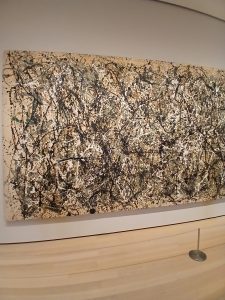
The first artwork that stood out to me at the MoMA was a canvas covered in paint splatters. It wasn’t because it evoked any strong emotions or filled me with awe. Instead, I found myself wondering how it ended up in a museum. As I continued through the galleries, I came across more pieces that made me ask the same question. How is this art? One painting was a canvas that was painted half black and half gray. Nothing more, nothing less. Another was an entirely blue canvas. Surprisingly, I stood in front of that painting for nearly fifteen minutes attempting to understand the purpose of this blue canvas. It looked like less of a masterpiece and more like a paint sample I could find in the Home Depot paint aisle. I couldn’t help but wonder if perhaps I was too stupid for modern art because I just couldnt understand what some of these artworks were made for. While I comtemplated my thoughts, I overheard two men dressed in suits with fancy watches (and rich vibes) discussing how stunning the blue painting was. In that moment I thought to myself, maybe I’m just too broke for modern art. I couldn’t help but think that I could buy a canvas, a bottle of royal blue paint, and recreate the exact same painting for less than five dollars in under five minutes. As I continued to wander through the museum, I eventually found a dark room where visitors sat watching a film installation on modern art. In that room, a man had fallen asleep and was snoring loudly. I couldn’t help but relate to him. After spending an hour trying to make sense of the exhibits, I realized I was beginning to feel the same way. My visit to the MoMA left me wondering whether modern art is meant to be understood, questioned, or simply experienced. Was my confusion a part of the experience all along?
Before I left the MoMA, I was determined to see Vincent van Gogh’s The Starry Night. It was surprisingly difficult to find, but eventually I noticed a crowd gathered around a single painting and realized I had finally found it. Seeing The Starry Night in person felt surreal because of its immense popularity and the countless times I had seen it reproduced elsewhere. It was truly beautiful. On my way to the gift shop, I couldn’t help but notice that The Starry Night was everywhere. It appeared on notebooks, reusable bags, decks of cards, Legos, Barbie dolls, and even Miffy merchandise. Seeing Van Gogh’s masterpiece printed on so many products made the painting feel less like a work of art and more like a brand. When people see The Starry Night, they immediately recognize it as one of Vincent van Gogh’s paintings. Yet during his lifetime, Van Gogh struggled financially and lived with mental illness. He died before his work received the admiration and recognition it enjoys today. Now, companies profit from reproducing his art on countless products, basking in his glory while earning money from a legacy he never had the chance to benefit from himself. It almost felt like an example of consumerism at its finest. As if the message was, “You love this painting? Then we’ll put it on everything so you’ll buy it and we the company’s make an easy buck.” Instead of simply celebrating the artwork, its constant reproduction made me question where appreciation for art ends and commercialization begins. It left me wondering whether these products honor Van Gogh’s legacy or reduce one of the world’s most celebrated paintings to just another marketable image.
The photo my group took during our workshop at the Alice Austen House made me think about how different life is today compared to when Alice Austen lived. Even though my groups photo and Alice’s photos were taken in the same place, they have very different meanings because of the different time periods. Our photo shows a group of people smiling and laughing while Alice’s photo shows a woman (Katie, who was one of the Austen’s live in maids) by herself sitting on the stairs of her porch with two dogs (punch the pug and Chico the chihuahua). To me our photo represents community, friendship, and also the freedom to be ourselves while Alice’s photo focuses on her dogs and her maid Katie.
Alice Austen house was more than just her home, it was a place where she felt safe to express who she really was. Often taking photos of herself and her friends in drag which included wearing clothes like top hats, fake mustaches, and pant suits, even though women were expected to wear dresses and follow strict gender roles. She also shared her life with the woman she loved at a time when being openly gay was not accepted. Because of that, I think her home became a safe space where she could be herself without fear of being judged by society.
As a visitor, I see the Alice Austen House as a museum that teaches people about history of NYC but also the LGBTQ+ community. For Alice it was a place where she created memories and built a community with the people she cared about most. Looking at our photo and comparing it to hers made me realize how much has changed. Today, many people have the freedom to wear what they want, love whoever they want, and express themselves more openly. While there is still much progress to be made in our societys today, our photo reflects a world with more freedom than the one Alice Austen lived in. Being at her house helped me appreciate not only her photography but also the courage it took for her to live as authentically as she could during her time.
During my first visit to the MET I came across multiple pieces of artwork that stood out to me especially these two stained glass windows made from Tiffany Studios, designed by Agnes Northrop. As a little girl I had always admired stained glass windows. However these two pieces are some of the best stained glass windows I have ever seen. The details in these pieces is extradorinary and truly highlights the beauty of nature. I couldn’t help but notice how the glass almost blends together to create a vibrant image. Ive always believed that there are many different forms of art and that art doesn’t necessarily need to be a painting or a sculpture but can be expressed in many different forms. These stained glass windows re-enforced my idea of art. As much as I loved the stained glass windows I also couldn’t help but notice the pillars and and lamps around the stained windows which I believed complimented the stained artworks beautifully. While looking at the Autumn Landscape Stained artwork it reminded me of when I would walk through Kissena park in Queens, NYC, during the fall and the trees would begin to change colors.
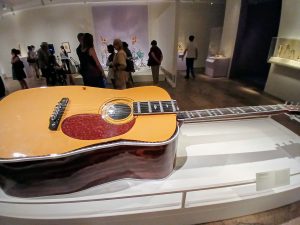
Another piece of artwork that left an impact on me was this casket in the shape of a guitar.
A musician spends much of their life with their instrument, and music often becomes a defining part of who a person is. The idea of a musician being laid to rest in the very thing that shaped and defined their life felt deeply beautiful to me. I also play the guitar and at times playing my guitar was the only thing that brought me comfort in life. The thought of that same instrument continuing to provide me comfort even in death was truly impactful. Music is present in NYC in many different ways. For example, waiting for the train station and someone playing the drums or singing or walking down the streets and someone is throwing a barbeque blasting their favorite music.