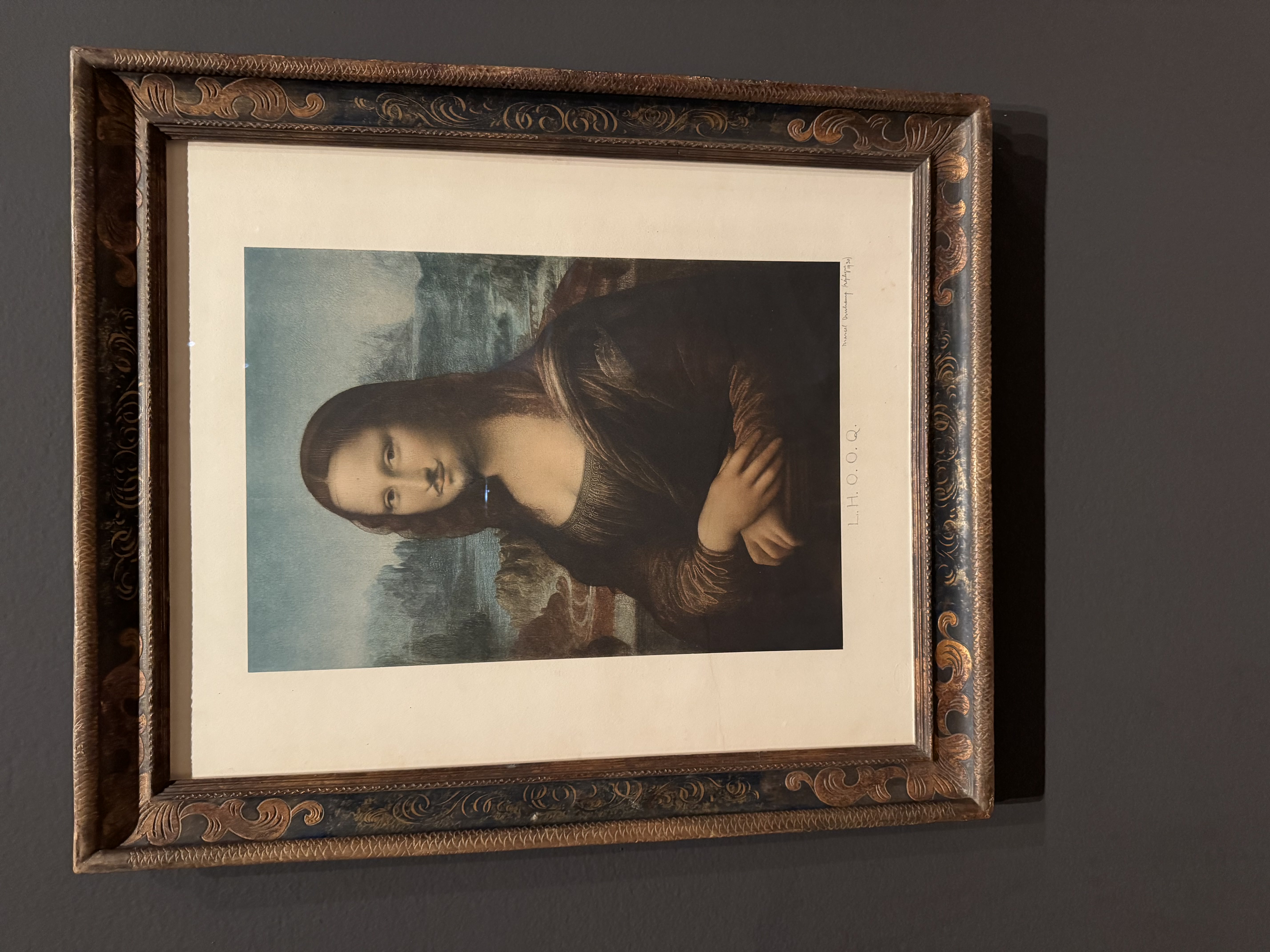
Marcel Duchamp, L.H.O.O.Q., 1930 replica of the 1919 original. On view at MoMA.
The plan going into MoMA was pretty simple, pick a piece I liked, find the copy of it in the gift shop, and compare the two. I tried to game the system and do the assignment backwards. Duchamp foiled that plan almost immediately, because it turns out L.H.O.O.Q. has no original seemingly anywhere in the building. What’s on the wall is a replica from 1930 that Duchamp made of his own 1919 piece. A few feet away, there’s a 1942 version that Francis Picabia reproduced, a signed edition from the 60s, and then a 1965 piece where Duchamp glued a completely untouched Mona Lisa playing card to a dinner invitation and called it “L.H.O.O.Q. Shaved.” I came looking for an original and its copies, and instead I found a room full of copies pointing at each other spider-man meme style.
Duchamp’s style impacted me in stages. When you first see it, you’re kind of taken aback, because it really does just look like the Mona Lisa. Then you look closer, notice the mustache and the goatee, and realize this is a remix/sampling of the original. Your first instinct is that it’s sacrilegious, maybe even disrespectful, to do that to a masterpiece. Then you take into consideration who Duchamp was and how he looked at art, and you realize the whole thing is a dare. He’s challenging your conception of what art is, what it could be, and what it has been. Once that clicks, you’re sort of in on the joke with him. The wall text has an interesting quote, “I have forced myself to contradict myself in order to avoid conforming to my own taste.” For Duchamp, nothing was sacred except the concept of art itself.
How did it’s meaning change? Honestly, through repetition. As you walk through the exhibit, the same image just keeps showing up. On paper, on playing cards, attached to envelopes, he mailed out. At some point, you can’t tell which one is the original, or if any of them are. The one that really got me was L.H.O.O.Q. Shaved. By 1965, the mustached version was so famous that Duchamp could put up a totally normal Mona Lisa, and everyone would read it as the altered one. She looks “shaved” because his conceit is that the facial hair is the original now. The reproduction basically overwrote the original in our heads. It reminded me of what Berger said in the video we watched, that reproduction detaches an image’s meaning and lets it travel and get manipulated. Most artworks lose something in that process. L.H.O.O.Q. is enhanced.
As for seeing it in person versus reproduced, the meaning changed for me in two ways. The small way is the details. In person, you can see the pencil grain, the tape holding the postcard down, and a handwritten note on the 1942 version that says Picabia forgot the goatee when he copied it, so Duchamp came back 22 years later and drew it in himself. A correction to a copy of a copy, made by the original vandal.
His readymades keep popping up right next to famous traditional paintings, and it starts to feel like he’s daring you in real time. Like, yeah, here’s this really famous piece of art, but hey, here’s mine too. Remember me? Like the meme “is he in the room with us right now?” Duchamp was in the room with me the entire visit. You read a label saying the thing you’re looking at isn’t even the original, so you’re in on the joke again, and then two rooms later it’s reproduced even more. His art is multiplying. For lack of a better term, it’s an infection, and what it infects you with is the question of what art is.
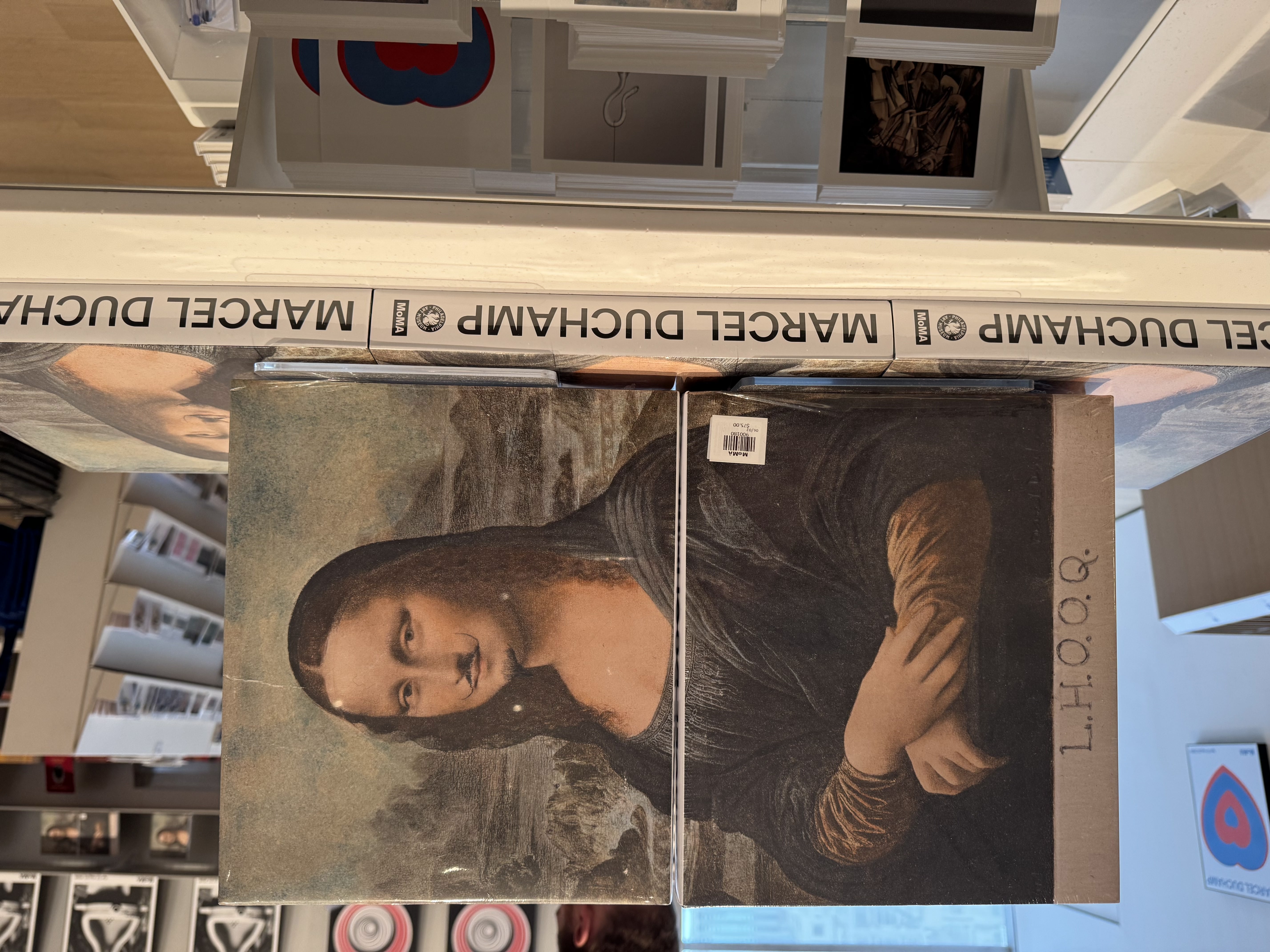
L.H.O.O.Q. reappropriated one more time: the exhibition catalog in the gift shop, $75.
Then there’s the gift shop, where the same defaced Mona Lisa is shrink-wrapped on a $75 catalog with a barcode on her sleeve. A piece that was made to make fun of the art market, being sold back to me at an art market.
By the time I was trying to leave the Duchamp galleries, it honestly felt like I couldn’t bear the weight of it and had to escape. What is the actual art, the object itself or the idea it imparts to us? I walked out past a hundred people taking phone pictures of pictures, and realized all of us were making more copies of L.H.O.O.Q.