Urban environments contain a mosaic of habitat types that differ greatly in vegetation structure, disturbance, and resource availability. These differences shape where arthropods can survive, and understanding these patterns is essential because arthropods support pollination, decomposition, nutrient cycling, and food-web stability in cities. This project investigates how standardized urban habitat types influence arthropod species richness across more than a decade of BioBlitz events in New York City.
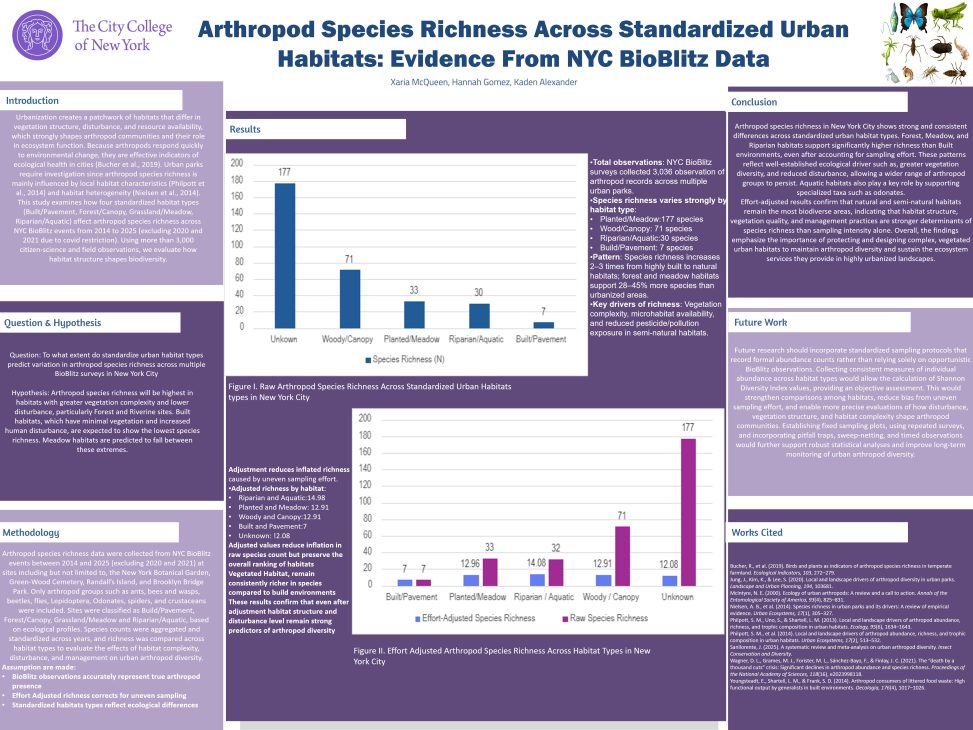
Using over 3,000 arthropod observations collected between 2014 and 2025, I compared species richness across Forest, Meadow, Aquatic, and Built habitats. The results clearly show that natural and semi-natural habitats support far more species than heavily urbanized zones. Forest habitats contained the highest richness, followed closely by Meadow habitats, while Aquatic sites supported specialized groups such as dragonflies and damselflies. Built habitats showed the lowest richness and were dominated by a small number of disturbance-tolerant species, particularly ants.
Even after adjusting for uneven sampling effort, vegetated habitats consistently supported higher arthropod diversity than paved environments. This confirms that habitat structure, vegetation complexity, and microhabitat availability are strong predictors of biodiversity in urban ecosystems.
The key takeaway is that cities can support substantial arthropod diversity, but only when habitats retain ecological complexity. Urban planning that prioritizes forests, meadows, and high-quality green spaces can greatly enhance biodiversity and sustain the essential ecosystem services arthropods provide. This project highlights the importance of thoughtful habitat design and sets the stage for future research using standardized abundance data to calculate diversity indices such as Shannon’s Index for even more robust comparisons.

