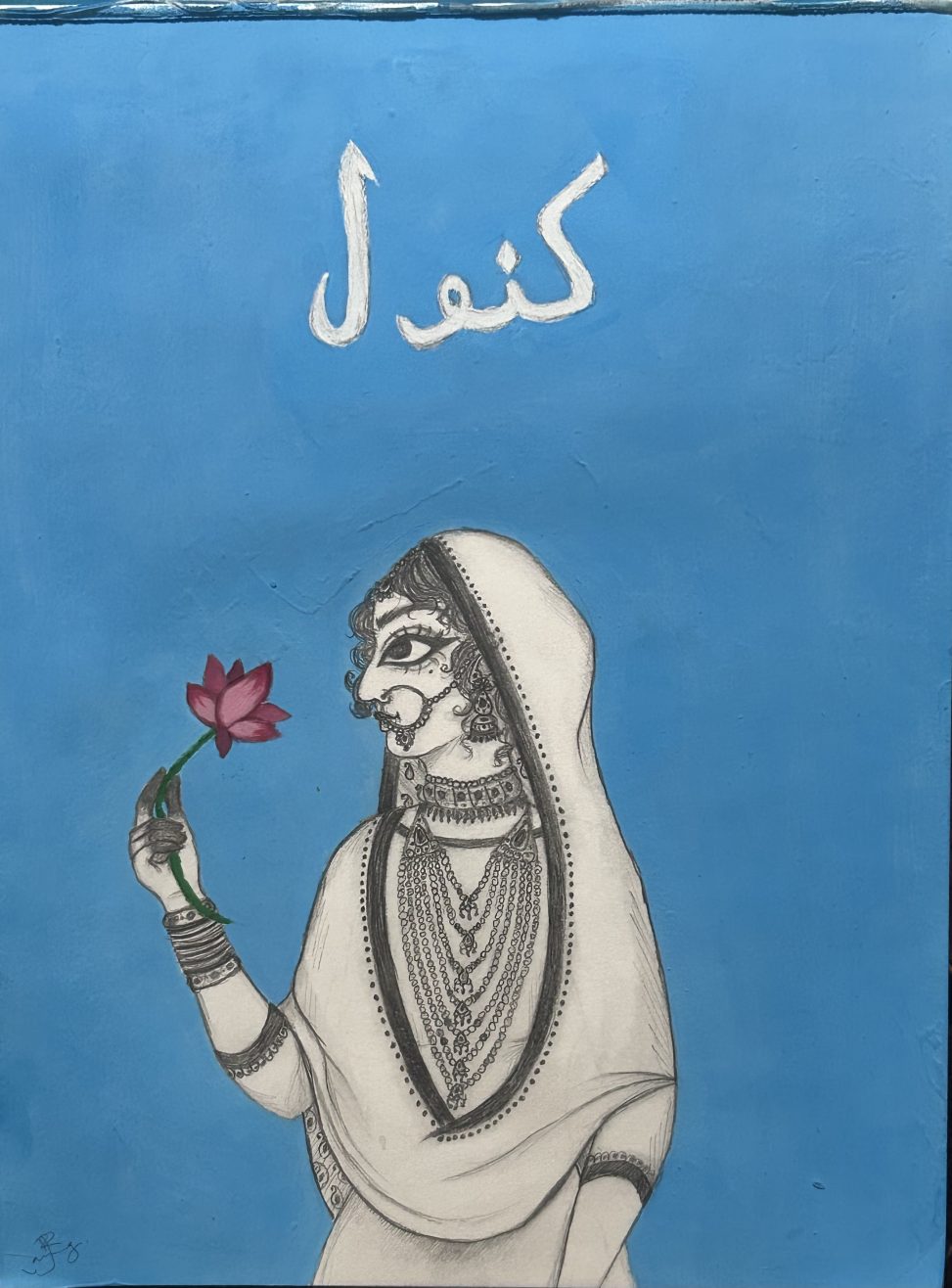
This piece, Kanwal, is inspired by me. Since I was three years old, I have been sketching. I started with very simple stick people with triangular dresses and spiky hair, all in crayon. Then, I found out about cute art tutorials on YouTube in elementary school and started to copy them, learning how to make big-eyed cupcakes and princesses. After that, in middle school, I watched YouTube videos of artists who made slightly more “professional” art, such as making their own comics or sketchbook flip-throughs, while I scrolled on Pinterest nonstop. I would fill up sketchbooks so easily because that was all I knew. Me and my little sketches. But in high school, I found myself having less time and less interest in making art. This idea of me leaving behind art for my academics made me feel uncomfortable. Nonetheless, I still did not draw. However, one thing that got me back after four years was the idea of using paint. I watched people on social media create these beautiful and intricate paintings with so much care that it made me want to pick up my sketchbook again. The difference between me now and younger me is that my sketchbooks were only ever pencil sketches, but now my sketchbook has pages of both pencil and paint. To incorporate this idea into this piece, I used a bright blue against the pencil drawing of the figure to draw attention to the contrast in the colors. I found that using colors allowed me to start art again. Though I am not good at painting, I still wanted it to be a part of this piece.
As I explored different art this semester due to MHC 10101, I noticed that almost all the older art (1700s-1900s) that I found in museums surrounded American and European experiences. Being Pakistani, I always desired to see pieces of my life reflected in art, but I never saw any South Asian art in museums, at least the ones that I went to. If I ever did see any South Asian artists, they did only contemporary art. Due to this, I went out of my way to really search for South Asian traditional art. I would spend hours on Pinterest and Google just trying to find art that I loved. I found a couple of artists like Abdur Rahman Chughtai or Babar Azeemi that really motivated me to create art that I didn’t see growing up. Though they are not from the 1700s, they have art styles that are reminiscent of the traditional art that I mentioned. Discovering this type of art led me to create a piece of this style. The figure in the middle of the piece is made in an art style that I usually do not draw in, but decided to as this felt similar to traditional South Asian art styles. Also, I had picked this specific pose because of how common it is seen in older South Asian art. The smooth lines, especially in the wrinkles of the clothes, are made because I observed how clean and round the shapes/forms were in the art of the Mughal period in India.
Beyond just the art style, I made other choices to really put myself into my art. If someone is not aware of South Asian jewelry, one might gloss over the detail, but the jewelry adorned by the figure is unique. Oftentimes, the jewelry shown in the traditional South Asian art I was looking at was quite common jewelry styles of the time they were painted in; it didn’t mean anything personal to me necessarily. So, to make this piece more about my own experience, I added two necklaces. The choker-style necklace the figure wears is called a guluband, and the really long necklace is called a satlada. These two neck pieces are significant as they are traditionally worn by Hyderabadi women. Although I am Pakistani, my ammi’s side is from Hyderabad, India, so I often heard stories from my ammi where ten-year-old her would take my nani’s Hyderabadi jewelry and wear it, acting as elegant and graceful as any ten-year-old could be.
Expanding on that, I added a lotus in the hand of the figure, not only because this is a common image drawn in the older artworks, but also because I love lotuses. I love flowers in general, but if someone for some reason forced me to pick only one favorite, it would be the lotus flower. Overall, I think the flower’s petals and seed/fruit are so unique that I have always just loved them. In addition to that, the lotus flower is a common symbol in South Asian cultures, especially for those who practice the religions of Hinduism or Buddhism. As I became obsessed with finding art related to my background, I found loads of Pakistani magazines from the 90s that had astonishing covers of stylized art with print Urdu fonts. This then made me want to write lotus in Urdu in the top center, کنول (kanwal), in order to evoke a similar feeling. This was another small hint of me in my art. In a way, this whole art piece is me making art that I didn’t get the chance to experience growing up, something that reflected my experiences. Instead of waiting years for museum curators to listen, I ended up making the art that I have been wanting to see in museums.
By completing my project, I was able to explore the role of arts in the lives of POC and immigrant New Yorkers through the lens of art as a way to communicate identity. Living in and being a part of a community made entirely of POC and immigrants in NYC, I have come to realize how much art means to us. We use art as a means to put forward what we want to say when our voices are not heard. Let it be graffiti, posters, music, and even food, we use art to cope with our voices being silenced. Because NYC is a central place for the arts, many of us still find our experiences remain hidden in the shadows for some white European guy's art to be hung on the walls of a world-renowned museum. Of course, as the years have progressed, we have seen more emphasis on POC and immigrant voices in NYC, which is beautiful. Through my piece, I learned and applied how art is a way for these communities in NYC to show up for themselves when the art industry couldn’t for them. It is resistance and love. Creating art is valuable to them because it symbolizes the act of living.

