

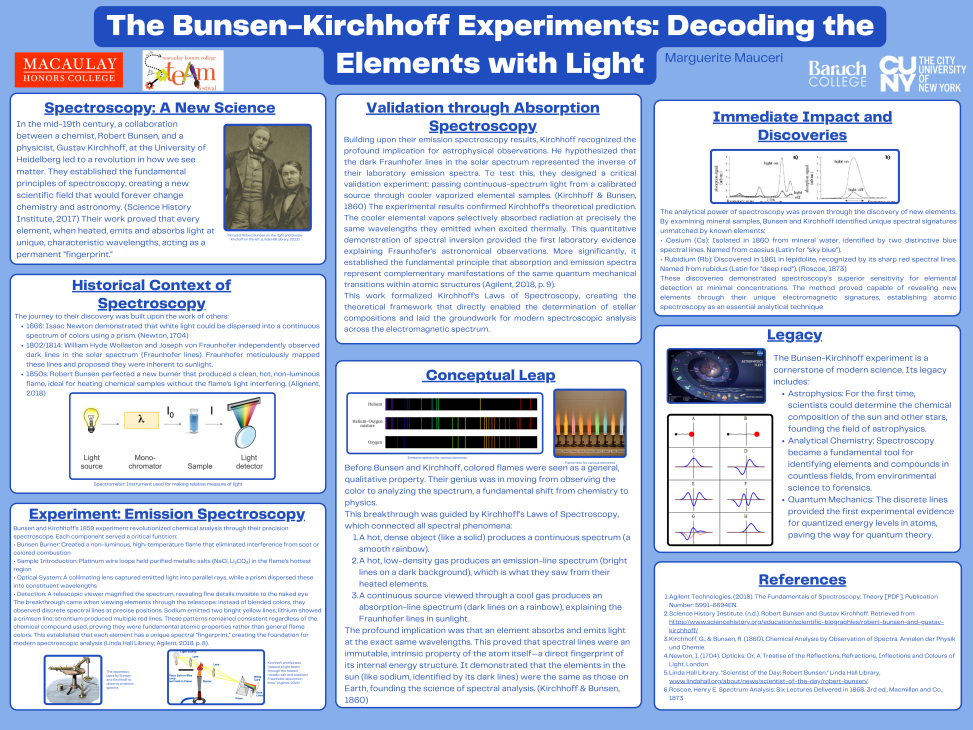
This project examines the foundational 19th-century experiments of Robert Bunsen and Gustav Kirchhoff, which established spectroscopy as a transformative scientific discipline. Through a detailed reconstruction of their methodology from the use of Bunsen’s non-luminous burner and Kirchhoff’s precision spectroscope to the validation of spectral reciprocity between emission and absorption, I demonstrate how their work decoded the unique “fingerprint” of elements, leading directly to the discovery of cesium and rubidium. The project emphasizes how their collaboration bridged chemistry and physics, proving that atomic spectra are invariant and quantifiable. Ultimately, we highlight how their principles not only explained Fraunhofer’s solar lines, founding astrophysical chemistry, but also laid the experimental groundwork for modern analytical spectroscopy and quantum theory.

