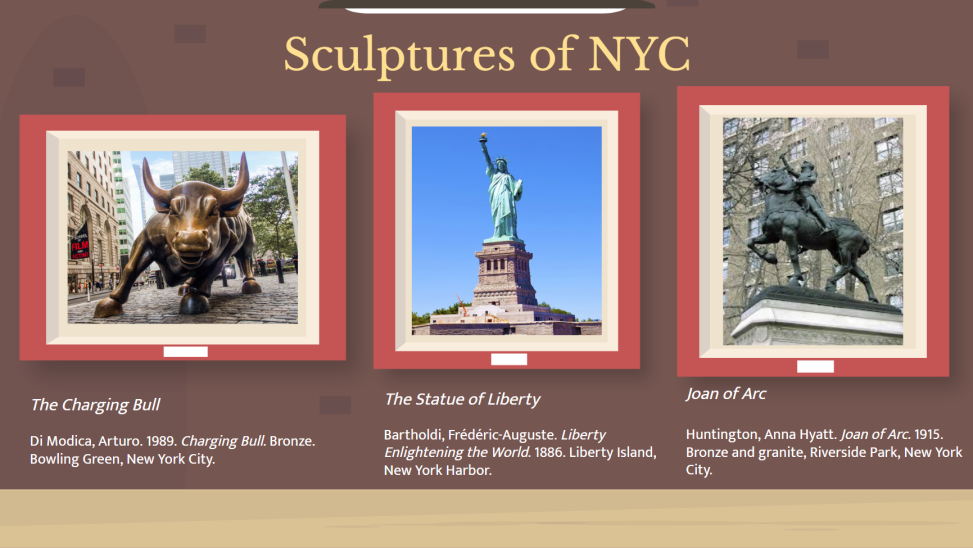
Throughout the semester, our seminar class learned about different types of art in NYC, including comedy, graffiti, and podcasting. We chose to focus on tangible art and decided on sculptures, since we were interested in creating a physical art piece that complemented our information slideshow.
In our slideshow linked below, we provided information on characteristics and examples of two historical sculpture types, Green and Roman, before discussing types of sculptures found in NYC and how they draw their attributes from historical pieces. For example, The Charging Bull statue in Bowling Green (seen in our presentation and the cover image) is dynamically posed and emphasizes detail, similar to Roman sculptures. This statue also contains similarities to both types of historical sculpture by being a vision of power, a main facet in Green and Roman depictions of emperors or other people in power.
Through this project, we want people to understand how the past still shapes art today, and that art is everywhere in NYC if you know where to look for it.
Works Cited
Benson, Stuart. Sculptures by Stuart Benson. Nov. 1934., https://www-jstor-org.remote.baruch.cuny.edu/stable/community.12066155.
Bogart, Michele H. “Sculpture in Gotham: Art and Urban Renewal in New York City.” ProQuest Ebook Central, Reaktion Books, Limited, 15 July 2018, ebookcentral.proquest.com/lib/baruch/reader.action?docID=5631451&query=&c=UERG&ppg=1.
Day, E. V. Divas Ascending. 2009, https://www-jstor-org.remote.baruch.cuny.edu/stable/community.14200185.
Gazda, Elaine K. “Roman Sculpture and the Ethos of Emulation: Reconsidering Repetition.” Harvard Studies in Classical Philology, vol. 97, 1995, pp. 121–56. JSTOR, https://doi.org/10.2307/311303. Accessed 7 Dec. 2025.
Hammond, Gabriella. “History of the Charging Bull (and How to See It)” The Wall Street Experience, 2025, https://www.thewallstreetexperience.com/blog/story-behind-legendary-charging-bull.
Heinrich, Will. “Outdoor Delights For Anxious Days: New York City’s Monuments Can Offer Respite, Not to Mention Social Distancing.” The New York Times, 20 Mar. 2020, https://www.proquest.com/hnpnewyorktimes/docview/2902863522/612A361555042DEPQ/1?accountid=8500&sourcetype=Newspapers.
Senie, Harriet. “Responsible Criticism: Evaluating Public Art.” International Sculpture Center, vol.13, no.10, 2003. Americans for the Arts, https://www.americansforthearts.org/sites/default/files/Sculpture.org_.pdf.
Zilczer, Judith. “‘The World’s New Art Center’: Modern Art Exhibitions in New York City, 1913-1918.” Archives of American Art Journal, vol. 14, no. 3, 1974, pp. 2–7. JSTOR, http://www.jstor.org/stable/1556944.
Our project helped us understand how art influences people’s perceptions, as the emotions evoked and opinions formed on the art will cause them to draw connections to their communities, even if only through brief interaction. Through our research, we learned about the characteristics of sculptures from two of the most famous eras: Greek and Roman. We saw how these defining aspects stayed constant, even as the type of sculpture evolved, like how the Joan of Arc statue in Riverside Park replicates the dynamism of Roman sculptures and evokes the same feeling of power emanating from it. The sculptures placed around NYC are both intentional in their location and also the emotion the viewer gets from observing it, as the viewer’s takeaways influence their perception of the city, even if subconscious. For example, many sculptures exude power and leadership, which represents the strength of the city and its global presence. Or, the fluidity of abstract sculptures could make one subconsciously think about NYC’s role as a melting pot of diverse cultures.
What makes public art special in the city is its exposure to New Yorkers and how even just a quick glimpse of the artwork, even in passing, will still allow them to form some sort of emotion that adds to their perception of NYC.

