New York: A City of Migrants and Immigrants II

Find another artist who addresses migration or immigration through art. What issues does
this artist address in this specific artwork?

So I picked Martin Wong after some research. He was a Chinese-American painter who moved to New York from the california to the lower east side. The artwork is called Attorney Street (Handball Court, 1982-84). It’s actually at the Met, which we’re pretty close to now that I mention it. Now based on what I can see, there is a chain fence and brick buildings behind it, and there’s graffiti on the wall and a poem written in the sky. Additionally, Martin also finger-spelled the title and his name on the frame in sign language. I think the brick buildings are about housing after people move here, and I think the chain fence is about the neighborhood feeling closed in. I fell that the art piece about crime and getting locked up. I think that Wong being Chinese-American and painting a Puerto Rican street really demonstrates the different immigrant groups living next to each other in New York in 1982(a very different time). I think it feels almost constricting and I also think that it shows about a separation of culture being a big issue in today’s world as well.

A painting called Attorney Street Handball Court 1982 showing a graffitied tennis wall with buildings and a chain fence full enclosing it with hands(seperation.

New York: A City of Migrants and Immigrants II, Leah Katash

frieda kahlo my dress hangs there

Frida Kahlo was a notable painter, who used vivid colors and symbolic imagery to capture her identity, physical pain, relationships, and Mexican culture in her artworks. She lived in Mexico for her whole life, but briefly traveled to the United States for three years in the early 1930s. She stayed in New York for about a year while her partner, Diego Rivera was commissioning a piece for Rockefeller Center. In the image above, My Dress Hangs There, Kahlo depicts her disgust for American culture. Carefully illustrated in this artwork are many elements of industrialization you can find in the United States at the time. Pictured are tall skyscrapers, smoke and fire filling the air, and garbage filling the streets. Additionally, a high society woman is placed in a building, without a care for the seeming “decay” of her surroundings. Kahlo’s image encapsulates the negative effects of industrialization on the country, America’s imbalance in social classes, and the greed involved in consumer culture. In all of the chaos, hangs a Mexican style dress, portraying Kahlo’s deep desire to return back to Mexico, where she will be free of America’s stifling ecosystem. 

New York: A City of Migrants and Immigrants II, Gianna Bintas

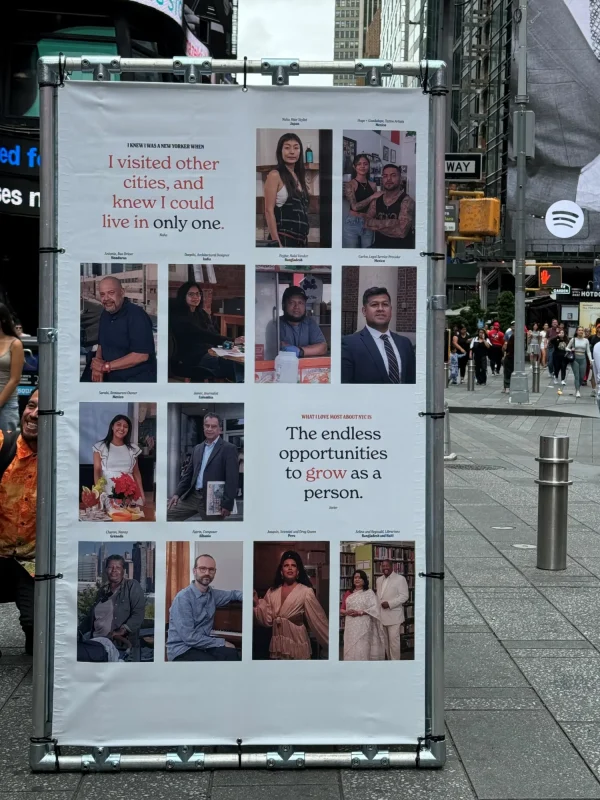
Born in Venezuela, Oscar B. Castillo is a Brooklyn-based photographer who showcased New York City immigrants in different parts of daily life in a public art project titled “New York Proud”. In his photographs and the public installation of them, he highlights immigrant labor and their contributions to our city that might otherwise go overlooked or undermined. Among the 25 portraits he took, some include Marie Rose, a fruit vendor from the Ivory Coast, and Antonio, a bus driver from Honduras. There’s a specific photograph art piece where Castillo complied 12 different portraits of NYC immigrants on one collage, captioning each portrait with their name, profession, and country of origin. He quotes NYC immigrants and writes it out on the poster, saying “I visited other cities, and knew I could only live in one.” and “The endless opportunities to grow as a person”. By emphasizing immigrant labor, Castillo points out his message of hoping to inspire empathy and understanding across our city for the many contributions of labor in different aspects of NYC.

* Something else interesting: Yumi Heo’s “Q is for Queens” art installation in train stations ! I didn’t make the assignment about her because the artwork isn’t about issues related to immigration, but rather showcasing the beauty of the many different cultures, festivals, and landmarks that we have in the Queens borough, thanks to immigrants. It’s worth noting and the stained glass artwork is very beautiful and can be found across three subway stations along the 7 train in Sunnyside and Flushing.

Rachel Rachmany, New York: A city of Migrants and Immigrants II

The artist that I would like to talk about is Oded Halahmy. 

Oded is a visual artist that is an immigrant. He was born in Iraq to an orthodox Jewish family and eventually moved to New York City. His art is influenced by his immigration, exile, and leaving Iraq behind. In 1951 he had to leave Iraq and move to Israel because the Jews were facing a lot of persecution and restriction. I relate and love the work of Oded because my family had to go through a very similar situation, so his art feels closer to home than many others. He finally came to New York City, a place that was a native land to him and struggled which is represented in his art. His artwork reflects his life and the memories he has of Iraq and struggle yet build of his new life here in America. In most of his pieces, his Iraqi – Jewish identity continues to stay connected to his culture and art no matter where he lives. 

In this artwork, there are many blocks stacked on top of one another that all have different resemblances. But as a whole I view it as a balancing act. There are things to take away from America, things from his culture and religion as well as Iraq itself, but he’s trying to balance it all, learning to keep that balance sustained and learning about his new life as well. It’s hard to be an immigrant and Oded shows that through his artwork. 

New York: A City of Migrants and Immigrants II, Rebecca Bukobza

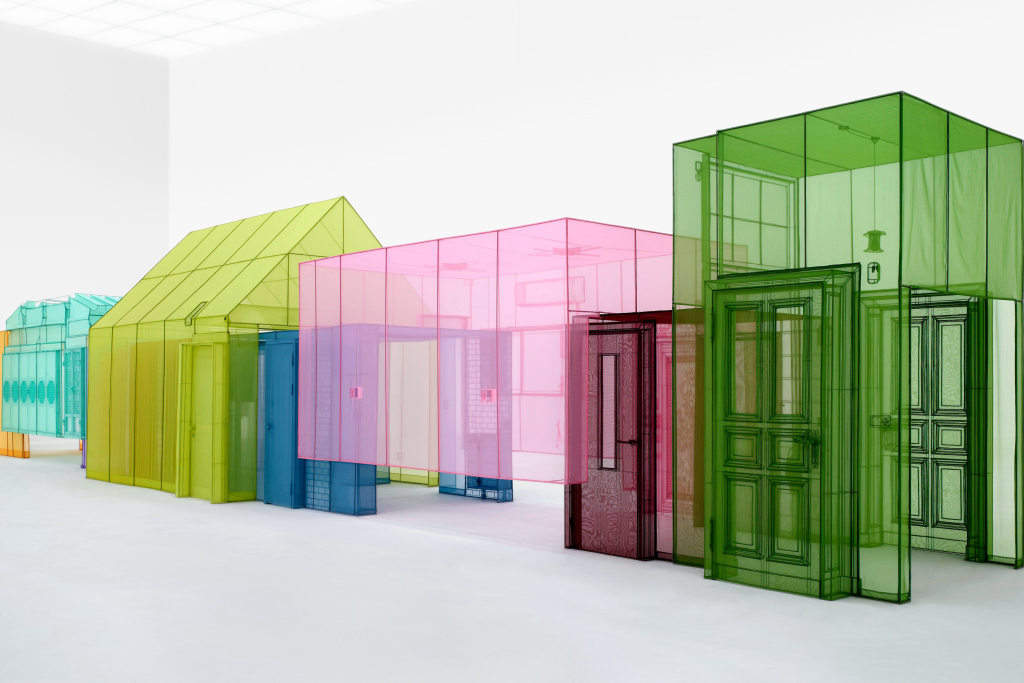
Do Ho Suh is an artist from South Korea who moved to the United States and lived in New York City. In this artwork, he addresses the issues of migration, displacement, and the meaning of home. After leaving Korea, Suh recreated his childhood home in Seoul using thin, translucent fabric. The house looks almost like a memory because it is there, but it also feels temporary and fragile. This connects to the immigrant experience of leaving ones home and trying to create another somewhere new. The artwork shows how moving to another country can change a person’s idea of where they belong, while their memories and connection to their original home can stay with them. I also noticed that the house is placed inside a completely different space, which makes it look like it does not fully belong there. This can represent how immigrants may sometimes feel out of place when adjusting to a new country, even while trying to make it feel like home.

New York: A City of Migrants and Immigrants II, Mohamed Ibrahim

I chose Ahmed Morsi, an Egyptian artist who was born in Alexandria, Egypt, and moved to New York City in 1974, and has lived there since. Despite residing in New York City for a long time, Ahmed Morsi still has a strong connection to Alexandria and Egypt, which led to many of his artworks being created, specifically those that represent alienation, and struggling to integrate. His experience of living away from his homeland became an integral part in how his artworks were created. I can relate to his experiences as I moved from Cairo, Egypt to New York City, so I have a similar background to him. I felt especially connected to his artwork named Black Bird II.

Black Bird II, Morsi uses human and bird-like figures are uncanny, with an empty landscape. This artwork specifically represents not completely belonging to one place, and feeling tied to your homeland. It is meant to show how the birds and humans are not completely connected to the place that they are currently in, and have a little bit of their homeland still residing in them. The figures appear uncomfortable and do not fit in with their surroundings, which is similar to how an immigrant may feel, especially one that is first-generation and is more used to their home country than their new country. The black bird that they are sitting on appears to be dead represents the feeling of loss and displacement, and the longing for a homeland that may be difficult to return to. Morsi’s artwork is interesting because it is more than just about physically moving countries, but about mentally leaving behind yourself in your homeland and adopting new rules, traits, and behaviors from the new country. Even after moving to New York City and residing in it for many years, he still longs for his homeland. It shows that most immigrants especially first generation tend to never forget their home and always like to return. I feel that this artwork is very relatable and very representative of many immigrants who feel like strangers in a barren, desert-like landscape.

New York: A City of Migrants and Immigrants II, Evelina Vyshyvaniuk

Tania Bruguera

Tania Bruguera is a Cuban artist and activist who was born in Havana, Cuba, in 1968. As the daughter of a Cuban diplomat, she spent her childhood moving between countries and became accustomed to constant displacement. Coming from a background of constantly witnessing political unrest and oppression of free speech in her home country, the center of Bruguera’s creative career became exploring the relationship between activism and art, with an emphasis on political power and social justice. Additionally, Bruguera’s constant movement in childhood exposed her to the beauty of various world cultures and ways of life, which later encouraged her to create much art concerning immigration.

In 2011, Bruguera, along with the Queens Museum, started the Immigrant Movement International (IMI) in Queens, NY, a community-based project that aimed to work with New York City’s immigrants firsthand, document their experiences, and then later address issues such as political representation and access to education and healthcare. This advocacy was done by combining real human experiences with various art mediums to foster public awareness and social change. This way of creating art is known as “Arte Útil,” which translates to “useful art,” because it involves real, pressing topics and leaves a lasting impact on the political and social landscape.

One example of Bruguera’s work is titled Monument to New Immigrants in Pennsylvania, and it features a clay, human-like structure that represents an immigrant child. It was made featureless to represent immigrants of all ethnicities entering the US and having a very similar experience. The monument was also made out of unfired clay, which left this structure to wither away with changing weather. This portrays how America sometimes strips immigrants of their identities through assimilation and forces them to start completely new lives.

A crumbling clay structure depicting a child immigrant holding onto a teddy bear.

New York: A City of Migrants and Immigrants II, Fariba Ibtisam

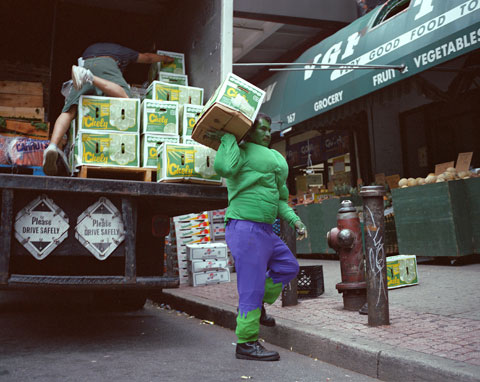
Born in Mexico City, Mexico, Dulce Pinzón is a famous Mexican artist whose photography is heavily influenced by themes of immigration, nostalgia, and questions of identity. Her artwork is so touching and exceptional, to the point where Forbes Magazine named her “one of the 50 most creative Mexicans in the world” and Vogue Magazine identified her as one of the “8 Mexican female photographers who are breaking through a global level.” Her artwork speaks to millions of immigrants across the United States, especially her photography collection from 2006. In her collection “The Real Story of Superheroes” Pinzón captures photographs of immigrants in New York City dressed as superheroes while working their jobs. Most of the people she captured were immigrants from the same place as her: Puebla, Mexico. Her artistic choice of depicting everyday hard-working people in New York as recognizable superheroes puts an emphasis on how important immigrants are to the backbone of society. She made this collection of art to pay a sense of tribute to hard workers who largely go unnoticed for their sacrifices and labor in this country. In the picture above we can see “the Hulk” working to stock grocery stores with shipments; in another picture I listed below we can see a man dressed as “the thing” working in construction. In her artwork Pinzón sets to humanize immigrants; by showcasing that they are more than just statistics or stereotypes, they are real people who forget their own needs every day for a better life and are the reason society can properly function. Babysitters, construction workers, and food delivery workers— they all play a significant role in a stable society and should be commemorated for it. But Pinzón doesn’t just stop there; she takes it a step further to display just how heroic the subject of her photos truly are by stating in the caption of her photographs how much money they send back home to relatives. By doing so she cultivates a new level of nuance that urges audiences to see the never-ending selflessness our heroes have to offer. In essence, Pinzón captures photographs of courageous men and women to pay homage to the true heroes of the city that manage to survive unfair labor and forfeit their comfortableness to help both their communities—whether that be back home or the home they have learned to survive in.

New York: A City of Migrants and Immigrants II, Vina Chen

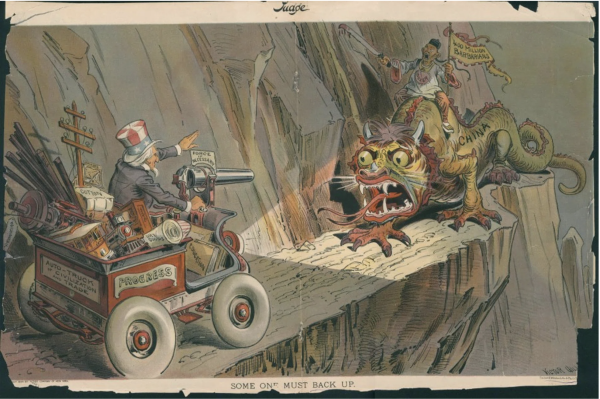
This cartoon addresses the Chinese Exclusion Act and the broader reluctance to accept Chinese people into the country, though more specifically here it’s about America’s stance toward China as a nation. The banner reading “400 Million Barbarians” depicts Chinese people as barbaric, and this is reinforced by the contrast between the sword and the gun, since the gun represents advanced technology and industrial development while the sword feels primitive by comparison, showing that Americans viewed Chinese people as less advanced than themselves. You can also notice the truck Uncle Sam is riding in, which says “Progress,” and it’s contrasted with the dragon, which I think is also meant to show that the Chinese aren’t as advanced. The setting even reinforces this, since the two are stuck on a narrow mountain ledge with cliffs on either side, so there’s no room to pass or go around one another, and this traps them into a standoff where someone has to yield, fitting the caption “Someone must back up” and making the confrontation feel unavoidable rather than something that could be worked out. The “Force if Necessary” label also stands out to me, and it points to the issue that Americans feared the Chinese so much that they thought it was okay to threaten force, fear as in fear of them taking jobs, resources, or influence, and not wanting to back down or compromise. The mountain setting adds to this fear driven framing too, since the steep cliffs and stormy sky make the moment feel dangerous and high stakes, almost like a frontier standoff, which makes Uncle Sam’s aggressive stance seem more justified within the cartoon’s own logic.


Abby Badalov, New York: City of Immigrants II

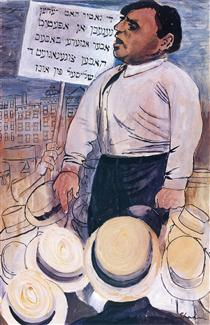
Ben Shahn was a Lithuanian Jewish artist who documented the Lower East Side and Jewish immigrant life in the 1930s-40s. The image I chose from his art is “East Side Soap Box,” which shows a union rally of Jewish workers with protest signs written in Yiddish, a common language spoken by European Jews. The Jewish Museum connects this artwork to poverty in the Great Depression, unemployment, and Shahn’s own Jewish identity. While many Jewish immigrants tried to integrate culturally, it was difficult because many kept Shabbat. This limited them from working on Saturdays, which was extremely important at the time. Many Jewish immigrants were working poorly paid jobs with difficult working conditions. Therefore, because of economic inequality, Shahn depicts working-class Jewish immigrants demanding better treatment. Additionally, Shahn draws attention to how immigrants maintained their cultural roots while adapting to American life through the Yiddish language. In this case, a shared language brought Jewish immigrants together through a common form of communication. However, language can also divide communities through a lack of understanding. Therefore, Shahn’s artwork on Eastern Jewish immigration during the Great Depression era depicted the labor and economic hardships people experienced. 


Proudly powered by WordPress | Theme: Baskerville 2 by Anders Noren.

Up ↑