New York: A City of Migrants and Immigrants II, Angelica Wong

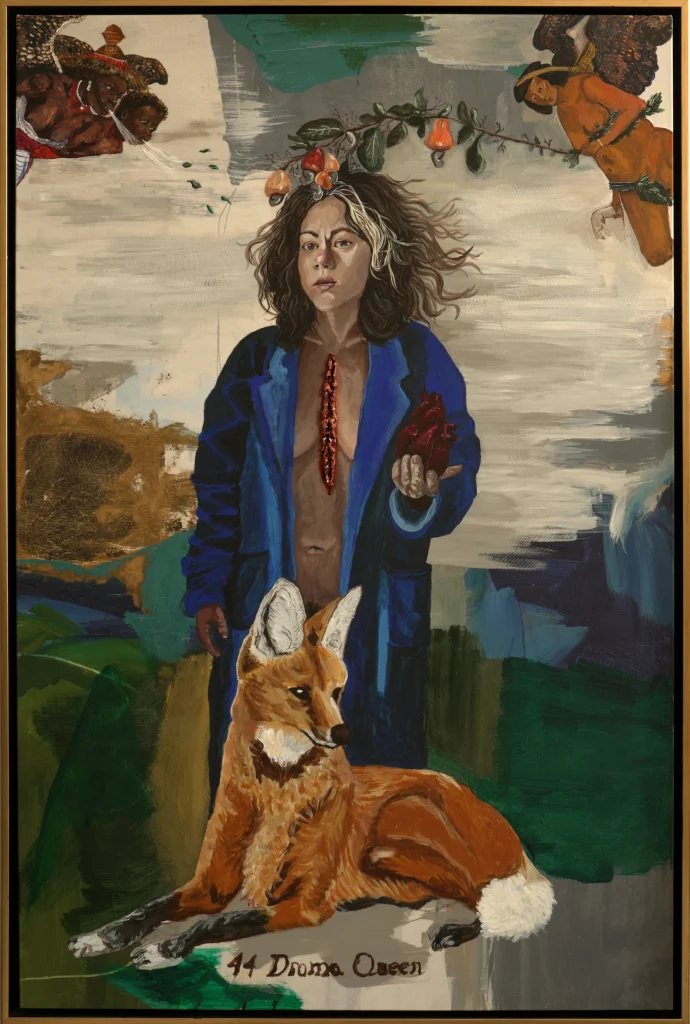
Painting of woman in a landscape with a fox.

Patrìcia Colmenero is a multimedia artist from Brazil, now residing in New York City. She has a PhD and MFA that she also views art and self-expression through. She expresses her identity as a Brazilian immigrant to the U.S. through film, writing, paintings, sculptures and more. Through her artwork, she tackles themes of immigration, womanhood, the land, existing in a state of in-between, post-colonialism, and existing in a euro-centric world as Brazilian.

In the specific artwork above, Calmenero depicts herself existing in an unstable, stitched together landscape of Brazil. The instability depicts her perceived “wild” and “savage” identity as a Brazilian within the European lens, but it does not show her yielding any of it. Additionally, the mesh of Brazilian landscape depicts the instability of the country of Brazil after European colonialism has thrown it askew politically and economically. Her use of texture throughout the painting, including in her hair blowing in the wind expresses freedom and wildness. This piece is part of a larger exhibit called “Drama Queen,” which illustrates the juxtaposition between the different worlds she exists in and observes.
New York: A City of Migrants and Immigrants, Jack Terzi

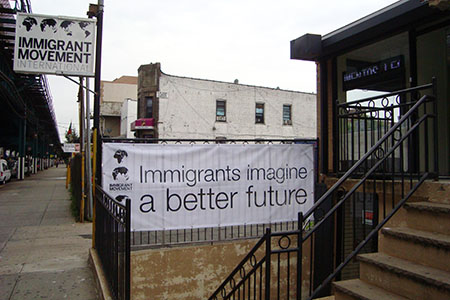
Tania Bruguera: Immigrant Movement International

The Immigration Movement International

We watched Paola Mendoza and Jose Vargas discuss art as a means to call for immigration reform, and another artist who addresses immigration through her art is Tania Brugueras. Born in Cuba, and later moved to NYC, she worked on a project called Immigrant Movement International. It takes place in Corona, Queens, and focuses on immigrants’ lives, experiences, and their rights. The artwork isn’t your typical painting or sculpture, instead it is an entire community project, working with politicians, immigrants, and community organizations. It deals with a few issues immigrants face; their lack of voice in the political system, the limited access to resources, and the negative way society can view them. She was interested in the conditions they lived in, so much so that in 2011, she “spent the year living with 5 immigrant families and their children.” She wanted to better understand these problems, like the challenges undocumented immigrants faced surviving with little pay and no health insurance. The project opened a storefront where the immigrants could work on their own art, learn English, and even find employment. It allowed them to become a part of a community. In the Art21 video, where they interview members and attendees of the exhibit, you could so clearly tell how at home, and how comfortable they feel among each other, and when free to just be, and paint, and do whatever. There are shows and displays of the immigrants’ culture, and the scenes of them appreciating it is so wholesome. Its so great that the artist makes something the entire community could interact with. Its something called “Arte Útil”, or useful art in Spanish, and I couldn’t agree more. The piece is so connected to real life. It addresses some social and political problems, while also bringing the community together.

New York: A city of Migrants and Immigrants II- Kelly Mayer

New York: A City of Migrants and Immigrants II, Daniel Postelnik

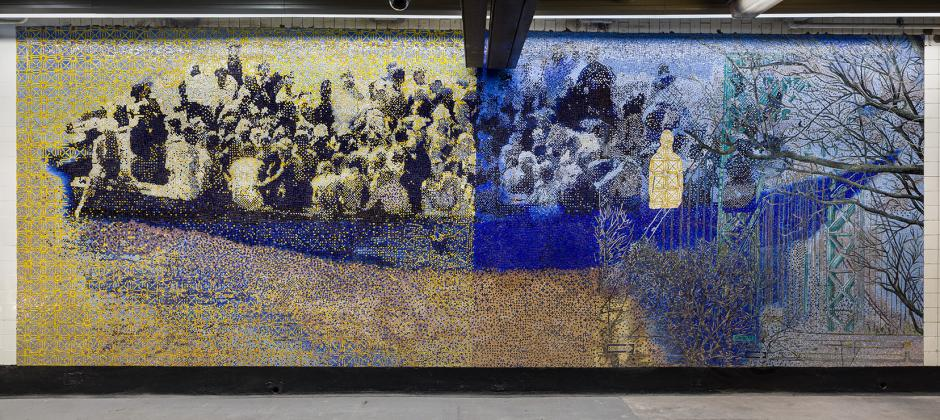
The artist I chose is Carmen Lizardo. Lizardo is an artist from the Dominican Republic who uses photography to explore themes of immigration, race and identity. She was born in the Dominican Republic and immigrated to the United States at the age of 19. In her artwork, Lizardo focuses on cultural heritage and adaptation. In art such as “To Swallow a River” and “Americana,” Lizardo displays multiple pictures and self-portraits to explore the role of immigrants in American history. In 2023, Lizardo was commissioned by the MTA to create artwork at the 181 St Station.

This artwork, titled, “Great Waves of Immigration” shows the travel of immigrants to New York. Having the artwork in Washington Heights is especially significant as many immigrants have made the neighborhood their home. This piece shows a crowded and overfilled boat showing the danger that many immigrants went through to reach New York. In the background, the George Washington Bridge is portrayed going through the boat, showing that the immigrants are a part of New York. In addition to this mural, there are two others displayed at the same station. One shows a woman holding a certificate of citizenship, and the other shows an unidentified woman. These three murals show the journey of immigrants and also the issues of obtaining citizenship.

New York: A City of Migrants and Immigrants II, Shana Monas

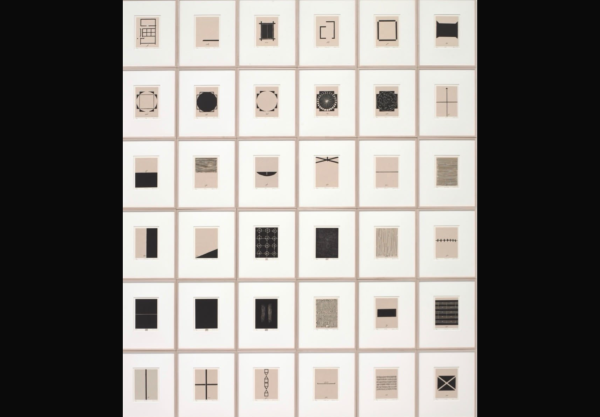
In Home Is a Foreign Place, Zarina Hashmi addresses migration, displacement, language, and the feeling of leaving your home behind. She uses words in Urdu, her native language and images of things like borders, roads, and houses to show her memories of the home she left. I think the artwork shows how moving to a new country can make someone question where they really belong and how they can still carry memories of their original home with them. Her artwork shows how moving to a new country can be extremely difficult even when it can seem easy once you are settled. You always carry memories of where you came from which can make things difficult. The use of Urdu is also important because it connects Zarina to the language and culture of where she came from. Even though she moved and lived in different places, her original home was still a part of her identity. The simple images of houses, borders, and maps also show how home is not always just one physical place. It can be connected to memories, family, language, and experiences. I think the title Home Is a Foreign Place shows how someone can miss their old home while also starting to feel unfamiliar with it after being away for so long. This relates to immigration because immigrants can sometimes feel caught between two places and not feel completely at home in either one. Zarina’s artwork shows both the physical experience of moving and the emotional experience that comes with it.

Rebecca Mero, New York: A City of Migrants and Immigrants

Jacob Lawrence painted this in 1943 as part of his effort to show the lives of African Americans. His parents were migrants and they migrated during The Great Migration. He was born in 1917 and as a teenager he started his passion for art to express himself and his feelings. He was also a teacher. He was the first African American artist that artwork was in the MOMA.

Jacob Lawrence shows the issues immigrants faced through this piece of art. They had to carry everything and walk with the anxiety of how their lives would change. They were probably nervous of how they would integrate into the new culture, what job they would have, and how they would be treated by others as a immigrant. But, we see some of their hope and excitement for the new opportunities they would encounter through the lens of this art. The sky is blue and a few of them are looking forward to it with the big steps they are taking. On the other hand, we also see the hardships the younger children are facing as they are looking down and burdened with the walking and carrying the bags.

New York: A City of Migrants and Immigrants II

Find another artist who addresses migration or immigration through art. What issues does
this artist address in this specific artwork?

So I picked Martin Wong after some research. He was a Chinese-American painter who moved to New York from the california to the lower east side. The artwork is called Attorney Street (Handball Court, 1982-84). It’s actually at the Met, which we’re pretty close to now that I mention it. Now based on what I can see, there is a chain fence and brick buildings behind it, and there’s graffiti on the wall and a poem written in the sky. Additionally, Martin also finger-spelled the title and his name on the frame in sign language. I think the brick buildings are about housing after people move here, and I think the chain fence is about the neighborhood feeling closed in. I fell that the art piece about crime and getting locked up. I think that Wong being Chinese-American and painting a Puerto Rican street really demonstrates the different immigrant groups living next to each other in New York in 1982(a very different time). I think it feels almost constricting and I also think that it shows about a separation of culture being a big issue in today’s world as well.

A painting called Attorney Street Handball Court 1982 showing a graffitied tennis wall with buildings and a chain fence full enclosing it with hands(seperation.

New York: A City of Migrants and Immigrants II, Gianna Bintas

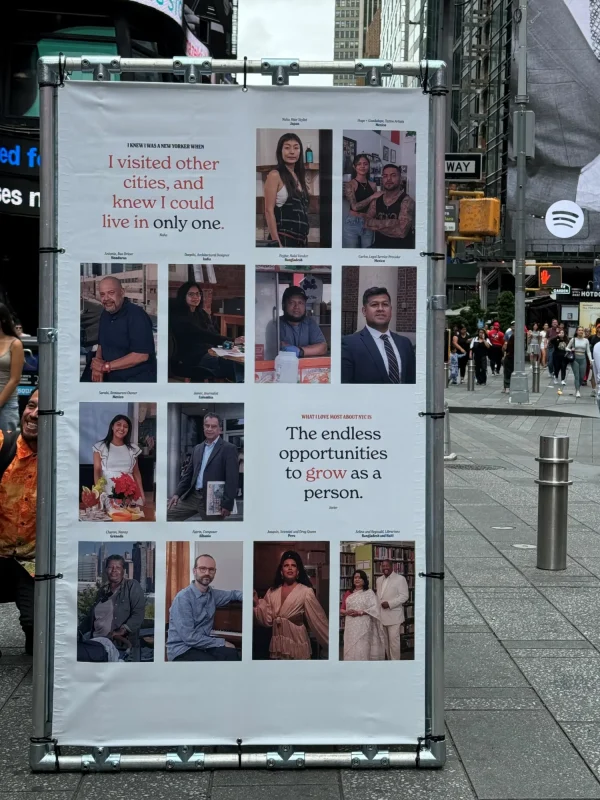
Born in Venezuela, Oscar B. Castillo is a Brooklyn-based photographer who showcased New York City immigrants in different parts of daily life in a public art project titled “New York Proud”. In his photographs and the public installation of them, he highlights immigrant labor and their contributions to our city that might otherwise go overlooked or undermined. Among the 25 portraits he took, some include Marie Rose, a fruit vendor from the Ivory Coast, and Antonio, a bus driver from Honduras. There’s a specific photograph art piece where Castillo complied 12 different portraits of NYC immigrants on one collage, captioning each portrait with their name, profession, and country of origin. He quotes NYC immigrants and writes it out on the poster, saying “I visited other cities, and knew I could only live in one.” and “The endless opportunities to grow as a person”. By emphasizing immigrant labor, Castillo points out his message of hoping to inspire empathy and understanding across our city for the many contributions of labor in different aspects of NYC.

* Something else interesting: Yumi Heo’s “Q is for Queens” art installation in train stations ! I didn’t make the assignment about her because the artwork isn’t about issues related to immigration, but rather showcasing the beauty of the many different cultures, festivals, and landmarks that we have in the Queens borough, thanks to immigrants. It’s worth noting and the stained glass artwork is very beautiful and can be found across three subway stations along the 7 train in Sunnyside and Flushing.

Rachel Rachmany, New York: A city of Migrants and Immigrants II

The artist that I would like to talk about is Oded Halahmy. 

Oded is a visual artist that is an immigrant. He was born in Iraq to an orthodox Jewish family and eventually moved to New York City. His art is influenced by his immigration, exile, and leaving Iraq behind. In 1951 he had to leave Iraq and move to Israel because the Jews were facing a lot of persecution and restriction. I relate and love the work of Oded because my family had to go through a very similar situation, so his art feels closer to home than many others. He finally came to New York City, a place that was a native land to him and struggled which is represented in his art. His artwork reflects his life and the memories he has of Iraq and struggle yet build of his new life here in America. In most of his pieces, his Iraqi – Jewish identity continues to stay connected to his culture and art no matter where he lives. 

In this artwork, there are many blocks stacked on top of one another that all have different resemblances. But as a whole I view it as a balancing act. There are things to take away from America, things from his culture and religion as well as Iraq itself, but he’s trying to balance it all, learning to keep that balance sustained and learning about his new life as well. It’s hard to be an immigrant and Oded shows that through his artwork. 

New York: A City of Migrants and Immigrants II, Rebecca Bukobza

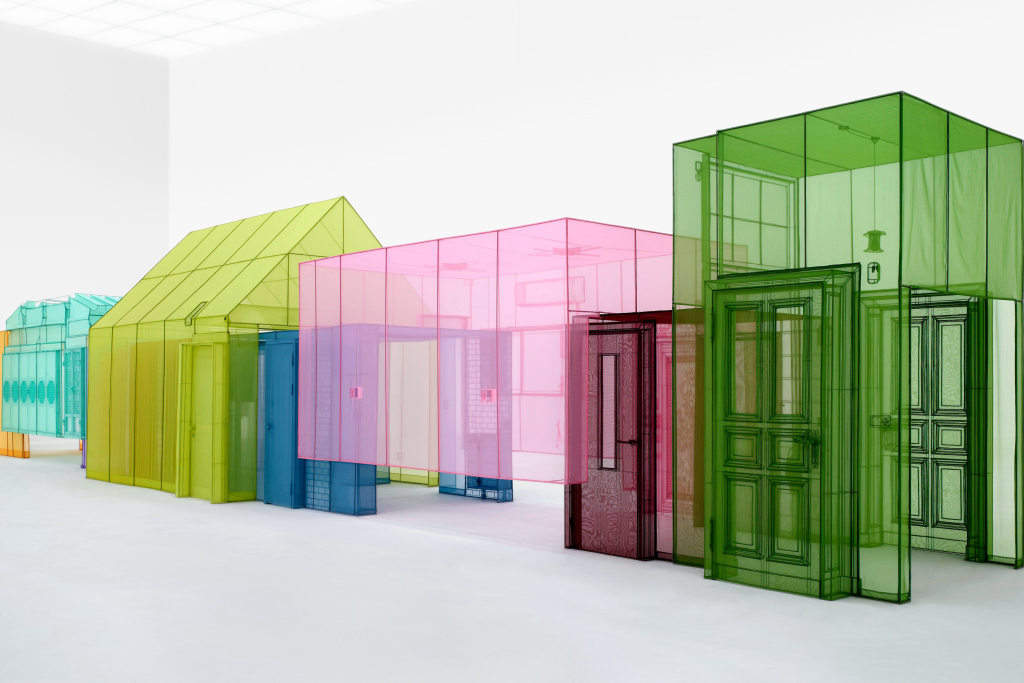
Do Ho Suh is an artist from South Korea who moved to the United States and lived in New York City. In this artwork, he addresses the issues of migration, displacement, and the meaning of home. After leaving Korea, Suh recreated his childhood home in Seoul using thin, translucent fabric. The house looks almost like a memory because it is there, but it also feels temporary and fragile. This connects to the immigrant experience of leaving ones home and trying to create another somewhere new. The artwork shows how moving to another country can change a person’s idea of where they belong, while their memories and connection to their original home can stay with them. I also noticed that the house is placed inside a completely different space, which makes it look like it does not fully belong there. This can represent how immigrants may sometimes feel out of place when adjusting to a new country, even while trying to make it feel like home.

Proudly powered by WordPress | Theme: Baskerville 2 by Anders Noren.

Up ↑