Nona Faustine, Fragment of Evidence (2019).
Prof. Karen Shelby | Fall 2026 | Baruch
Nona Faustine, Fragment of Evidence (2019).

a thirst for compleat freedom . . . had been her only motive for absconding, Oney Judge, Federal Hall, NYC
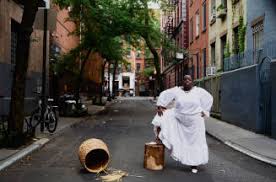
The artwork I’ve chosen is called “From Her Body Came Their Greatest Wealth” by Nona Faustine
In this photo a black woman is standing with her foot up right on a pedestal posed in a white dress.
I think the main goal of this artwork is to remind people about the history of slavery in New York.
The location this picture was photographed was actually a place where slaves were bought and sold.
It’s stated that the location is right near Wall Street which is known for great wealth and businessmen. I believe one reason the picture was taken there was because Nona wanted to show that slavery was connected to the wealth and wealthy people of New York.
I love this title photo and find it so compelling, because, “From Her Body Came Their Greatest Wealth,” means that people made money from the bodies and work of enslaved people.
Nona uses this photo to show women’s new empowerment. The strength and confidence is overflowing out of the photo – in order to make the history feel personal. Even though the city looks very different today, the history is still part of the city.
So this photograph is so important because it not only shows one of the origins of slavery, it also comes as a reminder of how they were treated, the African Americans were the slums while the others were making riches for themselves. It also shows black pride and a new and better future they have made for themselves, that they should be proud of.

From Her Body Sprang Their Greatest Wealth, Nona Faustine

This photograph shows Nona Faustine standing in right front of Federal Hall, with her back to us, looking up at the bronze statue of George Washington(the FIRST president). She’s wearing a white skirt, her back is shown bare, and she’s holding a pair of white shoes in her hand. The title is a quote from a report about Oney Judge, a woman the the George Washington family enslaved. She ran away in Philadelphia of 1796, and when a customs officer in New Hampshire questioned why she left, the officers wrote that “a thirst for compleat freedom” was her only motive. Oney Judge daringly(this sent a pretty clear message) offered to come back to philadelpia if Washington promised to freedom after his death, and he SAID NO. In essence, I think Faustine’s goal was to show that we shouldn’t glorify Washington like a hero because he was a slave owner. Faustine stands small in the middle of the picture as you can. feel that something is wrong as she looked as if she was running from people with her shoes in her hands and her bare back shown. Her goal is to inform and “call attention to [places]” because a lot of places in New York are tied to slavery and people walk past them thinking those places have a clean slate.

Nona Faustine’s They Tagged the Land with Trophies and Institutions from Their Rapes and Conquests (2013) shows the artist standing nude in front of the Tweed Courthouse in New York City. By placing her body against this powerful historic building, Faustine draws attention to the history of slavery, racism, and exploitation connected to New York’s development. The contrast between her vulnerability and the courthouse’s grand architecture makes the viewer think about the histories that are often hidden behind important institutions. – MAKING HISTORY VISIBLE,KELLY MAYER

This photograph is of the former site of Andrew William’s home in Seneca Village, a mostly Black community that existed before Central Park was created. Andrew Williams was a renowned black property owner, which is important because owning property gave Black New Yorkers greater independence and, at the time, could also help men meet property requirements connected to voting. Seneca Village was also displaced when the city cleared the land to build Central Park. In this photo, Nina Faustine is reading the book “Black Indians: A Hidden Heritage”. This book connects to how Black and Indigenous history are often overlooked or left out of mainstream representation. Faustine places herself physically on the site so that the viewer confronts the fact that that peaceful area of Central Par used to be someone else’s home and community.


Isabel, by Nona Faustine, serves as a window into the past, representing the dehumanization and abuse enslaved African-American women had to go through in slave-owning homes all around New York. In this self-portrait, Faustine steps into the shoes of Isabel, an enslaved woman who, according to historical records, was property of the Lefferts in the 18th century. She is half nude, carrying a pan, with white baby shoes tied around her waist, which carry the weight of generational trauma and the resillience African American woman carry through generations. This work depicts a clash of time, and although the photograph was taken in the modern day, it carries a haunting energy to it, which shows how the impacts of slavery still plague today’s world.

The artwork above, Fragment of Evidence, is from Nona Faustine’s 2019 series of large-scale silkscreen photographs that integrate iconic American symbols with a simple strip of red or black going across the photo. These bars of color intentionally obstruct the audience’s view of certain parts of these ionic symbols. For example, in the artwork above we can only see the upper half of the Statue of Liberty and not the pedestal it is on. This visual juxtaposition of a view you cannot fully see is Faustine’s way of depicting how marginalized groups and minorities in America are not given the full breadth of what America has to offer because of things like systemic racism. It is a powerful symbol that represents seeing the “land of the free” but being blocked from fully attaining it despite helping to build that very same land.
Proudly powered by WordPress | Theme: Baskerville 2 by Anders Noren.

Read our documentation to learn more about how you can use CBOX OpenLab to create a commons for open learning.
Powered by: