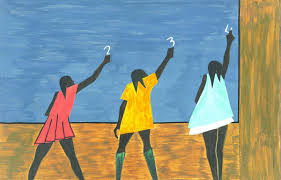
Read: Jacob Lawrence, “The Migration Series,” (1941) and perspectives
What is the content of Lawrence’s Migration Series? How were the paintings installed at MoMA?
Did any of the perspectives resonate with you? Why one? Why? How? Be specific.
In The Great Migration, Lawrence shows people with their possessions. What does he depict? Is there an object that you or your family associates with your history? See the information from Your Story, Our Story below.
Please add an image of that object to OpenLab. Explain what that object means to your family.
Your Story, Our Story is a national digital exhibit initiative of the Tenement Museum in New York City and its partners across the United States. Your Story, Our Story is a collection of stories that is expansive enough to hold the connections we share as Americans, along with our similarities and differences. Your Story, Our Story explores the ways that people are profoundly impacted by the places they come from and move into, telling a fuller and more holistic story of American identity in ways that honor the complexity and multiplicity of individual experience.
The Tenement Museum was founded with the belief that history is personal and relational. Every individual makes history and their actions have the capacity to impact others in both small and transformational ways. Just as the museum’s historic tenement buildings contain the stories and objects of extraordinary Americans, our lives also hold important truths.
** This is referred to as “bottoms-up” history – the history of the common people.
Your Story, Our Story offers participants the opportunity to become historians of their experiences so that they can better understand who they are, how their identities came to be and connect to other Americans, and the roles people play in shaping community and society.
It is important to note that because Your Story, Our Story asks participants to answer the deeply personal question of Who are you? it can surface a range of emotions from joy through traumatic, and everything in between. Exploring the complexity and nuance of one’s identity can be especially challenging when one’s story intersects with ideas around power, race, and ethnicity that are shaped by global and local politics. Giving participants permission to decide which parts of their identity they want to share with you, their classmates, or the public is foundational to the project.
What types of stories can participants include in Your Story, Our Story?
Stories on Your Story, Our Story use an object to reveal the ways moving to a new place impacts identity and one’s understanding and experience of the world. These include the movements of ancestors and one’s personal lived experience, moves that were welcomed and those that were forced, and moves from another country or within the United States.
These movements holds countless possibilities for story topics, including:
- Traditions preserved or adapted from one place to another (e.g. food, music, attire, religion)
- New rituals invented to bring comfort or mark important moments or milestones
- Objects or stuff one cares about
- Successes and struggles encountered (e.g. dreams, opportunities, challenges, disappointments)
- Emotions and feelings that surfaced as a result of the movement (e.g. joy, hope, discomfort, confusion)
- Important people in their lives (e.g. family members, caregivers, friends, neighbors, or community members connected to a location)
- Parts of their identity and family history one is curious about
- Things we haven’t yet considered. We are learning together and are grateful to be co-creating this with smart people like you who can help us identify and expand our ideas.