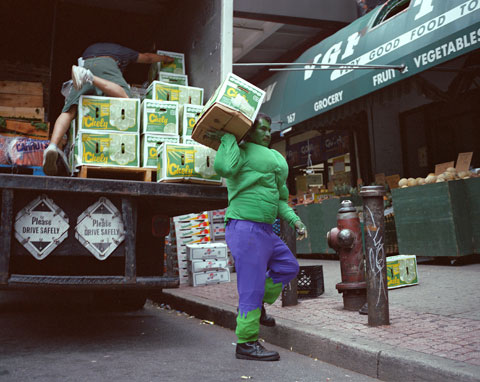
New York: A City of Migrants and Immigrants II, Fariba Ibtisam

Born in Mexico City, Mexico, Dulce Pinzón is a famous Mexican artist whose photography is heavily influenced by themes of immigration, nostalgia, and questions of identity. Her artwork is so touching and exceptional, to the point where Forbes Magazine named her “one of the 50 most creative Mexicans in the world” and Vogue Magazine identified her as one of the “8 Mexican female photographers who are breaking through a global level.” Her artwork speaks to millions of immigrants across the United States, especially her photography collection from 2006. In her collection “The Real Story of Superheroes” Pinzón captures photographs of immigrants in New York City dressed as superheroes while working their jobs. Most of the people she captured were immigrants from the same place as her: Puebla, Mexico. Her artistic choice of depicting everyday hard-working people in New York as recognizable superheroes puts an emphasis on how important immigrants are to the backbone of society. She made this collection of art to pay a sense of tribute to hard workers who largely go unnoticed for their sacrifices and labor in this country. In the picture above we can see “the Hulk” working to stock grocery stores with shipments; in another picture I listed below we can see a man dressed as “the thing” working in construction. In her artwork Pinzón sets to humanize immigrants; by showcasing that they are more than just statistics or stereotypes, they are real people who forget their own needs every day for a better life and are the reason society can properly function. Babysitters, construction workers, and food delivery workers— they all play a significant role in a stable society and should be commemorated for it. But Pinzón doesn’t just stop there; she takes it a step further to display just how heroic the subject of her photos truly are by stating in the caption of her photographs how much money they send back home to relatives. By doing so she cultivates a new level of nuance that urges audiences to see the never-ending selflessness our heroes have to offer. In essence, Pinzón captures photographs of courageous men and women to pay homage to the true heroes of the city that manage to survive unfair labor and forfeit their comfortableness to help both their communities—whether that be back home or the home they have learned to survive in.

Alice Austen, Fariba Ibtisam

Alice Austen was an extremely influential and revolutionary photographer during the Victorian era, producing over 8,000 photos of a bustling New York City. Much like any medium of art, some of the photos that Austen captured were a direct reflection of her identity and life. She was a Victorian woman who didn’t follow traditional gender norms or expectations; therefore she found herself capturing photographs of the nontraditional lifestyle of her and her friends. Many of her photographs also captured her home, “Clear Comfort”, that showcased the life of an upper middle class woman and her family.

Alice Austen’s album of photographs is nothing short of diverse; she manages to capture many different walks of life. From nature to the immigrants of NYC to the private lives of Victorian women, and of course to her lifelong partner Gertrude Tate. Her photographs, when viewed from a contemporary lens, are revealed to be just as influential and impactful as they were during her lifetime. Her documentation of the city’s immigrants working as vendors or arriving at the Quarantine Stations gave a gateway into the lives that they lived, something that is still being researched and studied today. Her documentation of rare intimate relationships between Victorian women is also extremely important to LGBTQ+ representation. She even captures pictures of women riding bikes or using gym equipment challenging traditional gender norms that can still be found today in 2026. Overall her pictures showcase human life in a way that we can still relate to in 2026, which is what makes them so significant.

In the photograph above, Austen captures a wholesome moment of her lover Gertrude dancing under the sunshine. Austen was not afraid to love; she lived with Gertrude for up to three decades, and they visited each other every week when they were separated despite their families’ disapproval. This photograph (among many other photos in the collection purely dedicated to Gertrude in the sun) is a testament to LGBTQ+ rights and is especially pertinent in today’s society because Austen didn’t shy away from her identity. New York City is a city of self-exploration/expression and the subject matter of this photograph adds to the already robust history of the city as if to tell audiences to not be afraid of being true to oneself, to not be afraid to love. Love and the desire to freely express oneself can still be found in today’s life all over the city. Austen merely captured her own journey and life among the millions New York City has to offer.

Proudly powered by WordPress | Theme: Baskerville 2 by Anders Noren.

Up ↑