Making History Visible, Gianna Bintas

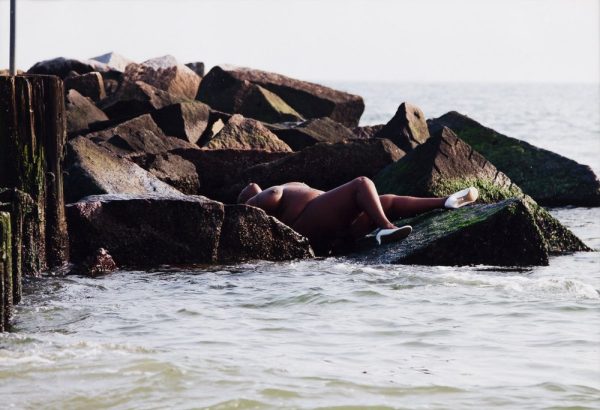
This artwork is titled “Like a pregnant corpse, the ship expelled her into the patriarchy”, a self-portrait taken in 2012 along the Atlantic Coast in Brooklyn, apart of Nona Faustine’s “White Shoes” series. Faustine was a Brooklyn-based photographer who explored race and history, and most specifically New York slave history in this series that includes my chosen self-portrait. She took this photograph, among others, at a historic slave trade site in NYC, and poses herself as completely naked with only white pumps/heels on. Her appearance as “washed upon shore”, in amalgamation with the vulgar and raw language in the title, plays a significant role conveying the message of the barbaric conditions and violence Black women endured. The Brooklyn Rail notes an interesting point about the series, that “she is a channel for, and a physical manifestation of, the countless and nameless women who were subjected to the tortures of slavery, ancestors who did not arrive through Ellis Island, who were never provided a choice of whether they wished to settle in the New World.”

Her deliberate choice to wear nothing but white shoes in these self-portraits also evokes a lot of thought in the viewer. The white in the shoes can symbolize slaves being stripped down to nothing, mentally and physically, but still needing to carry the values of white supremacy. She forces you to digest the brutal trauma the slaves faced with a piece of artwork that’s not easy to look at, but also not easy to look away from.

Icons of New York, Gianna Bintas

I chose pigeons as an image that best represents New York City. When looking at the history of pigeons, one can see that they are “immigrants”, not completely native to New York. They arrived in the city alongside European immigrants in the 1600s and were originally domesticated. Since then, pigeon life drastically shifted from rooftop coops, pigeon fanciers, and pigeon racing to becoming a wild species on their own in the city. Yet, they persisted to stay on windowsills, skyscraper roofs, and train overpasses. They were resilient and adaptive and still called this city home, much like New Yorkers. The pigeon represents the larger picture of New York City as an icon by reflecting the migrant foundation of the city and how they adapted to constant change. A prominent example of love for our pigeons came from artist Ivan Argote, who sculpted a massive pigeon statue called “Dinosaur”, located on the Highline in New York City. He based this sculpture on the notion of going against the norm of the “traditional historical figure monument”. Unfortunately, the pigeon statue was recently taken down in April 2026, starting a “pigeon protest”, which I think shows how much this city adores pigeons.

An icon is a symbol representing larger, encompassing traits of a place, community, or culture. Icons can be people, like in music or cinema, or they can be icons of a culture, such as black, hispanic, or LGBTQ culture. When considering what an icon of a place would be, it has to be widely recognized and “agreed upon”. Although upfront it’s just a person/monument/object, the icon represents a larger history about the place and the culture of its people.

Afro-Futurist Room, Gianna Bintas

A period room acts as a life-size diorama one can step into, made up from many different art mediums to “freeze” a specific moment in time. I can’t recall ever going to a period room in particular, but I think the room at the Tenement Museum seems quite similar to the concept, where the living room of the Irish-American immigrants was designed perfectly on this St. Patrick’s Day so many years ago, with Catholic decorations, furniture, and newspapers. Afro-Futurism is an aesthetic concept that weaves the past, present, and future together through ancestral history and the African diaspora. The room’s title of “Before Yesterday We Could Fly: The Afro-Futurist Room” derives from noting the blossoming potential of Black life in the exhibition, if acts of violence hadn’t restricted them. The article delves into Seneca Village and how this predominantly-Black neighborhood and vibrant community got torn away in order to further the creation of Central Park. Due to this, artists contributing to this period room don’t have sufficient real-life evidence or artifacts to base anything off of–and so, they use their imagination, leading to afro-futurism.

This plays further into the title, “Before Yesterday We Could Fly”, because these period room artists don’t know what “flying” looked like, but they can make very good educated guesses. These guesses lead to the inclusion of Beyonce’s “Lemonade” and Barry Jenkins’ “Moonlight” to intertwine more modern art of the “future” into the period room. The title, with the notion of flying, led the artists to include imagery of flight all over the room, with a vase by Andile Dyalvane engraved with feather imagery and a metal bird from the nineteenth-century Kingdom of Dahomey, ultimately referencing ” ‘The People Could Fly’, a 1985 collection of intergenerational African folk tales”, as the article states. The book by Ta-Nehisi Coates is included with the Afro-Futurist Room because he’s known for his contributions to Afro-Futuristic concepts from his graphic novel series Black Panther. He writes about major political narratives in these books, proving that Black storytelling is essential to literature, and ultimately essential to the “future” aspect of this Afro-Futurist room.

New York: A City of Migrants and Immigrants II, Gianna Bintas

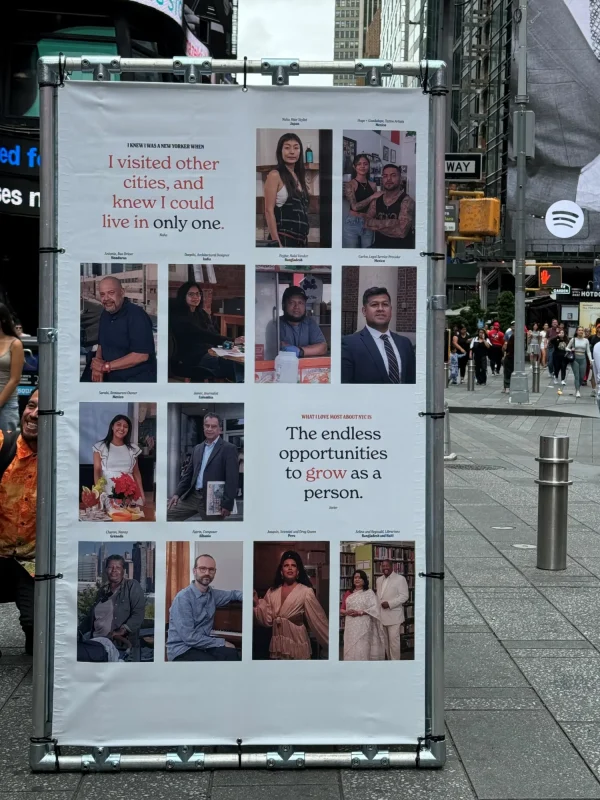
Born in Venezuela, Oscar B. Castillo is a Brooklyn-based photographer who showcased New York City immigrants in different parts of daily life in a public art project titled “New York Proud”. In his photographs and the public installation of them, he highlights immigrant labor and their contributions to our city that might otherwise go overlooked or undermined. Among the 25 portraits he took, some include Marie Rose, a fruit vendor from the Ivory Coast, and Antonio, a bus driver from Honduras. There’s a specific photograph art piece where Castillo complied 12 different portraits of NYC immigrants on one collage, captioning each portrait with their name, profession, and country of origin. He quotes NYC immigrants and writes it out on the poster, saying “I visited other cities, and knew I could only live in one.” and “The endless opportunities to grow as a person”. By emphasizing immigrant labor, Castillo points out his message of hoping to inspire empathy and understanding across our city for the many contributions of labor in different aspects of NYC.

* Something else interesting: Yumi Heo’s “Q is for Queens” art installation in train stations ! I didn’t make the assignment about her because the artwork isn’t about issues related to immigration, but rather showcasing the beauty of the many different cultures, festivals, and landmarks that we have in the Queens borough, thanks to immigrants. It’s worth noting and the stained glass artwork is very beautiful and can be found across three subway stations along the 7 train in Sunnyside and Flushing.

Alice Austen, Gianna Bintas

Alice Austen was a famous female photographer in America who lived from 1866 to 1952, introducing not only a female lens to the world of photography, but her background as a lesbian woman. She built on that further by breaking away from traditional standards of the Victorian era, and continued to pursue her career nonetheless. In regards to the types of things or sites she photographed, it’s best explained by her title as a “documentary photographer”, where she mostly captures people and the environment in their natural, candid, and unposed state. Through this method of photography, she would capture the working class of New York, such as street sweepers, messenger boys, and newsboys, as well as her own friends and family, some of which included more intimate photos of her own female friends. She also photographed places and landscapes throughout New York including photographs of the Alice Austen House–a subject already still relevant to 2026, among others. Beyond her own house, which has since then become a landmark and symbol for LGBTQ+ history, the subjects in her photography are significant to 2026 because they show the seemingly ordinary life of ordinary people in New York, yet these are immigrants and the working class which the city is built upon, an idea that still holds great importance today. The “Pretzel Vendor and Emigrant” photo stands out to me, since these are two types of people that are still largely present in New York City today, and it captures how from what could be entirely different backgrounds the people in the photo are still talking and being cordial with each other.

Proudly powered by WordPress | Theme: Baskerville 2 by Anders Noren.

Up ↑