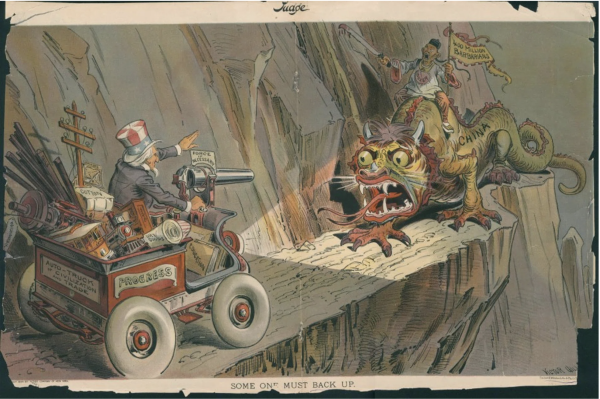
This cartoon addresses the Chinese Exclusion Act and the broader reluctance to accept Chinese people into the country, though more specifically here it’s about America’s stance toward China as a nation. The banner reading “400 Million Barbarians” depicts Chinese people as barbaric, and this is reinforced by the contrast between the sword and the gun, since the gun represents advanced technology and industrial development while the sword feels primitive by comparison, showing that Americans viewed Chinese people as less advanced than themselves. You can also notice the truck Uncle Sam is riding in, which says “Progress,” and it’s contrasted with the dragon, which I think is also meant to show that the Chinese aren’t as advanced. The setting even reinforces this, since the two are stuck on a narrow mountain ledge with cliffs on either side, so there’s no room to pass or go around one another, and this traps them into a standoff where someone has to yield, fitting the caption “Someone must back up” and making the confrontation feel unavoidable rather than something that could be worked out. The “Force if Necessary” label also stands out to me, and it points to the issue that Americans feared the Chinese so much that they thought it was okay to threaten force, fear as in fear of them taking jobs, resources, or influence, and not wanting to back down or compromise. The mountain setting adds to this fear driven framing too, since the steep cliffs and stormy sky make the moment feel dangerous and high stakes, almost like a frontier standoff, which makes Uncle Sam’s aggressive stance seem more justified within the cartoon’s own logic.
Alice Austen, Vina Chen
Alice Austen was a Staten Island photographer born in 1866. Working from the 1880s through the early 1900s, she was one of the first American women to shoot outside a studio, in real settings as opposed to the common posed portraits. The three main themes she delved into were immigration, the street types of New York, and her private, femaled-centered world. Her immigration photos came from a commissioned series documenting the immigrant quarantine stations near her home. She documented their living conditions and their overall lifestyle. This was during the 1890s, when about half a million immigrants a year were arriving in New York, the largest wave of mass immigration in history. She kept returning to photograph there for about ten years, even after the paid assignment ended, capturing scenes like immigrants lined up for health inspections and people waiting anxiously behind fences before being allowed into the country. Her street types work captured vendors and laborers in Manhattan. Her private world photos showed intimate moments with her close friends and her longtime partner, Gertrude Tate. Her photos of her friends dressed in men’s clothes, lounging together, or sharing a bed offer a rare and candid look at a private, non-conforming world that Victorian society had no language for. In addition to documenting her daily life, she uses her photography to give visibility to people and relationships that were often overlooked or hidden.

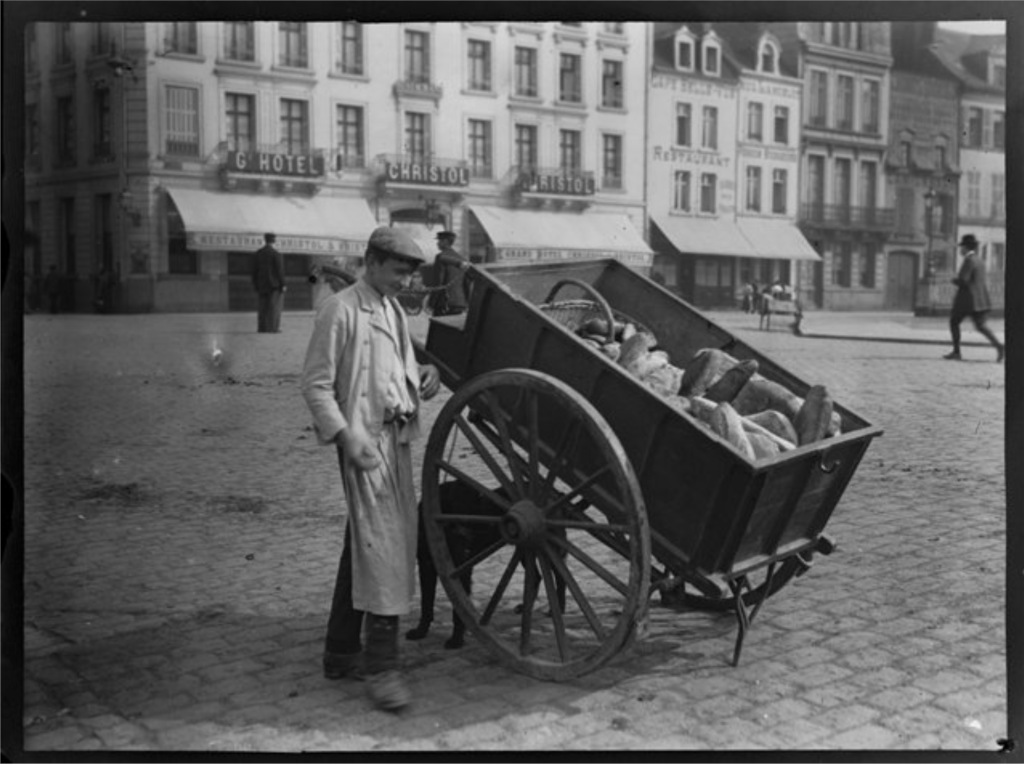
In this photo, Alice Austen showcases a young street vendor selling bread via a heavy wooden cart pulled by a dog through a cobblestone square. This kind imaged mattered in Austen’s time because it helped to highlight ordinary working people, who were often immigrants, and their own authentic lives, as opposed to the norm, where photography often focused on posed portraits of the wealthy. This is also relevant in today’s world because it parallels street vending in New York City, like halal carts scattered across the city, fruit vendors in Chinatown, or even the people selling jewelry or stick-on nails in Koreatown. It also emphasizes the grueling work conditions that even today’s vendors have to face, like long hours, physical strain, and an economy that depends on their labor while offering them little security. Austen’s photograph is a reminder that this kind of work, and the people who do it, have always been part of what makes New York run.