

Group Members: Amirah Alkiswani, Emely Ortiz, Alexandra Hall
- Our project The Buddy.GPT. ad is a reference to the war between New Yorkers and AI. Ever since the start of the new school semester we started to notice weird ad posters titled, “friend.com”. Friend.com is a $125 AI-pendant necklace that you can speak to and it sends response messages to your phone. At first glance they looked like blank canvases because the ads are meant to adopt a modern-simplicity look, with almost passive aggressive comments like “I’ll never leave dishes in the sink” as if the ads are a better alternative to real friends. The reason why we chose this project was because of how New Yorkers responded to it.
- Ever since the beginning of the new school year we noticed more and more AI-generated ads such as Injury Law firm, and the UNO skechers ad. But the one that was most captivating were the Friend.com Ads , not just because they were the most abundant but because they were vandalized the most.
- As soon as they went up, many New Yorkers put graffiti on them as a response to the potential takeover of AI. Many comments were “Get real friends” “Don’t let AI take over”, “Join our club for real friends”.
- The creator Avi Shiffman, the 23-year old Havard dropout spent approximately $1 million on spreading these subway Ads. Many New Yorkers say that ” This is the largest marketing campaign ever”. Despite the graffiti, the creator stated that he embraced the ads because he intentionally made them blank as canvases so New Yorkers can enter their speech, like public forums. Which is how the ads got more attention. However, that still doesn’t mean that people want to use the product.
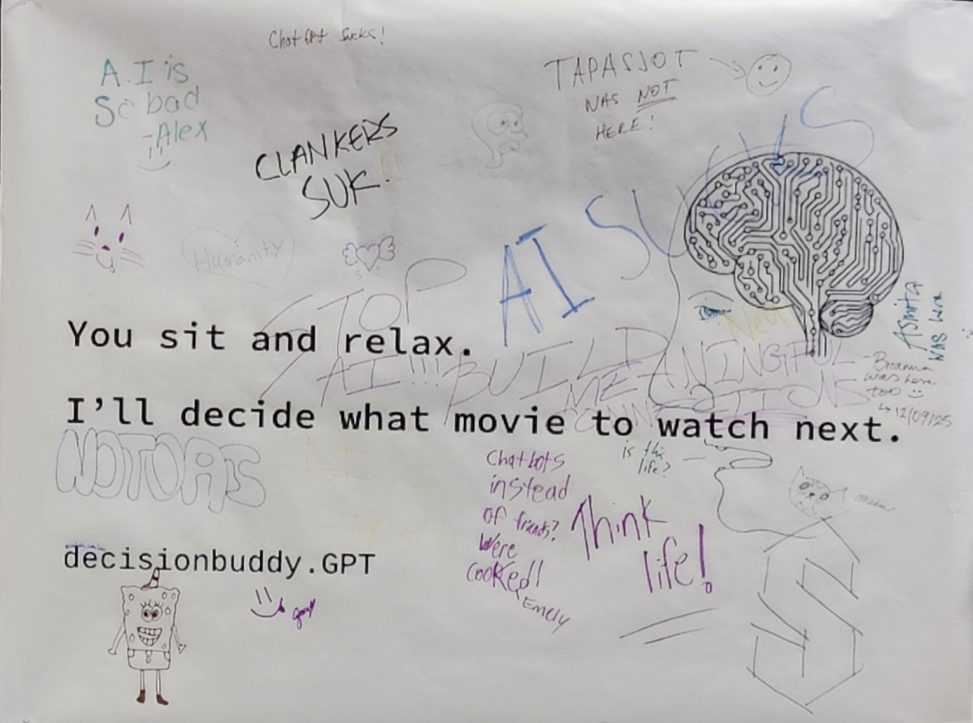
- The graffiti rebelling against the Ai ads. Not only did we make a satirical parody of the ad but let people vandalize it as well.
About Our Project:
- One of our groupmates pointed out the Friend.com ads, specifically the ones in the train stations that have been vandalized by commuters. The ads sounded too perfect, too cheerful, too eager to “help.” After a while they stopped feeling friendly and started feeling unsettling. We joked about how the AI sounded like it wanted to crawl out of the poster and manage our entire lives, and that joke slowly turned into an idea.
- We decided to make our own fake AI ad…something that would look polished and accommodating on the surface but had that same uncanny, slightly intrusive tone underneath. A poster that felt almost real, just off enough to make people question it.
- We mimicked the clean typography and the facade of enthusiastic promises, but twisted them a little. Friend.com sells comfort, so we pushed it towards discomfort. We borrowed the vibe of a service that wanted to “help” you so much that it forgets to let you live your own life.
- We’re hoping to get the same energy people had with the Friend.com ads: scribbles, stickers, black-marker warnings -little acts of rebellion against something that feels too controlling. If someone vandalizes it or writes “NO THANKS” across the face, that means the poster worked; it elicited a sudden feeling of dislike in them. Which was precisely the point.
- From the Project, we are not supporting vandalism or rejecting AI overall. Instead recognize AI as a tool, not a replacement for human roles. Human roles such as friendship and designers for subway ads. The grafiti on these ads became a symbol of New Yorkers rejecting AI in fields that feel inherently human.
How did completing your project help you explore the role of arts in the lives of New Yorkers and their communities?
Completing our project made us realize that New York's urban environment have always had desirable spaces for advertising. However, now companies use these spaces that promote services that replace human roles such as designers and friends. Which is out of place, for a city built on human creativity. Our project reflects ongoing war between New Yorkers and AI replacement, emphasizing to protect human authenticity.

