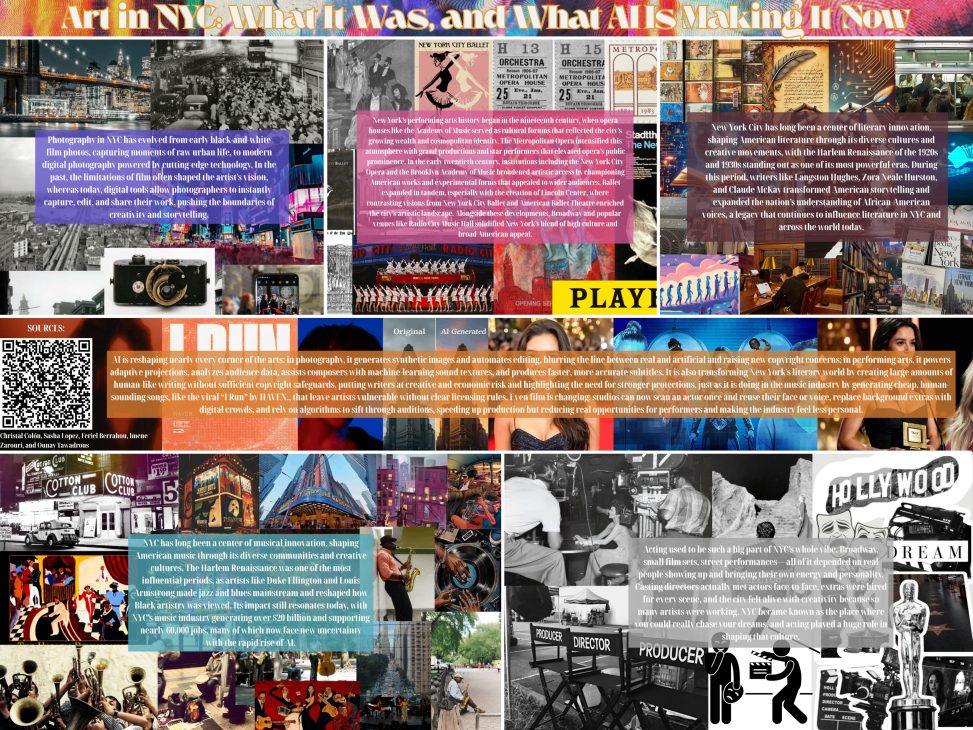
When you hear New York City, what’s the first thing that comes to mind? For some people, it’s the city lights, the rats in the street, the pizza, the celebrities, and everything in between. But for most, it’s the art culture that keeps the city alive – the very reason so many people dream of living in the Big Apple.
Photography
In the early 20th century, photography in NYC relied on slow, skill-heavy processes using film or glass plates. These methods produced black-and-white images capturing immigrants, workers, and the everyday life of the city. This era was rooted in documentary work, aiming to preserve raw, authentic moments exactly as they unfolded.
As technology evolved, color photography and high-definition digital sensors made images sharper, more vibrant, and far easier to produce. Digital cameras and smartphones transformed photography into something instant and accessible, shifting the focus from pure documentation to creative expression and the capturing of energy and style. Today, AI tools can edit, enhance, or even generate entire images, offering instantaneous adjustments, surreal effects, and new creative possibilities that are reshaping photography yet again.
Theater/Opera
Opera in New York began to flourish in the mid-nineteenth century as European works captivated a rapidly growing urban audience. The Academy of Music was the city’s first major venue, but it was soon overshadowed by the Metropolitan Opera after its opening in 1883. Over time, the Met became a cultural powerhouse, premiering important productions and shaping national tastes.
As the city grew, smaller companies emerged, bringing experimental and contemporary works to new neighborhoods. By the late twentieth century, opera in NYC had become a blend of deep tradition and bold innovation, with the Met maintaining grand repertory productions while organizations like New York City Opera, BAM’s Next Wave Festival, and the Bronx Opera championed contemporary composers, unconventional staging, and underrepresented voices. Today, these institutions continue to balance classic repertoire with fresh artistic experimentation.
Artificial intelligence now influences the opera world in several ways. AI-driven projection and lighting systems generate adaptive stage designs that shift with the music. Major companies use machine-learning tools to analyze ticketing data and predict attendance. Composers experiment with AI-generated textures and vocal simulations, and AI-assisted translation tools help create faster, more accurate subtitles. In short, AI is becoming another tool, powerful, but still unfolding, in the evolution of New York’s performance arts.
Literature/Poetry
New York City has long been a home for literary innovation. For generations, writers and poets have found inspiration in its bookstores, libraries, subways, and street corners. From the Beat poets of Greenwich Village to the Black Arts Movement in Harlem, the city’s diversity has shaped American literature by bringing together countless cultures and artistic voices.
Among these eras, the Harlem Renaissance of the 1920s and 1930s stands out as one of the most influential literary movements in NYC’s history. Harlem became a creative epicenter for Black poets, novelists, playwrights, and thinkers. Writers such as Langston Hughes, Zora Neale Hurston, and Claude McKay redefined American storytelling by blending personal experience, cultural identity, and political expression. Their work didn’t just transform literature – it reshaped the nation’s understanding of Black voices and opened doors for generations of writers to come. Its impact remains deeply felt today, in New York and beyond.
NYC’s literary scene is still a massive cultural and economic force, supporting thousands of writers, editors, publishers, and bookstores. But many of these jobs and traditions are now facing new pressures with the rise of AI. AI can generate huge amounts of text, poems, stories, essays, and even novels, at a speed and scale no human can match. These machine-generated works sometimes sound convincingly real, blurring the line between human and AI creativity.
This shift has sparked debates about authenticity and originality, especially because many AI tools are trained on real authors’ work without their knowledge or consent. Copyright laws and publishing standards haven’t caught up to these changes, leaving writers vulnerable to style imitation, voice replication, and uncredited reuse of their ideas. Just like in the music industry, the literary world is approaching a critical turning point. New policies are urgently needed to protect human creativity while still allowing innovation to progress. AI may be impressive, but without clear rules, it risks reshaping writing in ways that could permanently impact authors, poets, and the future of storytelling.
Music
New York City has been the center of musical innovation for centuries, giving rise to genres ranging from jazz and salsa to punk, disco, and hip-hop. Throughout its history, the city has shaped American music by merging diverse communities and creative cultures.
Among all these eras, the Harlem Renaissance (1920s–mid-1930s) stands as one of the most influential cultural periods in NYC’s musical history. During this time, Harlem became a vibrant hub for Black musicians, writers, and performers. Jazz and blues rose from local clubs like the Cotton Club into the American mainstream through artists like Duke Ellington and Louis Armstrong. These musicians transformed music through improvisation, emotional depth, and bold musical experimentation. The Renaissance didn’t just revolutionize sound – it reshaped how African-American artistry was perceived and helped break down racial and cultural barriers. Its influence remains central to both NYC’s identity and global music culture.
Today, the music industry contributes over $20 billion to NYC’s economy and supports nearly 60,000 jobs – many of which are now under threat from AI. AI can produce massive amounts of cheap, unlimited music that competes with licensed, human-made work. A recent example is the song I Run by HAVEN, which gained widespread attention online. Many listeners were shocked to learn it was AI-generated, raising concerns about transparency, consent, and artistic authenticity.
Because AI’s growth is so rapid, copyright and licensing rules haven’t kept pace, leaving artists exposed as AI systems train on their work without clear permission. The industry now faces a crucial moment: new regulations are needed to protect creativity and ensure artists are fairly compensated.
Acting/Movie Production
Before AI, acting in NYC depended entirely on human talent. Actors showed up to set, productions hired real extras, and auditions were evaluated by people who observed subtlety, personality, and nuance.
Now, AI is reshaping that landscape. Studios can scan an actor once and reuse their face or voice indefinitely. Productions can fill scenes with digital crowds instead of hiring extras. Even auditions are being filtered or analyzed by algorithmic tools. These changes reduce job opportunities, limit creative control, and move the industry toward a model that relies less on human performance and more on automated systems. As a result, the acting world, especially in NYC, is being forced to adapt, reconsider its standards, and push for new protections to ensure that human artistry remains at the center of film and theater.
As New York continues to evolve, its creative communities are being pushed to adapt faster than ever before. The challenge now is finding a balance where innovation can grow without overshadowing the artists and traditions that make the city what it is.
Completing this project helped show just how deeply the arts are woven into the everyday lives of New Yorkers – not just as entertainment, but as identity, history, community, and economic survival. By looking at how each art form has evolved, and how AI is now reshaping them, it became clear that creativity isn’t just something New Yorkers consume; it’s something they rely on, contribute to, and protect. The project highlighted how the arts bring people together, give voice to underrepresented communities, and keep the city’s culture alive even as technology pushes it into new territory.

