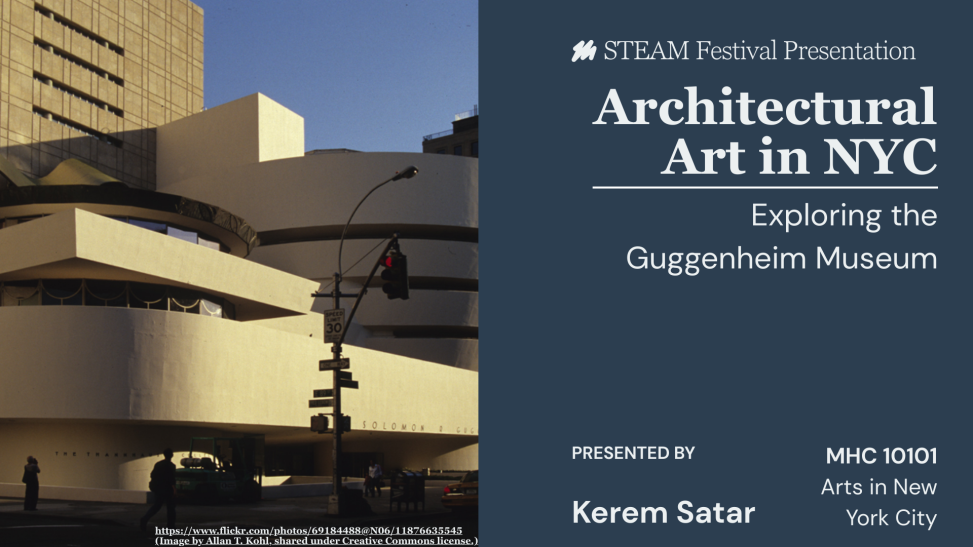
My goal with this project is to present and investigate the Solomon R. Guggenheim
Museum through architecture and how its unique design and structure changed and is still changing the way New Yorkers view art around the city (through a slideshow). The main argument will be how Frank Lloyd Wright’s spiral design in the museum doesn’t just “contain” the artwork inside but also builds a custom path for viewers to navigate and experience all the artwork, borrowing aspects from Avant Garde architecture (challenging traditional layouts of a museum). Basically, I will talk about how the museum’s inclined ramp (its form) conveys a dynamic perspective of each artwork, which forces viewers to shift their perception of each of these works. The slideshow will go into the history behind the museum and its initial, critical ratings and how it both succeeds and fails in some respects at what Wright had initially intended, and how it ultimately came to shift the idea of a museum in the end.
Completing my project helped me explore the role of arts in the lives of New Yorkers and their communities as it made me realize that it is not only artworks like paintings and murals that have an effect on us, but also the buildings and abstract spaces we inhabit that change our lives. Through this research on the Guggenheim museum, I learned that designing a space that can be utilized in a way that helps the intractability of the objects inside gives a whole new perspective on those objects. For instance, in the museum, the spiral ramp aids viewers to look at the artwork differently, in a more fast-paced and flowing kind of way. The ups and downs of the museum also aid in a way to shift the viewers viewpoint on the artworks, which can convey different meanings. Because of the complexity of the Guggenheim museum, through its research, I was able to come to the conclusion that the spaces we inhabit can have as much of an effect on our lives as the other forms of art we see throughout the city. They can toy with our emotions or make us reminiscing of the old times, just like paintings or sculptures can.

