

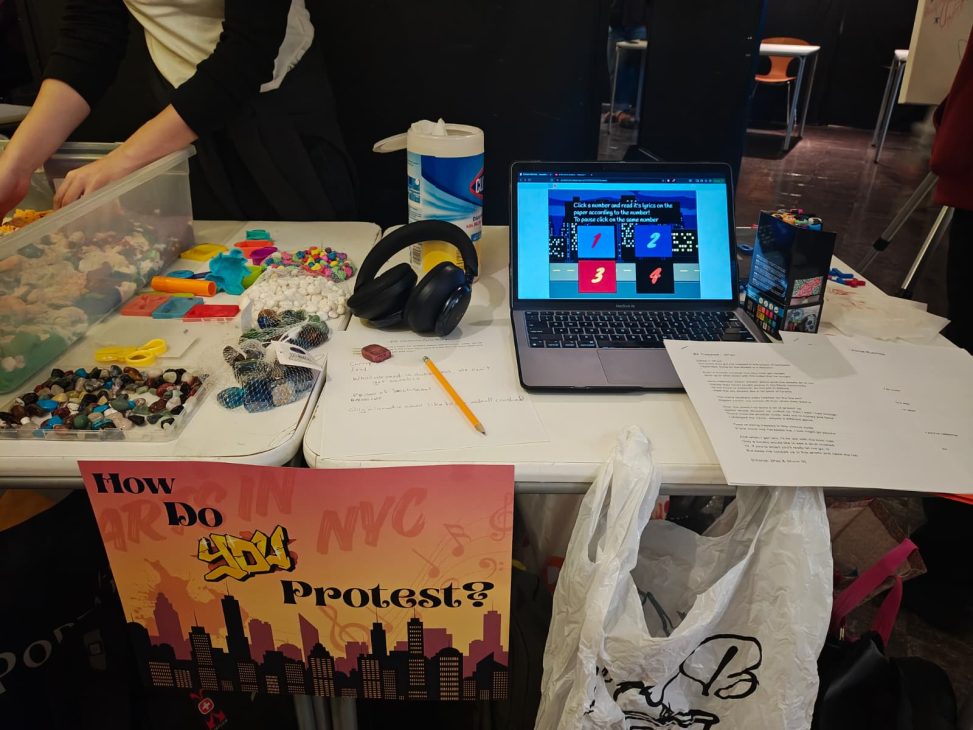
Music is a way for us to relate and bond to but it is also a way for us to discuss its meaning. Songs and poetry can share the voices of people in their community and city like ours. We ask the audience to pick a song, a line or word that sticks to them and to engage in Cento poetry.
Graffiti is the voice of those who otherwise don’t have one. Certain communities were shut out of conversations. Since the beginning, a divide between the artists and authority was created. Graffiti artists were ostracized and deemed outlaws, but their craft continued to flourish. In NYC, graffiti is a fight for belonging. The city is insanely diverse, but the ethnicities that are key to the city’s livelihood are silenced. Graffiti became a way to push back against ethnocide. It allows people’s paintings to speak for themselves, and provides people with a canvas free of judgement, bias and formality. The transformative aspect is it turns walls in cities into human stories; those who are unheard are the artists of the city.
The Destruction of Property is a form of protest that can be both violent and nonviolent. Throughout history, many people have engaged in various forms of protest to express their commitment, dedication, and resilience to a specific cause.
Protests that involve property destruction are typically intended to evoke sympathy and display passion. If and when the Destruction of Property is non-violent, it is typically seen as a form of self-sacrifice. Take Japanese Zen Gardens, for example. Those engaging in this form of protest command attention by conveying their willingness to incur personal loss if it means standing up for a cause. It may make any onlookers question why the person is willing to go to such an extreme in the first place.
Completing this project has permitted us to have an in-depth look at how even the most ‘unconventional’ forms of art can serve to illustrate the morals and values of those who reside in our city, however diverse through culture, race, gender, or other ideology; as well as how these messages are shared and disseminated through protest and other means of activism.

