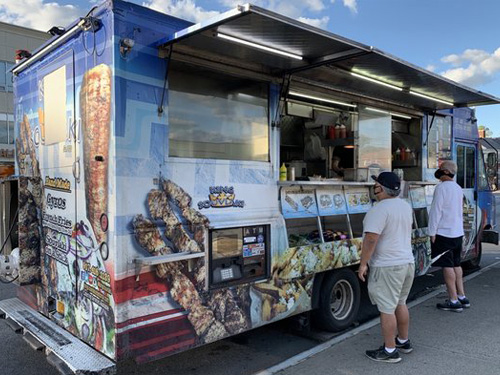
New York City is a bustling landscape of many different cultures. Often referred to as the “melting pot” of American cities, it is only natural that the cuisines of many different cultures have found their way to the city streets. Many of these foods are so ingrained in New York City’s culture that they have even popularized themselves as local delicacies: the one dollar pizza slice, the bodega’s chopped cheese, the Coney Island hotdogs and many more are examples of New York City’s “specialties”. One that has gained particular notoriety over the years is New York Halal, often known for its meat-over-rice platters sold from food carts around the city, ranging anywhere from five to fifteen dollars in price. Championed for its simplicity and convenience, these platters of halal food have cemented their place among other New York local delicacies. However, the rise of these halal food truck vendors is not without controversy. The sanitation and possible health risks of street food have always been under scrutiny, and halal trucks are no different. Many New Yorkers are skeptical of halal trucks, having doubts about the ability of vendors to keep their food uncontaminated. Whether or not these fears are founded or not is a point of contention that still exists to this day. Though it may be impossible to truly tell whether every single food truck out of the thousands in New York City is sanitary, in this article we will attempt to answer the question of whether or not New York City halal carts are generally sanitary enough to be considered “safe.”
Street food history
There are many different variations of street food in New York City, ranging from bagel and coffee trucks to stands dedicated to selling nuts. However, the category of street food Halal carts fall under is commonly referred to as “Street Meat,” which usually consists of chopped up pieces of grilled meat paired with rice or bread, seasoned with hot sauce, tzatziki sauce, or other similar ingredients. However, the history of Street Meat runs long before the advent of Halal carts.
If we consider “Street Meat” to be any food dish with meat as its centerpiece that is sold on the street, many would consider German immigrants to be its pioneer in New York City. German immigrants in the 1860s are believed to have started this trend with sausages, evolving into what is today known as the hot dog. These trucks are now ingrained in the city’s culture and history, even having big restaurant companies such as Nathan’s Famous start out as mere street food stands. This very street food stand would later evolve into one of the most popular tourist spots in the city, eventually becoming the original Nathan’s restaurant in Coney Island.
Street Meat has a long running history in the city due to Halal’s German predecessors, making Halal’s rise in fame across the city fairly recent. In the late 20th century, more Muslims began migrating to the city to practice religious freedom and escape war-torn areas, resulting in an increase of Muslim cultural presence. Following the same business model as the many food carts preceding it, Halal food carts came into the New York food scene in the 1980s, gaining traction in the 1990s. Nowadays, they can be seen almost everywhere in Manhattan, offering the very Street Meat many New Yorkers have come to know and love.
Concerns over Street Halal
Though Halal food has certainly become an integral part of New York City, it is still widely reproached as many consumers are skeptical of food carts and their sanitation levels. However, this is not only limited to Halal carts; many citizens are distrustful of the cleanliness of street food as a whole. Francisco Moya, a city council member of New York City, even recounts that his most frequently received complaints are about “unsafe food handling caused by street vendors,” making evident the people’s distrust for street food. The people’s distrust for the cleanliness of food carts is made even more understandable when considering that food trucks only started getting restaurant-style sanitation grades in January of 2019. With no way to tell how clean establishments were before then, other than one’s own judgement, the stigma surrounding street vendors causing many to distrust their hygiene is more than understandable.
Another explanation for the skepticism around Halal Carts is xenophobia. Throughout history, especially in New York City, the street food business has been largely dominated by immigrants. For example, the now common New York City Hot Dog Stand was started by German immigrants, and gyro carts come from Greek immigrants. It is still that way today: Sean Basinski, founder and director of the Street Vendor Project at New York’s Urban Justice Center, estimates that “98 percent of today’s New York street food vendors are immigrants.” Naturally, the same is true for Halal carts, popularized and run mostly by Egyptian and Bangladeshi immigrants. Unfortunately, along with this foreign implication to food carts comes skepticism in the form of xenophobia. According to Basinski, “consistently throughout the history of New York, vendors have been the target of anti-immigrant bias.” This xenophobia runs deep in New York’s Street Food business scene, affecting vendors through their perceptions by both the government and the people.
However, many regulations have been put in place to control the safety of street food. While the history of street food vendors in New York City is not the most pristine, it could be argued that food carts are safer today than ever before. While some continue to distrust street food vendors, whether or not their worries are founded is not certain.
How Food Carts Work
Much of the issue that people have with food carts can be explained by their fear of the unknown. Where food carts get their ingredients from and whether or not they are fresh and reliable sources of ingredients is something many consumers do not know, causing them to distrust food vendors more. A common source of ingredients is from wholesale companies, allowing many carts to buy food in bulk. According to John, the boss of a King Souvlaki food cart on the corner of Bell and Northern Boulevard in Bayside, Queens, the truck gets its ingredients from Jetro, a wholesale supplier. John also commented on the frequency with which he refreshes his ingredient supply: “Supply is every day. Fresh, every day,” he said, “every day fresh.”
Many also worry about how often food truck owners clean their carts. John also provided insight with his methods of sanitation, saying that he cleans “every day, every night.” He mentioned that he requires everything to be clean, especially places where food is kept or cooked such as refrigerators and steam tables. However, when asked about other food trucks, he was unable to speak to their sanitation: “I don’t know other trucks, I know my truck,” he said when asked about his experience with other food cart vendors.
Existing Regulations
The New York City Department of Health has many rules put in place to regulate street vending, attempting to ease the previously discussed concerns regarding food hygiene of mobile food vendors. One prime example of one such regulation is inspection of food trucks. According to Article 89 of the New York City health code, Food Truck vendors are required to “permit inspections by the Department of any mobile food vending unit.” This inspection also requires vendors to make clear the sources of their ingredients, the same Article stating that vendors must “make available for inspection documentation satisfactory to the Department identifying the source of all food units being held, sold, offered for sale, sold or distributed free of charge from the mobile food vending unit.” John, the aforementioned owner of a King Souvlaki food truck in Bayside, Queens, mentions that Government inspectors come in person three to four times a year to deem the truck sanitary or not. According to a post on 7shifts, a blog for New York City restaurant owners, random inspections usually happen one to two times per year.
Arguably the most important regulation for food carts is the necessity of a mobile food vendor permit to legally sell street food. In order to get this permit, individuals must first obtain a mobile food vendor license as a prerequisite. In order to obtain this license, vendors must register and complete a mobile food vending food protection course. According to the New York City government’s website, this course “trains individuals in food protection practices to ensure the safety of the food served from New York City’s mobile food carts and trucks.” Altogether, the application for the license as well as the course costs $53.
After obtaining a license, food vendors must then apply for a permit specific to their truck, which is granted by the Commissioner “after inspection by the department,” according to Article 89 of the New York City Health Code. These inspections are conducted in order to ensure the cleanliness of the cart, and the permits provided differ from the aforementioned licenses as permits are specifically for ensuring the cleanliness of the carts, while licenses are to educate individual vendors in the ways of clean food practices. Both these permits and licenses must be renewed every two years, most likely to ensure that the trucks and vendors stay clean enough for consumers’ health.
Many more regulations stated in Article 89 of the New York City Health Code address sanitation practices. For example, Article 89.19 requires staff to wash hands and be fully clothed, while also prohibiting smoking and the use of toxic materials such as pesticides and poisonous cleaning supplies. While many of these regulations are indeed helpful in keeping food carts clean, they also have some unintended side effects that may detriment the quality of New York City’s food carts.
The Problems
The many regulations that attempt to keep street food safe in New York City are without a doubt reassuring to consumers at face value. With the right to sell street meat being protected by a license, permit, and food safety course, as well as the unannounced inspections and sanitation grades, it certainly seems as though the city’s street food is without a doubt safe for consumption. While this is generally true, there are some caveats to this conclusion, the biggest one being the workarounds many take against the permit system: the black market.
With permits somewhat time consuming to obtain, requiring the previously mentioned prerequisites, many wannabe food vendors looking to make quick money on the streets opt instead to illegally purchase permits. According to an article on Marketplace, “the number of legal street food vending permits issued in the city has barely increased since the 1980s.” This implies that since the 1980s, most food carts have been established through illegal purchase of permits. Through this illegal workaround, the vendors are able to bypass the required course on food safety, potentially leading to health hazards due to food preparation not being handled correctly.
Selling permits illegally is also extremely profitable. According to the same article, “original permit holders charge as much as $25,000 for a permit purchased for a mere $200,” selling for over 125 times the price that they originally got the permit for. With this information, it is no surprise that the black market for food vendor permits is flourishing.
Another problem is the idea that government regulations may be enforcing the stigma of unclean street food. Basinski writes that “police and health inspectors enforce the rules through frequent sweeps, resulting in as many as 40,000 vending summonses written each year,” adding on that despite many street food vendors not knowing English, as well due to their immigrant backgrounds, officials insist on communicating with them in English anyways, resulting in miscommunication between the two. While more strict reinforcement may be viewed as a benefit, since more regulation generally leads to safer food, it may simply aid the spread of xenophobia in extreme cases. The miscommunication between government officials and immigrants may also lead to a miscommunication of regulations and strengthen the black market of permits, due to the absurd difficulty presented to non-English speakers regarding obtaining a permit from the government.
Conclusions and Solutions
One previously proposed solution was to pass a local law that planned to double the amount of street food vending permits given time. However, this idea was shut down only 11 hours after its proposal, as it was seen as a band-aid solution to a bigger issue. Dan Biederman, an American Urban Redevelopment Expert, cautioned members of the city council not to “take a lousy program and double the size of it.” It is clear that the issue of the permit black market is one that is not only a result of the scarce quantity supplied of permits, but rather a more deep running problem stemming from lackluster enforcement and the ease of permit reselling.
A potential solution to this problem would be to increase the sentence of the offense of illegally selling permits, while also increasing the amount of inspections per year on food carts. This solution would certainly be difficult to implement, however, likely requiring either a budget raise to law enforcement or reallocation of the law enforcement’s current resources. More manpower would be spent on food cart inspections, also potentially sacrificing manpower from other departments of law enforcement. However, despite this, it would still greatly help to reduce the amount of illegal street food vendors across the city.
Though the black market is certainly an issue plaguing the food carts of New York City, it must also be acknowledged that there are still many regulations to the street food system. Especially considering the unannounced inspections of food carts, it is reasonable to assume that illegally operating food trucks that are also selling unsanitary food would be hastily reprimanded. Similarly, consumers can make more well informed decisions about where to purchase their street meat from by paying close attention to the sanitation grades assigned to different carts. With this in mind, we can conclude that most of the time, New York City street meat is safe for consumption, especially with responsible consumer habits. However, there are certainly some improvements to be made.
While strict regulations may be best to enforce for the sake of consumer safety, xenophobia must also be addressed in order to make street vending a more fair business. Considering that overly strict regulations and poor communication may be encouraging the permit black market to flourish, the New York City government must create countermeasures to such issues. For example, making the permit application process and courses more accessible through multiple language options or interpreters could encourage non-English speaking immigrants to conduct business through legal processes. While xenophobia is certainly an issue that cannot be fixed through mere regulatory changes, curbing towards less xenophobic policy could certainly encourage the use of legal procedure, increasing the safety of street food overall.

