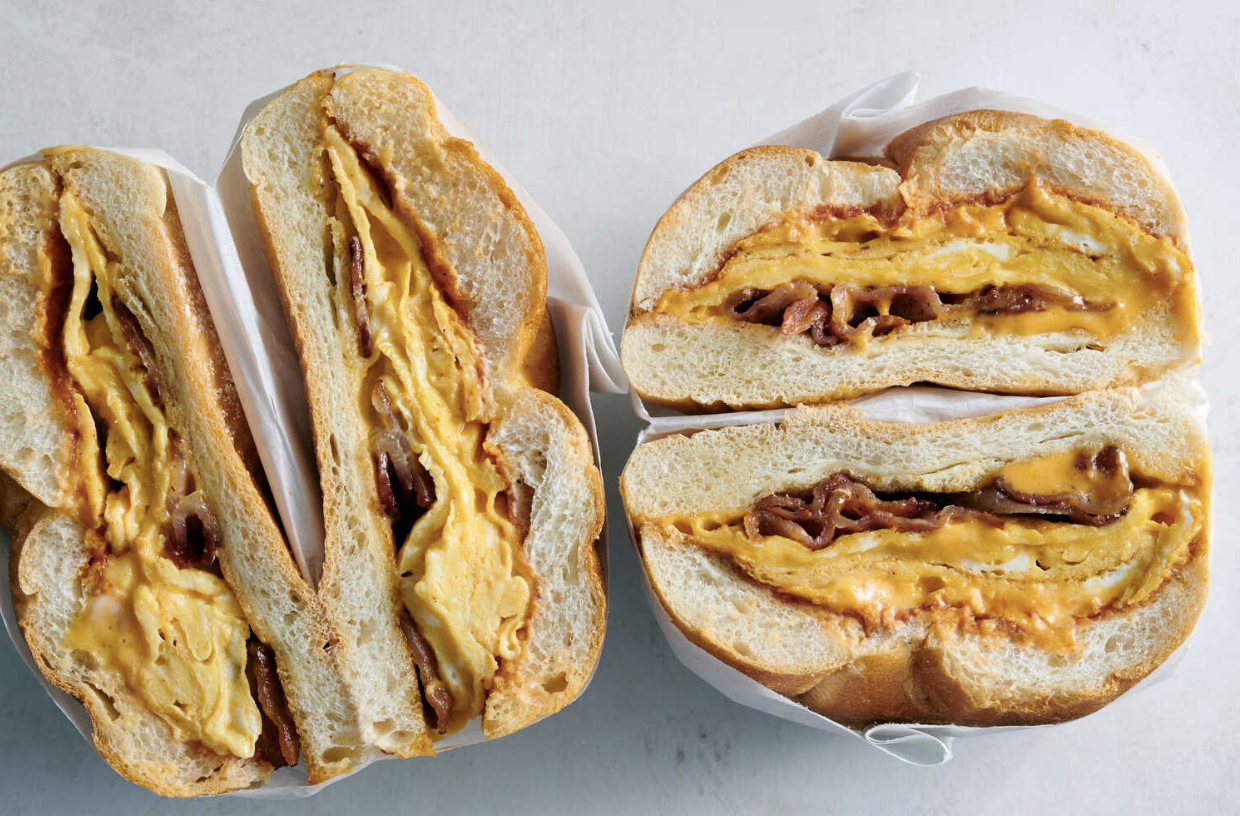
The bacon, egg, and cheese is a sandwich that has become a symbol of New York City, synonymous with the city’s hustle in a way no other dish is. Sure, New York is known for its international cuisine—offering everything from Japanese to Italian—but those meals, as delicious as they are, are stationary. They’re dinner or lunch experiences, meant to be slowly enjoyed in quiet, moody rooms after the rush of the day has passed. So how, then, did such a simple sandwich—eaten from greasy wax paper, on the go, or in a loud, crowded bodega—become the breakfast of choice in a city otherwise regarded as the food capital of the world? And what came first, the bacon, the egg, or the cheese?
The answer to these questions, like many, is that… it’s complicated. And to fully understand the bacon, egg, and cheese, we need to look beyond the city that seems to enjoy the sandwich the most. Unlike the chopped cheese or other staple New York sandwiches, the BEC doesn’t have a single inventor or birthplace. Instead, it’s the result of ingredients and habits that slowly evolved into the sandwich we know and love today.
Looking beyond the city of New York
The earliest version we can trace the BEC back to is 19th-century London, where it was known as a bap sandwich.1 Though it didn’t include all the same ingredients as the modern bacon, egg, and cheese, it laid the groundwork for what would eventually become the beloved New York classic. The term “bap” referred to a soft bread roll made with milk, lard, and butter.2 During the Industrial Revolution, early factory workers in need of a quick breakfast before long shifts would grab these buns—often paired with a drink—from local street vendors. Over time, pork sausages and fried eggs were added to the rolls, creating a breakfast sandwich that was tasty, calorie-dense, and relatively inexpensive, since it often made use of what were considered leftovers at the time.
As the Industrial Revolution spread to America, so too did the need for quick, filling breakfasts to fuel the growing workforce. The bap sandwich came along with English immigrants and was soon adapted into the “Denver sandwich” —a mix of scrambled eggs, bell peppers, and chunks of ham served between two bap buns—and the “Denver omelet,” its bapless cousin.3
A familiar sandwich under a different city’s name
The Denver sandwich remained popular, and both the dish and the broader concept of a breakfast sandwich stuck with food and street vendors across American cities. It was cheap to make, easy to serve, and required no utensils, plates, or seating—perfect for people on the move.
The Denver sandwich we’re describing looks like a rough framework for the bacon, egg, and cheese—except for one key ingredient: the cheese. It wasn’t until 1916 that sliced American cheese entered the picture, simply because it hadn’t been invented yet.4 When it finally entered the market, it was a hit. American cheeses were considered byproducts—leftovers from more expensive cheese-making processes—and they fit perfectly into the kind of no-fuss sandwiches people were already eating.
The Denver sandwich, along with the Denver omelet, stayed on breakfast menus through the early 20th century. But by the 1920s, there was a shift: a bigger cultural push toward sitting down and enjoying breakfast. The focus moved away from grabbing something quick to “stuff your face” with, and toward slower meals, where each component was eaten individually and savored.5 That shift caused the popularity of early bacon, egg, and cheese precursors to decline. People began to deconstruct the sandwich, turning instead to the now-iconic American breakfast plate—bacon and eggs served side-by-side, sunny-side up with a fresh piece of toast.
The sandwich we all know and love
It wasn’t until after World War II that the bacon, egg, and cheese rose again. As American life sped up, so did its meals. The country leaned back into fast, portable breakfasts. Instead of deconstructed eggs and bacon on a plate, people started combining them again—bacon, eggs, and now cheese, all between a roll. And with that, the modern bacon, egg, and cheese sandwich was born.
Large fast food chains began adding the sandwich to their breakfast menus, spreading both the concept and the craving for it across the country. Still, it was in larger cities—where jobs demanded punctuality—that the sandwich truly thrived. It fit perfectly with fast-paced urban life. Of these cities, New York was naturally the hungriest for a quick fix, and its many corner store bodegas began serving the already popular sandwich. The BEC found fans across the board—students, office workers, construction crews—while its cheap ingredients and easy prep made it a go-to for many immigrant-owned bodegas and corner stores.6
Becoming the sandwich of New York
The sandwich’s simplicity fueled its success, both for those eating it and those making it. But its deeper connection to New York City’s identity is largely credited to the internet. Online, people began glamorizing their everyday routines with a bacon, egg, and cheese in hand. Thousands posted about starting their day with one, drawing international attention and boosting the sandwich’s presence on menus all over the city.
That online attention is ultimately what cemented the BEC as part of New York’s cultural identity.7 Bodegas and sandwich shops started leaning into the “hype,” catering to tourists who were eager to try the now-iconic sandwich. Many places began offering playful, over-the-top twists on the classic to encourage social media posts and draw in more customers.
One standout example is the account “General-Ock,” which went viral for accommodating outrageous bacon, egg, and cheese orders—like serving the sandwich on a blueberry muffin, stuffing it with mozzarella sticks, or dunking the whole thing in melted cheese before handing it off. Often, the creations were barely sandwiches at all—but they got attention.

These accounts brought even more attention to the sandwich, helping solidify its image as a true NYC staple. After all, no other sandwich was being modified so wildly, and no other city was hosting trends like these. In a way, the creativity matched New York’s energy—always moving, always changing. While tourists and newcomers chased the latest sandwich trends, many local bodegas and corner shops were quietly putting their own spin on the classic, adding things like hash browns or new proteins for their regulars.
A trip to Elim
Elim Corner Deli is one of those shops. Located just around the corner of Hunter College on Lexington Avenue, the deli primarily serves hungry college and high school students on their way to class. We spoke with the owner, who told us the store had been around since 2001 but took on the Elim Corner Deli name in 2010. Hoping to get insight into the sandwich’s origins, we asked about the bacon, egg, and cheese. But there was no mystery to solve. “The sandwich has always been popular—it’s a no-brainer to serve it,” the manager said.
We may not have found its origin there, but we got a look at its future. Elim now serves a version of the BEC called the “Egg Slut.” At its core, it’s still a BEC on a roll—but with a twist: over three kinds of cheese and multiple protein options beyond bacon. Elim is just one of many spots treating the BEC as a base to build on.

The owners admitted the Egg Slut is now more popular than their standard bacon, egg, and cheese—proof that these tweaks resonate with the communities they serve. And that points to a broader truth about New York food culture: adaptability.
A new crossroads
After more than a century of reinvention, the bacon, egg, and cheese has come to represent the changing needs of urban workers throughout the world. In New York specifically, it reflects the shifting rhythms of students, commuters, and laborers alike. Its constant evolution mirrors the city itself—restless, responsive, never standing still. The sandwich’s shape-shifting nature says something simple but true: the needs of workers are never fixed.
Yet, in the environment of New York specifically, we’re starting to see a divide in the appeal of the BEC. On the one hand, it is relished for its simplicity, four ingredients, served in under 10 minutes, greasy wrapper, packed bodega, and all. For these hungry customers, less is more: A sandwich made for the everyday commuter to conquer their day. On the other hand, there are those who come to New York for tourism and those who glamorize the city. For them, more is more; the bacon, egg, and cheese isn’t just a breakfast sandwich but an experience. For them, the experience of ordering and the outrageous toppings served by General-Ock make the whole sandwich. These are the people who champion the egg slut over the bacon, egg, and cheese at Elims.
Regardless of which version of the sandwich you pick from either the fancy new bodega down the street or the old corner deli that has been feeding the block for decades, the BEC continues to tell the history of the place where it’s served. In England the ingredients of the sandwich reflected the needs of workers; in post-World War II America it symbolized the growing popularity of consumerism; and now in New York City, it represents our unique instance, an intersection of the city’s grittiness and glamour, a crossroads of those who visit for leisure and those who call the city home.
So despite its murky origins, maybe the bacon, egg, and cheese is less about where it came from and more about where it’s going. Maybe the real question isn’t what came first—but what comes next and what that direction says about our time.
“Bacon-egg-and-cheese-salt-pepper-ketchup-on-a-roll”—a phrase almost every New Yorker knows by heart. But how did this iconic sandwich become the city’s breakfast anthem?
Campus: Hunter College
Professor: Mike Owen Benediktsson
References: Endnotes:
1. “Bacon, Egg and Cheese Sandwich Recipe.” n.d. NYT Cooking. https://cooking.nytimes.com/recipes/1023421-bacon-egg-and-cheese-sandwich.
2. Huddleston, Justina. “The Humble History of the Breakfast Sandwich.” HuffPost, December 7, 2017. https://www.huffpost.com/entry/the-humble-history-of-the_b_9721710.
3. Huddleston, Justina. “The Humble History of the Breakfast Sandwich.” HuffPost, December 7, 2017. https://www.huffpost.com/entry/the-humble-history-of-the_b_9721710.
4. Rice, Hannah. “The Industrial Origins of the Classic Bacon, Egg, and Cheese Sandwich.” The Daily Meal, May 11, 2023. https://www.thedailymeal.com/1283608/tclassic-bacon-egg-cheese-sandwich-origins/.
5. Broderick, Neala. “The History of New York’s Iconic Bacon, Egg, and Cheese Breakfast Sandwiches.” Tasting Table, May 11, 2024. https://www.tastingtable.com/1578154/bacon-egg-cheese-breakfast-sandwich-history-new-york/.
6. Johanson, Daniel. “New York’s Breakfast Staple: The Evolutionary Tale of Bacon, Egg, and Cheese.” Scapi Magazine, January 22, 2024. https://scapimag.com/2024/01/30/new-yorks-breakfast-staple-the-evolutionary-tale-of-bacon-egg-and-cheese/.
7. Bel, Pierina Pighi. “The Small Shops That Run NYC.” BBC News, October 6, 2023. https://www.bbc.com/travel/article/20231005-bodegas-the-small-corner-shops-that-run-nyc.
8. “Bacon, Egg and Cheese Sandwich Recipe.” n.d. NYT Cooking. https://cooking.nytimes.com/recipes/1023421-bacon-egg-and-cheese-sandwich.
- Huddleston, Justina. “The Humble History of the Breakfast Sandwich.” HuffPost, December 7, 2017. https://www.huffpost.com/entry/the-humble-history-of-the_b_9721710. ↩︎
- Huddleston, Justina. “The Humble History of the Breakfast Sandwich.” HuffPost, December 7, 2017. https://www.huffpost.com/entry/the-humble-history-of-the_b_9721710. ↩︎
- Rice, Hannah. “The Industrial Origins of the Classic Bacon, Egg, and Cheese Sandwich.” The Daily Meal, May 11, 2023. https://www.thedailymeal.com/1283608/tclassic-bacon-egg-cheese-sandwich-origins/. ↩︎
- Broderick, Neala. “The History of New York’s Iconic Bacon, Egg, and Cheese Breakfast Sandwiches.” Tasting Table, May 11, 2024. https://www.tastingtable.com/1578154/bacon-egg-cheese-breakfast-sandwich-history-new-york/. ↩︎
- Johanson, Daniel. “New York’s Breakfast Staple: The Evolutionary Tale of Bacon, Egg, and Cheese.” Scapi Magazine, January 22, 2024. https://scapimag.com/2024/01/30/new-yorks-breakfast-staple-the-evolutionary-tale-of-bacon-egg-and-cheese/. ↩︎
- Bel, Pierina Pighi. “The Small Shops That Run NYC.” BBC News, October 6, 2023. https://www.bbc.com/travel/article/20231005-bodegas-the-small-corner-shops-that-run-nyc. ↩︎
- “Bacon, Egg and Cheese Sandwich Recipe.” n.d. NYT Cooking. https://cooking.nytimes.com/recipes/1023421-bacon-egg-and-cheese-sandwich. ↩︎

